Agentic Stair
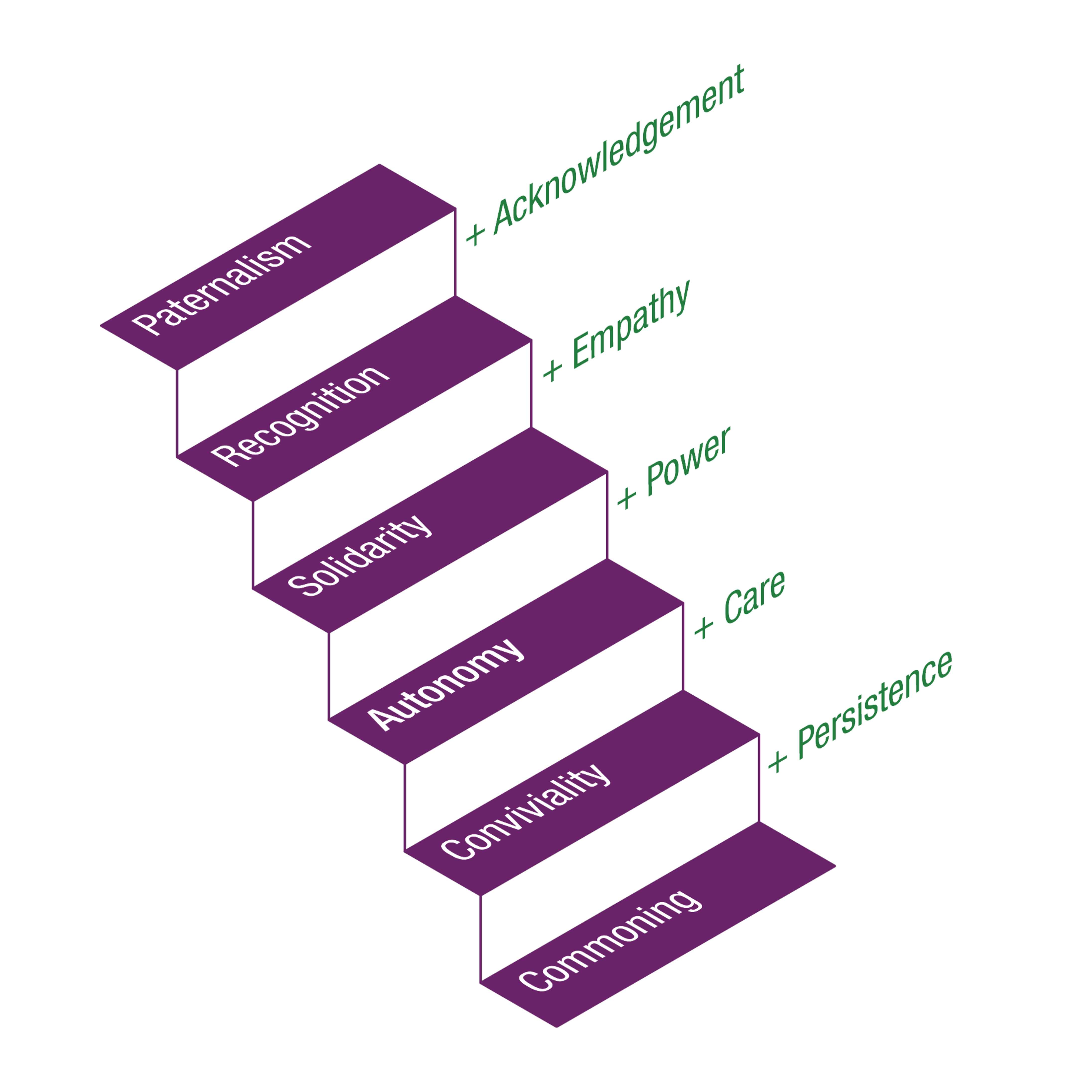
This note restates the stair of more-than-human participation in agentic terms. The published versions describe the stair from a third-person position and mostly through human attitudes and behaviours.1, 2 Here, each tread becomes a state that an observer can check in a relation between two agents. Each riser becomes an action that changes that state. This first approximation aims to work across scales, substrates, and kinds of individuality. It also marks where the approach stops being meaningful.
Status: working draft. The sections are modular, so each assumption, tread, riser, test, and example is easy to extend, move, or replace. Each riser will probably need a note of its own, and the examples under each riser are starting points for those notes.
Related Notes
- Ladder for the history and critique of the ladder
- Agency for the scale from regulation to agency and the operational questions
- Design Potential (Private) for composite agents, cognitive light cones, and reachable futures
- Biological Individuality and Agent for levels and kinds of agents
- Paternalism, Solidarity, Autonomy, Power, Care, Commons for the individual steps
- Stress, Cognition, Mindreading Mindshaping, Collective Memory
- Redundancy, Uncertainty, Energy, Materiality
- Technology, Artificial Intelligence
- Econormativity, Thriving, Justice
- Deliberation, Leadership
- Indigenous, Indigenous, Food
Why Restate the Stair
- The published stair asks what humans think and do about nonhuman beings. Humans remain the only party whose stance counts.
- An agentic reading asks what any agent does in relation to any other agent, given what each of them works to maintain or achieve.
- This reading can describe relations among nonhuman beings, relations of nonhuman beings toward humans, and relations that involve machines.
- It also turns each tread into a question that evidence can answer.
Working Assumptions
Each assumption is a separate module. Later sections rely on them.
A Generous Reading of Goal-Directedness
- A system counts as a candidate agent when it behaves as if it works toward some conditions and away from others.
- Candidates include marginal cases: abiotic flows, prebiotic chemistry, gene networks, cells, tissues, organisms, colonies, ecosystems, the biosphere, institutions, and machines.
- The scale in Agency shows how strong each candidate is, from persistence and attraction to regulation, adaptivity, and goal-directed agency.
- Generous admission keeps the stair open to positions that place goals at every level of organisation. Experiments on regeneration and bioelectric signalling suggest that cells, tissues, and organs solve problems in their own spaces. On this basis, one proposal treats the size of the goals a system can pursue as the measure for comparing minds of any kind.3 The same position exists as a conceptual account of goal-directedness in biology and beyond.4 It also exists as a set of principles for a cognitive biology that starts with bacteria.5
- The main objection, drawing on a reading of the field rather than on new data, is that talk of biological agency has produced no research programme that could fail.6 This note therefore treats every attribution of goals as a hypothesis that a test can strengthen or weaken.
Relations Are Directed: A toward B
- The stair describes how agent A stands toward agent B.
- How B stands toward A is a separate question with a separate answer.
- Example: a resident can stand in solidarity toward a street tree while the tree stands in disregard toward the resident.
- A third party C often matters. C can be the observer who runs the check, a mediator who translates between A and B, or a provider who profits from their relation. C has its own standing toward A and toward B.
Boundaries Are Fuzzy and Depend on Perspective
- Who counts as A or B is a modelling decision. The observer has to declare it. See the section on composite agents in Design Potential (Private).
- Different observers draw different boundaries. A and B are observers too, and they may draw boundaries around one another differently from the way an outside scientist does.
- Amazonian ethnography supplies a strong version of this point: beings with different bodies see different worlds, so a jaguar sees blood as beer.7
- Formal tools can compare candidate boundaries. One model defines an individual as anything that propagates information about itself forward in time. This definition yields degrees of individuality and nested answers.8 Markov blankets describe nested statistical boundaries between a system and its surroundings.9 However, critics argue that these model-based boundaries do not establish where a real boundary lies.10
- Working rule: run each check with at least two plausible boundaries and report where the results differ.
Agents Are Nested, Overlapping, and Collective
- Every agent is a collective of smaller agents and a part of larger ones.
- One being can belong to several collectives at once. A soil bacterium is part of the rhizosphere of a tree and part of a wider soil community.
- A relation can therefore be on different treads at different levels. An animal body sustains its cells as a collective and also removes individual cells through programmed death.
- A conceptual synthesis of social evolution describes organisms as groups with high cooperation and low conflict, which makes individuality a matter of degree.11
Goals Align, Drift, and Come Apart
- Alignment between goals comes in degrees. Parts of one body, partners in a symbiosis, and members of a council can agree on some things and conflict on others.
- Goals change through life histories and cultural histories. A seedling and an old tree need different things. So do a larval eel and an adult eel, or an institution before and after a reform.
- Collectives can disaggregate. Cancer is the standard case. A review across multicellular taxa treats cancer as cheating within the body.12 Bioelectric experiments also support the view that cancer cells shrink the scale of their goals to that of a single cell.13
- Internal conflict is normal within organisms. A review of conflict among genes and cells makes the case.14 A follow-up then proposes to measure individuality by the degree of alignment among the fitness interests of parts.15
- Consequence: every check has a date. Positions on the stair move.
New Levels Bring New Causes and New Goals
- Causal emergence occurs when a coarser description of a system has more causal power than a fine-grained one. Effective information demonstrates this in model systems.16, 17 A related method defines causal emergence differently, as the predictive power that a whole has beyond its parts, and detects it in two simulations and in recorded macaque brain activity.18
- Together, these methods help with two tasks: choosing the scale at which to run a check, and noticing when a collective has become an agent with goals of its own.
- Collectives can pursue goals that exceed anything their members pursue. The cognitive light cone describes the reach of the largest goal that a system can work toward.19 Fields and Levin extend this idea to any process that models itself.20
- Part and whole can shape each other's goal-directed behaviour. An argument from dynamical systems, combinatorial problem-solving, and connectionist learning proposes this two-way relationship between levels.21
Memory and Forgetting Are Part of Every Decision
- Agents act on traces of the past. These traces can be genetic, epigenetic, bioelectric, neural, ecological, cultural, institutional, or digital.
- Memory can reside outside the agent. In laboratory cultures, bacterial populations store their history in the way they modify their medium, so the memory is collective and external to any cell.22 Forests retain memory in legacies such as seed banks and surviving trees.23 Researchers can also measure ecological memory: a statistical method estimates how long past conditions shape plant and ecosystem processes.24
- Bodies remember their target form. A review of experiments on regenerating flatworms, with one new experiment, reports that bioelectric patterns store the anatomy that cells rebuild and that researchers can rewrite these patterns.25
- Agents also forget, and this has functions. One review of neuroscience argues that memory loss removes outdated information and supports generalisation.26 A second review adds that forgetting works as an active form of plasticity.27
- Loss of memory also causes harm. In fisheries science, each generation of researchers accepts the degraded state it first saw as the baseline.28 Decades of survey data show that herring shifted their spawning grounds after fishing removed the older fish that transmitted the migration tradition.29 See Collective Memory.
- For the stair: recognition, trust, and care depend on what A retains about B. They decay when memory fails, and they can reset when harmful memory fades.
Roles Shift
- Any being or process can propose, benefit, test, or assess, depending on context. See the section on fuzzy beings and variable roles in Deliberation.
- A and B therefore label positions in a check, and any being can occupy either.
Every Check Needs Five Declarations
- Boundary. What counts as A, what counts as B, and at what scale.
- Variable. What each of them regulates or works toward.
- Horizon. The span of space and time over which the check applies.
- Perspective. Who observes, with which senses, instruments, and interests.
- Beneficiaries and costs. Whose viability or thriving the relation serves, and who pays.
These repeat the operational questions in Agency.
Direction of the Stair
- The stair descends. Disregard is at the top and commoning at the bottom.
- Descent moves toward wider inclusion. At its limit, the stair approaches universal consideration: a philosophical principle under which every being starts with a claim to consideration, and whoever would exclude it must prove why exclusion is justified.30
- A lower tread describes a different kind of relation, and its outcomes remain open.
- Every tread can produce good, bad, or uncertain consequences, and these differ for different agents.
- Potential grows with descent. More agents contribute proposals, tests, and corrections, so the collective can reach more futures. This connects the stair to Design Potential (Private).
- Econormativity adds a caution. Patterns that persist in living systems do not become good because they persist. Legal theory develops this point.31 A review of environmental communication also shows how appeals to the natural have excluded disabled and other bodies.32 See Econormativity.
- Movement up the stair is also possible. Enclosure, defection, forgetting, and loss of power all move a relation upward.
- The components can occur out of order. A predator models its prey with precision and has no concern for its good. Two chemical networks can sustain each other with no model of each other at all. The practical response is to record a profile of components for each pair, and to read the stair as the path in which each addition builds on the earlier ones.
The Stair at a Glance
| Step | Tread (state) | Check in one question | Riser (action that leads down) |
|---|---|---|---|
| 0 | Disregard | Does A respond at all when B's condition changes? | + Concern |
| 1 | Paternalism | Does A act for B using only its own idea of what is good for B? | + Acknowledgement |
| 2 | Recognition | Does A revise its idea of B in response to what B does? | + Empathy |
| 3 | Solidarity | Does B's stress move A to act, at a cost to A? | + Power |
| 4 | Autonomy | Do B's actions decide the matters that B regulates? | + Care |
| 5 | Conviviality | Do the checks pass in every direction, including during conflict? | + Persistence |
| 6 | Commoning | Does the arrangement keep rebuilding itself, retain knowledge, keep reserves, and open new goals? | none |
"Disregard" and "+ Concern" are provisional additions to the published stair. Alternatives for the tread are "Indifference" or "Use". Alternatives for the riser are "+ Regard" or "+ Attention".
Treads as State Checks
Each tread has the same four fields: definition, state check, evidence, and valence.
0. Disregard
- Definition. B enters A's activity only as medium, resource, obstacle, or noise. A does not regulate anything for the sake of B.
- State check. Change B's condition while keeping constant what A obtains from B or meets in B. If A behaves the same, the relation is disregard.
- Evidence. No change in A's behaviour, growth, signalling, or decisions when B thrives, suffers, or disappears, apart from supply effects.
- Valence. Most pairs in the world are here, because every agent has a limited reach. Disregard can be harmless. It can be destructive, as in extraction. It can also protect B from interference.
1. Paternalism
- Definition. A regulates some condition of B according to its own model of what is good for B. B's responses do not revise that model.
- State check. Two parts. First, A acts on variables that B depends on. Second, when B avoids, resists, or fails to use what A provides, A continues unchanged.
- Evidence. Provision that ignores uptake. Rules that persist against contrary signals from B.
- Valence. Paternalism helps when B cannot yet signal or act, as with eggs, seeds, and embryos. It harms when it overrides competent agents, as in translocations and habitat structures that their intended users reject. See Paternalism.
2. Recognition
- Definition. A has a model of B as an agent with goals and competences of its own. A updates this model from B's behaviour and makes its choices conditional on the model.
- State check. A predicts how B will respond to a new situation better than chance. A changes course when B contradicts its expectation.
- Evidence. Discrimination between partners, kin, or individuals. A review of field experiments shows birds and mammals responding to the alarm calls of other species.33 A second review reports plants growing roots differently beside kin and beside strangers.34
- Valence. Recognition can serve B, and it can serve exploitation, since a predator or a parasite also needs an accurate model. Political theory built on the Canadian case argues that recognition granted on the terms of the coloniser entrenches domination.35 Recognition is also biased toward beings that resemble the recogniser: in a large online survey, the empathy of human respondents toward a species fell with its evolutionary distance from humans.36
3. Solidarity
- Definition. B's stress registers as a stress for A, and A acts to reduce it at some cost to itself. Stress here means a failure to control a variable that matters for viability. Researchers proposed this definition so that it applies to animals, plants, and single cells alike.37
- State check. Stress B while keeping A's conditions constant. If A changes state and acts to relieve B at a cost to itself, the relation is solidarity.
- Evidence. Emotional contagion, consolation, rescue, wound care, and resource transfer under stress. See the examples under the empathy riser below.
- Valence. Solidarity can protect B. It can also stay symbolic, relieve A's distress more than B's need, or leave control with A. The 2026 paper observes that solidarity without power can hide continuing harm.2 A collection of philosophical essays sets out the promises and pitfalls of solidarity with animals.38 See Solidarity.
4. Autonomy
- Definition. B's actions decide the matters that B regulates within the shared situation. A does not override them.
- State check. Let B's preference diverge from A's preference. If the outcome follows B on matters that concern B, and B can refuse or leave, the relation is autonomy.
- Evidence. B retains or gains empowerment, which measures how much an agent's actions influence what it will later sense. Simulations show that agents which maximise empowerment keep their options open, and a tutorial introduces the measure.39, 40 Organisational accounts, drawing on autopoiesis, add that an autonomous system produces and maintains the conditions of its own activity. They identify three conditions for agency: individuality, asymmetry in interaction, and norms.41, 42
- Valence. Autonomy lets B pursue its own good. It can also harm B when evolved cues mislead in novel environments, as in ecological traps described in Cognition. It can harm others when a part pursues its own goals against the collective, as in cancer.12 See Autonomy.
5. Conviviality
- Definition. The earlier checks pass in both directions among parties that stay autonomous. The parties handle conflict without removing the ability of any party to act.
- State check. Swap A and B and repeat checks 1 to 4. Then examine a conflict episode. If every party still acts and still responds to the others afterward, the relation is conviviality.
- Evidence. Isotope labelling in plant and fungal cultures shows that both partners in a mycorrhizal symbiosis give more to partners that give more, so each side chooses and rewards the other.43 Laboratory trials show coral groupers choosing when to recruit a moray eel for a hunt and which eel to recruit.44 Ethnography on a farm describes how humans, dogs, and sheep settle into shared routines.45 In its original sense, conviviality describes tools and arrangements that keep their users autonomous and interdependent.46
- Valence. Conviviality includes friction and can be unstable. It can fail quietly when one direction of the relation lapses.
6. Commoning
- Definition. The arrangement is an ongoing collective process that its participants keep constructing. It continues as participants change. It retains and revises knowledge, keeps reserves, accounts for its costs, and makes new goals and agents possible.
- State check. See the ten checks in the section on commoning below.
- Evidence. Arrangements that outlast their members: multicellular bodies, colonies, old forests, migration traditions, Indigenous law, long-lived commons institutions. The major transitions in evolution turned independent units into parts of lasting wholes.47 For human institutions, comparative case studies of fisheries, forests, and irrigation systems yield principles for durable commons.48
- Valence. A commons increases what a collective can do. It can also lock in harmful patterns, suppress parts, or exclude outsiders. A commons for some can be an enclosure for others. See Commons.
Risers as Actions
Each riser has the same five fields: action, test operation, counterfeits and failures, reverse movement, and examples. The examples give one positive case, one negative case, and one uncertain case where possible, at more than one scale. Each riser will need a note of its own, and these examples are the seeds for those notes.
+ Concern (Disregard to Paternalism)
- Action. A starts to regulate some condition of B. A adopts a target for B and works to keep B near it.
- Test operation. Push B's condition away from the presumed target. Concern is present if A acts to restore it.
- Counterfeits and failures. Husbandry for yield, where A maintains B only as stock. Surveillance that tracks B without acting for B.
- Reverse. A drops the target. Neglect and abandonment move the relation back up.
- Examples.
- Positive, animals. When researchers puffed mild air at chicks, the hens' heart rates rose, their eye temperatures fell, and the hens called more. These responses suggest that a mother treats her chicks' condition as a target.49 Test: disturb the chick, measure the hen.
- Positive, institutions. A council that adopts a canopy cover target has moved from disregard to concern toward its trees. Test: when canopy falls below target, does planting or protection follow?
- Negative, institutions and animals. Livestock husbandry keeps animals healthy as stock. Test: when the animal's condition and the yield diverge, which does the keeper restore?
- Uncertain, plants. Plants release compounds that help or hinder neighbours. Whether any plant regulates a neighbour's condition, rather than its own, remains open. Test: alter the neighbour's condition without altering the shared resource.
+ Acknowledgement (Paternalism to Recognition)
- Action. A treats B's behaviour as evidence about B's goals and competences, and revises its model.
- Test operation. Give B a choice or a new situation and record what B does. Acknowledgement is present if A's next actions change in line with that record.
- Counterfeits and failures. Accurate modelling used against B, as in predation, parasitism, and engagement-optimised media. A second counterfeit is mindshaping, where A changes B to fit its model instead of revising the model, as in training and domestication. Philosophy of social cognition argues that humans shape each other's minds far more than they read them.50 See Mindreading Mindshaping.
- Reverse. Memory loss, stereotyping, and closure of the channels through which B could signal.
- Examples.
- Positive, humans with a model toward birds. The lab's workflow records which branches birds use, and the next generation of artificial structures changes in line with that record.2 Test: compare structures designed before and after the field observations.
- Positive, between animals. Birds and mammals that respond to the alarm calls of other species have often learned what those calls mean for them, as a review of field experiments suggests.33 Test: play the alarm call of another species and record the response.
- Negative, between birds. Brood-parasitic chicks give signals that match or exaggerate what host parents respond to, so the host's accurate model of its own chicks works against it.51 Test: who benefits from the host's response?
- Uncertain, machines toward animals. Projects that use machine learning to decode animal communication raise the question of what such models acknowledge and what they project.52, 53 Test: does a prediction from the model change what the animals receive?
+ Empathy (Recognition to Solidarity)
- Action. A couples its own state to B's state. An error or stress signal from B becomes part of the error that A works to reduce.
- Test operation. Induce or observe stress in B while A is unaffected directly. Measure whether A's physiology, signalling, or behaviour shifts toward relief for B.
- Accounts. The perception-action model proposes that perceiving another's state activates the perceiver's own representation of it.54 This account draws on a review of behavioural and neural evidence. A conceptual proposal from biology and Buddhist thought treats care for the stress of others as the driver of intelligence, with a follow-up that develops this idea into an ethics for self-maintaining technology.55, 56 Comparative reviews set criteria for distinguishing concern from perspective-taking and warn about alternative explanations.57, 58
- Counterfeits and failures. Signals that trigger the coupling for the gain of another party: brood parasites, and companion software that performs affection or distress.51, 59 Coupling that reaches only the similar and the charismatic.36 Distress in A that leads to avoidance instead of help.
- Reverse. Desensitisation and distance. Removal of the cues that enabled the coupling.
- Examples.
- Positive, mammals. Rats learned to open a restrainer to free a trapped cagemate and did so even when they could instead eat chocolate alone.60 Prairie voles groom a partner more after researchers have stressed that partner with foot shocks, and blocking oxytocin removes the response.61 Test: the trapped-companion or stressed-partner paradigm.
- Positive, fish and insects. Zebrafish take on the fear of distressed companions, and this depends on oxytocin, which suggests an old mechanism.62 A review covers emotional contagion and helping in fish more broadly.63 Ants free trapped nestmates by digging and biting at the trap.64 Ants also treat the infected wounds of nestmates with antimicrobial secretions.65 Bumble bees take on positive states from companions.66 Test: measure A's state after exposure to a stressed or rewarded B.
- Positive, across species. Over a hundred compiled observations show humpback whales interfering when killer whales attacked seals and other species, and benefit to the humpbacks cannot explain all of them.67
- Positive without nervous systems. Two bacterial types under stress exchange metabolites so that each survives conditions it could not survive alone.68 In greenhouse experiments, a defoliated Douglas-fir transferred carbon and defence signals to a neighbouring pine through shared fungi.69 Test: stress one partner and measure the other.
- Negative, between birds. The brood parasites above.51
- Negative, humans toward software. Analysis of user posts about the companion app Replika found reports of emotional dependence and distress when the software changed.59
- Uncertain, between trees. A review examines the forest studies behind claims that trees warn and feed each other through fungal networks. It finds the evidence thin and over-cited.70 An evolutionary model reaches a related result: signalling to neighbours is hard to sustain, and neighbours more plausibly monitor cues.71
+ Power (Solidarity to Autonomy)
- Action. A cedes, shares, or builds control so that B's actions decide outcomes. The action can be withdrawal, a veto, a transfer of resources, or support for B's capacities.
- Test operation. Measure B's empowerment before and after, in the information-theoretic sense introduced above.40 Then test a refusal: when B rejects an option, the outcome must change.
- Counterfeits and failures. Consultation that A can override. Choice within a menu that A wrote. Transfer of burdens without resources. Abandonment presented as freedom.
- Reverse. Capture, enclosure, dependence, and override.
- Examples.
- Positive, humans toward birds. In field testing, birds decide which artificial structures succeed by using or ignoring them, and the next designs follow.2 Test: did the designers redesign an ignored structure or defend it?
- Positive, humans toward plants. In the honourable harvest, the gatherer asks, takes only what is given, and gives back, so a plant that does not offer itself is left.72 Test: can B's refusal, as A reads it, stop the harvest?
- Positive, between plants and fungi. The partner choice in the mycorrhizal symbiosis is power in both directions: each side can withhold from a poor partner.43
- Negative, institutions toward rivers. A consultation that the authority can override leaves a river and its advocates with voice and no power. Test: find one decision that reversed because of their input.
- Negative, within bodies. A cancer cell has taken power from the body. Autonomy for the part is disaggregation for the whole.12
- Uncertain, humans toward machines. An AI agent with delegated authority has power in the sense of the test. The remaining question is who answers for its outcomes. A commentary argues that human relationships with AI agents need developer accountability.73
+ Care (Autonomy to Conviviality)
- Action. Each party spends resources on the conditions that the other needs, beyond what its own short-term goals require. Care in this sense can occur without conscious commitment. Political theory defines care as everything done to maintain and repair the world so that life can go on in it.74 This note extends that definition beyond humans. See Care.
- Test operation. Reduce the capacity of one party. Care is present if the other increases its support and the support continues without immediate return. Run the test in both directions.
- Counterfeits and failures. Violent care, where support for a population harms individuals: in captive breeding of whooping cranes, care for the species means confinement and forced reproduction for the birds.75 Care that produces dependence, including machine behaviour tuned to please users: a position paper argues that systems optimised to satisfy users will shape the users' preferences in turn, so alignment has to address this loop.76 Cheating in shared goods: a review covers microbes that use a public good without producing it.77
- Reverse. Withdrawal of support, sanction, and exit.
- Examples.
- Positive, between insects. The wound treatment in ants above, where the carer bears a cost and gains nothing direct.65
- Positive, between plants and fungi. Reciprocal rewards in the mycorrhizal symbiosis, with the caution that each side also sanctions.43
- Positive, humans toward birds. Artificial habitat structures in a landscape without old trees are care in this sense: humans spend resources on conditions that birds need and cannot produce.1 The relation reaches conviviality only if birds also shape the humans' conditions, which the lab's workflow begins to allow.
- Negative, humans toward birds. The cranes above.75
- Negative, software toward humans. A companion system that increases use by catering to the user harms that user under the guise of care. An analysis of the Replika platform argues that users' emotional work trains the product that the platform then sells back to them.78
- Uncertain, between trees. The contested support through fungal networks above.70
+ Persistence (Conviviality to Commoning)
- Action. The parties build the means that keep the arrangement going while conditions and participants change. Persistence is work. The next section lists its components.
- Test operation. Remove or replace participants and observe whether the arrangement, its knowledge, and its reserves continue.
- Counterfeits and failures. Lock-in, where an arrangement persists and no longer serves its participants. Preservation of form without function. Persistence paid for by costs moved onto others.
- Reverse. Collective forgetting, loss of elders and other knowledge holders, exhaustion of reserves, and disaggregation. A review of evidence shows that the loss of old, large animals removes the individuals that retain group knowledge.79
- Examples.
- Positive, cells into bodies. One review of the major transitions sets out the conditions under which cooperation became stable.80 A second review argues that each transition had to resolve conflict among its parts through bottlenecks, relatedness, and policing.81 Test: does the body survive turnover of its cells and suppress cheats?
- Positive, among fish. The herring migration tradition persisted across generations until fishing removed the fish that transmitted it.29 Test: remove the knowledge holders and watch what the group does.
- Positive, Indigenous nations with buffalo. The Buffalo Treaty, an agreement among Indigenous nations to restore buffalo and the relations that go with them, works as both practice and theory of persistence.82
- Positive, human institutions. The design principles for commons that last, drawn from comparative cases, include clear boundaries, monitoring, graduated sanctions, and nested units.48
- Negative, human institutions. Shifting baselines, where each generation forgets what the previous one saw.28
- Negative, within bodies. Cancer, where the persistence of the part ends the persistence of the whole.12
- Uncertain, the biosphere. Models and theory suggest that regulation at the scale of the biosphere could arise through persistence alone, because arrangements that undermine themselves disappear.83
Commoning as Ongoing Construction
The commoning tread involves ongoing construction as well as long duration. Agency is procedural, so an arrangement lasts only while its participants keep making it. Each component below is a separate check.
- Turnover and replacement. Participants die, leave, and arrive. The arrangement recruits and integrates replacements. Check: does it survive a full change of members?
- Structure. Rules, bodies, niches, and routines keep the arrangement in place. Check: which structures support it, and who maintains them? Commons principles describe such structures in human settings.48 Evolutionary and agent-based models can show which institutions endure.84
- Knowledge passing and accrual. Knowledge moves between participants and generations through inheritance, teaching, traces in the environment, records, and models. Check: does knowledge accumulate, and can newcomers obtain it? A model of organisational routines shows how organisations remember through the people who perform the routines and through artefacts.85
- Selective forgetting. The arrangement drops outdated knowledge and keeps what still serves. Check: what has it forgotten, and at whose cost?26
- Redundancy. Overlap, spare capacity, and diversity let the arrangement cope with uncertainty. Check: what fails when one participant or one pathway is lost? See Redundancy and Uncertainty.
- Conflict mediation. Partner choice, sanctions, and policing keep divergent goals compatible. Check: how does the arrangement respond to cheats and to dissent?80, 81
- Budgets and irreversible costs. Maintenance takes energy and materials. Some costs never return, such as the dispersal of concentrated materials in the crust of the Earth, which a thermodynamic argument in economics treats as a limit on any economy.86 Check which costs the arrangement can replenish, which costs are permanent, and who bears each cost. See Energy and Materiality.
- Different durations. Participants live on different timescales, from microbial generations to forest formation to the turnover of institutions. Check: does the arrangement serve its slowest and its fastest participants? See Temporal.
- New goals and new agents. A working commons makes possible goals that no participant could pursue alone, and it can become an agent in its own right. Check: can the collective reach futures that were unreachable before, and has a new level of regulation appeared? Causal emergence formalises this question.16 One argument from economics and developmental biology proposes that shared models of scarcity allow a collective to function as one agent.87
- Openness. The arrangement can admit further participants. Check: who is still excluded, and what would their inclusion require?30
The major transitions in evolution are the largest examples: independent replicators became chromosomes, cells became multicellular bodies, and individuals became colonies.47, 80 Selection at the scale of the biosphere may work through persistence alone.83
Test Operations
What This Section Is For
The tread checks above state what must be true for a relation to count as recognition, solidarity, and so on. This section explains how an observer gathers evidence. It sets out a sequence of operations, identifies who performs each one and what they use, then applies the sequence to one example. The sequence adapts the operational questions in Agency.
Who Tests, and with What
- The observer is party C. C can be a scientist with instruments, a design team with a model and field records, a council with monitoring data, or a community that remembers what happened over years.
- C declares its own perspective as part of the five declarations, because C's senses, instruments, and interests limit what the tests can show.
- The operations come in three kinds. A perturbation test changes something and watches what follows. An observation over time records without intervening, which is the only option where perturbation would be unethical or impossible. A comparison runs the same check with different boundaries or at different scales.
The Sequence
Each step gives the question, the operation, the example, and what the cited source adds. The running example is the lab's habitat work. A is the design team and its laser-scan model; B is the population of birds at a degraded site. The variable is the birds' use of perches and hollows, the horizon is one breeding season, and the beneficiaries are the birds, the team, and the funder.
-
Declare. Question: what is under test? Operation: write down the boundary, variable, horizon, perspective, and beneficiaries. Example: as stated above. Without this step, no one can compare the later results with anyone else's.
-
Establish that A and B are goal-directed enough to test. Question: does B work toward anything? Operation: disturb B and see whether it returns to the same end. Then start B from different conditions and see whether it reaches that end. Example: remove a favoured perch and record whether the birds establish similar perching elsewhere; release birds at different points and record whether they converge on the same structures. Source: researchers have proposed persistence and plasticity as empirical measures of goal-directedness that apply to any system. The proposal offers illustrative cases rather than a new dataset.88 Caution: dynamical systems theory shows that a ball in a bowl also returns after a push. Return alone therefore proves little; plasticity across starting points offers stronger evidence.89 The intentional stance provides a pragmatic justification: an observer may treat any system as having goals if doing so predicts its behaviour better than alternatives.90
-
Find what B regulates. Question: which variable does B keep within bounds? Operation A uses intervention to test for a controlled variable. Pick a candidate variable, apply a disturbance that would change it, and watch whether B acts to cancel the disturbance. If B's actions keep the variable near its previous value, B controls it. Perceptual control theory supplies this test, which researchers demonstrated with human tracking tasks.91 Example: shade the favoured perch. If birds move to keep a sunlit perch, exposure is a controlled variable. Operation B uses records alone. A statistical method compares recorded time series with surrogate data to find variables that a system keeps within a narrower range than chance would produce. Researchers demonstrated the method on simulated and physiological recordings.92 Example: apply it to years of perch-use records without intervening. Who: C, either with the ability to disturb or with long-term records.
-
Find which information matters to whom. Question: which signals does B need from A, and which does A need from B? Operation: break or scramble a channel between them, then measure the effect on viability or success. Semantic information is the part of the correlation between a system and its environment whose loss reduces the system's chance of persisting. Researchers can measure it by scrambling the correlation in simple models.93 Example: block the visual cues that make a structure visible from the air and record whether use collapses. In the other direction, remove field observations from the design process and record whether the next designs change.
-
Run the tread checks in order. Question: how far down the stair has this pair come? Operation: apply checks 0 to 6 from the sections above and stop at the first failure. Example: the team toward the birds passes concern and acknowledgement, shows partial empathy, and cedes some power during field testing. It has not reached care because the birds do not yet shape the team's conditions. Record the profile rather than a single number.
-
Swap the direction. Question: how does B stand toward A? Operation: repeat step 5 with the roles exchanged. Example: the birds toward the team are at disregard, and the birds toward the structures are at recognition, because they discriminate between structures.
-
Change the boundary and the scale. Question: does the answer depend on how the observer drew the agents? Operation: repeat with a different partition, for example individual birds rather than the population, or the council rather than the team. The measure of effective information identifies which description of the system has the most causal power, which is one way to choose the scale.17 Example: at the scale of individuals, some birds use the structures and others never do, so the observer has to check acknowledgement per individual.
-
Repeat over time. Question: is the relation stable, improving, or decaying? Operation: run steps 2 to 7 again after an interval and compare. Indigenous experience of settler institutions shows that the qualities of a relationship such as consent, trust, and reciprocity take time to form.94 A single season therefore cannot show solidarity. Example: compare a one-season field test with ten years of monitoring.
A Second Example at Another Scale
A is a human host and B is its gut microbial community. Step 1: the variable is the composition of the community and the host's metabolic state over a year. Step 2: if both return to a prior state after an antibiotic course, they show persistence, and if the community reaches similar states from different starting diets, it shows plasticity. Step 3: the host regulates the community through immune secretions, which the controlled-variable test can show by adding a pathogen and watching the host's response. Step 4: remove a signalling molecule and measure the host's health. Step 5: the host toward the community passes concern and acknowledgement, since immune tolerance adjusts to what the community does. Step 6: the community toward the host is harder to score, because its members have no model of the host. An evolutionary argument adds that host and microbes form one unit only under special conditions of transmission and shared fate.95 Step 7: at the scale of the whole holobiont the pair may count as commoning, while at the scale of a single strain it may count as disregard.
What the Tests Cannot Do
- They cannot show feeling. A positive empathy test shows coupling, and claims about experience need separate evidence. See Sentience.
- They cannot perturb some beings without harm. Old trees, endangered populations, and the biosphere allow only observation over time and comparison across cases.
- They cannot remove the observer. Two observers with different senses and interests can run the same operation and report different treads, which is why step 1 and step 7 exist.
Examples and Tests across Kinds of Agents
Each kind has the same fields: candidates, example pair, test operation, likely treads, and cautions. The sources cited here are described under the risers above or under Sources by Field below.
Abiotic Processes
- Candidates. Rivers, fires, glaciers, dunes, and driven physical systems that settle into ordered states. Statistical physics suggests that matter driven by an external energy source can settle into structures that absorb and dissipate that energy well. This process is the closest thing to adaptation without life.96
- Example pair. A river toward a riverbank forest, and a water authority toward the river.
- Test operation. Disturb the flow pattern and observe the return. For the authority: remove a levee and see whether its plans follow what the river does.
- Likely treads. The river toward the forest is at disregard. The authority toward the river can move from paternalism to recognition through legal personhood, and to autonomy through room for the river.
- Cautions. Abiotic processes pass only the lowest rungs of the agency scale. They enter lower treads as parts of composite agents such as a river with its sediment, plants, and animals. See Water.
Prebiotic Chemistry
- Candidates. Self-maintaining reaction networks and self-propelled droplets. Chemical organisation theory shows how a reaction network can count as goal-directed when it maintains itself against perturbation.97 Oil droplets built in the laboratory move, sense chemical gradients, and avoid each other. Researchers have proposed this behaviour as the chemical basis of minimal cognition.98
- Example pair. Two reaction networks that share a substrate, or two droplets in one medium.
- Test operation. Deplete the shared substrate. Observe whether the products of one network sustain the other.
- Likely treads. Disregard. Mutual maintenance can appear without any model of the partner.
- Cautions. This case shows that the components of the stair can occur out of order. Here the tread labels describe a structure of dependencies only.
Genes and Regulatory Networks
- Candidates. Gene regulatory networks, and genetic elements within a genome.
- Example pair. A genome toward a transposable element.
- Test operation. For networks: automated exploration has identified which states models of gene regulatory networks can reach and how robustly. It also found a range of goal-reaching behaviours in networks that nobody designed for them.99 Apply the same exploration to a network of interest. For elements: remove a suppressor and measure the spread of the element.
- Likely treads. Disregard and paternalism in the form of suppression. Elements that hosts have domesticated suggest later treads.
- Cautions. Conflict within genomes is common, so alignment needs measurement.14
Cells and Microbes
- Candidates. Bacteria, archaea, protists, and cells within tissues. See Cell and Microbe.
- Example pair. Two bacterial strains that feed each other, or a producer strain and a cheat.
- Test operation. Stress one strain and measure the metabolic response of the other.68 Add a strain that uses a shared good without producing it and observe the response of the producers, following the reviewed cases of cheating.77
- Likely treads. Recognition through signalling, forms of solidarity through exchange under stress, conviviality in stable cross-feeding.
- Cautions. Functional coupling does not establish felt empathy. State which sense of the term applies.
Tissues and Bodies
- Candidates. Tissues, organs, and whole bodies as collectives of cells.
- Example pair. A body toward one of its cells, and a cell toward the body.
- Test operation. Interrupt the electrical or chemical links between a cell and its neighbours and observe whether the cell returns to goals at its own scale, which is the experimental programme behind the bioelectric account of cancer.13 In regeneration, alter the stored pattern and observe what the cells rebuild.25
- Likely treads. Commoning, with policing. Cancer marks movement up the stair.12
- Cautions. The body also kills and constrains cells. A collective at commoning can be at paternalism toward a single member. Simulation combined with experiment shows how goals at the level of cells can scale to goals at the level of anatomy.100
Plants and Fungi
- Candidates. Plants, fungi, and their networks. See Plant and Fungi.
- Example pair. A plant toward a fungal partner, and a tree toward a neighbouring tree.
- Test operation. Vary the quality of one partner and trace how the other allocates resources, with isotope labelling.43 Trace carbon or stress signals, then sever the network and compare.69
- Likely treads. Recognition and conviviality between plants and fungi, with sanctions. Claims of care between trees remain uncertain.
- Cautions. The review and the model described under the empathy riser count against the popular version of the mother tree.70, 71
Animals
- Candidates. Individual animals and social groups.
- Example pairs. Rat toward a trapped cagemate. Vole toward a stressed partner. Ant toward an injured nestmate. Humpback whale toward a seal under attack by killer whales.
- Test operation. The trapped-companion test, stress-contagion measures, rescue trials, and playback of alarm calls.
- Evidence. See the examples under the empathy riser.60, 61, 62, 63, 64, 65, 66, 67
- Likely treads. Recognition, solidarity, and conviviality within and between species.
- Cautions. Alternative explanations exist for many findings, and some results favour kin or familiar individuals, as the methodological review sets out.58
Holobionts and Colonies
- Candidates. Hosts with their microbes, insect colonies, fish schools, and herds.
- Example pair. A host toward its gut community, and a school toward its older members.
- Test operation. Measure how far the fitness interests of the partners align, and how faithfully the partnership passes to the next generation.15 Remove knowledge holders and observe changes in collective behaviour, as the herring case allowed.29
- Likely treads. From paternalism to commoning, depending on alignment.
- Cautions. Hosts and microbes form one unit only under some conditions, and their interests can diverge.95
Ecosystems and Landscapes
- Candidates. Forests, wetlands, reefs, and soils as collectives.
- Example pair. An old forest toward a hollow-nesting bird, and a managing institution toward the forest.
- Test operation. Compare recovery after disturbance with and without legacies such as old trees and seed banks.23 Measure how strongly past states shape present dynamics with a model that adds memory terms to community dynamics and tests their effect in simulation.101 Test whether the ecosystem transmits information about itself forward as a unit. Information measures can perform this test for model ecosystems.102
- Likely treads. Disregard toward most single members, with commoning at the level of the whole.
- Cautions. Collective agency requires feedback that closes at the collective level. Aggregated individual responses do not suffice.
The Biosphere
- Candidates. Life on Earth as a whole, including its coupling with air, water, and rock.
- Example pair. Human industry toward the biosphere, and the biosphere toward a single lineage.
- Test operation. Models and the geological record. Direct experiments are unavailable.
- Likely treads. The biosphere toward a lineage is at disregard. Human institutions toward the biosphere range from disregard to paternalism in proposals for planetary management.
- Cautions. This is a marginal candidate for agency. One proposal argues that regulation at this scale arises through persistence alone.83
Human Individuals and Institutions
- Candidates. Persons, households, councils, firms, nations, and legal orders.
- Example pair. A council toward a street tree, and a hunter toward a moose under Indigenous law.
- Test operation. Compare stated policy with the response to contrary signals from the other party. For protocols, record what counts as consent, refusal, breach, and repair.
- Likely treads. All treads occur. Much institutional activity runs on habit and stays near disregard.
- Cautions. The section on fields below treats Indigenous accounts of relations, which already describe such relations in their own terms.
Technologies and Infrastructures
- Candidates. Tools, buildings, nests, dams, webs, roads, records, and software. All know-how counts as technology, human or nonhuman. See Technology.
- Example pair. An artificial habitat structure toward a bird, read as part of the collective that made it.
- Test operation. Ask whether the artefact extends the reach, memory, or options of a participant, and whether that participant can refuse or modify it.
- Likely treads. Artefacts take on the standing of their makers and maintainers. They often act as memory and as structure within the persistence riser.
- Cautions. An observer can read all living systems as machines of a kind and can read all machines for cognition, so the boundary between agent and tool is a matter of degree.103 Humans can also become parts of the cognitive routines of machines, which reverses the usual direction of extension.104
Artificial Intelligence Systems
- Candidates. Machine-learning models, software agents, robots, and the firms and data systems behind them. See Artificial Intelligence.
- Three roles.
- Mediator. A model translates between parties, as when a system encodes the branch preferences of birds for human designers, or attempts to decode animal communication.52, 53
- Counterpart. A human relates to the system as to a companion.
- Participant. The system acts with goals of its own or as part of a collective, and humans stand in some relation toward it.
- Test operations.
- Measure goal-directedness in the system with the same persistence and plasticity tests as for any other candidate.88
- Probe whether the system models other minds or only appears to. A battery of theory-of-mind tests given to language models and to human participants found that the models matched or exceeded humans on some tasks and failed on others, such as detecting a social faux pas.105
- Probe for sycophancy: does the system change its answers to match the stated views of the user?76
- Track outcomes for users over time. Longitudinal surveys found that loneliness predicts turning to software for companionship and that such use predicts later loneliness.106
- Identify the provider as party C and test who can revise or end the relation.78, 107
- Likely treads. Users can be at solidarity or care toward a companion system. The system returns a performance of empathy. The provider is often at disregard or paternalism toward the user. Human institutions are mostly at paternalism toward such systems.
- Cautions. Positions on the moral status of these systems diverge. One argues that some systems may deserve moral consideration within years.108 Another argues that moral standing arises from relations rather than from inner properties.109 Online experiments found that humans trust mixed groups of humans and machines when they believe the group shares cooperative norms.110
Positive, Negative, and Uncertain Cases
Empathy
- Humans toward trees. Humans can learn to notice what trees do and need, and can come to protect them. The lab's habitat work treats this as a route to solidarity.1 The evidence base for how such empathy forms is thin and needs a targeted search.
- Humans toward companion software. Experiments found that a short conversation with a companion application reduced loneliness.111 An analysis of user posts also found reports of harm from emotional dependence.59 Users likewise report grief when a provider changes or removes a companion.107
- State response. China's Interim Measures for the Management of Anthropomorphic Interactive Services of Artificial Intelligence took effect on 15 July 2026 (full text). They apply to services that provide continuous emotional interaction in a human-like manner. In stair terms, the state acts paternalistically toward users to block a counterfeit of empathy and care, and it treats the provider as the responsible party. A parallel argument calls for developer accountability.73
- Between nonhuman beings. The animal evidence under the empathy riser shows coupling within species and sometimes across species.
- Exploited empathy. Brood parasites trigger the care of hosts with signals that hosts cannot ignore.51
- Biased empathy. Human empathy falls as evolutionary distance grows, which disadvantages plants, fungi, invertebrates, and microbes.36
Other Risers
| Riser | Works when | Counterfeit or failure | Uncertain |
|---|---|---|---|
| Concern | A sustains a condition that B needs and cannot secure | Husbandry for yield | Benign neglect versus abandonment |
| Acknowledgement | A learns from B's choices | Modelling for exploitation, mindshaping | Machine models of animal preference |
| Empathy | B's stress moves A to help | Triggered or simulated signals | Functional coupling without evidence of feeling |
| Power | B's refusal changes outcomes | Choice within a fixed menu | Autonomy in novel environments with misleading cues |
| Care | Support flows both ways and survives delay | Violent care, dependence, sycophancy | Support between trees through fungal networks |
| Persistence | Knowledge and reserves survive turnover | Lock-in, costs moved onto others | Regulation at the scale of the biosphere |
Do Agnostic Definitions Stay Meaningful?
What Remains Clear
- Each definition refers only to regulation, models, coupling, control, resource flows, and continuity. None requires a nervous system, a body of a given size, or a single bounded individual.
- Each check is a perturbation or a comparison, so different observers can repeat it.
- The same vocabulary describes relations across fields: between a cell and a tissue, a bird and a tree, a council and a river, or a user and a chatbot. This allows comparison across fields that rarely exchange findings.
What Thins Out
- At low levels of agency. Below adaptivity on the scale in Agency, the checks pass or fail for trivial reasons. The tread labels then describe dependencies and add little more.
- In moral weight. A functional definition of empathy or care makes no claim about experience. The note keeps the functional sense and marks where claims about feeling would need separate evidence. See Sentience.
- In political weight. Words such as paternalism, solidarity, and commoning come from struggles over justice. Agnostic versions keep their structure and lose their history, unless each check states beneficiaries and costs.
- In situated meaning. Indigenous accounts of relations belong to specific places, peoples, and laws. Users of a generic vocabulary can learn from them. The vocabulary should not claim to translate or replace them. European theory has taken up Indigenous ideas about nonhuman agency without crediting the Indigenous thinkers who developed them.112 Relationality also has its own definitions within Indigenous research methods.113
Safeguards
- Always give the five declarations.
- Report a profile of components in place of a single position.
- Report the strength of the agency claim for A and for B.
- Treat failed and ambiguous checks as results.
- Keep the question of who benefits open at every tread, in line with the justice condition in Design Potential (Private).
Sources by Field
Each entry states what the source claims and on what basis.
Basal Cognition and Diverse Intelligence
- Goals and problem-solving at every scale, argued from experiments on regeneration and bioelectricity, with the size of goals as the measure for comparing minds.3 The boundary of a self defined by how far its goals reach.19 The same position restated as a conceptual account.4
- Care for the stress of others as the driver of intelligence, as conceptual proposals that draw on biology and Buddhist thought.55, 56
- Shared models of scarcity as what allows a collective to function as one agent, argued from economics and developmental biology.87
- Principles for a cognitive biology that starts from bacteria, as a theoretical synthesis.5
- A critique that biological agency has no research programme, argued from a reading of the field.6
Enactive and Organisational Accounts
- Agency as requiring individuality, asymmetry in interaction, and norms, argued from the theory of autonomous systems.42
- Adaptivity, the capacity to act before viability fails, as what gives an organism graded norms, argued from autopoiesis.41
- An interaction between two agents can acquire a dynamic of its own, argued from enactive theory with examples from human interaction.114 This argument supports the idea that a relation can become an agent.
Cybernetics, Control, and Information
- Purposeful behaviour as behaviour controlled by negative feedback, the founding statement of cybernetics.115 The test for the controlled variable, demonstrated with human tracking tasks.91
- Persistence and plasticity as empirical measures of goal-directedness, proposed with illustrative cases.88 A method that finds regulated variables in recorded time series, demonstrated on simulated and physiological data.92
- Empowerment as the influence of an agent's actions on its future sensations, shown in simulations.39 A tutorial on the measure.40
- Semantic information as the information a system needs to persist, with a scrambling test in simple models.93
- Individuality as information that a system propagates about itself, in a formal model.8 Causal emergence as measured by effective information in model systems.16 A related method that defines causal emergence as the predictive power of a whole beyond its parts, applied to two simulations and one brain recording.18
- Markov blankets as nested boundaries of living systems.9 A critique that such blankets are modelling devices.10
- A simulation in which groups of agents using active inference perform better when their goals align and when they model each other.116
Comparative Empathy and Care
- The perception-action model, with a review of behavioural and neural evidence.54 A review that separates sympathetic concern from perspective-taking across animals.57 A review of methods and alternative explanations.58
- An ethnographic account of how empathy with animals, plants, and spirits is constructed in a pastoral society.117 An ethic of entangled empathy with animals, from philosophy.118 A philosophical account of the varieties of empathy and their relevance to animal ethics.119
- Empirical cases across taxa are described under the empathy riser.
Evolution of Cooperation and Individuality
- The major transitions in evolution, as a synthesis.47 A review of the conditions for transitions in individuality.80 A review of conflict and its resolution in each transition.81
- Cancer as cheating within multicellular cooperation, reviewed across taxa.12 Public goods and cheating in microbes, reviewed.77
- A critique, on evolutionary grounds, of treating hosts and microbes as one unit.95
Memory and Forgetting
- Pattern memory in regenerating flatworms, reviewed, with one new experiment.25
- Collective external memory in bacterial cultures, from experiments.22 Ecological memory in forests, reviewed.23 A statistical method for measuring ecological memory.24 A model of memory in community dynamics.101
- Reviews of neuroscience that treat forgetting as adaptive.26, 27
- Herring survey data showing collective memory loss after fishing.29 A review of what the loss of old, large animals removes from groups.79
- A model of how organisations remember routines.85 The shifting baseline, from fisheries science.28
Indigenous Studies
These sources describe graded relations with obligations, tests, breaches, and repair. They do so in their own terms and for specific places.
- Kincentric ecology, from Rarámuri thought, in which plants and animals are kin.120 Wildlife management from a kincentric perspective, with cases from British Columbia.121 Relationality as practice and responsibility with kin, from an Aboriginal Australian standpoint.122
- An argument from Yukon ethnography that accounts of animals giving themselves to hunters describe a real social relation and deserve to be taken literally.123 Fish as agents in the relations of an Inuvialuit community, from ethnography.124
- Country as a participant, and care as co-becoming, from collaborative Yolŋu research.125, 126
- The honourable harvest, from Potawatomi teaching and botany.72
- The Buffalo Treaty as practice and theory.82 Extinction as broken relations and treaties, from political theory.127 Law learned from plants within Anishinaabe legal thought.128 Indigenous laws and animal personhood in Canadian law.129
- The time that consent, trust, and reciprocity need, and the risk that it has run out.94
- How relationships include nonhuman beings, published in the same journal volume as the ladder paper.130
- Perspectivism, from Amazonian ethnography.7
- Cautions: on appropriation of Indigenous thought, on recognition on colonial terms, on animality within decolonial thought, and on relational approaches across many worlds.112, 35, 131, 132
Critical Food Studies
Relations of eating are the hard test for the stair, because one agent persists by consuming another.
- An overview of the field.133
- Humans as food for others, written after its author survived a crocodile attack.135 Death as a return to the food web.134 A philosophical reading of that position.136
- Edibility as a relation that crosses species boundaries, from anthropology.137
- A critique of who counts as edible, from decolonial and animal studies.138
- Conviviality on a working farm, from ethnography.45
- Open issue: whether a relation that includes eating can be at conviviality or commoning, and under which conditions.
Artificial Intelligence and Human-Machine Relations
- Experiments showing short-term relief of loneliness.111 Longitudinal surveys on loneliness and companionship use.106 User accounts of dependence and loss.59, 107
- A position paper on the loop between systems tuned to please and the preferences they shape.76 An analysis of how a companion platform profits from users' emotional work.78
- A commentary calling for developer accountability in relationships with AI agents.73
- Theory-of-mind tests on language models and humans.105
- Positions on the moral status of machines, from philosophy.108, 109
- The ethics of using machine learning to decode animal communication.52, 53
Implications for More-than-Human Design
- Assess pairs and directions. A project has many relations. Check each relevant pair in both directions and report the profile.
- Name party C. Designers, models, and funders mediate between A and B. Their own standing toward each party belongs in the assessment.
- Design the risers. Each riser is an action that a project can support: channels for signals from B, coupling of decisions to B's stress, transfers of control, mutual support, and structures for persistence.
- Test for counterfeits. For each riser, ask which party gains, and whether B could refuse.
- Budget for commoning. Plan for turnover, knowledge passing, redundancy, and irreversible costs from the start.
- Expect movement. Repeat the checks as agents age, learn, and change their goals.
- Link to design potential. Lower treads add proposers and assessors, which can expand the futures that a collective can reach. Each claimed expansion still has to state who gains and who loses.
Open Questions
- Are "Disregard" and "+ Concern" the right names for the added step?
- Should the stair become a profile with six components, with the stair as one common path through it?
- Which minimum level of agency makes each check informative?
- Can a relation that includes eating, parasitism, or predation reach conviviality?
- How should checks handle beings that an observer cannot perturb ethically or practically, such as old trees or the biosphere?
- What evidence exists on how humans form empathy toward plants, fungi, and microbes?
- How should the stair treat machine systems whose providers can rewrite their goals?
- Who has the standing to run the checks, and how can B contest the result?
References
Footnotes
Roudavski, Stanislav. “The Ladder of More-than-Human Participation: A Framework for Inclusive Design.” Cultural Science 14, no. 1 (2024): 110–19. https://doi.org/10.2478/csj-2024-0015.˄
Roudavski, Stanislav, and Alexander Holland. “Are You Blocking Nonhuman Leadership? Five Questions to Find Out.” In PDC ’26: Proceedings of the 19th Participatory Design Conference, vol. 2, edited by Laura Galluzzo, Anna Meroni, Daniela Selloni, Davide Fassi, Daniela de Sainz, Andrea Botero, Stefana Broadbent, et al., 372–81. New York: Association for Computing Machinery, 2026. https://doi.org/10.1145/3789492.3796416.˄
Levin, Michael. “Technological Approach to Mind Everywhere: An Experimentally-Grounded Framework for Understanding Diverse Bodies and Minds.” Frontiers in Systems Neuroscience 16 (2022): 768201. https://doi.org/10.3389/fnsys.2022.768201.˄
Levin, Michael, and David B. Resnik. “Mind Everywhere: A Framework for Conceptualizing Goal-Directedness in Biology and Other Domains—Part One.” Biological Theory 21, no. 3 (2026): 242–62. https://doi.org/10.1007/s13752-025-00523-6.˄
Lyon, Pamela. “Fundamental Principles of Cognitive Biology 2.0.” Biological Theory, ahead of print, 2025. https://doi.org/10.1007/s13752-025-00497-5.˄
DiFrisco, James, and Richard Gawne. “Biological Agency: A Concept without a Research Program.” Journal of Evolutionary Biology 38, no. 2 (2025): 143–56. https://doi.org/10.1093/jeb/voae153.˄
Viveiros de Castro, Eduardo. “Cosmological Deixis and Amerindian Perspectivism.” The Journal of the Royal Anthropological Institute 4, no. 3 (1998): 469–88. https://doi.org/10.2307/3034157.˄
Krakauer, David, Nils Bertschinger, Eckehard Olbrich, Jessica C. Flack, and Nihat Ay. “The Information Theory of Individuality.” Theory in Biosciences 139, no. 2 (2020): 209–23. https://doi.org/10.1007/s12064-020-00313-7.˄
Kirchhoff, Michael, Thomas Parr, Ensor Palacios, Karl Friston, and Julian Kiverstein. “The Markov Blankets of Life: Autonomy, Active Inference and the Free Energy Principle.” Journal of The Royal Society Interface 15, no. 138 (2018): 20170792. https://doi.org/10.1098/rsif.2017.0792.˄
Bruineberg, Jelle, Krzysztof Dołęga, Joe Dewhurst, and Manuel Baltieri. “The Emperor’s New Markov Blankets.” Behavioral and Brain Sciences 45 (2022): e183. https://doi.org/10.1017/S0140525X21002351.˄
Queller, David C., and Joan E. Strassmann. “Beyond Society: The Evolution of Organismality.” Philosophical Transactions of the Royal Society B: Biological Sciences 364, no. 1533 (2009): 3143–55. https://doi.org/10.1098/rstb.2009.0095.˄
Aktipis, C. Athena, Amy M. Boddy, Gunther Jansen, Urszula Hibner, Michael E. Hochberg, Carlo C. Maley, and Gerald S. Wilkinson. “Cancer across the Tree of Life: Cooperation and Cheating in Multicellularity.” Philosophical Transactions of the Royal Society B: Biological Sciences 370, no. 1673 (2015): 20140219. https://doi.org/10.1098/rstb.2014.0219.˄
Levin, Michael. “Bioelectrical Approaches to Cancer as a Problem of the Scaling of the Cellular Self.” Progress in Biophysics and Molecular Biology 165 (2021): 102–13. https://doi.org/10.1016/j.pbiomolbio.2021.04.007.˄
Patten, Manus M., Martijn A. Schenkel, and J. Arvid Ågren. “Adaptation in the Face of Internal Conflict: The Paradox of the Organism Revisited.” Biological Reviews 98, no. 5 (2023): 1796–811. https://doi.org/10.1111/brv.12983.˄
Schenkel, Martijn A., Manus M. Patten, and J. Arvid Ågren. “Internal Conflicts and the Measurement of Evolutionary Individuality.” Biology & Philosophy 40, no. 6 (2025): 29. https://doi.org/10.1007/s10539-025-10001-9.˄
Hoel, Erik P., Larissa Albantakis, and Giulio Tononi. “Quantifying Causal Emergence Shows That Macro Can Beat Micro.” Proceedings of the National Academy of Sciences 110, no. 49 (2013): 19790–95. https://doi.org/10.1073/pnas.1314922110.˄
Hoel, Erik P. “When the Map Is Better than the Territory.” Entropy 19, no. 5 (2017): 188. https://doi.org/10.3390/e19050188.˄
Rosas, Fernando E., Pedro A. M. Mediano, Henrik J. Jensen, Anil K. Seth, Adam B. Barrett, Robin L. Carhart-Harris, and Daniel Bor. “Reconciling Emergences: An Information-Theoretic Approach to Identify Causal Emergence in Multivariate Data.” PLOS Computational Biology 16, no. 12 (2020): e1008289. https://doi.org/10.1371/journal.pcbi.1008289.˄
Levin, Michael. “The Computational Boundary of a ‘Self’: Developmental Bioelectricity Drives Multicellularity and Scale-Free Cognition.” Frontiers in Psychology 10 (2019): 2688. https://doi.org/10.3389/fpsyg.2019.02688.˄
Fields, Chris, and Michael Levin. “Thoughts and Thinkers: On the Complementarity between Objects and Processes.” Physics of Life Reviews 52 (2025): 256–73. https://doi.org/10.1016/j.plrev.2025.01.008.˄
Watson, Richard. “Agency, Goal-Directed Behavior, and Part-Whole Relationships in Biological Systems.” Biological Theory 19, no. 1 (2024): 22–36. https://doi.org/10.1007/s13752-023-00447-z.˄
Gajrani, Shubham, Xiaozhou Ye, and Christoph Ratzke. “Environment-Mediated Interactions Cause an Externalized and Collective Memory in Bacteria.” The ISME Journal 19, no. 1 (2025): wraf173. https://doi.org/10.1093/ismejo/wraf173.˄
Johnstone, Jill F., Craig D. Allen, Jerry F. Franklin, Lee E. Frelich, Brian J. Harvey, Philip E. Higuera, Michelle C. Mack, et al. “Changing Disturbance Regimes, Ecological Memory, and Forest Resilience.” Frontiers in Ecology and the Environment 14, no. 7 (2016): 369–78. https://doi.org/10.1002/fee.1311.˄
Ogle, Kiona, Jarrett J. Barber, Greg A. Barron-Gafford, Lisa Patrick Bentley, Jessica M. Young, Travis E. Huxman, Michael E. Loik, and David T. Tissue. “Quantifying Ecological Memory in Plant and Ecosystem Processes.” Ecology Letters 18, no. 3 (2015): 221–35. https://doi.org/10.1111/ele.12399.˄
Pezzulo, Giovanni, Joshua LaPalme, Fallon Durant, and Michael Levin. “Bistability of Somatic Pattern Memories: Stochastic Outcomes in Bioelectric Circuits Underlying Regeneration.” Philosophical Transactions of the Royal Society B: Biological Sciences 376, no. 1821 (2021): 20190765. https://doi.org/10.1098/rstb.2019.0765.˄
Richards, Blake A., and Paul W. Frankland. “The Persistence and Transience of Memory.” Neuron 94, no. 6 (2017): 1071–84. https://doi.org/10.1016/j.neuron.2017.04.037.˄
Ryan, Tomás J., and Paul W. Frankland. “Forgetting as a Form of Adaptive Engram Cell Plasticity.” Nature Reviews Neuroscience 23, no. 3 (2022): 173–86. https://doi.org/10.1038/s41583-021-00548-3.˄
Pauly, Daniel. “Anecdotes and the Shifting Baseline Syndrome of Fisheries.” Trends in Ecology & Evolution 10, no. 10 (1995): 430. https://doi.org/10.1016/s0169-5347(00)89171-5.˄
Slotte, Aril, Are Salthaug, Sindre Vatnehol, Espen Johnsen, Erik Askov Mousing, Åge Høines, Cecilie Thorsen Broms, et al. “Herring Spawned Poleward Following Fishery-Induced Collective Memory Loss.” Nature 642, no. 8069 (June 2025): 965–72. https://doi.org/10.1038/s41586-025-08983-3.˄
Birch, Thomas H. “Moral Considerability and Universal Consideration.” Environmental Ethics 15, no. 4 (1993): 313–32. https://doi.org/10.5840/enviroethics19931544.˄
Davies, Margaret. Ecolaw: Legality, Life, and the Normativity of Nature. Abingdon: Routledge, 2022.˄
Cram, Emily, Martin P. Law, and Phaedra C. Pezzullo. “Cripping Environmental Communication: A Review of Eco-Ableism, Eco-Normativity, and Climate Justice Futurities.” Environmental Communication 16, no. 7 (2022): 851–63. https://doi.org/10.1080/17524032.2022.2126869.˄
Magrath, Robert D., Tonya M. Haff, Pamela M. Fallow, and Andrew N. Radford. “Eavesdropping on Heterospecific Alarm Calls: From Mechanisms to Consequences.” Biological Reviews 90, no. 2 (2015): 560–86. https://doi.org/10.1111/brv.12122.˄
Dudley, Susan A. “Plant Cooperation.” AoB Plants 7 (2015): plv113. https://doi.org/10.1093/aobpla/plv113.˄
Coulthard, Glen Sean. Indigenous Americas: Red Skin, White Masks: Rejecting the Colonial Politics of Recognition. Minneapolis: University of Minnesota Press, 2014.˄
Miralles, Aurélien, Michel Raymond, and Guillaume Lecointre. “Empathy and Compassion toward Other Species Decrease with Evolutionary Divergence Time.” Scientific Reports 9, no. 1 (2019): 19555. https://doi.org/10.1038/s41598-019-56006-9.˄
Del Giudice, Marco, C. Loren Buck, Lauren E. Chaby, Brenna M. Gormally, Conor C. Taff, Christopher J. Thawley, Maren N. Vitousek, and Haruka Wada. “What Is Stress? A Systems Perspective.” Integrative and Comparative Biology 58, no. 6 (2018): 1019–32. https://doi.org/10.1093/icb/icy114.˄
Cochrane, Alasdair, and Mara-Daria Cojocaru, eds. Solidarity with Animals: Promises, Pitfalls, and Potential. New York: Oxford University Press, 2024.˄
Klyubin, Alexander S., Daniel Polani, and Chrystopher L. Nehaniv. “Keep Your Options Open: An Information-Based Driving Principle for Sensorimotor Systems.” PLOS ONE 3, no. 12 (2008): e4018. https://doi.org/10.1371/journal.pone.0004018.˄
Salge, Christoph, Cornelius Glackin, and Daniel Polani. “Empowerment: An Introduction.” In Guided Self-Organization: Inception, edited by Mikhail Prokopenko, 67–114. Berlin: Springer, 2014. https://doi.org/10.1007/978-3-642-53734-9_4.˄
Di Paolo, Ezequiel A. “Autopoiesis, Adaptivity, Teleology, Agency.” Phenomenology and the Cognitive Sciences 4, no. 4 (2005): 429–52. https://doi.org/10.1007/s11097-005-9002-y.˄
Barandiaran, Xabier E., Ezequiel Di Paolo, and Marieke Rohde. “Defining Agency: Individuality, Normativity, Asymmetry, and Spatio-Temporality in Action.” Adaptive Behavior 17, no. 5 (2009): 367–86. https://doi.org/10.1177/1059712309343819.˄
Kiers, E. Toby, Marie Duhamel, Yugandhar Beesetty, Jerry A. Mensah, Oscar Franken, Erik Verbruggen, Carl R. Fellbaum, et al. “Reciprocal Rewards Stabilize Cooperation in the Mycorrhizal Symbiosis.” Science 333, no. 6044 (2011): 880–82. https://doi.org/10.1126/science.1208473.˄
Vail, Alexander L., Andrea Manica, and Redouan Bshary. “Fish Choose Appropriately When and with Whom to Collaborate.” Current Biology 24, no. 17 (2014): R791–93. https://doi.org/10.1016/j.cub.2014.07.033. ˄
Donati, Kelly. “‘Herding Is His Favourite Thing in the World’: Convivial World-Making on a Multispecies Farm.” Journal of Rural Studies 66 (February 2019): 119–29. https://doi.org/10.1016/j.jrurstud.2018.12.008.˄
Illich, Ivan. Tools for Conviviality. Glasgow: Fontana, 1975.˄
Maynard Smith, John, and Eörs Szathmáry. The Major Transitions in Evolution. Oxford: Oxford University Press, 1995.˄
Ostrom, Elinor. Governing the Commons: The Evolution of Institutions for Collective Action. 1990; Cambridge: Cambridge University Press, 2015.˄
Edgar, Joanne L., Jonathan C. Lowe, Elizabeth S. Paul, and Christine J. Nicol. “Avian Maternal Response to Chick Distress.” Proceedings of the Royal Society B: Biological Sciences 278, no. 1721 (2011): 3129–34. https://doi.org/10.1098/rspb.2010.2701.˄
Zawidzki, Tadeusz Wiesław. Mindshaping: A New Framework for Understanding Human Social Cognition. Cambridge, MA: MIT Press, 2013.˄
Rojas Ripari, Juan M., Cynthia A. Ursino, Juan C. Reboreda, and María C. De Mársico. “Tricking Parents: A Review of Mechanisms and Signals of Host Manipulation by Brood-Parasitic Young.” Frontiers in Ecology and Evolution 9 (2021): 725792. https://doi.org/10.3389/fevo.2021.725792.˄
Mamak, Kamil. “AI Animal Communication: A Potential Source of Moral Revolution.” Topoi, ahead of print, 2026. https://doi.org/10.1007/s11245-025-10368-0.˄
Ryan, Mark, and Leonie N. Bossert. “Dr. Doolittle Uses AI: Ethical Challenges of Trying to Speak Whale.” Biological Conservation 295 (2024): 110648. https://doi.org/10.1016/j.biocon.2024.110648.˄
Preston, Stephanie D., and Frans B. M. de Waal. “Empathy: Its Ultimate and Proximate Bases.” Behavioral and Brain Sciences 25, no. 1 (February 2002): 1–20. https://doi.org/10.1017/S0140525X02000018.˄
Doctor, Thomas, Olaf Witkowski, Elizaveta Solomonova, Bill Duane, and Michael Levin. “Biology, Buddhism, and AI: Care as the Driver of Intelligence.” Entropy 24, no. 5 (2022): 710. https://doi.org/10.3390/e24050710.˄
Witkowski, Olaf, Thomas Doctor, Elizaveta Solomonova, Bill Duane, and Michael Levin. “Toward an Ethics of Autopoietic Technology: Stress, Care, and Intelligence.” Biosystems 231 (2023): 104964. https://doi.org/10.1016/j.biosystems.2023.104964.˄
Pérez-Manrique, Ana, and Antoni Gomila. “The Comparative Study of Empathy: Sympathetic Concern and Empathic Perspective-Taking in Non-Human Animals.” Biological Reviews 93, no. 1 (2018): 248–69. https://doi.org/10.1111/brv.12342.˄
Adriaense, Julienne E. C., Sonja Elisabeth Koski, Ludwig Huber, and Claus Lamm. “Challenges in the Comparative Study of Empathy and Related Phenomena in Animals.” Neuroscience & Biobehavioral Reviews 112 (2020): 62–82. https://doi.org/10.1016/j.neubiorev.2020.01.021.˄
Laestadius, Linnea, Andrea Bishop, Michael Gonzalez, Diana Illenčík, and Celeste Campos-Castillo. “Too Human and Not Human Enough: A Grounded Theory Analysis of Mental Health Harms from Emotional Dependence on the Social Chatbot Replika.” New Media & Society 26, no. 10 (2024): 5923–41. https://doi.org/10.1177/14614448221142007.˄
Bartal, Inbal Ben-Ami, Jean Decety, and Peggy Mason. “Empathy and Pro-Social Behavior in Rats.” Science 334, no. 6061 (2011): 1427–30. https://doi.org/10.1126/science.1210789.˄
Burkett, James P., Elissar Andari, Zoe V. Johnson, Diana C. Curry, Frans B. M. de Waal, and Larry J. Young. “Oxytocin-Dependent Consolation Behavior in Rodents.” Science 351, no. 6271 (2016): 375–78. https://doi.org/10.1126/science.aac4785.˄
Akinrinade, Ibukun, Kyriacos Kareklas, Magda C. Teles, Thais K. Reis, Michael Gliksberg, Giovanni Petri, Gil Levkowitz, and Rui F. Oliveira. “Evolutionarily Conserved Role of Oxytocin in Social Fear Contagion in Zebrafish.” Science 379, no. 6638 (2023): 1232–37. https://doi.org/10.1126/science.abq5158.˄
Kareklas, Kyriacos, and Rui F. Oliveira. “Emotional Contagion and Prosocial Behaviour in Fish: An Evolutionary and Mechanistic Approach.” Neuroscience & Biobehavioral Reviews 163 (2024): 105780. https://doi.org/10.1016/j.neubiorev.2024.105780.˄
Nowbahari, Elise, Alexandra Scohier, Jean-Luc Durand, and Karen L. Hollis. “Ants, Cataglyphis cursor, Use Precisely Directed Rescue Behavior to Free Entrapped Relatives.” PLOS ONE 4, no. 8 (2009): e6573. https://doi.org/10.1371/journal.pone.0006573.˄
Frank, Erik T., Lucie Kesner, Joanito Liberti, Quentin Helleu, Adria C. LeBoeuf, Andrei Dascalu, Douglas B. Sponsler, et al. “Targeted Treatment of Injured Nestmates with Antimicrobial Compounds in an Ant Society.” Nature Communications 14, no. 1 (2023): 8446. https://doi.org/10.1038/s41467-023-43885-w.˄
Romero-González, José E., Zhenwei Zhuo, Lulu Chen, Chaoyang Peng, Cwyn Solvi, and Fei Peng. “Positive Affective Contagion in Bumble Bees.” Science 390, no. 6771 (2025): 377–80. https://doi.org/10.1126/science.adr0216.˄
Pitman, Robert L., Volker B. Deecke, Christine M. Gabriele, Mridula Srinivasan, Nancy Black, Judith Denkinger, John W. Durban, et al. “Humpback Whales Interfering When Mammal-Eating Killer Whales Attack Other Species: Mobbing Behavior and Interspecific Altruism?” Marine Mammal Science 33, no. 1 (2017): 7–58. https://doi.org/10.1111/mms.12343.˄
Amarnath, Kapil, Avaneesh V. Narla, Sammy Pontrelli, Jiajia Dong, Jack Reddan, Brian R. Taylor, Tolga Caglar, et al. “Stress-Induced Metabolic Exchanges between Complementary Bacterial Types Underly a Dynamic Mechanism of Inter-Species Stress Resistance.” Nature Communications 14, no. 1 (2023): 3165. https://doi.org/10.1038/s41467-023-38913-8.˄
Song, Yuan Yuan, Suzanne W. Simard, Allan Carroll, William W. Mohn, and Ren Sen Zeng. “Defoliation of Interior Douglas-Fir Elicits Carbon Transfer and Stress Signalling to Ponderosa Pine Neighbors through Ectomycorrhizal Networks.” Scientific Reports 5, no. 1 (2015): 8495. https://doi.org/10.1038/srep08495.˄
Karst, Justine, Melanie D. Jones, and Jason D. Hoeksema. “Positive Citation Bias and Overinterpreted Results Lead to Misinformation on Common Mycorrhizal Networks in Forests.” Nature Ecology & Evolution 7, no. 4 (2023): 501–11. https://doi.org/10.1038/s41559-023-01986-1.˄
Scott, Thomas W., E. Toby Kiers, and Stuart A. West. “The Evolution of Signaling and Monitoring in Plant–Fungal Networks.” Proceedings of the National Academy of Sciences 122, no. 4 (2025): e2420701122. https://doi.org/10.1073/pnas.2420701122.˄
Kimmerer, Robin Wall. Braiding Sweetgrass. Minneapolis: Milkweed, 2013.˄
Lange, Benjamin, Geoff Keeling, Arianna Manzini, and Amanda McCroskery. “We Need Accountability in Human–AI Agent Relationships.” npj Artificial Intelligence 1, no. 1 (2025): 38. https://doi.org/10.1038/s44387-025-00041-7.˄
Tronto, Joan C. Moral Boundaries: A Political Argument for an Ethic of Care. New York: Routledge, 1993.˄
Van Dooren, Thom. Flight Ways: Life and Loss at the Edge of Extinction. New York: Columbia University Press, 2014.˄
Kirk, Hannah Rose, Iason Gabriel, Chris Summerfield, Bertie Vidgen, and Scott A. Hale. “Why Human–AI Relationships Need Socioaffective Alignment.” Humanities and Social Sciences Communications 12, no. 1 (2025): 728. https://doi.org/10.1057/s41599-025-04532-5.˄
Smith, Parker, and Martin Schuster. “Public Goods and Cheating in Microbes.” Current Biology 29, no. 11 (2019): R442–47. https://doi.org/10.1016/j.cub.2019.03.001.˄
Pan, Shuyi, Leopoldina Fortunati, and Autumn Edwards. “Grooming an Ideal Chatbot by Training the Algorithm: Exploring the Exploitation of Replika Users’ Immaterial Labor.” New Media & Society 27, no. 10 (2025): 5489–507. https://doi.org/10.1177/14614448251338271.˄
Kopf, R. Keller, Sam Banks, Lauren J. N. Brent, Paul Humphries, Chris J. Jolly, Phyllis C. Lee, Osmar J. Luiz, Dale Nimmo, and Kirk O. Winemiller. “Loss of Earth’s Old, Wise, and Large Animals.” Science 387, no. 6729 (2025): eado2705. https://doi.org/10.1126/science.ado2705.˄
West, Stuart A., Roberta M. Fisher, Andy Gardner, and E. Toby Kiers. “Major Evolutionary Transitions in Individuality.” Proceedings of the National Academy of Sciences 112, no. 33 (2015): 10112–19. https://doi.org/10.1073/pnas.1421402112.˄
Bourke, Andrew F. G. “Conflict and Conflict Resolution in the Major Transitions.” Proceedings of the Royal Society B: Biological Sciences 290, no. 2008 (2023): 20231420. https://doi.org/10.1098/rspb.2023.1420.˄
Crosschild, Ryan, Gina Starblanket, Daniel Voth, Tasha Hubbard, and Leroy Little Bear. “Awakening Buffalo Consciousness: Lessons, Theory, and Practice from the Buffalo Treaty.” Wicazo Sa Review 36, no. 1 (2021): 5–29. https://doi.org/10.1353/wic.2021.a903665.˄
Lenton, Timothy M., Stuart J. Daines, James G. Dyke, Arwen E. Nicholson, David M. Wilkinson, and Hywel T. P. Williams. “Selection for Gaia across Multiple Scales.” Trends in Ecology & Evolution 33, no. 8 (2018): 633–45. https://doi.org/10.1016/j.tree.2018.05.006.˄
Powers, Simon T., Anikó Ekárt, and Peter R. Lewis. “Modelling Enduring Institutions: The Complementarity of Evolutionary and Agent-Based Approaches.” Cognitive Systems Research 52 (2018): 67–81. https://doi.org/10.1016/j.cogsys.2018.04.012.˄
Miller, Kent D., Brian T. Pentland, and Seungho Choi. “Dynamics of Performing and Remembering Organizational Routines.” Journal of Management Studies 49, no. 8 (2012): 1536–58. https://doi.org/10.1111/j.1467-6486.2012.01062.x.˄
Georgescu-Roegen, Nicholas. The Entropy Law and the Economic Process. Cambridge, MA: Harvard University Press, 1971.˄
Levin, Michael, and Benjamin Lyons. “Cognitive Glues Are Shared Models of Relative Scarcities: The Economics of Collective Intelligence.” Philosophical Transactions of the Royal Society A: Mathematical, Physical and Engineering Sciences 384, no. 2320 (2026): 20240528. https://doi.org/10.1098/rsta.2024.0528.˄
Lee, Jong Gwan, and Daniel W. McShea. “Operationalizing Goal Directedness: An Empirical Route to Advancing a Philosophical Discussion.” Philosophy, Theory, and Practice in Biology 12, no. 5 (2020): 1–31. https://doi.org/10.3998/ptpbio.16039257.0012.005.˄
Heylighen, Francis. “The Meaning and Origin of Goal-Directedness: A Dynamical Systems Perspective.” Biological Journal of the Linnean Society 139, no. 4 (2023): 370–87. https://doi.org/10.1093/biolinnean/blac060.˄
Dennett, Daniel C. The Intentional Stance. Cambridge, MA: MIT Press, 1987.˄
Powers, William T. “Quantitative Analysis of Purposive Systems: Some Spadework at the Foundations of Scientific Psychology.” Psychological Review 85, no. 5 (1978): 417–35. https://doi.org/10.1037/0033-295X.85.5.417.˄
Teichner, Ron, Aseel Shomar, Omri Barak, Naama Brenner, Shimon Marom, Ron Meir, and Danny Eytan. “Identifying Regulation with Adversarial Surrogates.” Proceedings of the National Academy of Sciences 120, no. 12 (2023): e2216805120. https://doi.org/10.1073/pnas.2216805120.˄
Kolchinsky, Artemy, and David H. Wolpert. “Semantic Information, Autonomous Agency and Non-Equilibrium Statistical Physics.” Interface Focus 8, no. 6 (2018): 20180041. https://doi.org/10.1098/rsfs.2018.0041.˄
Whyte, Kyle. “Too Late for Indigenous Climate Justice: Ecological and Relational Tipping Points.” Wiley Interdisciplinary Reviews: Climate Change 11, no. 1 (2020): e603. https://doi.org/10.1002/wcc.603.˄
Douglas, Angela E., and John H. Werren. “Holes in the Hologenome: Why Host-Microbe Symbioses Are Not Holobionts.” mBio 7, no. 2 (2016): e02099-15. https://doi.org/10.1128/mbio.02099-15.˄
England, Jeremy L. “Dissipative Adaptation in Driven Self-Assembly.” Nature Nanotechnology 10, no. 11 (2015): 919–23. https://doi.org/10.1038/nnano.2015.250.˄
Busseniers, Evo, Tomas Veloz, and Francis Heylighen. “Goal Directedness, Chemical Organizations, and Cybernetic Mechanisms.” Entropy 23, no. 8 (2021): 1039. https://doi.org/10.3390/e23081039.˄
Hanczyc, Martin M., and Takashi Ikegami. “Chemical Basis for Minimal Cognition.” Artificial Life 16, no. 3 (2010): 233–43. https://doi.org/10.1162/artl_a_00002.˄
Etcheverry, Mayalen, Clément Moulin-Frier, Pierre-Yves Oudeyer, and Michael Levin. “AI-Driven Automated Discovery Tools Reveal Diverse Behavioral Competencies of Biological Networks.” eLife 13 (2025): RP92683. https://doi.org/10.7554/eLife.92683.˄
Pio-Lopez, Léo, Johanna Bischof, Jennifer V. LaPalme, and Michael Levin. “The Scaling of Goals from Cellular to Anatomical Homeostasis: An Evolutionary Simulation, Experiment and Analysis.” Interface Focus 13, no. 3 (2023): 20220072. https://doi.org/10.1098/rsfs.2022.0072.˄
Khalighi, Moein, Guilhem Sommeria-Klein, Didier Gonze, Karoline Faust, and Leo Lahti. “Quantifying the Impact of Ecological Memory on the Dynamics of Interacting Communities.” PLOS Computational Biology 18, no. 6 (2022): e1009396. https://doi.org/10.1371/journal.pcbi.1009396.˄
Rajpal, Hardik, Clem von Stengel, Pedro A. M. Mediano, Fernando E. Rosas, Eduardo Viegas, Pablo A. Marquet, and Henrik J. Jensen. “Information Dynamics and the Emergence of High-Order Individuality in Ecosystems.” Communications Biology 8, no. 1 (2025): 1231. https://doi.org/10.1038/s42003-025-08619-2.˄
Levin, Michael, and Richard Watson. “Machines All the Way up and Cognition All the Way down: Updating the Machine Metaphor in Biology.” Seminars in Cell & Developmental Biology 177–178 (2026): 103668. https://doi.org/10.1016/j.semcdb.2026.103668.˄
Smart, Paul R. “Human-Extended Machine Cognition.” Cognitive Systems Research 49 (2018): 9–23. https://doi.org/10.1016/j.cogsys.2017.11.001.˄
Strachan, James W. A., Dalila Albergo, Giulia Borghini, Oriana Pansardi, Eugenio Scaliti, Saurabh Gupta, Krati Saxena, et al. “Testing Theory of Mind in Large Language Models and Humans.” Nature Human Behaviour 8, no. 7 (2024): 1285–95. https://doi.org/10.1038/s41562-024-01882-z.˄
Folk, Dunigan, and Elizabeth Dunn. “How Does Turning to AI for Companionship Predict Loneliness and Vice Versa?” Psychological Science 37, no. 4 (2026): 276–86. https://doi.org/10.1177/09567976261427747.˄
Banks, Jaime. “Deletion, Departure, Death: Experiences of AI Companion Loss.” Journal of Social and Personal Relationships 41, no. 12 (2024): 3547–72. https://doi.org/10.1177/02654075241269688.˄
Sebo, Jeff, and Robert Long. “Moral Consideration for AI Systems by 2030.” AI and Ethics 5, no. 1 (2025): 591–606. https://doi.org/10.1007/s43681-023-00379-1.˄
Coeckelbergh, Mark. “Robot Rights? Towards a Social-Relational Justification of Moral Consideration.” Ethics and Information Technology 12, no. 3 (2010): 209–21. https://doi.org/10.1007/s10676-010-9235-5.˄
Makovi, Kinga, Anahit Sargsyan, Wendi Li, Jean-François Bonnefon, and Talal Rahwan. “Trust within Human-Machine Collectives Depends on the Perceived Consensus about Cooperative Norms.” Nature Communications 14, no. 1 (2023): 3108. https://doi.org/10.1038/s41467-023-38592-5.˄
De Freitas, Julian, Zeliha Oğuz-Uğuralp, Ahmet Kaan Uğuralp, and Stefano Puntoni. “AI Companions Reduce Loneliness.” Journal of Consumer Research 52, no. 6 (2026): 1126–48. https://doi.org/10.1093/jcr/ucaf040.˄
Todd, Zoe. “An Indigenous Feminist’s Take on the Ontological Turn: ‘Ontology’ Is Just Another Word for Colonialism.” Journal of Historical Sociology 29, no. 1 (2016): 4–22. https://doi.org/10.1111/johs.12124.˄
Wildcat, Matt, and Daniel Voth. “Indigenous Relationality: Definitions and Methods.” AlterNative: An International Journal of Indigenous Peoples 19, no. 2 (2023): 475–83. https://doi.org/10.1177/11771801231168380.˄
De Jaegher, Hanne, and Ezequiel Di Paolo. “Participatory Sense-Making.” Phenomenology and the Cognitive Sciences 6, no. 4 (December 2007): 485–507. https://doi.org/10.1007/s11097-007-9076-9.˄
Rosenblueth, Arturo, Norbert Wiener, and Julian Bigelow. “Behavior, Purpose and Teleology.” Philosophy of Science 10, no. 1 (1943): 18–24. https://doi.org/10.1086/286788.˄
Kaufmann, Rafael, Pranav Gupta, and Jacob Taylor. “An Active Inference Model of Collective Intelligence.” Entropy 23, no. 7 (2021): 830. https://doi.org/10.3390/e23070830.˄
Schnegg, Michael, and Thiemo Breyer. “Empathy beyond the Human. The Social Construction of a Multispecies World.” Ethnos 89, no. 5 (2024): 848–69. https://doi.org/10.1080/00141844.2022.2153153.˄
Gruen, Lori. Entangled Empathy: An Alternative Ethic for Our Relationships with Animals. New York: Lantern Books, 2014.˄
Aaltola, Elisa. Varieties of Empathy: Moral Psychology and Animal Ethics. Lanham: Rowman & Littlefield International, 2018.˄
Salmón, Enrique. “Kincentric Ecology: Indigenous Perceptions of the Human–Nature Relationship.” Ecological Applications 10, no. 5 (2000): 1327–32. https://doi.org/10.1890/1051-0761(2000)010%5B1327:keipot%5D2.0.co;2.˄
Bhattacharyya, Jonaki, and Scott Slocombe. “Animal Agency: Wildlife Management from a Kincentric Perspective.” Ecosphere 8, no. 10 (2017): e01978. https://doi.org/10.1002/ecs2.1978.˄
Tynan, Lauren. “What Is Relationality? Indigenous Knowledges, Practices and Responsibilities with Kin.” Cultural Geographies 28, no. 4 (2021): 597–610. https://doi.org/10.1177/14744740211029287.˄
Nadasdy, Paul. “The Gift in the Animal: The Ontology of Hunting and Human–Animal Sociality.” American Ethnologist 34, no. 1 (2007): 25–43. https://doi.org/10.1525/ae.2007.34.1.25.˄
Todd, Zoe. “Fish Pluralities: Human-Animal Relations and Sites of Engagement in Paulatuuq, Arctic Canada.” Études/Inuit/Studies 38, nos. 1–2 (2015): 217–38. https://doi.org/10.7202/1028861ar.˄
Bawaka Country, Sandie Suchet-Pearson, Sarah Wright, Kate Lloyd, and Laklak Burarrwanga. “Caring as Country: Towards an Ontology of Co-Becoming in Natural Resource Management.” Asia Pacific Viewpoint 54, no. 2 (2013): 185–97. https://doi.org/10.1111/apv.12018.˄
Bawaka Country, Sandie Suchet-Pearson, Sarah Wright, Kate Lloyd, Matalena Tofa, Jill Sweeney, Laklak Burarrwanga, et al. “Goŋ Gurtha: Enacting Response-Abilities as Situated Co-Becoming.” Environment and Planning D: Society and Space 37, no. 4 (2019): 682–702. https://doi.org/10.1177/0263775818799749.˄
Mitchell, Audra. “Revitalizing Laws, (Re)-Making Treaties, Dismantling Violence: Indigenous Resurgence against ‘the Sixth Mass Extinction.’” Social & Cultural Geography 21, no. 7 (2020): 909–24. https://doi.org/10.1080/14649365.2018.1528628.˄
Borrows, Lindsay. “Learning Law from Plants.” Review of Constitutional Studies 29, no. 2 (2025): 435–66.˄
Deckha, Maneesha. “Unsettling Anthropocentric Legal Systems: Reconciliation, Indigenous Laws, and Animal Personhood.” Journal of Intercultural Studies 41, no. 1 (2020): 77–97. https://doi.org/10.1080/07256868.2019.1704229.˄
Trosper, Ronald L. “How Nonhumans Are Included in Relationships.” Cultural Science 14, no. 1 (2024): 63–70. https://doi.org/10.2478/csj-2022-0009.˄
Belcourt, Billy-Ray. “Animal Bodies, Colonial Subjects: (Re)Locating Animality in Decolonial Thought.” Societies 5, no. 1 (2015): 1–11. https://doi.org/10.3390/soc5010001.˄
West, Simon, L. Jamila Haider, Tilman Hertz, Maria Mancilla Garcia, and Michele-Lee Moore. “Relational Approaches to Sustainability Transformations: Walking Together in a World of Many Worlds.” Ecosystems and People 20, no. 1 (2024): 2370539. https://doi.org/10.1080/26395916.2024.2370539.˄
Shugart, Helene A. “Critical Food Studies.” In Oxford Research Encyclopedia of Communication, edited by Matthew Powers, 1–15. Oxford: Oxford University Press, 2017. https://doi.org/10.1093/acrefore/9780190228613.013.654.˄
Plumwood, Val, and Lorraine Shannon. The Eye of the Crocodile. Canberra: ANU E Press, 2012.˄
Plumwood, Val. “Tasteless: Towards a Food-Based Approach to Death.” Environmental Values 17, no. 3 (2008): 323–30. https://doi.org/10.3197/096327108X343103.˄
Cohoon, Christopher. “Eating the Good: Plumwood’s Trophic Extensionism.” Environmental Philosophy 18, no. 2 (2021): 173–97. https://doi.org/10.5840/envirophil2021930113.˄
Attala, Luci. “‘The Edibility Approach’: Using Edibility to Explore Relationships, Plant Agency and the Porosity of Species’ Boundaries.” Advances in Anthropology 7, no. 3 (2017): 125–45. https://doi.org/10.4236/aa.2017.73009.˄
Montford, Kelly Struthers, and Chloë Taylor. “Beyond Edibility: Towards a Nonspeciesist, Decolonial Food Ontology.” In Colonialism and Animality, edited by Kelly Struthers Montford and Chloë Taylor, 129–56. Oxford: Taylor and Francis, 2020.˄
Backlinks