Knowledge Networks
This note develops an approach for tracing knowledge relations across organisms, environments, technologies, scholarship, design practice and governance. It keeps three network layers distinct, then asks what evidence can connect them. The underlying concepts are developed in Knowledge, Learning and Pedagogy.
Cf.
- Bibliographic analysis.
- Citation networks.
- Co-authorship networks.
- Social network analysis.
- Knowledge mapping, see Mapping.
- Literature discovery tools, see Semantic Analysis.
Research Question
How can research trace contributions across different agents and knowledge practices, including contributions that remain marginal, weakly recognised or excluded?
The question has two connected parts:
- Scholarly exchange. How do research traditions cite, interpret and translate each other's claims about more-than-human knowledge?
- More-than-human learning. How do organisms and collectives acquire, retain, communicate, transform or use information?
Citation networks provide evidence about the first part. The second part requires behavioural or other direct evidence.
Core Distinctions
- Citation. A recorded reference between publications. Claims about endorsement, substantive influence or knowledge transfer need further evidence from citation context or other sources.
- Information transfer. A measurable relation between a source, signal or cue and a recipient's response.
- Social learning. Acquisition shaped by observation of, or interaction with, others. Studies separate it from independent acquisition where the evidence allows.
- Knowledge transfer. An interpretation of information transfer that requires evidence of acquisition, retention, interpretation, use or competence.
- Epistemic translation. The change in form that a contribution undergoes as it moves among agents, media, methods or institutions.
- Epistemic recognition. Acknowledgement that a participant contributes knowledge, beyond supplying data. A recent proposal extends this recognition to animal communities that maintain and transmit ecological knowledge across generations, which it calls Non-Human Traditional Ecological Knowledge.1
- Epistemological analysis. Inquiry into what counts as knowing and who or what counts as a knower. Epistemology is a standard part of Euro-American philosophy, yet it is "rarely examined within a multispecies context".2 This analysis differs from measuring transfer events.
Use "epistemic transfer network" for the empirical object and "epistemological" for analysis of its assumptions. Questions about the attribution of agency are developed in Agency.
Working Commitments
These commitments guide the methods below.
- Design extends beyond professional practice. Define design broadly enough to include preparation for future conditions by nonhuman agents. See Design.
- Claims about knowers need evidence. Treat organisms and collectives as potential knowledge-generating agents. Specify the evidence for each particular claim.
- Knowledge is partial and situated. Each agent or tradition senses, processes and communicates in its own way.
- Scope covers scholarship, practice and policy. A single disciplinary index cannot define the corpus.
- Clustering precedes categories. Cluster the corpus independently of the Stair of More-than-Human Participation (Ladder) before testing the Stair against it. Categories built from the framework would only confirm it.
- Weakness is relational. A contribution can be prominent in one domain while neglected in another.
- Bottlenecks have mechanisms. Attention, authority, institutional routines and uptake can create bottlenecks. Low citation counts alone cannot identify these mechanisms.
- Selection can reproduce boundaries. Selection by source prestige, or conventional horizon scanning, can reproduce disciplinary boundaries and path dependence. See Horizon Scanning.
- Plurality remains accountable. More-than-human design should stay open to plural knowledge while remaining accountable to observable consequences for the beings it claims to serve.
- Objectives differ. Animal welfare, target-species conservation, biodiversity enhancement and ecosystem restoration are separate objectives. Success under one does not establish success under another.
- Consequences outweigh novelty. Long-term monitoring, maintenance and ecological consequences matter more than claims of novelty or of "living" materials.
- Use is evidence that needs context. Nonhuman use, alteration, avoidance or destruction of a structure is evidence for evaluation. Each behaviour needs contextual analysis before it can support a claim about preference, learning or welfare.
Three Network Layers
The research object has three linked layers. Each requires distinct data and supports different claims.
- Scholarly representation. Nodes include publications, authors, venues, institutions and identified traditions. Edges include citation, co-citation, bibliographic coupling, collaboration and concept use. This layer can reveal intellectual lineages, disciplinary separation and possible bridges.
- Epistemic translation. Nodes include observations, claims, methods, instruments, design decisions, policy concepts and interventions. Edges include observing, recording, interpreting, formalising, citing, operationalising, excluding and revising. This layer traces how contributions change form and authority as they enter institutions or decisions.
- More-than-human learning. Nodes include organisms, populations, collectives, environments, humans, instruments and artefacts. Edges include exposure, signalling, observation, response, acquisition, retention, retransmission and environmental modification. Collective knowledge, where a group achieves more than any member could alone, also belongs to this layer.3 See Learning and Pedagogy.
Human knowledge practices enter all three layers. They include scientific research, academic discourse, professional practice, collaborative problem solving and informal knowledge sharing.
Evidence must connect the layers. For example, a study might trace an observation into a recorded claim, then into a decision, then into consequences for the beings affected. Co-occurrence alone does not establish this pathway.
Convergence, Pluralism and Agency
Two recent proposals for planetary futures set the context for this note. Each summary is followed by this note's own reading.
One Earth + One Health
- Proposal. A convergence paradigm for One Earth and One Health requires "a causally coherent evolutionary framework" with cross-scale conceptual models based on "a common language and reconciled ontology". Computational frameworks, a decision-support system and an educational pedagogy complete it (p. 9725).4
- Definition of convergence. The paper sets out its case for convergence as follows.
Although the definition of convergence has evolved, it has recently been emphasized that "new frameworks, paradigms, or even disciplines can emerge from convergence research, as research communities adopt common frameworks and a new scientific language." Convergence, therefore, facilitates transdisciplinary research, which is seen as the pinnacle of integration across disciplines. Because the Anthropocene systems span a vast number of disciplinary boundaries, convergence is required to address the resulting societal challenges.
Page 9726, citations omitted.4
The embedded quotation comes from an analysis of knowledge integration in convergence research.5
The points below are this note's own.
- Agentic perspective missing. The paradigm includes "individual organisms (spanning plants, fungi, and animals) engaging in niche construction" (p. 9725). Stakeholders, by contrast, "have an interest in the system but are outside the boundary of the system of interest" (p. 9733). The decision-support system integrates "a wide range of stakeholder perspectives" (p. 9727). Agency is not a topic of the text. The framework therefore models organisms as causes within systems, while it leaves open whether they contribute to the decisions that the models inform.
- Convergence preferred to pluralism. Coordination, capacity building and collaboration "will be essentially impossible to achieve without a common language and reconciled ontology" (p. 9737). Pluralism asks instead how distinct traditions keep their own terms, standards of evidence and authority. The text does not discuss pluralism.
- A limited list of relevant disciplines. The paradigm "aims to coherently integrate geophysical sciences, biological sciences, health sciences, social sciences, engineering, and the humanities" (p. 9729). Design, the arts and Indigenous knowledge systems do not appear among the contributing fields. Legal and governance systems appear only as sociocultural systems to be modelled (p. 9729).
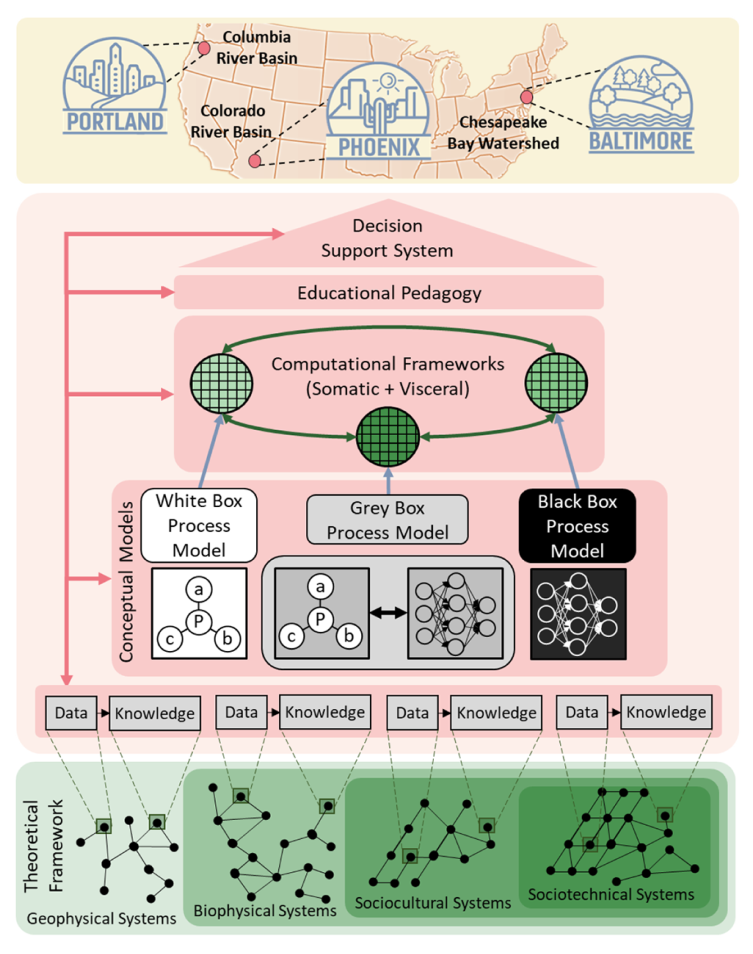
Schematic of the agile, evolutionary, system-of-systems convergence paradigm for One Earth and One Health (Fig. 7 in the source).4
An Aspirational Approach to Planetary Futures
- Proposal. The approach aims at "empowering people to shape a better future for all of life on Earth" (p. 889).6
- Critique of limits. Framings focused on negative outcomes have "contributed to disempowering social conditions, including rights dispossessions of Indigenous peoples and local communities" (p. 889).
- Reading. An aspirational orientation should have consequences for who holds power over decisions and over knowledge. This note asks how far those consequences extend to nonhuman participants.
What This Note Tests
An agentic perspective treats design as potentially nonhuman-led, as in Agentic Stair. It asks which beings, groups or systems produce, retain or use knowledge. It also asks what evidence supports those attributions, and how their activity changes shared conditions. The note therefore tests convergence frameworks against three questions:
- Agency. Which participants can generate or alter the knowledge under study?
- Plurality. Which ways of knowing remain distinct after researchers compare them?
- Scope. Which disciplines and traditions enter the analysis, and which remain outside it?
Integration alone does not answer these questions. A common framework can improve comparison while it narrows the range of disciplines or translates distinct knowledge practices into one vocabulary.
Approaches by Layer
| Approach | What it examines | Layer |
|---|---|---|
| Citation, coupling and co-citation analysis | Explicit reference relations and intellectual structure | Scholarly representation |
| Main-path and key-route analysis | Trajectories through directed citation networks | Scholarly representation |
| Atypical-combination analysis | Unusual pairings of prior work against a random baseline | Scholarly representation |
| Policy-citation analysis | Uptake of research in policy documents | Scholarly representation, translation |
| Network-based diffusion analysis | Acquisition and spread along social connections | Learning |
| Diffusion and disruption studies | Causal evidence for transmission, or its loss | Learning |
| Multilayer ecological networks | Heterogeneous agents and interaction types | Learning |
| Information theory | Signal structure and statistical dependence | Learning |
| Biosemiotics | Interpretation and meaning | Learning |
| Longitudinal monitoring | Retention and consequences | Learning, translation |
| Qualitative more-than-human methods | Situated relations and meanings | Translation |
| Decision tracing | Translation into design or governance | Translation |
Scholarly Representation
Citation Projections
Let be the citation matrix of a corpus of publications. Its entry equals 1 when publication cites publication , and 0 otherwise. is its transpose.
- Direct citation. The matrix itself. A citation edge points from a newer citing work to an older cited work, while a hypothesised influence runs the opposite way. State the convention in each study.
- Bibliographic coupling. . Each entry counts the references that publications and share. Coupling can show convergence early, before incoming citations accumulate.
- Co-citation. . Each entry counts the later publications that cite both and . Co-citation shows retrospective recognition.
- Main-path and key-route analysis. These methods trace high-traversal trajectories through a directed acyclic citation network.7 The method has been extended to patent citations, for example in the history of fuel cell research.8 Main paths can also indicate path-dependent transitions in the development of a field.9 A single main path favours the dominant lineage. Key-route and multiple main paths keep several trajectories, so they may suit interactions between traditions better.10 A recent analysis gives main-path analysis an information-theoretic and geometric basis, and finds that "baskets" of critical nodes cover main paths and more key nodes.11 The R package mpaR implements global, local and key-route main paths.
- Semantic similarity. Conceptual proximity without citation. Check it against terminology, methods and contextual meaning.
Atypical Combinations
Unusual combinations of prior work can be detected against a randomised baseline.12 For each pair of journals and that a paper cites together:
- : the observed frequency of the pair across all papers published in a given year.
- , : the mean and standard deviation of that frequency across randomised citation networks that preserve each paper's citation counts.
- : the pair appears more often than chance, which indicates a conventional pairing. A value below zero indicates a novel pairing.
- Median conventionality: whether a paper's median lies in the upper or lower half of all papers' medians.
- Tail novelty: whether a paper's 10th-percentile lies above or below zero. A value below zero means that the paper includes atypical pairings.
- Hit: a paper in the top 5% of the citation distribution.
Across 17.9 million papers, those with high median conventionality and high tail novelty were hits in 9.11 out of 100 cases, nearly double the background rate of 5%.12 Citation impact and epistemic value are different properties, so this measure can only flag candidates for close reading.
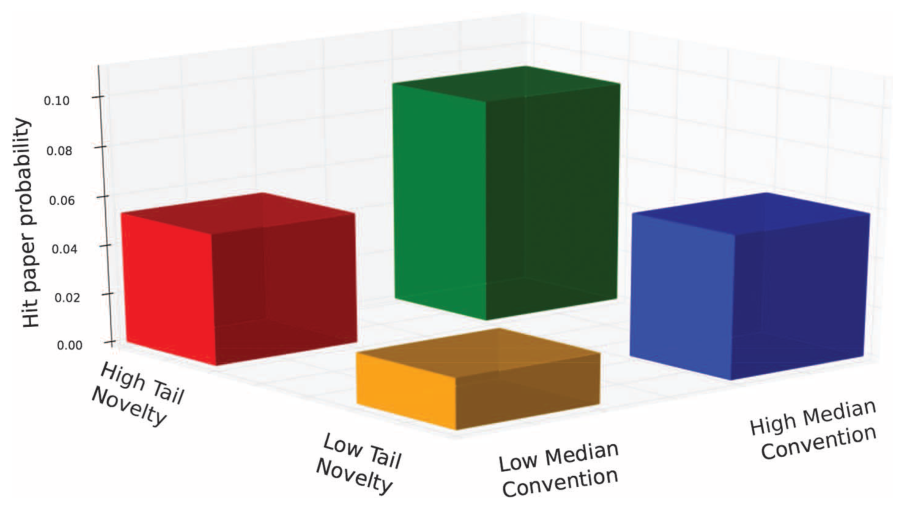
Probability of a hit paper by median conventionality and tail novelty (Fig. 2 in the source).12
Weak Signals
The following candidate profiles need testing before they can support a validated score.
- Rare connections between citation communities.
- Unusual combinations of references.
- Increasing shared references without direct cross-citation.
- Semantic proximity despite structural separation.
- Repeated, independent bridge-building by different groups.
- Revival of neglected sources.
- New cross-community edges that persist over time.
- Policy documents that combine traditions with no connection in scholarly citations.
- Translation that changes decisions as well as vocabulary.
A weak signal differs from low frequency, a low citation count or a rare edge. A weak bridge can also be a coverage artefact.
- Structural variation. New boundary-spanning connections that a paper introduces to an intellectual structure can predict its later citations. Cluster linkage predicted citation counts better than the number of references cited.13
- Delayed recognition. A "Sleeping Beauty" is a paper whose citations burst after a long period, and its "Prince" is the citing paper that triggers the burst. Such pairs integrate separate fields more often than ordinary citations do. Even so, the rarity of a citation cannot predict which citation will wake a Sleeping Beauty.14
- Knowledge flows. Flows through directed acyclic citation graphs offer one way to trace how knowledge moves through a citation network.15
Policy Uptake
- Coverage. For some topics, including health, economics, social care and the environment, the Overton database contains enough policy documents with citation links to support citation analyses.16
- Reference presence. Of about 17.5 million Overton-indexed documents, 7.7% contain scholarly references and 10.6% contain policy references. Presence varies across publication years, source types, countries, languages, subject areas and policy topics.17
- Database comparison, Finland. For social-science publications from Finnish universities and research institutes, about 39% were cited in Overton-tracked documents and 9% in Altmetric-tracked documents. The overlap between the two sources was about 5%.18
- Document families. A count of unique citing documents requires merging "multiple editions/versions, translations, and duplicates of the same document". Case studies can then show how the citing documents used the evidence.19
- Two designs. One design starts with papers and finds the policy documents that cite them. The other starts with policy topics, builds a policy corpus, then analyses its evidence and content.
- Citation function. Code whether a citation supplies background, a method, evidence, criticism or support for a recommendation. A policy citation differs from demonstrated implementation.
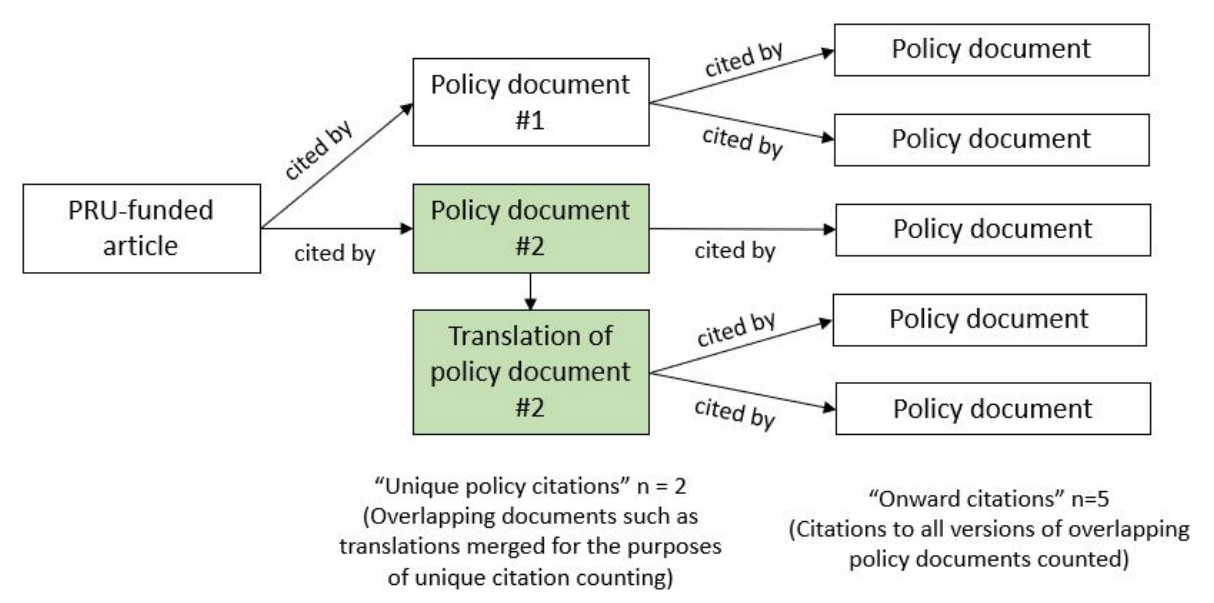
Terminology for counting policy citations, including unique and onward citations (Fig. 1 in the source).19
Data Sources
| Source | Proposed role | Caution |
|---|---|---|
| OpenAlex | Open scholarly metadata and citation backbone | Matching, versions and reference coverage need auditing |
| Crossref | DOI metadata, deposited references and publication relationships | Publisher deposits vary; incomplete as a forward-citation service |
| OpenCitations | Open citation edges and a provenance cross-check | Coverage depends on indexed sources and identifier matching |
| Semantic Scholar | Secondary graph and semantic discovery | Identifiers, merging and coverage differ; check reuse terms |
| Scopus, Web of Science | Curated comparative coverage | Subscription and export limits; selection bias |
| Overton | Policy and grey-literature corpus with research-to-policy links | Citation differs from policy impact; document versions matter |
| Dimensions | Links across research, grants, policy and patents | Verify current access and licence |
| Lens | Links between scholarship and patents | Verify access, coverage and permitted bulk use |
Product features, corpus sizes and access terms change, so check current documentation before use. OpenAlex launched as a fully open replacement for the discontinued Microsoft Academic Graph.20 A heterogeneous graph model over OpenAlex data, with seven node types and seven edge types, shows how its records can support citation and co-authorship projections.21
More-than-Human Learning
Network-Based Diffusion Analysis
Network-based diffusion analysis (NBDA) tracks the spread of a behaviour through a group. It assumes that "social network structure directs social learning opportunities".22 It then fits models of social and asocial learning to the order or timing of acquisition. The basic model is:23
- : the rate at which individual acquires the target behaviour at time , in the sense of a hazard rate.
- : the baseline rate function, which gives the rate of asocial learning.
- : the status of individual at time , with 1 for informed and 0 for naïve.
- : the number of individuals in the population.
- : a non-negative value for the connection strength from to in the social network.
- : the relative strength of social transmission, estimated as the rate of transmission per unit connection relative to the rate of asocial learning.
The factor sets the rate to zero for individuals that already perform the behaviour. The sum measures how strongly connects to informed individuals at time .
- Confounds. A multi-network NBDA can separate social transmission from shared environment and genetic relatedness, as one study of a foraging behaviour in bottlenose dolphins shows.23
- Opportunities. An association network records potential learning opportunities. It does not identify the transmitting individual or the cognitive mechanism.
- Gulf of Maine, United States. Lobtail feeding, a foraging innovation first observed in one humpback whale in 1980, spread through the population by cultural transmission over 27 years.24
Experiments and Disruption
- Diffusion experiments. A review of 33 diffusion experiments in fishes, birds, rodents and primates found transmission across populations of up to 24 individuals. Chains reached up to 14 transmission events.25
- Manipulated social structure. Control over which wild songbirds could feed together changed the pathways by which new food patches were discovered. Birds "disproportionately learnt from those whom they could forage with". With fewer conspecific sources available, birds increased their use of information from other species.26
- Seattle, Washington, United States. Wild American crows learnt to scold a mask worn by people who had trapped them. Crows that were never captured also learnt to scold it through horizontal social learning. Young crows learnt from their parents through vertical social learning. Scolding spread at least 1.2 km from the trapping sites.27
- Disruption. A systematic review of 95 papers found that severely disrupted elephant populations are less cohesive and may respond inappropriately to threats. Severe disruption "can inhibit or break potential pathways of information transmission", which offers indirect evidence for social transmission.28
- Failed transmission. Studies of diffusion examine the factors that enhance or inhibit transmission. They also ask why social transmission sometimes fails to occur when researchers expect it.29
Multilayer and Interspecific Networks
- Layers and aspects. Multilayer networks connect distinct layers through interlayer edges. Each independent way of layering, such as time or interaction type, is an aspect.30
- Shared structure. A multilayer network "incorporates multiple sets of relationships into the same mathematical structure, often with each layer representing a distinct form of connectedness". It inherits the complexities of standard network analysis and adds challenges of its own.31
- Space and time. Animal social networks can be studied within an integrative framework that embeds social interactions in space and time.32
- Information network of nature. Species exchange signals and cues that form an "information network of nature". Combining information flows with matter flows in multilayer networks "can lead to shorter pathways connecting species and a denser aggregation of species in fewer modules".33
- Keystone informants. Some species act as keystone sources of information for others. They include "community informants", whose signals about predation risk shape other species' landscapes of fear. They also include "aggregation initiators", which create cues or signals about resources.34
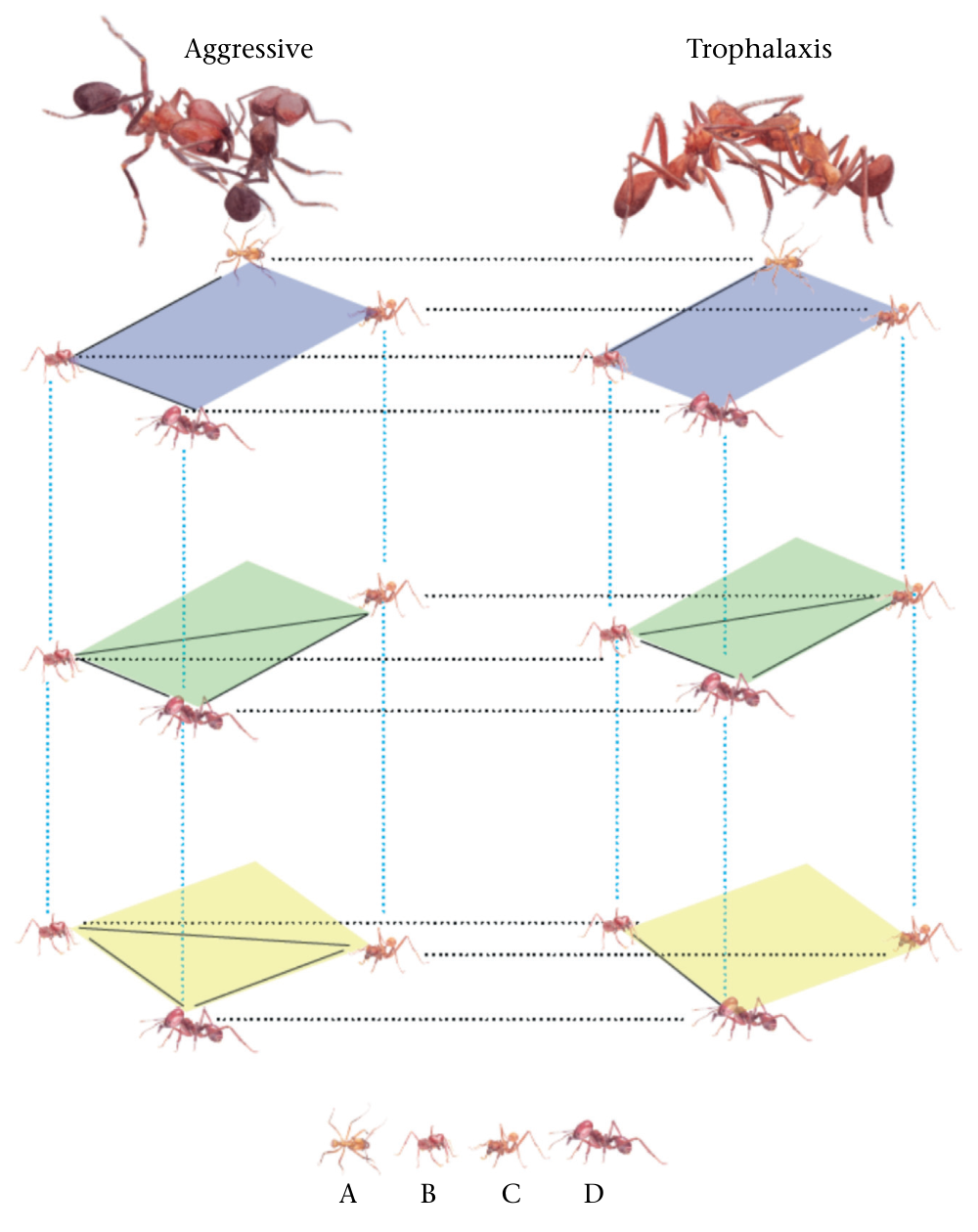
A hypothetical multilayer network of four ants that interact at three time points in two ways, aggressive and trophallactic. Solid lines are intralayer edges. Dotted lines are interlayer edges that link the same individual across times or interaction types (Fig. 1 in the source).30
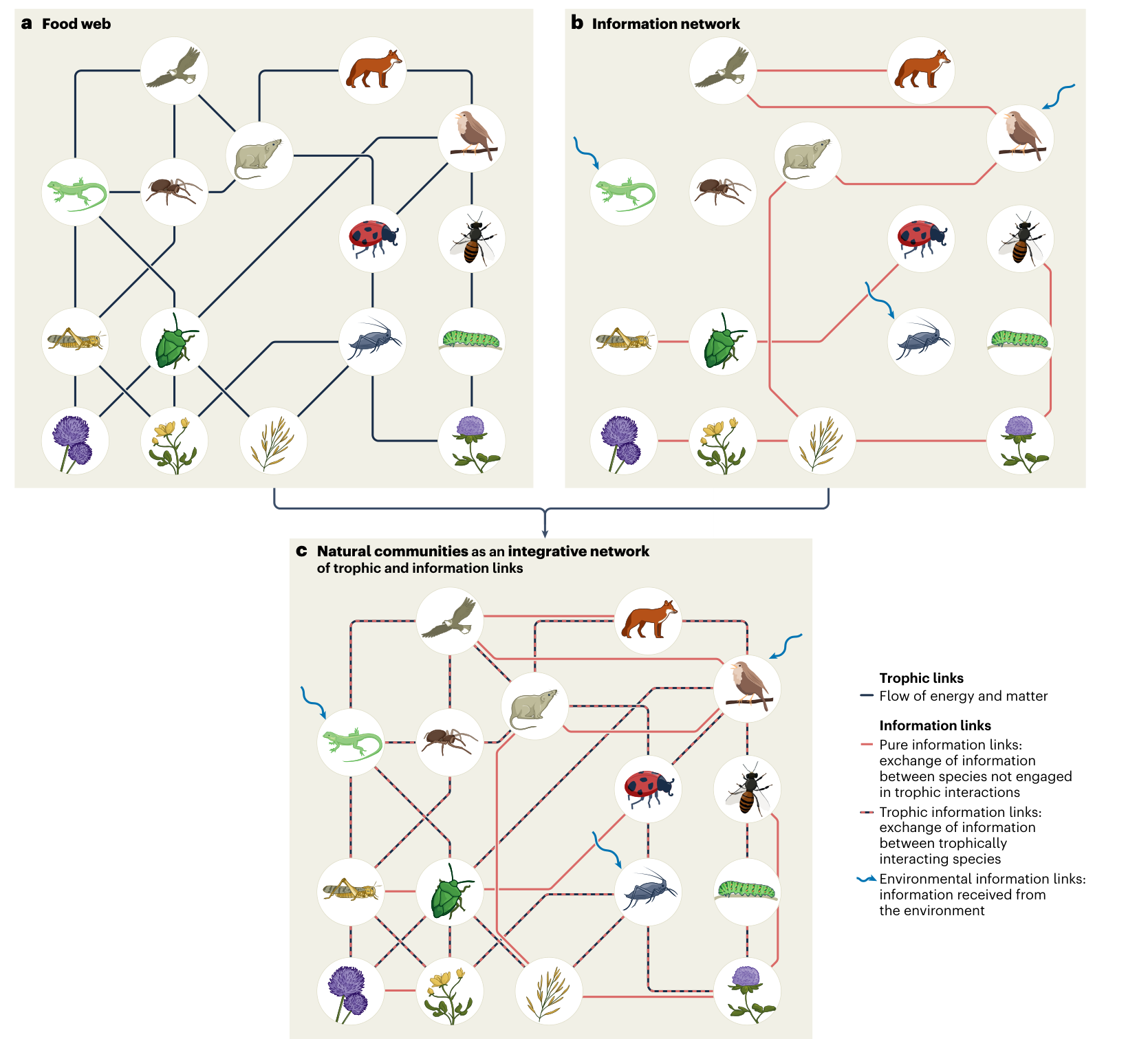
A food web (a), an information network (b) and their integration as a multilayer network of trophic and information links (c) (Fig. 1 in the source).33
- Ecological multilayer networks. Multilayer networks extend ecological analysis to multiple interaction types, to interactions that vary in space or time, and to networks of networks. They distinguish intralayer from interlayer connectivity.35
- Mixed-species groups. Heterospecific information can drive the formation or maintenance of mixed-species groups. It can also shape leadership within them and habitat selection.36
- Software. The Animal Network Toolkit Software (ANTs), an R package, computes network measures, runs permutation tests for static or temporal networks and visualises networks.37
Information Theory
Information-theoretic tools quantify uncertainty and statistical dependence.38 For observed variables and :
- , : observed variables, such as an animal's heading or the presence of an alarm call.
- : one outcome of ; : the set of possible outcomes.
- : the probability of outcome .
- : a logarithm whose base sets the unit, with base 2 giving bits and base giving nats.
- : the Shannon entropy, or average uncertainty, of .
- : the joint entropy of and .
- : the conditional entropy, the uncertainty that remains in when is known.
- : the mutual information, the reduction in uncertainty about one variable from knowing the other. It is symmetric, so it carries no direction.
- : the present time.
- : the past trajectory of , the values of for all .
- : the transfer entropy from to , the information that the past of adds about the present of beyond the past of itself. It is asymmetric, so it measures directed influence.
These measures need care in use.
- Sample size. Estimates are sensitive to sample size. Formally correct values need large amounts of data at high resolution.38
- Markov assumption. Applications often assume that only the previous time step matters. This assumption is "often made more for mathematical simplicity and tractability than for biological realism".38
- Origin of transfer entropy. Transfer entropy was introduced because time-delayed mutual information cannot distinguish information actually exchanged from information shared through common history or input signals.39
- Dependence and meaning. Statistical dependence alone does not establish meaning, learning or causation. Common drivers, lag choice and estimator bias need explicit controls.
- Physical limits. Animal size, anatomy, physiology and habitat shape how acoustic signals encode information. They also set possibilities and limits for information transfer, from insects through songbirds to humans.40
Biosemiotics
Biosemiotics asks how signals acquire significance for a particular organism (see Biosemiotics). Quantitative operationalisation remains a research task. A statistical dependence should therefore be read as semiosis only with further evidence.
- Quantitative biosemiotics. The place of quantitative methods in biosemiotics remains open. Their use ties biosemiotics to other scientific fields and to interdisciplinary dialogue.41
- Semiotic Modern Synthesis. Quantitative behavioural analysis can serve zoosemiotics because signs and signals form patterns in space and time that can be measured. Ethological test paradigms, carefully adapted, could fit a Peircean tripartite model of signs.42
Collective Knowledge and Culture
- Collective knowledge. Collective knowledge covers "phenomena in which significantly more is achieved by the collective than is possible for any one individual alone". Research on collective knowledge and research on culture have developed "largely as separate endeavours".3
- Interspecies cultures. Interspecies design "incorporates human and nonhuman cultural knowledge in the management of future habitats". The capabilities of powerful owls (Ninox strenua) illustrate the approach.43 See Artificial Habitat Structur.
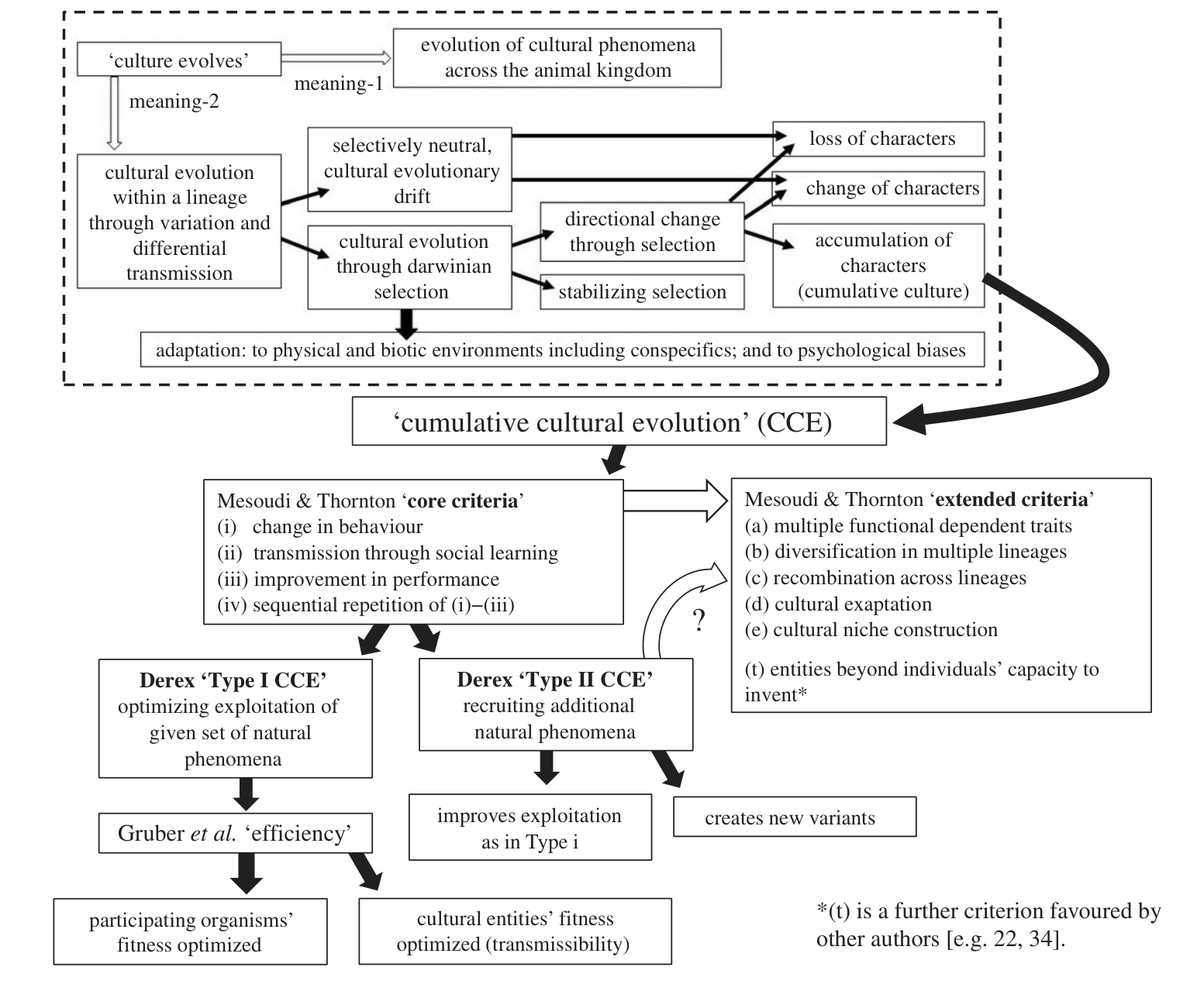
A taxonomy of distinctions between forms of cultural evolution, including distinctions within cumulative cultural evolution (Fig. 1 in the source).3
Epistemic Translation
Recursive Design Feedback
Design for and with other species can be studied as a recursive chain.
Each transition needs its own evidence. Track welfare, occupancy, reproduction or ecological outcomes separately from human interpretation and design revision.
Qualitative Methods
- Methods for a multispecies world. Five methodological approaches extend qualitative research to relations with plants, animals and rivers. They use onto-epistemology, "multimodal noticing", time as a methodological tool, posthuman disability studies and ontological multiplicity.44
- Kentish Town, London, United Kingdom. Care practices for animated trees in mobile games and for city-farm animals suggest two concepts: "learning from" and "facing" the other.45
Working Graph Schema
Shorthand
- : the complete more-than-human epistemic transfer network for one study.
- : the vertices, or nodes, which are the entities that take part.
- : the directed edges, which are empirically specified relations between entities.
- : the layers, which are the relation types and domains in which edges occur.
- : the timestamps or observation intervals that make the network temporal.
The shorthand leaves node-layer membership, edge endpoints and interlayer connections undefined. The formal definition below supplies them.
Formal Definition
A multilayer network can carry several aspects of layering at once, such as interaction type and time.30 It can be written as:
- : the multilayer network for one study.
- : the set of entities. Examples include individual organisms, populations, multispecies groups, ecosystems, researchers, designers, sensors, computational systems, artefacts, documents and institutions.
- : the number of aspects, the independent ways of layering. This note uses .
- : the set of elementary layers for aspect , where .
- : relation types, such as observes, signals, imitates, teaches, modifies an environment, constrains, responds, retains, transmits, cites, decides, benefits or loses access to knowledge.
- : domains, such as biological, ecological, technical, scholarly, institutional or policy.
- : ordered observation times or intervals.
- : the sequence of elementary-layer sets.
- : one layer, a combination of one relation type, one domain and one time.
- : the node-layers. The pair records that entity is present in layer . An entity need not appear in every layer.
- : the directed edges between node-layers. The edge runs from in layer to in layer .
- : the intralayer edges.
- : the interlayer edges. They record translation between relation types, between domains or across time.
- : the coupling edges, which link the same entity across layers, such as one population in two survey years.
- : the edge weights, such as exposure counts or response strengths.
- : the function that attaches an attribute record to each edge. is the set of possible records (see Edge Attributes).
- : a delay. A response at time to a signal at time becomes the interlayer edge , shown here with the time aspect only.
The shorthand corresponds to the formal definition as follows: , , and .
The general multilayer framework supplies the quadruple . It splits edges into intralayer, interlayer and coupling edges. It also represents delays as interlayer edges.46 Temporal networks treat the timing of edge activations as part of the network. Some properties of static networks, such as the transitivity of edges, do not necessarily hold in them.47
Network Components
- Nodes. Entities in , present in layers through .
- Edges. Relations in , typed by elements of .
- Attributes. Records attached to edges through .
- Sub-networks. Communities, which are sets of node-layers more densely connected to each other than to the rest of the network.
- Dynamics. Change across the ordered time aspect .
Edge Attributes
| Attribute | Definition |
|---|---|
source_agent | The entity that expresses the signal, cue, trace or claim. |
recipient_agent | The entity exposed to it. |
relation_type | The element of that types the edge. |
observation_time | The time or interval of observation, an element of . |
exposure_count | The number of recorded exposures of the recipient to the source. |
response_measure | The recorded change in the recipient's behaviour, state or output, with its unit. |
retention_measure | Evidence that the response persists after a stated interval. |
decision_consequence | The design or governance decision that the relation changed, if any. |
evidence_type | The kind of evidence: observational, experimental, documentary or testimonial. |
measurement_method | The protocol or instrument that produced the record. |
observer | The person, team, sensor or system that made the record. |
uncertainty | A stated estimate of error or confidence for the record. |
provenance | The source record and its chain of handling from observation to dataset. |
source_modality | The channel of expression: acoustic, chemical, visual, tactile, material or textual. |
recipient_access | Whether, and how, the recipient could perceive or reach the source. |
context | The site, season, social setting and other conditions of the observation. |
condition | Intervention or control, where the design is experimental. |
translation_step | The step in the chain from observation to decision that the edge represents. |
evidence_passage | The passage or record that supports the edge. |
missingness_reason | The reason that data for the edge are absent or incomplete. |
competing_explanation | An alternative account of the relation that the evidence has not excluded. |
Evidence Profile
These dimensions need not form a fixed sequence. Retransmission does not always show the retention measured in a particular study. A consequential response does not by itself establish learning.
- Source expression or trace. Evidence that the source produced a signal, cue, trace or claim.
- Recipient exposure. Evidence that the recipient could perceive or access it.
- Response. A measurable change in the recipient after exposure.
- Acquisition. A new behaviour, skill or representation in the recipient.
- Retention or generalisation. Persistence of the acquisition over time, or its use in new contexts.
- Retransmission. Passage of the acquisition from the recipient to further recipients.
- Decision change. A recorded change in a design or governance decision.
- Ecological consequence. A measured change in welfare, occupancy, reproduction or ecosystem condition.
- Recognition of the originating agent. Acknowledgement of the source as a contributor of knowledge.
Candidate Measures
These definitions are proposals for testing. Each measure needs a unit, a denominator, an observation protocol and an uncertainty estimate.
- Reach : the number of distinct entities that respond to, or acquire, a contribution from within a time window .
- Latency : the time from expression by to the first recorded response by .
- Persistence: the period over which an acquired behaviour, citation lineage or design change remains observable.
- Fidelity: the similarity, on a stated scale, between the form that the source expressed and the form that the recipient expresses or records.
- Cross-layer translation : the number of interlayer edges on a path from an originating observation to a decision.
- Reciprocity : the fraction of directed edges from to in a window that have a return edge from to .
- Pathway dependence: the fraction of paths from originating observations to decisions that pass through a single node or edge. A high fraction indicates a bottleneck.
- Outcome change : the difference in a stated decision or ecological variable before and after an intervention, compared with a control where possible.
Plurality and recognition require defensible coding. A single numerical proxy cannot stand in for either.
Analysis Safeguards
- Keep inference proportional to evidence. An organism's response does not automatically establish preference, teaching, learning or welfare.
- Separate structure from cause. Citation rarity does not establish novelty or influence. Link prediction suggests candidate relations; actual transfer needs further evidence.
- Audit missingness. An absent edge may reflect database coverage, identifier matching or documentation gaps. A database records only what it indexes, while knowledge systems extend beyond it.
- Check robustness. Compare results against degree-, age- and field-aware baselines. Test community resolution, edge normalisation and time windows.
- Avoid hindsight leakage. Use historical snapshots or time cut-offs.
- Separate bridges from hubs. Generic methods papers and review articles can act as hubs without substantive bridging.
- Watch main paths. Main paths may suppress the marginal traditions that the project seeks to recover.
- Retain the unindexed. Keep books, chapters, non-English sources and non-indexed knowledge in view, separately where necessary.
- Separate capabilities. Full-text access, bibliographic indexing and citation coverage are separate capabilities.
- Distinguish recognition from influence. A contribution can change a decision without acknowledgement. It can also receive acknowledgement without changing anything.
- Include cues and traces. More-than-human networks need not be interpersonal or intentional. Cues, environmental traces and material modification can matter.
- Protect provenance. Record the originating agent, observation context, evidence type and uncertainty as a contribution moves across layers.
- Keep outcomes distinct. Scholarly recognition, policy uptake, design change and ecological consequence are separate outcomes. A single impact score would merge them.
Study Design
- Staged review. A staged review might move from about 1,000 records for screening of titles, abstracts and keywords to 300 for passage-level analysis. It would then chart 50 in full text and read 10 closely. These are planning figures, not sample-size requirements.
- Policy corpus. Searches can start with broad concepts, such as "more-than-human" and "ecocentric". Targeted concepts, such as "Half Earth", "multispecies justice" and "animal-aided design", follow. Screening considers document type, institution and substantive relevance.
- Stopping rules. Thematic saturation differs from exhaustive systematic retrieval. State which review design applies and justify the stopping rule accordingly.
A study can follow these steps:
- Define the research question, the relevant agents and the claims the evidence should support.
- Keep the review corpus and its inclusion decisions separate from discovery results.
- Resolve identifiers and publication versions, while retaining unresolved and ambiguous matches.
- Retrieve references and citing works with retrieval dates and database provenance.
- Build the internal corpus graph first. Then add a one-hop neighbourhood of references and citations.
- Expand selected second-hop neighbourhoods around candidate interactions, avoiding generic hubs.
- Build direct-citation, coupling and co-citation graphs separately. Compare their community structure across resolutions and time windows.
- Add textual similarity, then code citation contexts qualitatively.
- Check candidate bridges against bibliographies and passages.
- Select a documented case. Reconstruct its events from observation to response.
- Report coverage, uncertainty, alternative explanations and missing evidence for each layer.
Ethics and Governance
Recognition of nonhuman knowledge raises questions about "how we protect it against commercial exploitation, and how conservation, intellectual property, and environmental governance might adapt in response".1
- Who can authorise the representation of community-held knowledge?
- How can provenance preserve originating agents and communities through abstraction?
- Which observations or knowledge should remain restricted?
- How can monitoring avoid disturbing organisms or creating extractive relations?
- What counts as reciprocal benefit, and who decides the relevant outcomes?
Questions to Develop
Conceptual
- What minimum evidence warrants "knowledge" over information, cue use or behavioural change?
- When does "transfer" obscure knowledge that emerges through joint activity or environmental scaffolding?
- How can studies keep plural accounts of knowing while producing comparable measurements?
- How should distributed, embodied and environmental memory enter a network model?
- How should a model distinguish epistemic recognition, agency, participation and benefit?
Empirical
- Which habitat-design cases have detailed enough records of observation and decision for a pilot?
- Can design revisions be linked to specific nonhuman responses, beyond post-hoc narratives?
- What intervention or counterfactual would distinguish causal uptake from coincidence?
- Which pathways are observable, and which remain systematically unrecorded?
- How can a study represent blocked, failed or refused transfer without reading missing data as exclusion?
Network Analysis
- Which node types does a study need, and how can it avoid an unmanageable ontology?
- How should uncertainty propagate along paths?
- How should community detection handle small, non-English or book-centred traditions?
- Can rare-edge, semantic and temporal signals be validated against independently identified historical bridges?
- How can temporal null models preserve citation age, field and degree structure?
- What distinguishes substantive conceptual borrowing from generic methodological citation?
References
Footnotes
Freymann, Elodie, Fabien Schultz, and Daniel Redfearn. “Could Non-Humans Have Traditional Ecological Knowledge? And If so, What Should We Do about It?” Journal of Ethnobiology and Ethnomedicine 22, no. 1 (2026): 30. https://doi.org/10.1186/s13002-026-00877-6.˄
Donaldson, Brianne, ed. Knowing Life: The Ethics of Multispecies Epistemologies. Abingdon: Routledge, 2025. Introduction.˄
Whiten, Andrew, Dora Biro, Nicolas Bredeche, Ellen C. Garland, and Simon Kirby. “The Emergence of Collective Knowledge and Cumulative Culture in Animals, Humans and Machines.” Philosophical Transactions of the Royal Society B: Biological Sciences 377, no. 1843 (2022): 20200306. https://doi.org/10.1098/rstb.2020.0306.˄
Little, John C., Roope O. Kaaronen, Michael Muthukrishna, Sondoss Elsawah, Max S. Bennett, Inas Khayal, Janne I. Hukkinen, C. Michael Barton, Anthony J. Jakeman, and Amro M. Farid. “One Earth + One Health: An Agile, Evolutionary, System-of-Systems Convergence Paradigm.” Environmental Science & Technology 60, no. 13 (2026): 9725–43. https://doi.org/10.1021/acs.est.5c11895.˄
Misra, Shalini, Megan A. Rippy, and Stanley B. Grant. “Analyzing Knowledge Integration in Convergence Research.” Environmental Science & Policy 162 (2024): 103902. https://doi.org/10.1016/j.envsci.2024.103902.˄
Ellis, Erle C., Yadvinder Malhi, Hannah Ritchie, Jasper Montana, Sandra Díaz, David Obura, Susan Clayton, et al. “An Aspirational Approach to Planetary Futures.” Nature 642, no. 8069 (2025): 889–99. https://doi.org/10.1038/s41586-025-09080-1.˄
Hummon, Norman P., and Patrick Doreian. “Connectivity in a Citation Network: The Development of DNA Theory.” Social Networks 11, no. 1 (1989): 39–63. https://doi.org/10.1016/0378-8733(89)90017-8.˄
Verspagen, Bart. “Mapping Technological Trajectories as Patent Citation Networks: A Study on the History of Fuel Cell Research.” Advances in Complex Systems 10, no. 1 (2007): 93–115. https://doi.org/10.1142/S0219525907000945.˄
Lucio-Arias, Diana, and Loet Leydesdorff. “Main-Path Analysis and Path-Dependent Transitions in HistCiteTM-Based Historiograms.” Journal of the American Society for Information Science and Technology 59, no. 12 (2008): 1948–62. https://doi.org/10.1002/asi.20903.˄
Liu, John S., and Louis Y. Y. Lu. “An Integrated Approach for Main Path Analysis: Development of the Hirsch Index as an Example.” Journal of the American Society for Information Science and Technology 63, no. 3 (2012): 528–42. https://doi.org/10.1002/asi.21692.˄
Price, Henry C. W., and Tim S. Evans. “Understanding Main Path Analysis.” arXiv:2512.12355. Preprint, arXiv, 2025. https://doi.org/10.48550/arXiv.2512.12355.˄
Uzzi, Brian, Satyam Mukherjee, Michael Stringer, and Ben Jones. “Atypical Combinations and Scientific Impact.” Science 342, no. 6157 (2013): 468–72. https://doi.org/10.1126/science.1240474.˄
Chen, Chaomei. “Predictive Effects of Structural Variation on Citation Counts.” Journal of the American Society for Information Science and Technology 63, no. 3 (2012): 431–49. https://doi.org/10.1002/asi.21694.˄
Miura, Takahiro, Kimitaka Asatani, and Ichiro Sakata. “Large-Scale Analysis of Delayed Recognition Using Sleeping Beauty and the Prince.” Applied Network Science 6, no. 1 (2021): 48. https://doi.org/10.1007/s41109-021-00389-0.˄
Renoust, Benjamin, Vivek Claver, and Jean-François Baffier. “Flows of Knowledge in Citation Networks.” In Complex Networks & Their Applications V, edited by Hocine Cherifi, Sabrina Gaito, Walter Quattrociocchi, and Alessandra Sala, 159–70. Cham: Springer, 2017. https://doi.org/10.1007/978-3-319-50901-3_13.˄
Szomszor, Martin, and Euan Adie. “Overton: A Bibliometric Database of Policy Document Citations.” Quantitative Science Studies 3, no. 3 (2022): 624–50. https://doi.org/10.1162/qss_a_00204.˄
Murat, Biegzat, Zhichao Fang, Ed Noyons, and Rodrigo Costas. “Evidence for Studying Interactions between Science and Policy: An Exploration of Scholarly and Policy References in Overton-Indexed Policy Documents.” Journal of Data and Information Science 11, no. 1 (2026): 63–87. https://doi.org/10.2478/jdis-2025-0054.˄
Maleki, Ashraf, and Kim Holmberg. “Policy Citations Tracked by Overton.Io versus Altmetric.Com: Case Study of Finnish Research Organizations in Social Sciences.” Informaatiotutkimus 43, nos. 3–4 (2024): 4–28. https://doi.org/10.23978/inf.145570.˄
Tunn, Ruth, Fiona Alderdice, and Marian Knight. “Evaluating Overton and Altmetric as Tools for Tracking Healthcare Research Use and Impact on Policy and Practice: A Descriptive Study.” NIHR Open Research 5 (2025): 59. https://doi.org/10.3310/nihropenres.13999.1.˄
Priem, Jason, Heather Piwowar, and Richard Orr. “OpenAlex: A Fully-Open Index of Scholarly Works, Authors, Venues, Institutions, and Concepts.” arXiv:2205.01833. Preprint, arXiv, 2022. https://doi.org/10.48550/arXiv.2205.01833.˄
Šamárek, Robert, and Radek Martinek. “A Graph Approach to the Academic Publishing Network: A Heterogeneous Model and Structural Screening over OpenAlex Open Data.” arXiv:2608.10774. Preprint, arXiv, 2026. https://doi.org/10.48550/arXiv.2608.10774.˄
Franz, Mathias, and Charles L. Nunn. “Network-Based Diffusion Analysis: A New Method for Detecting Social Learning.” Proceedings of the Royal Society B: Biological Sciences 276, no. 1663 (2009): 1829–36. https://doi.org/10.1098/rspb.2008.1824.˄
Hasenjager, Matthew J., Ellouise Leadbeater, and William Hoppitt. “Detecting and Quantifying Social Transmission Using Network-Based Diffusion Analysis.” Journal of Animal Ecology 90, no. 1 (2021): 8–26. https://doi.org/10.1111/1365-2656.13307.˄
Allen, Jenny, Mason Weinrich, Will Hoppitt, and Luke Rendell. “Network-Based Diffusion Analysis Reveals Cultural Transmission of Lobtail Feeding in Humpback Whales.” Science 340, no. 6131 (2013): 485–88. https://doi.org/10.1126/science.1231976.˄
Whiten, Andrew, and Alex Mesoudi. “Establishing an Experimental Science of Culture: Animal Social Diffusion Experiments.” Philosophical Transactions of the Royal Society B: Biological Sciences 363, no. 1509 (2008): 3477–88. https://doi.org/10.1098/rstb.2008.0134.˄
Firth, Josh A., Ben C. Sheldon, and Damien R. Farine. “Pathways of Information Transmission among Wild Songbirds Follow Experimentally Imposed Changes in Social Foraging Structure.” Biology Letters 12, no. 6 (2016): 20160144. https://doi.org/10.1098/rsbl.2016.0144.˄
Cornell, Heather N., John M. Marzluff, and Shannon Pecoraro. “Social Learning Spreads Knowledge about Dangerous Humans among American Crows.” Proceedings of the Royal Society B: Biological Sciences 279, no. 1728 (2011): 499–508. https://doi.org/10.1098/rspb.2011.0957.˄
Bates, Lucy, Victoria Louise Fishlock, Joshua Plotnik, Shermin de Silva, and Graeme Shannon. “Knowledge Transmission, Culture and the Consequences of Social Disruption in Wild Elephants.” Philosophical Transactions of the Royal Society B: Biological Sciences 380, no. 1925 (2025): 20240132. https://doi.org/10.1098/rstb.2024.0132.˄
Duboscq, Julie, Valéria Romano, Andrew MacIntosh, and Cédric Sueur. “Social Information Transmission in Animals: Lessons from Studies of Diffusion.” Frontiers in Psychology 7 (2016): 1147. https://doi.org/10.3389/fpsyg.2016.01147.˄
Finn, Kelly R., Matthew J. Silk, Mason A. Porter, and Noa Pinter-Wollman. “The Use of Multilayer Network Analysis in Animal Behaviour.” Animal Behaviour 149 (2019): 7–22. https://doi.org/10.1016/j.anbehav.2018.12.016.˄
Hasenjager, Matthew J., Matthew J. Silk, and David N. Fisher. “Multilayer Network Analysis: New Opportunities and Challenges for Studying Animal Social Systems.” Current Zoology 67, no. 1 (2021): 45–48. https://doi.org/10.1093/cz/zoab006.˄
Sosa, Sebastian, David M. P. Jacoby, Mathieu Lihoreau, and Cédric Sueur. “Animal Social Networks: Towards an Integrative Framework Embedding Social Interactions, Space and Time.” Methods in Ecology and Evolution 12, no. 1 (2021): 4–9. https://doi.org/10.1111/2041-210X.13539.˄
Brose, Ulrich, Myriam R. Hirt, Remo Ryser, Benjamin Rosenbaum, Emilio Berti, Benoit Gauzens, Andrew M. Hein, et al. “Embedding Information Flows within Ecological Networks.” Nature Ecology & Evolution 9, no. 4 (2025): 547–58. https://doi.org/10.1038/s41559-025-02670-2.˄
Goodale, Eben, and Robert D. Magrath. “Species Diversity and Interspecific Information Flow.” Biological Reviews 99, no. 3 (2024): 999–1014. https://doi.org/10.1111/brv.13055.˄
Pilosof, Shai, Mason A. Porter, Mercedes Pascual, and Sonia Kéfi. “The Multilayer Nature of Ecological Networks.” Nature Ecology & Evolution 1, no. 4 (2017): 0101. https://doi.org/10.1038/s41559-017-0101.˄
Goodale, Eben, Guy Beauchamp, Robert D. Magrath, James C. Nieh, and Graeme D. Ruxton. “Interspecific Information Transfer Influences Animal Community Structure.” Trends in Ecology & Evolution 25, no. 6 (2010): 354–61. https://doi.org/10.1016/j.tree.2010.01.002.˄
Sosa, Sebastian, Ivan Puga-Gonzalez, Fenghe Hu, Jérôme Pansanel, Xiaohua Xie, and Cédric Sueur. “A Multilevel Statistical Toolkit to Study Animal Social Networks: The Animal Network Toolkit Software (ANTs) R Package.” Scientific Reports 10, no. 1 (2020): 12507. https://doi.org/10.1038/s41598-020-69265-8.˄
Pilkiewicz, Kevin R., Benoit H. Lemasson, Michael A. Rowland, Andrew Hein, Jun Sun, Alex Berdahl, Matthew L. Mayo, et al. “Decoding Collective Communications Using Information Theory Tools.” Journal of The Royal Society Interface 17, no. 164 (2020): 20190563. https://doi.org/10.1098/rsif.2019.0563.˄
Schreiber, Thomas. “Measuring Information Transfer.” Physical Review Letters 85, no. 2 (2000): 461–64. https://doi.org/10.1103/PhysRevLett.85.461.˄
Fletcher, Neville H. “The Variety of Information Transfer in Animal Sonic Communication: Review from a Physics Perspective.” Entropy 11, no. 4 (2009): 888–906. https://doi.org/10.3390/e11040888.˄
Lacková, Ľudmila, and Dan Faltýnek. “Can Quantitative Approaches Develop Bio/Semiotic Theory?” Biosemiotics 14, no. 2 (2021): 237–40. https://doi.org/10.1007/s12304-021-09443-x.˄
Lewis, Amelia. “A Semiotic Modern Synthesis: Conducting Quantitative Studies in Zoosemiotics and Interpreting Existing Ethological Studies through a Semiotic Framework.” Biosemiotics 14, no. 2 (2021): 295–327. https://doi.org/10.1007/s12304-021-09435-x.˄
Parker, Dan, Kylie Soanes, and Stanislav Roudavski. “Interspecies Cultures and Future Design.” Transpositiones 1, no. 1 (2022): 183–236. https://doi.org/10.14220/trns.2022.1.1.183.˄
Elton, Sarah, Noha Fikry, Aparna Menon, Arnika Peselmann, and Carlos Sanchez Pimienta. “Doing More-than-Human Research: Developing Qualitative Research Methods for a Multispecies World.” Qualitative Inquiry 32, no. 7 (2026): 627–40. https://doi.org/10.1177/10778004251377389.˄
Desai, Shruti, and Harriet Smith. “Kinship across Species: Learning to Care for Nonhuman Others.” Feminist Review, no. 118 (2018): 41–60. https://doi.org/10.1057/s41305-018-0104-0.˄
Kivelä, Mikko, Alexandre Arenas, Marc Barthelemy, James P. Gleeson, Yamir Moreno, and Mason A. Porter. “Multilayer Networks.” Journal of Complex Networks 2, no. 3 (2014): 203–71. https://doi.org/10.1093/comnet/cnu016.˄
Holme, Petter, and Jari Saramäki. “Temporal Networks.” Physics Reports 519, no. 3 (2012): 97–125. https://doi.org/10.1016/j.physrep.2012.03.001.˄