Functional Account of Agency
This note describes agency through what a participant does. A function is an activity that a participant can perform, an observer can test in a given setting, and other participants have to register. The word participant does not presume a self-contained individual. Every agent depends on relations with constituents, other agents, material conditions, and histories. Analysts draw boundaries around these relations for particular questions; the boundaries can overlap and change with scale. Whether agency can be attributed at any chosen scale remains an empirical question. Several accounts assign a participant a single level of agency, represented as a rung on a ladder or scale. A function profile records distinct functions instead, so one participant can show strong memory alongside weak anticipation. Three methods in other notes use this kind of profile: personas describe what a nonhuman stakeholder can do; capability lists state what a participant could do or be; and the checks of the agentic stair assess the strength of an agency claim for each party in a relation. See Agency for definitions, the evidence ladder and the five declarations. The Dimension column identifies the dimension of Three Axis Framework associated with each function.
Related notes:
- Agency for definitions, the seven-rung evidence ladder and the five declarations.
- Agentic Stair and the Stair of More-than-Human Participation for the checks that take a function profile as input.
- Design Potential (Private) for reachability, steerability and cognitive light cones.
- Process Ontology for process-based accounts of persistence and identity.
- Capabilities for capability lists.
- Cognition, Intelligence, Decision Making, Memory, Learning, Communication for single functions.
- Energy, Metabolism, Information for constitutive functions.
- Resistance, Redundancy, Diversity, Innovation, Transformation, Phase Space for relational and collective functions.
- Ignorance, Limitations, Bias for the limits of the evidence.
Why a Functional Account
Four senses of agent, two motivations. In biology, the concept of an agent has at least four senses: minimal, intelligent, rational and intentional. Biologists have two motivations for using the concept. Some argue that organisms differ in kind from other biological entities, such as genes or groups; some theorists call that difference autonomy. Others treat organisms as if they were agents, as a heuristic for explaining evolved behaviour. Which of the four senses fits a given study depends on the biologist's motivation.1
A third motivation: design. Design adds a third motivation for using the concept. A brief must specify what a participant can do within a proposed arrangement, which activities the arrangement supports or blocks, and where the participant can refuse. Designers therefore need to identify the participant's functions. The capability approach makes a related distinction between a capability, the real opportunity to do or be something, and a functioning, the doing itself.2 This note applies that distinction to agency: a profile records what a participant could do, what current conditions allow, and what it does.
Nest boxes show why the distinction matters. Over three years in restored woodlands in south-eastern Australia, researchers monitored 150 nest boxes across four designs. Superb Parrots and Squirrel Gliders used none, even though two designs targeted those species. Starlings and feral honeybees used the boxes instead.3 This result cannot show whether the target species declined the boxes, were absent from the area, or were kept out by the occupants. A profile therefore needs to record presence before it can record refusal.
Functions are frame-relative. Any measurement of agency depends on a reference frame: its boundary, causal variables, criterion for a goal, and reference class for adaptation.4 Observers posit a Self, and systems posit one about themselves. Estimates of agency therefore vary with the observer and the scale of observation.5 A profile also records the scale of goals a system can pursue, its cognitive light cone.6 Each entry states the five declarations (boundary, variable, horizon, perspective, beneficiaries) set out under Declaring the Agent. The five questions for nonhuman leadership apply the same declarations in practice.7
Relational constitution does not settle scale. A cell, animal, institution, or forest can be analysed as a composite of dependencies and interactions. This does not make every relation or assemblage an agent. A claim about agency at a particular scale needs evidence for the functions, regulation, and consequences attributed at that scale. The Design Potential (Private) account treats collectivity as a condition of agents, not as a separate kind; Phase Space keeps forest-level agency open as an empirical question.
Agencies overlap, nest and depend on circumstance. A manic episode shows why an observer must declare a boundary before assigning functions. Evidence locates possible contributions at several levels.
- Medication and gut pathways. Lithium, a chemical, halves the risk of a manic episode.8 A recent preprint reports that lithium acts mainly through the gut in mice and rats. It activates serotonin-producing cells in the gut lining, which signal to the brain through vagal and brainstem inputs. When researchers removed those cells or inputs, lithium's effects disappeared. The same activation occurred in human gut tissue.9
- Gut bacteria and host signalling. Antibiotics can trigger mania. Parker and Russo identify disruption of the gut microbiota as the likeliest route.10 In one reported case, a person with bipolar disorder improved after receiving another person's gut microbiota.11 Bacteria act through the host's own cells. In zebrafish, compounds that gut bacteria make from tryptophan prompt sensory cells in the gut lining to release serotonin and stimulate the vagal nerve. The same compounds act on the human receptor.12 Behaviour also changes the gut microbiota, so the relation runs in both directions.13
- Diet and symptoms. Diet may affect mental health through the microbiota, among other routes, although most studies so far used animals.14 In a trial of 59 people with irritable bowel syndrome and mild or moderate anxiety or depression, Mediterranean diet counselling improved depressive symptoms: 52% responded, compared with 20% in the control group. The microbiome changed no more than in the control group. Because the trial was unblinded, the diet, the counselling, or both may have produced the change.15
- Brain, emotion and sleep. Damage to different brain sites connected to one network can produce mania.16 People with bipolar disorder who dwell more on positive emotions have had more manic episodes.17 Lost sleep can also trigger an episode.18
- Implication for the boundary. Each finding locates part of the explanation in a different participant: a chemical, a gut-bacteria community, a brain network, a habit of thought, or a person's circumstances. These participants also nest within one another, as the lithium findings show. The boundary an observer chooses determines which participant counts as the agent of the episode, and each boundary suggests a different intervention.
Levels merge what profiles separate. Several accounts order agency into levels, while a function profile records distinct capacities. These schemes can serve as cross-checks without replacing the profile.
- Organismic agency. One account distinguishes five levels: organismic, ontogenetic, directed, directed with extended flexibility, and guided by preconceived goals. It also counts as agentic the processes by which an organism builds and maintains its body, such as metabolism. Autonomy theory does not.19
- Animal welfare. A four-level account distinguishes passive or reactive, action-driven, competence-building, and aspirational agency.20
- Psychological agency. A comparative account distinguishes four feedback-control organisations: goal-directed agency in ancient vertebrates, intentional agency in mammals, rational agency in great apes, and socially normative agency in humans.21 On this account, a bacterium or C. elegans behaves without being a psychological agent.
- Memory across substrates. An E. coli cell swims in runs broken by tumbles and steers towards food with a chemical memory held in modified signalling proteins. The protein determines how long this memory lasts, from seconds to more than five minutes.22 A separate account distinguishes five levels of biological organisation, from single cells to humans, and lists the cognitive characteristics of each.23
- Why profiles help. The seven-rung evidence ladder in Agency is another scheme. Each scheme puts many functions on one axis. A participant with strong memory but weak anticipation then receives a single rank, obscuring a difference that matters to design. Mimosa pudica illustrates the split: plants that learned to stop folding their leaves when dropped still showed the learned response after a month without disturbance.24 Yet experiments that paired a light touch with an electric shock found no conditioned response, apart from one result that a second study failed to replicate. The evidence therefore supports strong memory, while anticipation remains weak or unproven.25
- Consciousness profiles. Research on consciousness also rejects a single ranking. Five dimensions distinguish forms of consciousness, and "there is no single scale along which species can be ranked as more or less conscious". Each species instead has "its own distinctive consciousness profile".26 A function profile likewise records capacities separately. The schemes can then serve as cross-checks (see Coverage Across Schemes below).
The gap in applied fields. Social-ecological resilience research rarely measures agency. A review of 36 reviews published between 2010 and 2023 catalogued 312 resilience metrics, then examined how simulation models use them. Few metrics in either set included agency; only 5% of the metrics used in models did. The review counted human agency alone, "due to the challenges associated with defining and identifying non-human agency".27
A rapid review of 42 candidate terms retained ten terms for agents of change in social-ecological systems. The terms fall into two clusters: roles that facilitate information flows, and roles that instigate change. All ten describe human roles.28 The account of transformative capacity discussed below likewise describes that capacity as "harnessed via human agency".29
Conservation research shows a related gap. A review of 190 published evaluations of wildlife-management interventions, including translocation, reintroduction and fencing, found that interventions "insufficiently considered animal learning, decision-making, individuality, sociality, and relationships with humans".30 A functional account responds by describing the same functions for any participant, testing them, or recording them as unknown.
A standing objection. One critique argues that the agency perspective has produced no research programme and that no empirical evidence shows it advances experimental work. It holds that multiscale feedback mechanisms shaped by natural selection better explain the same phenomena.31 A function profile should therefore pair each function with a test that could fail, a record of the evidence, and a statement of who needs the result.
Four Questions Before Any Function
Four questions distinguish a participant's capacity to perform a function, its opportunity to do so, its actual activity, and its influence on others. First declare the boundary under study. It may overlap with other boundaries, and it need not correspond to one organism or one unitary individual. Each row of the function table below should answer all four questions for that declared case.
| Question | What it asks | What it separates | Example |
|---|---|---|---|
| Capacity | Could this participant perform the function at all, given its constitution? | Possession from exercise | A bat can echolocate whether or not it is doing so now. |
| Opportunity | Do present conditions allow the participant to exercise the function? | Capability from functioning2 | A caged bird has the capacity to fly but lacks the opportunity. |
| Activity | Is the participant exercising the function here, now? | Enacted from latent | Root exploration measured in one soil patch, this season: plants put more root growth into richer patches at the expense of roots in poorer soil.32 |
| Influence | Does the exercise change anything that other participants have to register? | Causal influence from mere activity | A beaver dam alters the hydrology for everyone downstream: below 13 dams in a Devon enclosure, peak storm flows averaged 30% less than the flows entering the site.33 |
Three further separations follow.
- Reachability from steerability. Whether a future is admissible, connected, affordable or durable is one question. Whether a participant can read, hold or steer toward it is another. Design Potential (Private) treats the two separately, so a function profile should say which of the two each function contributes to.
- Agency from closure. Autonomy theory defines organisational closure as "the mutual dependence among the functional parts of a purposive organization".34 An animal's heart pumps blood that carries nutrients to cells and removes waste. The rest of the body, in turn, maintains the heart.35 Agency is the part of this organisation that governs the system's relations with its surroundings: behaviour that the organisation controls and that helps maintain it. A neutrophil pursuing a bacterium, a plant bending toward light, and a rabbit foraging count as actions in this sense.34
- Closure is not sufficient. An ecosystem might realise closure without meeting the agency test.
- Artefacts fall outside this account. Machines and other artefacts do not maintain themselves. Instead, they exist as "means to achieve the goals of a third party", such as the people who make or use them.34
- Theoretical disagreement. Another account counts constitutive processes such as metabolism as agentic.19 The function table places constitutive functions in a separate tier to keep this disagreement visible.
- Agency, cognition, moral standing and causal influence. These concepts come apart in practice. A river changes a valley without a goal, so it has causal influence without agency. A slime mould has no nervous system, yet it solves mazes. In one experiment, a single cell of Physarum polycephalum filled a maze with food at two exits, then withdrew from the dead ends into one tube along the route about 22% shorter than the alternative.36 A caged hen can suffer, which gives it moral standing, yet have almost no influence over decisions about the farm.2
- Record the concepts separately. The Influence question above records causal influence; the interactive tier below records cognitive functions; moral standing needs its own field.
Functions
The table groups functions in three tiers. Constitutive functions sustain the participant through relations among its parts and surroundings. Interactive functions organise its exchanges with the surroundings. Relational functions explicitly involve other participants. The tiers distinguish functions, not kinds of agent: every function depends on relations, although those relations may not be the function under examination.
Most interactive functions come from the toolkit of basal cognition. Cognition, in this account, comprises the mechanisms an organism has "for becoming familiar with, valuing, and interacting productively with features of its environment [exploring, exploiting, evading] in order to meet existential needs".37 Researchers have described every capacity in the toolkit in prokaryotes. The interactive tier therefore does not restrict agency to animals.37
| Function | What to look for | Test | Dimension |
|---|---|---|---|
| Constitutive | |||
| Energy capture | Intake and conversion of energy that sustains the organisation | Starve or shade the participant; does it reorganise its intake? | Constituency |
| Material exchange | Uptake, transformation and export of matter | Change the inputs; trace the outputs | Constituency |
| Maintenance and repair | Correction of damage; replacement of parts | Injure; measure recovery toward the prior form | Constituency |
| Development | Change of form across the life course toward a target; parts aligned on one anatomy38 | Perturb; does the target anatomy still arrive? | Constituency |
| Interactive | |||
| Orienting | Selective attention to one state of affairs over others | Present two stimuli; which one wins? | Sense-making |
| Sensing and discrimination | Recognition of salient features; determination that a state affords an opportunity or presents a challenge | Vary a feature; does the response change? | Sense-making |
| Information seeking | Activity whose outcome is information or skill for later use (competence-building)20 | Does the participant explore when no immediate gain follows? | Sense-making |
| Valence | Assignment of value to a stimulus relative to current state | Does the same stimulus attract when the participant is deprived and repel when it is sated? | Valuing |
| Error detection | Determination that a behaviour has succeeded or failed; the basis of biological normativity37 | Block the outcome; does the participant switch behaviour? | Valuing |
| Motivation and goals | Implicit goals arising from existential conditions; a variable kept in range | Perturb-and-recover evidence for a controlled variable | Valuing |
| Memory | Retention of past information that recalibrates the sensorium, within the body or as traces in the surroundings (time-prints)39 | Erase the trace; does performance drop? | Temporal scope |
| Learning | Change of threshold or of kind of response from past experience | Repeat an exposure; does the response shift and persist? | Sense-making |
| Anticipation | Preparation from an early stimulus for what follows | Present the cue alone; does preparation follow? | Temporal scope |
| Decision-making | Combination of information from several sources followed by action, with flexible selection among alternatives and history-sensitive modification37, 39 | Offer options under shifting conditions; does the choice track history as well as the present? | Deciding |
| Problem solving | Behaviour selection under many, possibly conflicting, parameters and high uncertainty | Add a novel obstacle; does the participant find a route? | Sense-making |
| Action and environmental modification | Change of own structure or of spatial relations; construction that changes conditions for others40 | Remove the participant; does the modification persist or decay? | Acting |
| Refusal | Avoidance, non-occupancy, obstruction, withdrawal | Offer the designed condition; does the participant decline it?30 | Refusing |
| Relational | |||
| Communication | Productive interaction with other organisms by signalling, including the initiation of collective action37 | Block the signal; does coordination fail? | Communicating |
| Coordination and alignment | Parts or participants working toward one target; alignment makes many count as one38 | Isolate a subset; does it pursue the same target alone? | Constituency |
| Membership tests | Admission or rejection of candidate members, as in immunity or kin recognition | Introduce a candidate; record admission or rejection (cf. Agency) | Constituency |
| Diversity and redundancy | Spare or varied ways to meet a disturbance; requisite variety41 | Remove one pathway; what fails? (cf. Redundancy) | Capability |
| Collective decision | Group-level choice that no member makes alone;42 cognition distributed across people with artefacts43 | Vary group size or composition; does accuracy change? | Deciding |
| Novelty generation | New responses without new genes; new forms through plastic development40 | Introduce an unprecedented condition; does a new response appear? | Acting |
| Influence over shared decisions | Change to decisions across participants with incompatible goals | Does the outcome change when the participant is present? | Influencing |
The Basal Cognition Toolkit
The table below reproduces the toolkit in the original wording of Lyon and colleagues.37
| Capacity | Function |
|---|---|
| Orienting response | Ability to selectively attend to a state of affairs to the exclusion of others. Biological basis of attention. |
| Sensing/perception | The capacity to sense and recognize (re-cognize) existentially salient features of the external and internal milieux. |
| Discrimination | The ability to determine that a state of affairs affords an existential opportunity or presents a challenge requiring a change in internal state or relation to the external environment. |
| Memory | The capacity to retain information about the immediate (and possibly distant) past, and to calibrate the sensorium to take account of this information, at a minimum via habituation or sensitization. |
| Valence | An organism's capacity to assign a value (advantage/good, harm/bad) to a particular stimulus or the summary of information about its surroundings relative to its own current state. The 'building block' of affect. |
| Decision making | The capacity to combine information from multiple sources and act, typically in furtherance of an implicit or explicit goal. |
| Behaviour | An organism's capacity to adapt to changes in its internal or external milieux by changing its own structure and function (internal) and/or its spatial and interactive relations (external). |
| Problem solving | Behaviour selection in circumstances with multiple (possibly conflicting) parameters and high degrees of uncertainty. |
| Error detection | The capacity to determine whether a behaviour has succeeded or failed. Together with homeostasis/allostasis, this is the basis of biological normativity. |
| Motivation | Implicit goals arising from existential conditions. Teleonomic striving. The inclination of a thing to continue to exist and enhance itself. |
| Learning | The capacity to adapt behaviour to salient stimuli according to past experience by altering the threshold for or the nature of a response. |
| Anticipation | The capacity to predict what is likely to happen next based on an early stimulus. |
| Communication | The capacity to interact productively with other organisms via forms of signalling, notably (but not limited to) conspecifics, including initiating collective action, which may or may not include an explicit means of differentiating 'like me' (us) from 'not-like me' (them). |
Table 1 of the source, "Toolkit of basal cognitive capacities", re-typed.37
Decisions That Leave Traces
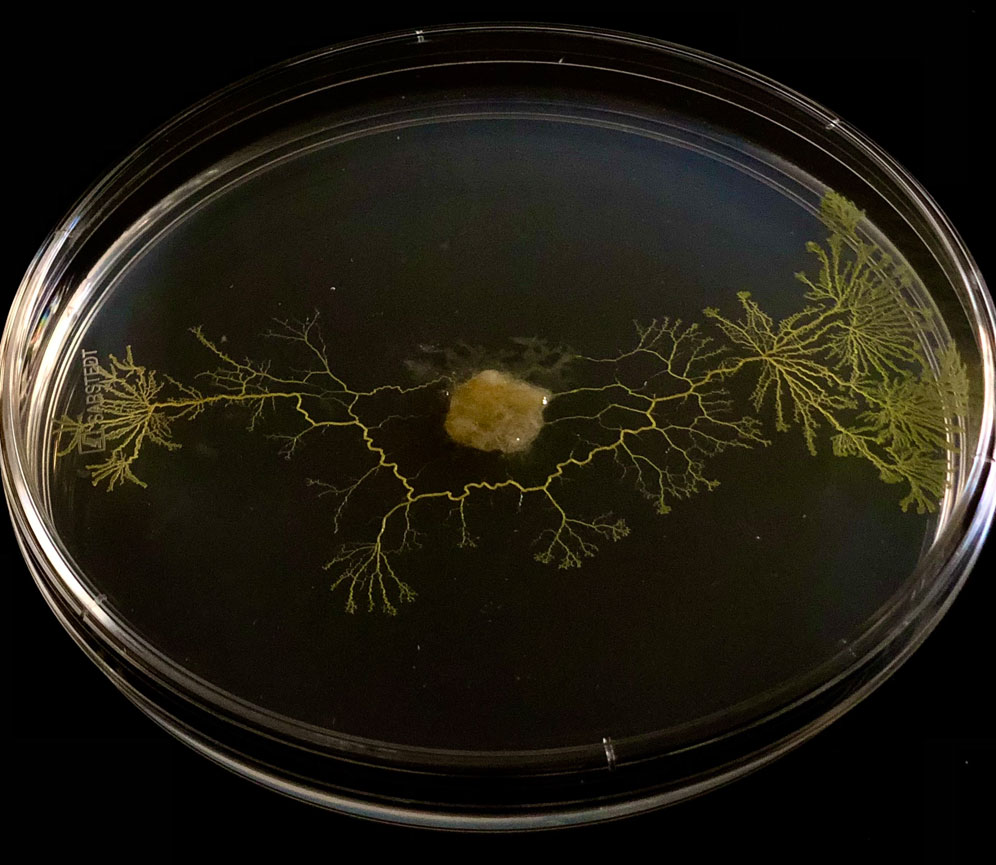 Physarum polycephalum on a dish. The network of tubes and slime trails records past decisions and constrains the next ones.39
- Definition. Decision-making can be a continual process that leaves time-prints: durable changes to a body or its surroundings that constrain later choices.39
- Criteria. A decision-maker accumulates persistent historical constraints, selects actions flexibly, and shows history-sensitive change. Rigid stimulus-response systems fail the flexibility criterion.39
- Control. Control can be heterarchical, as in slime moulds, plants, and flocks. A brain is therefore not required.39
- Tests. Erase a slime mould's trails, remove or chemically mask root exudates from explored soil, or track starling flock trajectories before and after a predator introduction. Then test for a loss of history-sensitivity.39
- Design application. These tests also apply to design because a built structure can become a time-print that a participant reads. Burrowing owls illustrate the point: when researchers replaced old nest material in artificial burrows with fresh soil, owls became less likely to reuse them. The odds of reuse were 3.5 times higher for burrows left unchanged.44
Coverage Across Schemes
For each function family, the table shows whether each scheme lists it. "Yes" means the scheme lists the function; "partly" means the scheme implies it or includes it under another item; "no" means the scheme does not mention it. A dagger (†) marks a cell that rests on a single passage in the source.
| Function family | Basal cognition toolkit37 | Five levels of organismic agency19 | Four behavioural levels20 | Animal agency in conservation30 | Transformative capacity29 | ICON levels of biological organisation23 | Dimension |
|---|---|---|---|---|---|---|---|
| Energy, material exchange, maintenance | no | yes (organismic) | no | no | no | no | Constituency |
| Development toward a target | no | yes (ontogenetic) | no | no | no | yes (adaptive morphogenesis) | Constituency |
| Sensing, discrimination, orienting | yes | partly (directed) | partly (reactive) | partly (cognition)† | no | partly (valence-sensitive states, awareness) | Sense-making |
| Valence, error detection, motivation | yes | partly (extended flexibility)† | yes (affective functioning) | partly (sentience) | no | yes (valence-sensitive states, error correction, affective states) | Valuing |
| Memory | yes | no | partly (competence-building, aspirational) | partly (sentience)† | yes (social and ecological memory) | yes (learning and memory) | Temporal scope |
| Learning | yes | partly (preconceived goals) | yes (competence-building) | yes | partly (iterative learning, human only) | yes (every level) | Sense-making |
| Anticipation, planning | yes | yes (preconceived goals) | yes (aspirational) | partly (sentience)† | partly (iterative learning, human only) | partly (goal-directed behaviour across longer time horizons) | Temporal scope |
| Decision-making | yes | partly (extended flexibility) | partly (choice between levels) | yes | partly (human only) | no | Deciding |
| Action, environmental modification | yes (behaviour) | yes | yes (action-driven) | yes | partly (human only) | yes (behaviourally expressed regulation, integrated behaviour) | Acting |
| Refusal | no | no | no | partly (unanticipated outcomes)† | no | no | Refusing |
| Communication, sociality | yes | partly (preconceived goals, Homo only)† | partly (competence-building: play, communication) | yes (sociality, cultures) | partly (stakeholder communication, human only) | partly (language, humans only) | Communicating |
| Diversity and redundancy | no | no | no | partly (individuality) | yes | no | Capability |
| Novelty | no | no | partly (novel behaviours)† | partly (adapting to new contexts) | yes | no | Acting |
| Influence over shared decisions | no | no | no | partly (relationships with humans, represented interests) | partly (power, human only) | no | Influencing |
The refusal cell for conservation draws on outcomes in the source's Table 1. Elephants grew used to deterrents and returned; other animals tried to return to their home range. The paper itself does not discuss refusal.
Four Behavioural Levels of Animal Agency
| Level | Type of overt behaviour | Affective functioning | Awareness |
|---|---|---|---|
| Passive/reactive agency | No overt behaviour except in direct reaction to external stimuli | Homeostatic and sensory affects | Anoetic self: experiencing without knowing (sentience awareness) |
| Action-driven agency | Actively behaving to achieve current outcomes | Emotional action systems | Anoetic self, as above |
| Competence-building agency | Actively behaving to build skills and acquire information for later use | Learning-related emotions | Noetic self: knowing (competence awareness) |
| Aspirational agency | Actively behaving in the pursuit of planned and reflected goals | Emotional rumination and regulation, affectively guided planning, intentions to act | Autonoetic self: recalling, planning, intending (autobiographical and introspective awareness) |
Re-typed from Table 1 of the source, which develops the levels "for the particular case of mammalian biology and psychology". This version omits the column on brain structures.20
Fields for Every Function
Each function in a profile has the same fields. The right-hand column lists the sources for individual fields.
| Field | What to record | Sources |
|---|---|---|
| Declarations | Boundary, variable, horizon, perspective, beneficiaries and costs | Agency; the five questions7 |
| Conditions of exercise | What has to be true of the setting for the function to run: season, life stage, density, presence of others | Capability from functioning2 |
| Evidence state | Present, absent, unknown because unstudied, or unknowable with current instruments; plus the evidence type (observation, perturbation, model, testimony) | Knowledge shortfalls;45 the call to fill light-cone diagrams with behavioural data6 |
| Control and constraint | Which variable the function regulates, which constraints it accumulates (time-prints), what it costs | Time-prints;39 Energy |
| Participation pathway | Which tread of the Stair the function supports, in which direction (A toward B) | Agentic Stair |
| Consequences | Who gains, who pays, what changes for others when the function runs or fails | "Resilience of what, to what?" and "for whom?"29 |
| Refusal and revision | Evidence that the participant declined or avoided; the date of the last revision of the entry | Resistance |
Unknowns Are Structured
Knowledge about any participant is uneven, so an "unknown" evidence state needs a reason. Seven shortfalls affect large-scale knowledge of biodiversity.45 The authors call "informed ignorance" "a powerful research tool".45 The Raunkiæran shortfall matters especially here: measured traits "are often the most simple, rather than the most functional".45
Taxonomic bias also shapes biodiversity records. Such records cluster around birds and other preferred groups, so an "absent" entry for an insect or fungus may describe the record rather than the participant.46 See Ignorance, Limitations and Bias.
| Shortfall | Aspect of biodiversity | Definition |
|---|---|---|
| Linnean | Species | Most of the species on Earth have not been described and cataloged; extended to extinct species |
| Wallacean | Geographic distribution | Knowledge about the geographic distribution of most species is incomplete at all scales |
| Prestonian | Populations | Data on species abundance and population dynamics in space and time are often scarce |
| Darwinian | Evolution | Lack of knowledge about the tree of life and the evolution of species and their traits |
| Raunkiæran | Functional traits and ecological functions | Lack of knowledge about species' traits and their ecological functions |
| Hutchinsonian | Abiotic tolerances | Lack of knowledge about the responses and tolerances of species to abiotic conditions |
| Eltonian | Ecological interactions | Lack of knowledge on species' interactions and these interactions' effects on individual survival and fitness |
Re-typed and shortened from Table 1 of the source.45
Each shortfall has a counterpart in a function profile. A participant may be unrecorded (Linnean), unlocated (Wallacean), uncounted (Prestonian), of unknown lineage (Darwinian), of unknown function (Raunkiæran), of unknown tolerance (Hutchinsonian), or of unknown relations (Eltonian). The function table is a Raunkiæran instrument; the relational tier is an Eltonian one.
Collective Scale: Transformative Capacity
Social-ecological systems can change through functions distributed across people, organisms, materials, and ecological processes. Whether to attribute agency to the system at that scale remains a separate empirical question. Michaels and colleagues describe transformative capacity as "the potential for a system to be intentionally shifted to a new, self-organizing, desired state".29 Their account foregrounds human agency in intentional transformation, while the ecological carriers below contribute memory, diversity, and novelty through their relations.
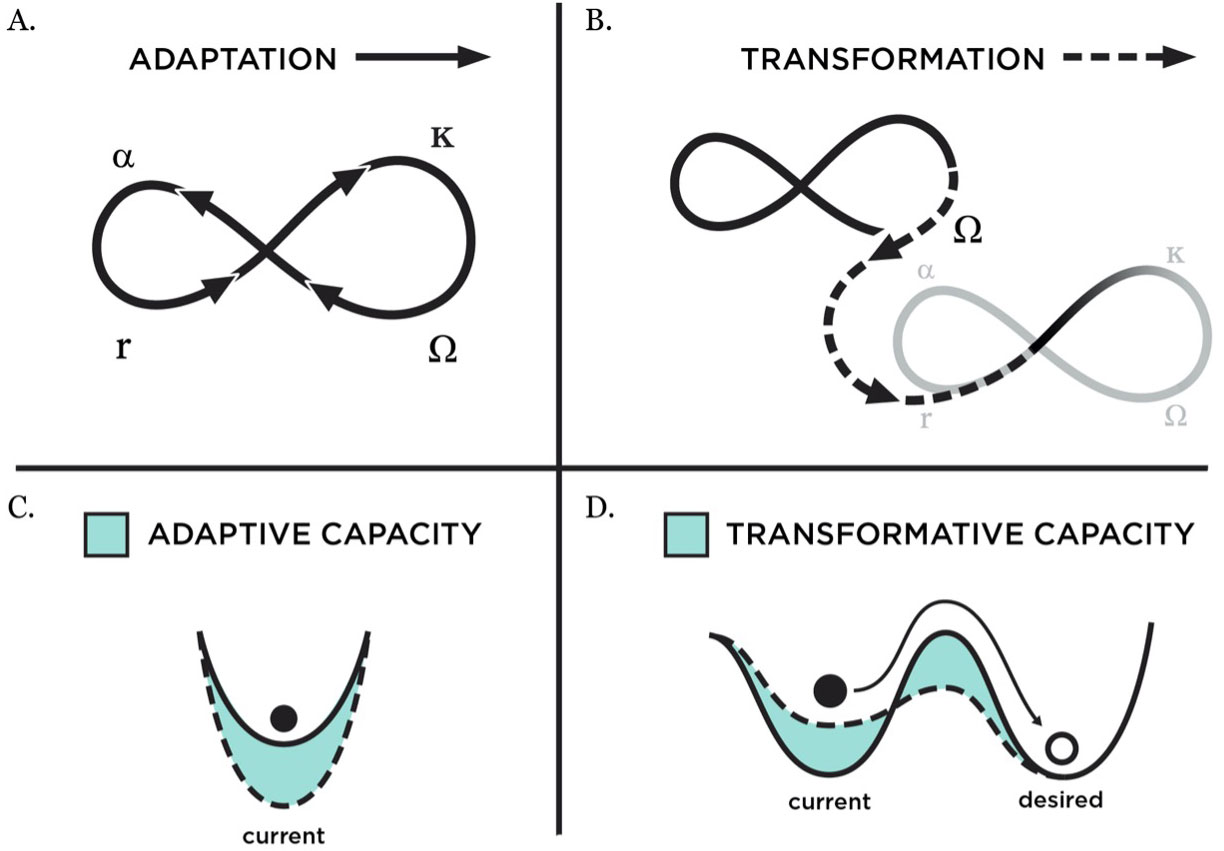 Adaptive capacity lets a system adapt while it remains in its current basin of attraction. Transformative capacity erodes the resilience of the current state, either by making its basin shallower or by lowering the resistance threshold between the current and a desired state.29
- Three attributes. Transformative capacity depends on memory, diversity and novelty. Memory has social carriers as well as ecological ones, the latter including "seed banks, migrations, rare species, ecological disturbances, and land use legacy effects".29 Lodgepole pine is one such carrier: its serotinous cones store seed on the tree, so a stand killed by bark beetles can still reseed after a later fire, provided the fire comes while the seed is still viable.47 Diversity covers functional and response diversity. Novelty consists of options that the current state lacks. Each attribute corresponds to a function in the relational tier above, performed by a collective.
- Windows of opportunity. Transformation may occur when a window opens for people to use a loss of resilience in the current state, or to erode that resilience.29 In a function profile, a window is an entry under conditions of exercise: the same function counts for more when the current state is weak. In Alaskan black spruce forest, a severe fire that burns off the thick organic soil layer opens such a window: deciduous trees establish on the exposed mineral soil, and the forest can switch to a deciduous state that persists through new plant–soil–microbial feedbacks.47
- For whom. Resilience researchers ask "resilience of what, to what?" and "for whom?"29 The consequences field of a function profile records the answer to the same question.
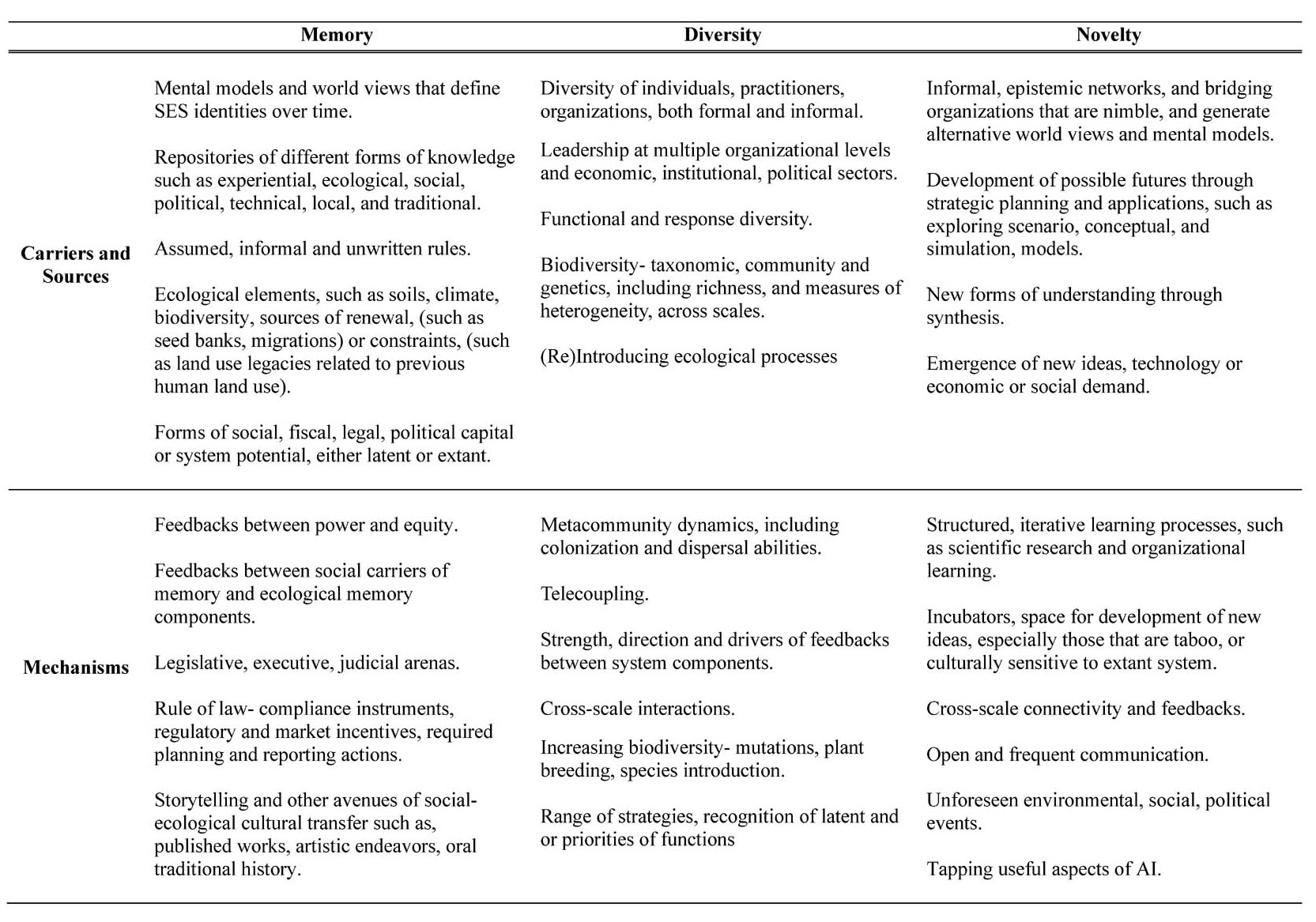 Some carriers, sources and mechanisms of memory, diversity and novelty, the three core attributes of transformative capacity in a social-ecological system.29
Cf. Transformation, Memory, Diversity, Innovation and Phase Space.
Mapping the Field Without Missing Lenses
Human knowledge of agency is uneven, so a map of the field has to say how it searched, where it stopped, and what it could not see. The procedure below combines reporting standards for meta-narrative reviews with a worked example from the same journal that published the transformative-capacity account.
Record how each source knows. A disciplinary label does not specify a source's method or epistemology. For each item, record:
- the activity or relation under study;
- the evidence used, who interprets it, and which instruments or practices they use;
- the spatial and temporal scales;
- the boundaries and exclusions.
Sources may combine methods or support incompatible interpretations. Keep those differences visible rather than forcing them into one hierarchy of evidence.
- Trace traditions, then compare them. A meta-narrative review follows how separate research traditions conceptualise a topic. It searches by snowballing from seminal sources and by database query, then reports where traditions agree, differ, or do not engage with one another.48 The traditions table below is one product of this step.
- Build a corpus, then read to saturation. One review extracted 1,577 articles from Scopus, clustered them by shared references, and characterised the clusters by distinctive vocabulary. Researchers then coded articles until new ones added no new statements. The coding yielded ten constructs of limits, arranged on two axes: a social paradigm (the view of the science-policy interface) and an epistemic paradigm (the value of knowledge). The review describes its corpus as Western-centred and English-only. It therefore maps influential international literature while leaving other parts of the field uncharted.49
- Map roles, then ask who is missing. Ten terms for agents of change fall into two clusters: facilitators of information flows and instigators of change. The review tabulates the roles against scale and strategy.28 The same matrix can map any participant: rows for strategies such as reframing or mobilising resources, columns for candidate agents, and cells for evidence. Empty cells show where researchers have looked only at people.
- Audit the metrics. Hirata Sanches and colleagues show how to check what a field measures: they classified every metric, then asked which categories include agency or diversity. In their figure, reproduced below, compound indicators at the individual level include agency most often.27 A researcher who runs the same audit on design or conservation literature can see where the functions above go unmeasured.
- Fill in the cones with behavioural data. The empirical task is to fill light-cone diagrams of goal scale "with behavioral data from real organisms".6 Each function row with the evidence state "present" is one datum for such a diagram.
- Perturb, then look for history. Erase a trace, mask an exudate, disturb a flock: the perturbation tests above show whether a function leaves a record that the participant later reads.39
- Stop with a record. Stop when a new source adds no new function or field, as the saturation criterion requires.49 Keep two lists with the map: the lenses tried that found nothing, and the items excluded with the reason. An empty search for a term means that the term is absent from the sources searched; it says nothing about the participant.
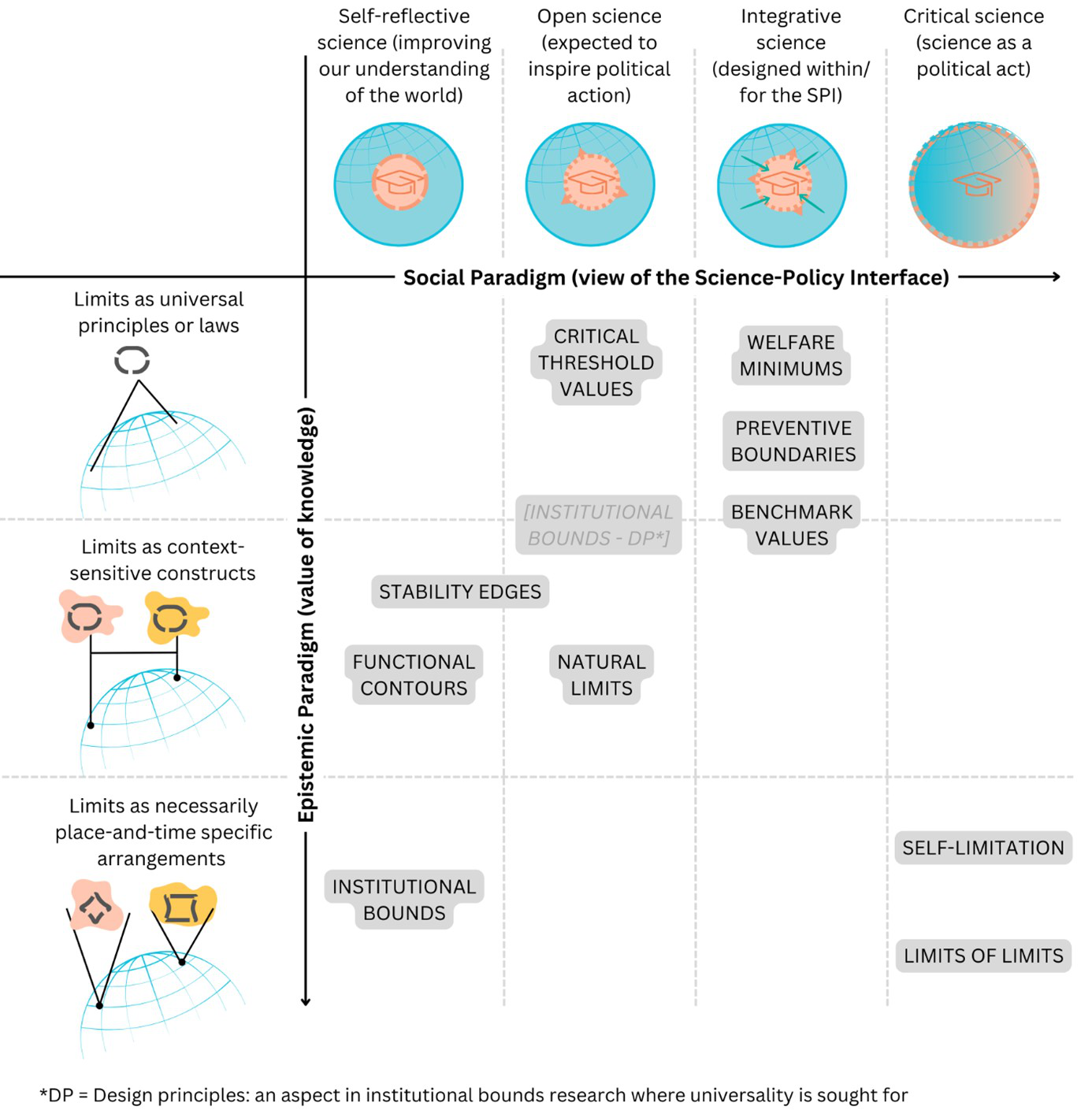 A cartography of ten constructs of limits across a social paradigm (horizontal) and an epistemic paradigm (vertical).49
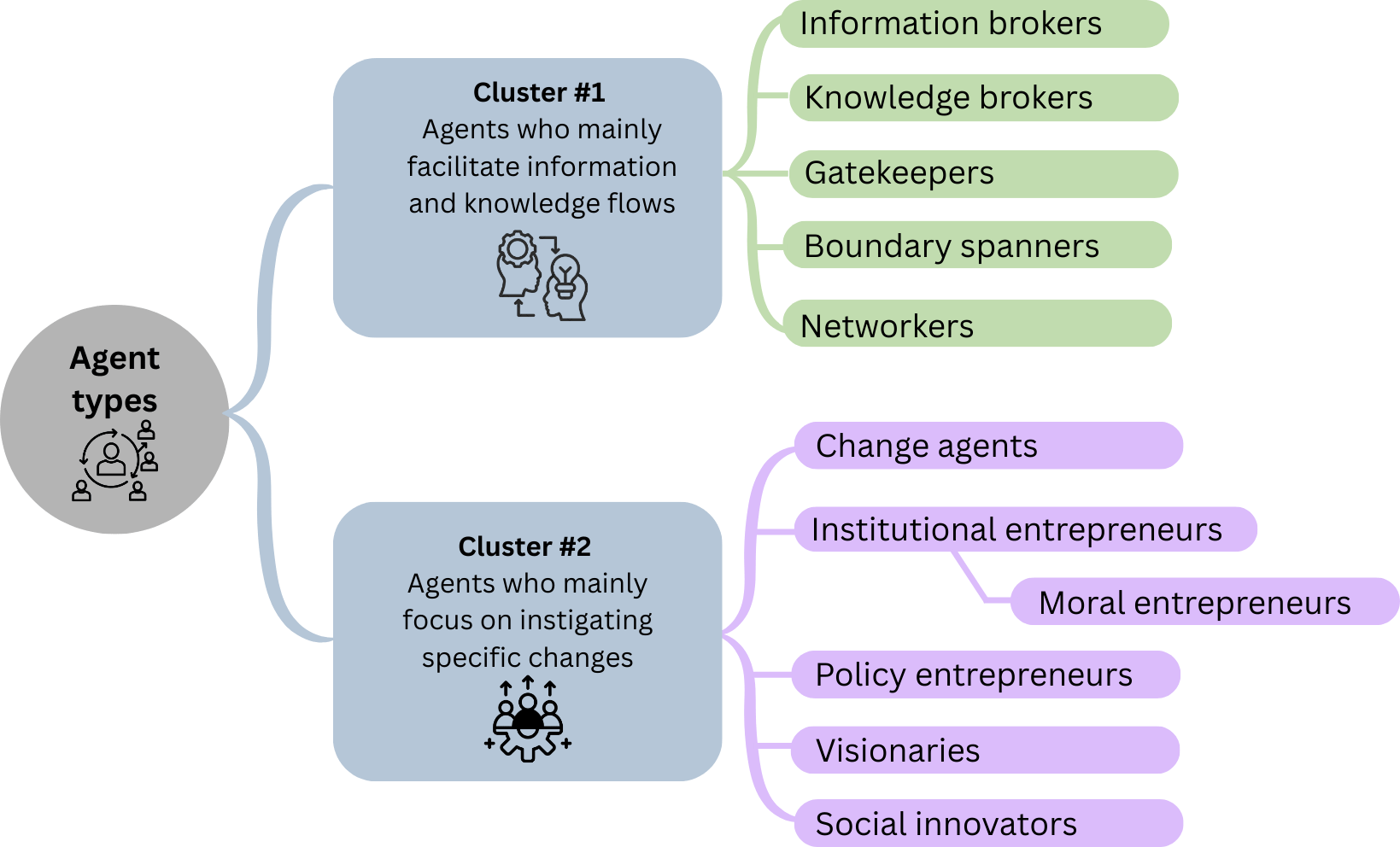 Two clusters of agents of change in social-ecological systems. All ten terms describe roles that people play.28
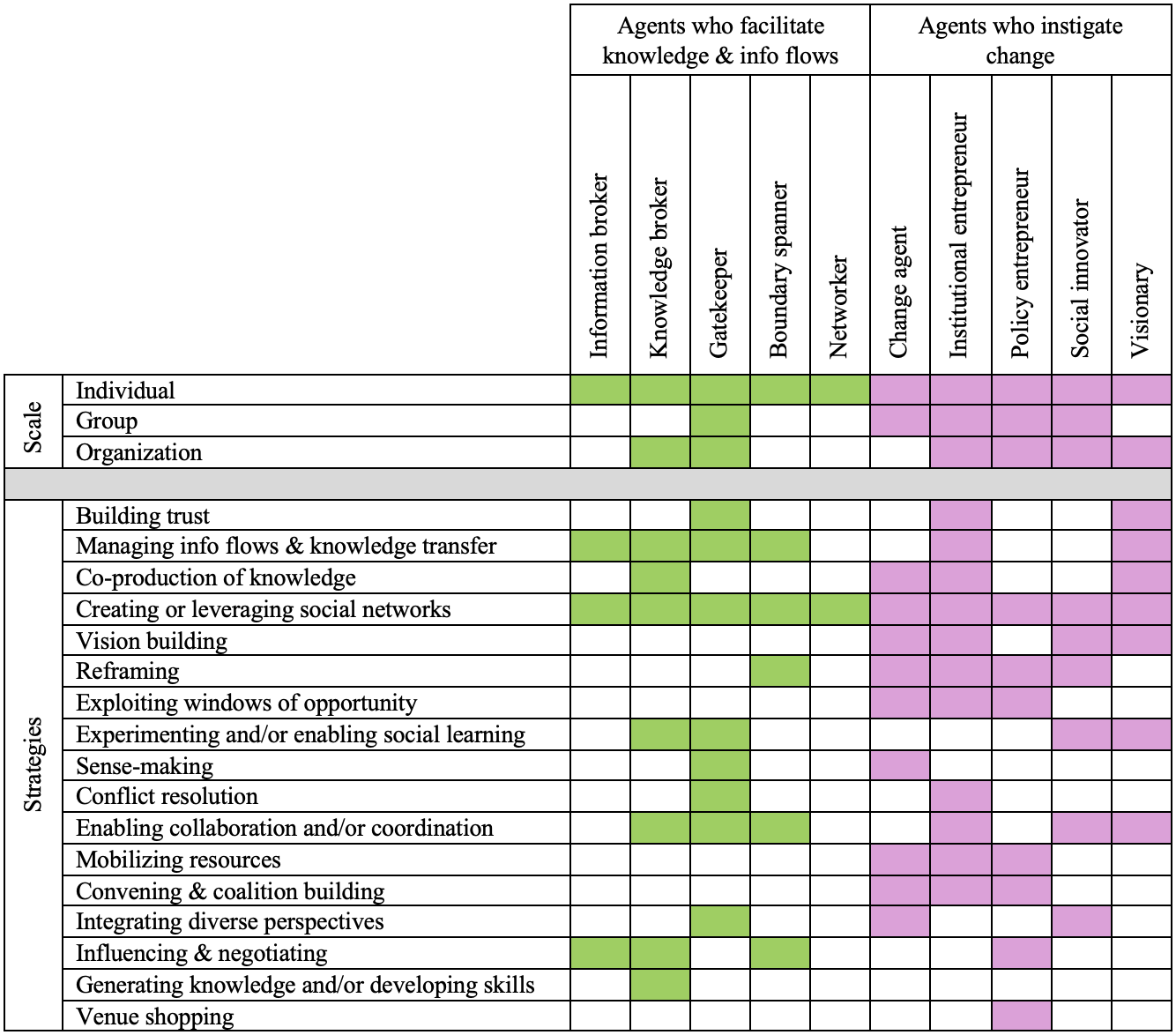 Agent types against scale and strategy. The matrix form transfers to other participants.28
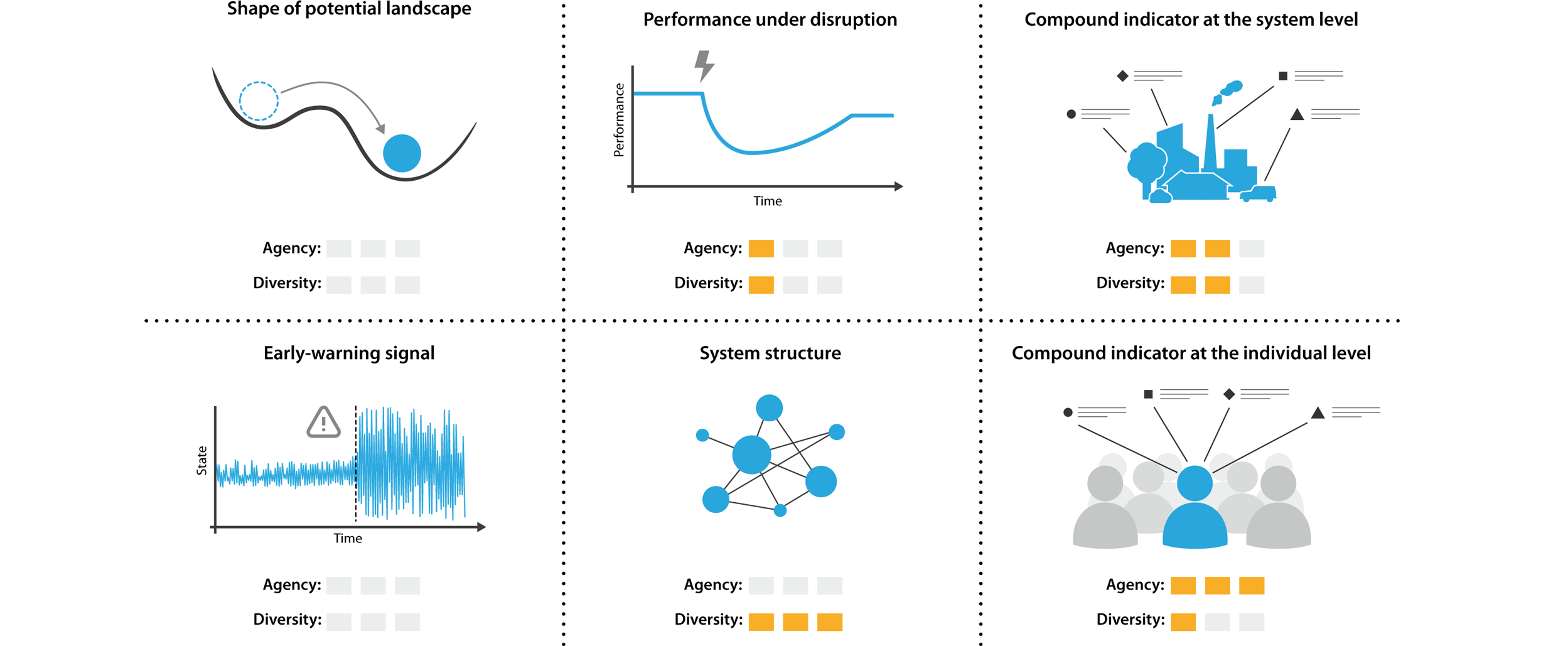 Six categories of resilience metric, with bars for how often each includes agency or diversity.27
Traditions and Epistemic Entry Points
The rows below are overlapping entry points, not mutually exclusive disciplines or a complete taxonomy. The middle column summarises which activities, relations, and scales each conversation makes legible; it does not assign a single definition of agency to that field.
The map uses humans for the species and people for situated communities or political collectives, including Indigenous peoples; the terms are not interchangeable. Publics shape whose activity becomes visible in collective decisions. In turn, representation concerns whose interests enter those decisions, who speaks for whom, and what authority representatives hold. Representation alone does not establish agency in the represented entity.
| Tradition or conversation | Activities, relations, and scales made legible | Entry points |
|---|---|---|
| Basal cognition, diverse intelligence | A toolkit of capacities present from prokaryotes up; competence measured as navigation of a problem space, across substrates; cognition as a spectrum across all living systems | 37, 5, 38, 23 |
| Autonomy theory, enactivism | The interactive dimension of a self-maintaining organisation; adaptivity as the source of norms | 34, 50, 51, 52 |
| Evolutionary and developmental biology | Agency, plasticity, and coordinated activity across biological levels; organismal individuality and its boundaries remain contested | 19, 38, 40 |
| Philosophy of biology | Four senses of agent with two motivations; accounts range from agency as a property of organisms to critiques that question its explanatory value | 1, 19, 31 |
| Ecological psychology | Self-initiated action by an animal within a mutual animal–environment relation; plants excluded, the organism–environment system excluded | 53, 54 |
| Comparative psychology, animal welfare | Nested feedback-control systems from reflex to volition; four psychological types; four behavioural levels | 21, 20, 55 |
| Social-ecological systems | Human agents of change; transformative capacity; agency rarely measured | 29, 28, 27, 49 |
| Conservation, wildlife management | Wild animals as participants whose learning, sociality or individuality shape outcomes | 30 |
| Collective behaviour and group cognition | Coordination and decision-making emerge through interactions among group members | 42 |
| Distributed cognition, actor-network theory | Decisions and cognition distributed across people, artefacts, institutions, and networks of human and nonhuman actors | 43, 56 |
| Cybernetics, control | Regulation needs variety to match the disturbances it faces | 41 |
| Reinforcement learning | Agency as a frame-dependent measurement | 4 |
| Justice, capabilities | Recognition, participation, capabilities as what justice owes; capability from functioning | 2, 57 |
| More-than-human design, participation | Nonhuman participants as leaders or decision-makers; five questions for nonhuman leadership; participatory research with other species | 7, 58, 59, 60, 61, 62 |
| Indigenous place-thought | Place and agency are understood through relations among humans and other-than-human beings in a specific knowledge tradition | 63 |
| Bawaka Country relational knowledge | A place-specific account of co-becoming among Yolŋu people, Country, and other beings | 64 |
| Potawatomi plant knowledge | Plants participate in reciprocal relations that include teaching, learning, and responsibility | 65 |
| Critical food studies | Microbes, livestock and food itself shape what people make, eat and become; cheesemakers treat microbes as partners, regulators treat some of the same microbes as hazards, and dairy cows act in ways that milking robots fail to anticipate | 66, 67, 68, 69 |
| Multispecies ethnography, anthropology | Animals, plants, fungi and microbes are selves that interpret signs and help make shared worlds, and they count without proof of consciousness, intention or ethics; Kohn limits agency to living selves, against new materialism | 70, 71, 72 |
| New materialism | Any material body, living or non-living, can act: edibles, commodities, storms and metals impede human designs and follow tendencies of their own; agency arises within relations | 68, 73, 74 |
| Rights of nature, legal personhood | A river or ecosystem becomes a legal person with rights, duties and liabilities and can sue and be sued; appointed human guardians act and speak for its health | 75, 76 |
| Environmental history | The behaviour and lives of particular organisms help shape historical events and the worlds those organisms inhabit; in the chapter "Can the mosquito speak?", Mitchell follows the Anopheles gambiae mosquitoes that carried malaria into wartime Egypt in 1942 | 77, 78 |
| Ecological humanities, ecofeminist philosophy | Agency as active intentionality that behaviour shows, with no test of consciousness; land, earth others and the systems that support human life act and create | 79 |
| Sentience studies | Agency in a basic sense, action guided by internal representations of goals, is widespread and easier to show than sentience; the interests of sentient beings take priority over those of merely agential ones; consciousness varies along five dimensions, and each species has its own profile across them | 80, 81, 82, 26 |
| Organisation studies | Nature's physical power over organisations is a reason to give it stakeholder status, as the "primordial stakeholder", with humans voicing its interests; sociomaterial accounts treat organising as an entanglement of the social and the material; recent work treats organising as multispecies, with agency distributed across species | 83, 84, 85, 86 |
| Ecological economics, ecosystem services | Living beings and ecological processes count as natural capital whose services yield benefits only with human-made capital; in its generalising perspective, IPBES acknowledges agency only in people; relational values concern human relationships with nature | 87, 88, 89, 90, 91 |
| Plant behaviour and signalling | Plants sense cues, recall past sensations, judge and decide, then respond through rapid, reversible plasticity; purposeful, goal-directed plasticity counts as agency, with survival as the goal | 92, 93, 94 |
| Political theory of animals | Animals act politically when they express a subjective good, communicate and help shape the terms of shared life; domesticated animals do so through dependent agency with trusted humans; critics require shared intentionality | 95, 96, 97 |
| Animal geographies | Animals show agency when they transgress or resist the places that humans assign them and make "beastly places" of their own | 98, 99, 100 |
| Niche construction, ecosystem engineering | Organisms modify habitats and resource flows for other species through their structures or activities, and change the selection pressures their descendants face | 101, 102 |
| Human–animal studies, animal history | Animals communicate, help, deceive and resist; such acts amount to a partial, local and limited agency, judged case by case; historians warn against reducing nonhuman agency to resistance | 103, 104 |
| Sociology of agency | Agency as a temporally embedded process of social engagement, informed by the past through habit and oriented to the future through imagined alternatives and to the present through practical judgement; the account concerns human actors | 105 |
| Biosemiotics | Semiotic agency, the capacity to interpret signs and act on them, belongs to all living organisms, at levels of semiotic competence that evolutionary transitions separate | 106 |
| Process ontology | Persistence and identity described through interacting processes across different timescales; objects and processes treated as complementary accounts | 107 |
| Ecological network science | Interaction types and strengths shape network structure, ecosystem function, and stability; engineering changes those relations | 108, 109 |
| Feminist standpoint epistemology, situated knowledge | Knowledge is partial and situated; the observer's position and practices shape what becomes legible | 110 |
| Epistemic justice | Power shapes whose testimony or know-how receives credibility, and who can acquire useful knowledge and skills | 111, 112 |
| Critical animal studies | Animal oppression, abolitionist and activist politics, and the colonial histories or exclusions that shape animal advocacy | 113 |
| More-than-human political ecology | Political communities, ecological processes, and more-than-human practices shape environmental change and distribute responsibilities across specific places | 114, 115, 116 |
| Vegan studies | Veganism as cultural, ethical, and political practice, including food systems, Indigenous perspectives, and colonial histories | 117, 118, 119 |
| Publics, democracy, and political representation | Publics can form around contested multispecies interventions; representation asks how animals' interests enter shared decisions, who speaks for whom, and what accountability follows | 120, 121 |
| Governance and leadership | Rules distribute decision rights; institutions structure participation and accountability. Leadership describes relational influence, including coordination, with or without formal office | 7, 58, 75, 76, 84, 95, 96, 97 |
This map remains provisional because its sources cover places and communities unevenly. The entries distinguish particular traditions, peoples, and places where the sources permit, while treating no tradition or discipline as internally uniform.
Open Questions
- Which functions in the constitutive tier belong in an agency profile at all, given the disagreement between autonomy theory and the five-level account?34, 19
- What evidence warrants attributing a function to a composite participant at a particular scale when its activity depends on relations among constituents?29
- Can the perturbation tests for time-prints run in a built setting without harming the participant?39
- Which evidence types count for "present" in a species with few records, given taxonomic bias?46
- How far does the separation of capability from functioning transfer from sentient animals to plants, fungi or collectives?2
- Does a function profile reduce the anthropocentric defaults listed in Bias, or does it relocate them into the choice of functions?
Notes
Footnotes
Okasha, Samir. “The Concept of Agent in Biology: Motivations and Meanings.” Biological Theory 19, no. 1 (2024): 6–10. https://doi.org/10.1007/s13752-023-00439-z.˄
Nussbaum, Martha C. Justice for Animals: Our Collective Responsibility. New York: Simon and Schuster, 2023.˄
Lindenmayer, David B., Mason Crane, Wade Blanchard, Sachiko Okada, and Rebecca Montague-Drake. “Do Nest Boxes in Restored Woodlands Promote the Conservation of Hollow-Dependent Fauna?” Restoration Ecology 24, no. 2 (2016): 244–51. https://doi.org/10.1111/rec.12306.˄
Abel, David, André Barreto, Michael Bowling, Will Dabney, Shi Dong, Steven Hansen, Anna Harutyunyan, et al. “Agency Is Frame-Dependent.” arXiv:2502.04403. Preprint, arXiv, 2025. https://doi.org/10.48550/arXiv.2502.04403.˄
Levin, Michael. “Technological Approach to Mind Everywhere: An Experimentally-Grounded Framework for Understanding Diverse Bodies and Minds.” Frontiers in Systems Neuroscience 16 (2022): 768201. https://doi.org/10.3389/fnsys.2022.768201.˄
Levin, Michael. “The Computational Boundary of a ‘Self’: Developmental Bioelectricity Drives Multicellularity and Scale-Free Cognition.” Frontiers in Psychology 10 (2019): 2688. https://doi.org/10.3389/fpsyg.2019.02688.˄
Roudavski, Stanislav, and Alexander Holland. “Are You Blocking Nonhuman Leadership? Five Questions to Find Out.” In PDC ’26: Proceedings of the 19th Participatory Design Conference, vol. 2, edited by Laura Galluzzo, Anna Meroni, Daniela Selloni, Davide Fassi, Daniela de Sainz, Andrea Botero, Stefana Broadbent, et al., 372–81. New York: Association for Computing Machinery, 2026. https://doi.org/10.1145/3789492.3796416.˄
Severus, Emanuel, Matthew J. Taylor, Cathrin Sauer, Andrea Pfennig, Philipp Ritter, Michael Bauer, and John R. Geddes. “Lithium for Prevention of Mood Episodes in Bipolar Disorders: Systematic Review and Meta-Analysis.” International Journal of Bipolar Disorders 2, no. 1 (2014): 15. https://doi.org/10.1186/s40345-014-0015-8.˄
Thorpe, Daniel W., Yoichiro Ootsuka, Rochelle A. Peterson, Lauren A. Jones, Adam Humenick, Alyce M. Martin, Jett Zivkovic, et al. “The Mood Stabilizer Lithium Alters Behaviour and Physiology via the Gut Brain Axis.” Preprint, bioRxiv, 2026. https://doi.org/10.64898/2026.01.26.701868.˄
Parker, Gordon, and Nicole Russo. “Antibiomania: An Update.” Australasian Psychiatry 33, no. 5 (2025): 797–99. https://doi.org/10.1177/10398562251370946.˄
Parker, Gordon, Michael J. Spoelma, and Nicholas Rhodes. “Faecal Microbiota Transplantation for Bipolar Disorder: A Detailed Case Study.” Bipolar Disorders 24, no. 5 (2022): 559–63. https://doi.org/10.1111/bdi.13187.˄
Ye, Lihua, Munhyung Bae, Chelsi D. Cassilly, Sairam V. Jabba, Daniel W. Thorpe, Alyce M. Martin, Hsiu-Yi Lu, et al. “Enteroendocrine Cells Sense Bacterial Tryptophan Catabolites to Activate Enteric and Vagal Neuronal Pathways.” Cell Host & Microbe 29, no. 2 (2021): 179-196.e9. https://doi.org/10.1016/j.chom.2020.11.011.˄
Rogers, Geraint B., Damien J. Keating, Richard L. Young, Ma-Li Wong, Julio Licinio, and Steve L. Wesselingh. “From Gut Dysbiosis to Altered Brain Function and Mental Illness: Mechanisms and Pathways.” Molecular Psychiatry 21, no. 6 (2016): 738–48. https://doi.org/10.1038/mp.2016.50.˄
Marx, Wolfgang, Melissa M. Lane, Meghan Hockey, Hajara Aslam, Michael Berk, Ken R. Walder, Alessandra Borsini, et al. “Diet and Depression: Exploring the Biological Mechanisms of Action.” Molecular Psychiatry 26, no. 1 (2021): 134–50. https://doi.org/10.1038/s41380-020-00925-x.˄
Staudacher, Heidi M., Sophie Mahoney, Kim Canale, Rachelle S. Opie, Amy Loughman, Daniel So, Lauren Beswick, Chris Hair, and Felice N. Jacka. “Clinical Trial: A Mediterranean Diet Is Feasible and Improves Gastrointestinal and Psychological Symptoms in Irritable Bowel Syndrome.” Alimentary Pharmacology & Therapeutics 59, no. 4 (2024): 492–503. https://doi.org/10.1111/apt.17791.˄
Cotovio, Gonçalo, Daniel Talmasov, J. Bernardo Barahona-Corrêa, Joey Hsu, Suhan Senova, Ricardo Ribeiro, Louis Soussand, et al. “Mapping Mania Symptoms Based on Focal Brain Damage.” Journal of Clinical Investigation 130, no. 10 (2020): 5209–22. https://doi.org/10.1172/JCI136096.˄
Gruber, June, Polina Eidelman, Sheri L. Johnson, Bailey Smith, and Allison G. Harvey. “Hooked on a Feeling: Rumination about Positive and Negative Emotion in Inter-Episode Bipolar Disorder.” Journal of Abnormal Psychology 120, no. 4 (2011): 956–61. https://doi.org/10.1037/a0023667.˄
Lewis, Katie Swaden, Katherine Gordon-Smith, Liz Forty, Arianna Di Florio, Nick Craddock, Lisa Jones, and Ian Jones. “Sleep Loss as a Trigger of Mood Episodes in Bipolar Disorder: Individual Differences Based on Diagnostic Subtype and Gender.” British Journal of Psychiatry 211, no. 3 (2017): 169–74. https://doi.org/10.1192/bjp.bp.117.202259.˄
Rosslenbroich, Bernd, Susanna Kümmell, and Benjamin Bembé. “Agency as an Inherent Property of Living Organisms.” Biological Theory 19, no. 4 (2024): 224–36. https://doi.org/10.1007/s13752-024-00471-7.˄
Špinka, Marek. “Animal Agency, Animal Awareness and Animal Welfare.” Animal Welfare 28, no. 1 (2019): 11–20. https://doi.org/10.7120/09627286.28.1.011.˄
Tomasello, Michael. The Evolution of Agency: Behavioral Organization from Lizards to Humans. Cambridge, MA: MIT Press, 2022.˄
Lyon, Pamela. “The Cognitive Cell: Bacterial Behavior Reconsidered.” Frontiers in Microbiology 6 (2015): 264. https://doi.org/10.3389/fmicb.2015.00264.˄
Dodig-Crnkovic, Gordana. “De-Anthropomorphizing the Mind: Life as a Cognitive Spectrum in a Unified Framework for Biological Minds.” Frontiers in Systems Neuroscience 20 (2026): 1730097. https://doi.org/10.3389/fnsys.2026.1730097.˄
Gagliano, Monica, Michael Renton, Martial Depczynski, and Stefano Mancuso. “Experience Teaches Plants to Learn Faster and Forget Slower in Environments Where It Matters.” Oecologia 175, no. 1 (2014): 63–72. https://doi.org/10.1007/s00442-013-2873-7.˄
Abramson, Charles I., and Ana M. Chicas-Mosier. “Learning in Plants: Lessons from Mimosa pudica.” Frontiers in Psychology 7 (2016): 417. https://doi.org/10.3389/fpsyg.2016.00417.˄
Birch, Jonathan, Alexandra K. Schnell, and Nicola S. Clayton. “Dimensions of Animal Consciousness.” Trends in Cognitive Sciences 24, no. 10 (2020): 789–801. https://doi.org/10.1016/j.tics.2020.07.007.˄
Hirata Sanches, Vitor, Rubi Quiñones, Jonathan Vivas, Joseph H. A. Guillaume, Takuya Iwanaga, Jan H. Kwakkel, Allyson E. Quinlan, et al. “Integrating Diversity and Agency into Social-Ecological Resilience Metrics.” Ecology and Society 30, no. 4 (2025): 51. https://doi.org/10.5751/ES-16726-300451.˄
Pringle, Catherine B., Reinette Biggs, and Nadia Sitas. “Agents of Change: Clarifying Terms and Their Functional Roles in Shaping Social-Ecological Systems.” Ecology and Society 31, no. 2 (2026): 13. https://doi.org/10.5751/ES-16998-310213.˄
Michaels, Theo, Ahjond Garmestani, Lance Gunderson, David Angeler, Daniel Uden, Gwendŵr Meredith, and Craig Allen. “Transformative Capacity of Social-Ecological Systems.” Ecology and Society 31, no. 1 (2026): 10. https://doi.org/10.5751/ES-16701-310110.˄
Edelblutte, Émilie, Roopa Krithivasan, and Matthew Nassif Hayek. “Animal Agency in Wildlife Conservation and Management.” Conservation Biology 37, no. 1 (2023): e13853. https://doi.org/10.1111/cobi.13853.˄
DiFrisco, James, and Richard Gawne. “Biological Agency: A Concept without a Research Program.” Journal of Evolutionary Biology 38, no. 2 (2025): 143–56. https://doi.org/10.1093/jeb/voae153.˄
Novoplansky, Ariel. “What Plant Roots Know?” Seminars in Cell & Developmental Biology 92 (2019): 126–33. https://doi.org/10.1016/j.semcdb.2019.03.009.˄
Brazier, Richard E., Alan Puttock, Hugh A. Graham, Roger E. Auster, Kye H. Davies, and Chryssa M. L. Brown. “Beaver: Nature’s Ecosystem Engineers.” WIREs Water 8, no. 1 (2021): e1494. https://doi.org/10.1002/wat2.1494.˄
Virenque, Louis, and Matteo Mossio. “What Is Agency? A View from Autonomy Theory.” Biological Theory 19, no. 1 (2024): 11–15. https://doi.org/10.1007/s13752-023-00441-5.˄
Moreno, Alvaro, and Matteo Mossio. Biological Autonomy: A Philosophical and Theoretical Enquiry. Dordrecht: Springer, 2015.˄
Nakagaki, Toshiyuki, Hiroyasu Yamada, and Ágota Tóth. “Maze-Solving by an Amoeboid Organism.” Nature 407, no. 6803 (2000): 470. https://doi.org/10.1038/35035159.˄
Lyon, Pamela, Fred Keijzer, Detlev Arendt, and Michael Levin. “Reframing Cognition: Getting down to Biological Basics.” Philosophical Transactions of the Royal Society B: Biological Sciences 376, no. 1820 (2021): 20190750. https://doi.org/10.1098/rstb.2019.0750.˄
McMillen, Patrick, and Michael Levin. “Collective Intelligence: A Unifying Concept for Integrating Biology across Scales and Substrates.” Communications Biology 7, no. 1 (2024): 378. https://doi.org/10.1038/s42003-024-06037-4.˄
Severs, Liberty, and Qiuran Wang. “Continual Decision-Making Dynamics across Biological Organisms.” Biological Reviews 101, no. 3 (2026): 1059–72. https://doi.org/10.1002/brv.70115.˄
Sultan, Sonia E., Armin P. Moczek, and Denis Walsh. “Bridging the Explanatory Gaps: What Can We Learn from a Biological Agency Perspective?” BioEssays 44, no. 1 (2022): 2100185. https://doi.org/10.1002/bies.202100185.˄
Ashby, W. Ross. “Requisite Variety and Its Implications for the Control of Complex Systems.” In Facets of Systems Science, edited by George J. Klir, 405–17. 1958; Boston: Springer, 1991.˄
Couzin, Iain D. “Collective Cognition in Animal Groups.” Trends in Cognitive Sciences 13, no. 1 (2009): 36–43. https://doi.org/10.1016/j.tics.2008.10.002.˄
Hutchins, Edwin. Cognition in the Wild. Cambridge: MIT Press, 2000.˄
Riding, Corey, and James Belthoff. “Removal of Old Nest Material Decreases Reuse of Artificial Burrows by Burrowing Owls.” Wildlife Society Bulletin 39, no. 3 (2015): 521–28. https://doi.org/10.1002/wsb.552.˄
Hortal, Joaquín, Francesco de Bello, José Alexandre F. Diniz-Filho, Thomas M. Lewinsohn, Jorge M. Lobo, and Richard J. Ladle. “Seven Shortfalls That Beset Large-Scale Knowledge of Biodiversity.” Annual Review of Ecology, Evolution, and Systematics 46 (2015): 523–49. https://doi.org/10.1146/annurev-ecolsys-112414-054400.˄
Troudet, Julien, Philippe Grandcolas, Amandine Blin, Régine Vignes-Lebbe, and Frédéric Legendre. “Taxonomic Bias in Biodiversity Data and Societal Preferences.” Scientific Reports 7, no. 1 (2017): 9132. https://doi.org/10.1038/s41598-017-09084-6.˄
Johnstone, Jill F., Craig D. Allen, Jerry F. Franklin, Lee E. Frelich, Brian J. Harvey, Philip E. Higuera, Michelle C. Mack, et al. “Changing Disturbance Regimes, Ecological Memory, and Forest Resilience.” Frontiers in Ecology and the Environment 14, no. 7 (2016): 369–78. https://doi.org/10.1002/fee.1311.˄
Wong, Geoff, Trish Greenhalgh, Gill Westhorp, Jeanette Buckingham, and Ray Pawson. “RAMESES Publication Standards: Meta-Narrative Reviews.” BMC Medicine 11, no. 1 (2013): 20. https://doi.org/10.1186/1741-7015-11-20.˄
Allain, Sandrine, Lucas Berard-Chenu, Thomas Bolognesi, Isabelle Boulangeat, Arnaud Buchs, Jonathan Cognard, Matthieu Combaud, Grace Kassis, Jean-François Ruault, and Yves Schaeffer. “‘Limits’ at the Human–Nature Interface: A Meta-Ethnographic Review.” Ecology and Society 31, no. 1 (2026): 21. https://doi.org/10.5751/ES-16991-310121.˄
Barandiaran, Xabier E., Ezequiel Di Paolo, and Marieke Rohde. “Defining Agency: Individuality, Normativity, Asymmetry, and Spatio-Temporality in Action.” Adaptive Behavior 17, no. 5 (2009): 367–86. https://doi.org/10.1177/1059712309343819.˄
Di Paolo, Ezequiel A. “Autopoiesis, Adaptivity, Teleology, Agency.” Phenomenology and the Cognitive Sciences 4, no. 4 (2005): 429–52. https://doi.org/10.1007/s11097-005-9002-y.˄
Barandiaran, Xabier E., and Matthew D. Egbert. “Norm-Establishing and Norm-Following in Autonomous Agency.” Artificial Life 20, no. 1 (2014): 5–28. https://doi.org/10.1162/ARTL_a_00094.˄
Gibson, James J. The Ecological Approach to Visual Perception. 1979; New York: Taylor & Francis, 1986.˄
Read, Catherine, and Agnes Szokolszky. “What Animals Can Do: Agency, Mutuality, and Adaptation.” Biological Theory 19, no. 3 (2024): 198–208. https://doi.org/10.1007/s13752-024-00463-7.˄
Killeen, Peter R., Stephen Helms Tillery, and Felipe Cabrera. “Agency.” The Journal of General Psychology 152, no. 3 (2025): 526–76. https://doi.org/10.1080/00221309.2024.2433277.˄
Latour, Bruno. Reassembling the Social: An Introduction to Actor-Network-Theory. New York: Oxford University Press, 2007.˄
Schlosberg, David. Defining Environmental Justice: Theories, Movements, and Nature. Oxford: Oxford University Press, 2007.˄
Roudavski, Stanislav, and Douglas Brock. “From Dingoes to AI: Who Makes Decisions in More-than-Human Worlds?” TRACE ∴ Journal for Human-Animal Studies 11 (2025): 56–96. https://doi.org/10.23984/fjhas.145720.˄
Rutten, Julian, Alexander Holland, and Stanislav Roudavski. “Plants as Designers of Better Futures: Can Humans Let Them Lead?” Plant Perspectives 2, no. 1 (2024): 92–139. https://doi.org/10.3197/whppp.63845494909729.˄
Parker, Dan, Kylie Soanes, and Stanislav Roudavski. “Interspecies Cultures and Future Design.” Transpositiones 1, no. 1 (2022): 183–236. https://doi.org/10.14220/trns.2022.1.1.183.˄
Bastian, Michelle, Owain Jones, Niamh Moore, and Emma Roe, eds. Participatory Research in More-than-Human Worlds. Abingdon: Routledge, 2017.˄
Mancini, Clara. “Animal-Computer Interaction: A Manifesto.” Interactions 18, no. 4 (2011): 69–73. https://doi.org/10.1145/1978822.1978836.˄
Watts, Vanessa. “Indigenous Place-Thought and Agency amongst Humans and Non Humans (First Woman and Sky Woman Go on a European World Tour!).” Decolonization: Indigeneity, Education & Society 2, no. 1 (2013): 20–34.˄
Bawaka Country, Sarah Wright, Sandie Suchet-Pearson, Kate Lloyd, Laklak Burarrwanga, Ritjilili Ganambarr, Merrkiyawuy Ganambarr-Stubbs, Banbapuy Ganambarr, Djawundil Maymuru, and Jill Sweeney. “Co-Becoming Bawaka: Towards a Relational Understanding of Place/Space.” Progress in Human Geography 40, no. 4 (2016): 455–75. https://doi.org/10.1177/0309132515589437.˄
Kimmerer, Robin Wall. Braiding Sweetgrass: Indigenous Wisdom, Scientific Knowledge, and the Teachings of Plants. Minneapolis: Milkweed Editions, 2013.˄
Paxson, Heather, and Stefan Helmreich. “The Perils and Promises of Microbial Abundance: Novel Natures and Model Ecosystems, from Artisanal Cheese to Alien Seas.” Social Studies of Science 44, no. 2 (2014): 165–93. https://doi.org/10.1177/0306312713505003.˄
Bear, Christopher, and Lewis Holloway. “Beyond Resistance: Geographies of Divergent More-than-Human Conduct in Robotic Milking.” Geoforum 104 (2019): 212–21. https://doi.org/10.1016/j.geoforum.2019.04.030.˄
Bennett, Jane. Vibrant Matter: A Political Ecology of Things. Durham: Duke University Press, 2010.˄
Paxson, Heather. “Post-Pasteurian Cultures: The Microbiopolitics of Raw-Milk Cheese in the United States.” Cultural Anthropology 23, no. 1 (2008): 15–47. https://doi.org/10.1111/j.1548-1360.2008.00002.x.˄
Kirksey, Eben, and Stefan Helmreich. “The Emergence of Multispecies Ethnography.” Cultural Anthropology 25, no. 4 (2010): 545–76. https://doi.org/10.1111/j.1548-1360.2010.01069.x.˄
Kohn, Eduardo. How Forests Think: Toward an Anthropology beyond the Human. Berkeley: University of California Press, 2013.˄
Tsing, Anna L. The Mushroom at the End of the World: On the Possibility of Life in Capitalist Ruins. Princeton: Princeton University Press, 2015.˄
Barad, Karen. “Posthumanist Performativity: Toward an Understanding of How Matter Comes to Matter.” Signs: Journal of Women in Culture and Society 28, no. 3 (2003): 801–31. https://doi.org/10.1086/345321.˄
Rosiek, Jerry Lee, Jimmy Snyder, and Scott L. Pratt. “The New Materialisms and Indigenous Theories of Non-Human Agency: Making the Case for Respectful Anti-Colonial Engagement.” Qualitative Inquiry 26, nos. 3–4 (2020): 331–46. https://doi.org/10.1177/1077800419830135.˄
O’Donnell, Erin L., and Julia Talbot-Jones. “Creating Legal Rights for Rivers: Lessons from Australia, New Zealand, and India.” Ecology and Society 23, no. 1 (2018): 7. https://doi.org/10.5751/es-09854-230107.˄
Youatt, Rafi. “Personhood and the Rights of Nature: The New Subjects of Contemporary Earth Politics.” International Political Sociology 11, no. 1 (2017): 39–54. https://doi.org/10.1093/ips/olw032.˄
O’Gorman, Emily, and Andrea Gaynor. “More-Than-Human Histories.” Environmental History 25, no. 4 (2020): 711–35. https://doi.org/10.1093/envhis/emaa027.˄
Mitchell, Timothy. Rule of Experts: Egypt, Techno-Politics, Modernity. Berkeley: University of California Press, 2002.˄
Plumwood, Val. “The Concept of a Cultural Landscape: Nature, Culture and Agency in the Land.” Ethics and the Environment 11, no. 2 (2006): 115–50. https://doi.org/10.2979/ete.2006.11.2.115.˄
Birch, Jonathan. The Edge of Sentience: Risk and Precaution in Humans, Other Animals, and AI. Oxford: Oxford University Press, 2024. https://doi.org/10.1093/9780191966729.001.0001.˄
Birch, Jonathan. “Animal Sentience and the Precautionary Principle.” Animal Sentience 2, no. 16 (2017): 1. https://doi.org/10.51291/2377-7478.1200.˄
Browning, Heather, and Jonathan Birch. “Animal Sentience.” Philosophy Compass 17, no. 5 (2022): e12822. https://doi.org/10.1111/phc3.12822.˄
Starik, Mark. “Should Trees Have Managerial Standing? Toward Stakeholder Status for Non-Human Nature.” Journal of Business Ethics 14, no. 3 (1995): 207–17. https://doi.org/10.1007/bf00881435.˄
Ehrnström-Fuentes, Maria, Steffen Böhm, Sophia Hagolani-Albov, and Linda Annala Tesfaye. “Multispecies Organizing in the Web of Life: Ethico-Political Dynamics of Matters of Care in Ecologies-in-Place.” Business Ethics Quarterly 35, no. 4 (2025): 525–54. https://doi.org/10.1017/beq.2025.8.˄
Driscoll, Cathy, and Mark Starik. “The Primordial Stakeholder: Advancing the Conceptual Consideration of Stakeholder Status for the Natural Environment.” Journal of Business Ethics 49, no. 1 (2004): 55–73. https://doi.org/10.1023/B:BUSI.0000013852.62017.0e.˄
Orlikowski, Wanda J. “Sociomaterial Practices: Exploring Technology at Work.” Organization Studies 28, no. 9 (2007): 1435–48. https://doi.org/10.1177/0170840607081138.˄
Costanza, Robert, Rudolf de Groot, Leon Braat, Ida Kubiszewski, Lorenzo Fioramonti, Paul Sutton, Steve Farber, and Monica Grasso. “Twenty Years of Ecosystem Services: How Far Have We Come and How Far Do We Still Need to Go?” Ecosystem Services 28 (2017): 1–16. https://doi.org/10.1016/j.ecoser.2017.09.008.˄
Díaz, Sandra, Unai Pascual, Marie Stenseke, Berta Martín-López, Robert T. Watson, Zsolt Molnár, Rosemary Hill, et al. “Assessing Nature’s Contributions to People.” Science 359, no. 6373 (2018): 270–72. https://doi.org/10.1126/science.aap8826.˄
Chan, Kai M. A., Patricia Balvanera, Karina Benessaiah, Mollie Chapman, Sandra Díaz, Erik Gómez-Baggethun, Rachelle Gould, et al. “Why Protect Nature? Rethinking Values and the Environment.” Proceedings of the National Academy of Sciences 113, no. 6 (2016): 1462–65. https://doi.org/10.1073/pnas.1525002113.˄
Costanza, Robert, Ralph d’Arge, Rudolf de Groot, Stephen Farber, Monica Grasso, Bruce Hannon, Karin Limburg, et al. “The Value of the World’s Ecosystem Services and Natural Capital.” Nature 387, no. 6630 (1997): 253–60. https://doi.org/10.1038/387253a0.˄
Pascual, Unai, Patricia Balvanera, Sandra Díaz, György Pataki, Eva Roth, Marie Stenseke, Robert T. Watson, et al. “Valuing Nature’s Contributions to People: The IPBES Approach.” Current Opinion in Environmental Sustainability 26–27 (2017): 7–16. https://doi.org/10.1016/j.cosust.2016.12.006.˄
Karban, Richard. Plant Sensing and Communication. Chicago: University of Chicago Press, 2015.˄
Karban, Richard, and John L. Orrock. “A Judgment and Decision-Making Model for Plant Behavior.” Ecology 99, no. 9 (2018): 1909–19. https://doi.org/10.1002/ecy.2418.˄
Gilroy, Simon, and Tony Trewavas. “Agency, Teleonomy and Signal Transduction in Plant Systems.” Biological Journal of the Linnean Society 139, no. 4 (2023): 514–29. https://doi.org/10.1093/biolinnean/blac021.˄
Donaldson, Sue, and Will Kymlicka. Zoopolis: A Political Theory of Animal Rights. Oxford: Oxford University Press, 2011.˄
Meijer, Eva. When Animals Speak: Toward an Interspecies Democracy. New York: New York University Press, 2019.˄
Pepper, Angie. “Political Agency in Humans and Other Animals.” Contemporary Political Theory 20, no. 2 (2021): 296–317. https://doi.org/10.1057/s41296-020-00430-4.˄
Philo, Chris, and Chris Wilbert, eds. Animal Spaces, Beastly Places: New Geographies of Human-Animal Relations. London: Routledge, 2000.˄
Hodgetts, Timothy, and Jamie Lorimer. “Methodologies for Animals’ Geographies: Cultures, Communication and Genomics.” Cultural Geographies 22, no. 2 (2015): 285–95. https://doi.org/10.1177/1474474014525114.˄
Hodgetts, Timothy, and Jamie Lorimer. “Animals’ Mobilities.” Progress in Human Geography 44, no. 1 (2020): 4–26. https://doi.org/10.1177/0309132518817829.˄
Odling-Smee, F. John, Kevin N. Laland, and Marcus W. Feldman. “Niche Construction.” The American Naturalist 147, no. 4 (1996): 641–48. https://doi.org/10.1086/285870.˄
Jones, Clive G., John H. Lawton, and Moshe Shachak. “Organisms as Ecosystem Engineers.” Oikos 69, no. 3 (1994): 373–86. https://doi.org/10.2307/3545850.˄
McFarland, Sarah E., and Ryan Hediger, eds. Animals and Agency: An Interdisciplinary Exploration. Leiden: Brill, 2009.˄
Pearson, Chris. “Beyond ‘Resistance’: Rethinking Nonhuman Agency for a ‘More-than-Human’ World.” European Review of History: Revue Européenne d’histoire 22, no. 5 (2015): 709–25. https://doi.org/10.1080/13507486.2015.1070122.˄
Emirbayer, Mustafa, and Ann Mische. “What Is Agency?” American Journal of Sociology 103, no. 4 (1998): 962–1023. https://doi.org/10.1086/231294.˄
Sharov, Alexei, and Morten Tønnessen. Semiotic Agency: Science beyond Mechanism. Cham: Springer, 2021.˄
Fields, Chris, and Michael Levin. “Thoughts and Thinkers: On the Complementarity between Objects and Processes.” Physics of Life Reviews 52 (2025): 256–73. https://doi.org/10.1016/j.plrev.2025.01.008.˄
Sanders, Dirk, and Enric Frago. “Ecosystem Engineers Shape Ecological Network Structure and Stability: A Framework and Literature Review.” Functional Ecology 38, no. 8 (2024): 1683–96. https://doi.org/10.1111/1365-2435.14608.˄
Ings, Thomas C., José M. Montoya, Jordi Bascompte, Nico Blüthgen, Lee Brown, Carsten F. Dormann, François Edwards, et al. “Review: Ecological Networks—beyond Food Webs.” Journal of Animal Ecology 78, no. 1 (2009): 253–69. https://doi.org/10.1111/j.1365-2656.2008.01460.x.˄
Haraway, Donna. “Situated Knowledges: The Science Question in Feminism and the Privilege of Partial Perspective.” Feminist Studies 14, no. 3 (1988): 575–99. https://doi.org/10.2307/3178066.˄
Fricker, Miranda. Epistemic Injustice: Power and the Ethics of Knowing. Oxford: Oxford University Press, 2007.˄
Lopez, Andrew. “Nonhuman Animals and Epistemic Injustice.” Journal of Ethics and Social Philosophy 25, no. 1 (2023): 136–63. https://doi.org/10.26556/jesp.v25i1.2201.˄
Belcourt, Billy-Ray. “An Indigenous Critique of Critical Animal Studies.” In Colonialism and Animality, 19–28. London: Routledge, 2020.˄
Choi, Myung-Ae. “More-than-Human Geographies of Nature: Toward a Careful Political Ecology.” Journal of the Korean Geographical Society 51, no. 5 (2016): 613–32.˄
Gesing, Friederike. “Towards a More-Than-Human Political Ecology of Coastal Protection: Coast Care Practices in Aotearoa New Zealand.” Environment and Planning E: Nature and Space 4, no. 2 (2021): 208–29. https://doi.org/10.1177/2514848619860751.˄
Smessaert, Jacob, and Giuseppe Feola. “On the Practices of Autonomous More-than-Human Political Communities.” Journal of Political Ecology 32, no. 1 (2025). https://doi.org/10.2458/jpe.5942.˄
Wright, Laura, ed. The Routledge Handbook of Vegan Studies. London: Routledge, 2021.˄
Dunn, Kirsty. “Kaimangatanga: Maori Perspectives on Veganism and Plant-Based Kai.” Animal Studies Journal 8, no. 1 (2019): 42–65.˄
Krásná, Denisa. “‘Decolonize Your Diet’: Politics of Consumption and Indigenous Veganism in Eden Robinson’s The Trickster Trilogy.” ISLE: Interdisciplinary Studies in Literature and Environment 31, no. 2 (2024): 312–32. https://doi.org/10.1093/isle/isac041.˄
Kelly, Ann H., and Javier Lezaun. “Urban Mosquitoes, Situational Publics, and the Pursuit of Interspecies Separation in Dar Es Salaam.” American Ethnologist 41, no. 2 (2014). https://doi.org/10.1111/amet.12081.˄
Magaña, Pablo. “The Political Representation of Nonhuman Animals.” Social Theory and Practice 48, no. 4 (2022): 665–90. https://doi.org/10.5840/soctheorpract2022811171.˄