Transformation
This note examines transformation as a concept for research and design in more-than-human collectives. It treats transformation as a change in the partial and temporary equilibria that hold a system in a given configuration, and it asks what triggers or structures such change across levels.
Related Notes
- Measuring Design-Pathway Transformation
- Resilience
- Phase Space
- Innovation
- Uncertainty
- Collapse
- Polycrisis
- Scale
- Temporal
- Organisational
- Disturbance Ecology
- Dynamics
- Niche
- Symbiosis
- Evolution
- Agency
- Intelligence
- Cognition
- Life
- Power
- Justice
- Leadership
- Commons
- Participation
- Deliberation
- Governance
- Ladder
- Futuring
- Scenarios
- Visions
- Nature Futures Framework
- Resistance
- Rewilding
- Restoration
- Need for Change
- Econormativity
Cf. also: sustainability transitions; just transitions; sociotechnical transitions; transformative governance; great transformation; metamorphosis; regime shift; phase transition; transformability; homeorhesis; setpoint.
Definitions and Approach
Working Definition
Transformation is a change in the constraints and feedbacks that hold a system in a partial and temporary equilibrium (or in the state where the system can reproduce itself, successfully work towards its goals, etc.), such that a different configuration becomes self-maintaining.
Different from adaptation, which changes behaviour while preserving the core constraints and feedbacks.
Qualifiers:
- Partial. Equilibrium is never system-wide. Some levels and subsystems reorganise while others persist unchanged or absorb the disturbance. Any claim about transformation is therefore level-indexed: it must state which level transformed, which did not, and how the levels are coupled.
- Temporary. No equilibrium is terminal. What is being described is metastability, not stability. A transformed state is itself a candidate for the next transformation, so transformation has no completion criterion, only intervals of relative constancy punctuated by reconfiguration.1
- Equilibrium as regime. The relevant object is a self-maintaining regime held by feedbacks, path dependencies, sunk infrastructure, and inheritance, which make return to the configuration cheaper than departure from it.2, 3
Two Descriptions of One Object
The parenthetical statement in the definition about reproduction shifts the focus from a physical equilibrium to a viability condition (cf. competence, persistence). This is relevant for living collectives because they do not exist near equilibrium thermodynamically. They persist by doing work. This results in two complementary descriptions:
- Dynamical description. A basin of attraction: the set of states from which the system settles to the same attractor if left alone. Perturbations decay; the system returns. This is the vocabulary of regime shifts and alternative stable states, and it comes with three measurable dimensions (latitude, resistance, precariousness) set out in Phase Space.17, 18, 51
- Agential description. A perceptual control loop: the system measures, compares against a setpoint, and acts to reduce error. Goal-directedness here is operational and observer-relative. A goal exists where goal-based frameworks give traction on the system.52, 55
A homeostatic loop is an attractor described from the inside.
The descriptions support different interventions: the dynamical description suggests pushing the system out of the basin, the agential description suggests changing what the system is trying to do. The second can be cheaper (cf. setpoint rewriting as per Levin).
Types of Change
A competent system can reach the same goal by novel means. Cf. tadpole embryos with surgically scrambled components still assembling largely normal frog faces; the parts move along paths they have never taken to reach the same target.53 That is change in mechanism with no change in goal.
| Process | Goals / setpoints | Means / constraints | Diagnostic |
|---|---|---|---|
| Fluctuation | Same | Same | Perturbation decays; system returns unaided |
| Adaptation | Same | Adjusted within repertoire | Performance changes, basin unchanged |
| Competent reconfiguration | Same | Novel path to the same target | Mechanism unrecognisable, outcome conserved53, 54 |
| Transformation | Changed | Changed | A different configuration becomes self-maintaining |
| Collapse | None maintainable | n/a | The unit dissolves; components disperse to other levels4, 5 |
Transformation changes what the system is trying to do, or what holds it to that. Adaptation changes how it does it. The same distinction is drawn in resilience theory as adaptability (capacity to manage resilience and stay within the basin) versus transformability (capacity to create a fundamentally new system when the existing one is untenable).51 Cf. Resilience.
Consequences:
- "Competent reconfiguration" is a transformation-resisting capacity. Interventions in living collectives often fail because the system is competent and holds a different target from those attempting the intervention. It absorbs the intervention and rebuilds the prior configuration by another route. This can be an alternative explanation to insufficient effort.
- What is goal change at one level is means change at the level above.
- Collapse is a transformation. Transformation is not intrinsically desirable; directionality is a separate, normative claim (see Collapse and critiques below).
Canonical Criteria
Three framings dominate current usage, and they answer different questions.
| Source | Criteria | What it measures | Limitation for this note |
|---|---|---|---|
| Fazey et al. (2018)6 | Depth (intensity or quality of change), breadth (distribution of change), speed (timeframe over which change occurs) | Magnitude of an observed change relative to an issue of concern | Explicitly subjective and relative; requires a stated "from what, to what"; silent on levels other than human society |
| IPBES / O'Brien et al. (2025)7 | Fundamental, system-wide shifts across views, structures and practices, assessed by type, quality and directionality rather than size or scale alone | Whether a change reaches underlying causes and integrates across all three dimensions | Keeps humans as the agents and nature as the object of a changed relationship |
| Avelino et al. (2024)8 | Politics, power, prefiguration as orthogonal analytical lenses | Who contests, who can mobilise, and who is already enacting alternatives | Species boundary is named as a blind spot but not developed |
The IPBES formulation is the most useful correction to a size-based reading:
"Deliberate transformative change pays more attention to the type, quality and directionality of a change, rather than to its size or temporal or spatial scale alone. If a small shift works to reform existing systems but does not target underlying causes or integrate shifts across views, structures and practices, it is unlikely to be transformative. In contrast, a small change representing a radical reorientation of existing views, structures or practices that addresses underlying causes is part of the process of transformative change."7
Under the working definition above, depth, breadth and speed are not independent criteria but diagnostics for locating a change relative to a basin. Depth indexes how close the change comes to the feedbacks that hold the regime; breadth indexes how many coupled subsystems moved; speed indexes whether the change outran the restoring feedbacks. See Measuring Design-Pathway Transformation for the operationalisation.
Position of This Note
The transformation literature is overwhelmingly a literature about contemporary human societies. Its unit of analysis is a society, a sociotechnical regime, or a policy system; nonhumans appear as environment, resource, constraint, or beneficiary.9, 10, 11 Even IPBES, which adopts respectful and reciprocal human–nature relationships as a guiding principle, retains humans as the actors who transform and nature as the object of a transformed relation.7, 12
This note takes a different question:
What triggers or structures transformation in collectives that are already more-than-human, where the transforming agency is distributed across species and across levels?
Consequences of the shift:
- The unit of analysis is a place-based collective (a street, a wetland, a reef, a soil, a remnant, a city), not a society.
- Human institutions are one level among several, not the frame within which the others sit.
- Nonhuman activity is a source of transformation, not only a signal about it (see Leadership and Agency).
- Success criteria are not derived from human policy goals alone (see Justice and Ladder).
- Detection problems become severe, because much of the relevant change is slow, distributed, or perceptually inaccessible to humans (see Uncertainty).
Levels and Cross-Level Dynamics
Transformation is level-indexed, so the levels must be named. Cf. Organisational and Biological Individuality.
| Level | Unit held in partial equilibrium | What transformation looks like | Characteristic trigger | Characteristic timescale |
|---|---|---|---|---|
| Molecular and cellular | Metabolic and regulatory networks | New metabolic route; merger of formerly independent replicators | Endosymbiosis, lateral gene transfer, mutation plus selection13, 14 | Hours to millions of years |
| Organism | Body plan, life history, behavioural repertoire | Plasticity-led shift; behavioural innovation | Developmental plasticity, learning, injury, damage | Days to generations |
| Population | Trait and behaviour frequencies, culture | Innovation fixing in a repertoire; inherited environmental modification | Social learning, bottleneck, founder event, niche construction15, 16 | Generations |
| Multispecies community | Interaction and trophic network | Regime shift to an alternative self-maintaining state | Keystone loss or addition, disturbance pulse, invasion17, 18 | Years to decades |
| Ecosystem and landscape | Hydrological, biogeochemical and structural feedbacks | State change (forest to grass, clear to turbid, incised to ponded) | Ecosystem engineering, fire regime change, hydrological alteration19, 20 | Decades to centuries |
| Collective conceptualisation | Network of mutually reinforcing ideas | A different conceptualisation becomes the one that makes practices feel obvious | Sustained pressure on structurally central ideas; new metaphors and paradigmatic questions56 | Years to decades |
| Human institution and regime | Rules, mandates, budgets, infrastructure | Mandate change, legal personhood, rule replacement | Litigation, coalition, crisis window, discourse shift21, 6 | Years to decades |
| Biosphere | Planetary regulation | Great Oxidation; Anthropocene | Cumulative organismal activity | Millions of years |
Levels as Agents, Not Only as Scales
The table above treats levels as scales of description. A stronger reading treats each level as a goal-pursuing agent in its own right, composed of and composing others. This is a multiscale competency architecture, in which higher levels direct lower ones without micromanaging them, and each level solves problems in its own space (metabolic, physiological, morphogenetic, behavioural, institutional) rather than only in 3D physical space.52, 53, 54 Cf. Intelligence, Cognition, Agency, Life.
Three consequences for this note:
-
Transformation propagates by re-scoping goals, not by specifying outcomes. Control flows across levels most successfully when a higher level changes what the level below is trying to achieve and leaves it to deploy its own competency. This is why the design handle for a competent collective is a target, not a blueprint.
-
Agents are compound, so agency claims must be level-indexed too. Each sub- and super-agent has its own boundary of concern; attributing a goal to "the wetland" without saying at which level is as loose as attributing a transformation to "the system".
-
The cognitive light cone is a candidate criterion. Defined as the outer boundary, in space and time, of the largest goal a system can work towards,52 it supplies an axis orthogonal to depth, breadth and speed:
Did this collective become able to pursue goals of larger spatial and temporal scope?
Larger selves work toward states further into the future, sometimes outlasting the agent's own lifetime; deploy memory further back; and manage sensing and effect over larger spaces.52 Expansion of the light cone is itself a transformation, and in some systems it happens "in software", within a lifetime, without structural change. This connects directly to the temporal-scale mismatch between human institutions and long-lived nonhuman collectives (see Temporal and Ladder), and it gives a species-neutral way to ask whether a designed intervention enlarged or shrank what a collective can care about. Note the honest limit: this is a comparative schematic, not a measurement, and its empirical base is cells and organisms rather than ecosystems or cities.
Cross-Level Coupling
- Revolt and remember. Fast small-scale cycles can trigger change at slower larger scales (revolt); slow large-scale structures supply the memory that determines what reassembles after disturbance (remember).1 Seed banks, soils, deadwood, and old individuals are the material carriers of "remember".
- Cascade asymmetry. Cross-scale interactions can reinforce or stifle change: local action can stimulate or be suppressed by higher levels, and higher-level change can enable or block local action.12
- Alignment. Effort at different levels reinforces when aligned and cancels when not; misalignment is a common failure mode of well-designed local interventions.12
- Level creation. The strongest form of transformation creates a new level of organisation, where formerly independent units become a single reproducing or self-maintaining unit.13, 14 This is the biological analogue of what design might aim at in Commons and commoning.
Triggers and Structuring Mechanisms
The distinction matters: a trigger initiates departure from a basin; a structuring mechanism determines which of the reachable configurations becomes self-maintaining. Most of the literature on human societies studies triggers. Most of the design leverage sits in structure.
| Mechanism | How it works | Level | More-than-human example | Design handle |
|---|---|---|---|---|
| Ecosystem engineering | Organisms modify abiotic conditions, changing which states are self-maintaining for others19 | Community to landscape | Beaver dams; oyster reefs; coral; earthworms | Site and protect engineers; remove what blocks them; accept the weirding of outcomes20 |
| Niche construction | Organisms alter the selective and material conditions that they and their successors inherit15, 16 | Population to ecosystem | Soil formation; forest microclimate; termite mounds | Design for inheritance across generations, not occupancy within one |
| Symbiogenesis and merger | Separately reproducing units become one unit, creating a new level13, 14 | Cell to organism | Lichens; mitochondria; holobionts | Design for durable obligate partnership, not transactional service provision |
| Threshold and quorum crossing | Distributed evidence is compressed into a scalar or a go/no-go signal; the regime flips when a threshold is crossed22, 23 | Cells to colonies to societies | Bacterial quorum sensing; honeybee nest-site choice; ant emigration under time pressure24 | Locate, expose and instrument thresholds; treat threshold crossing as the observable event |
| Keystone addition or removal | One node holds a disproportionate share of interaction structure | Community | Large old trees; apex predators; hollow-bearing structures | Protect keystone agents and keystone structures ahead of aggregate area targets |
| Pulse disturbance | Short high-intensity events reset successional trajectories and reopen the state space25 | Community to landscape | Fire; flood; storm; treefall | Schedule, mimic, or refrain from suppressing; distinguish pulse from press |
| Legacy and carrier structures | Slow-changing material persists across fast cycles and fixes what reassembles1 | Landscape | Deadwood; hollows; seed banks; soil; old individuals | Build persistence and substrate value into every intervention |
| Contagion and social tipping | Behaviour or technology spreads through a network past a critical mass26 | Population and institution | Animal cultural innovation; human norm cascades | Seed and connect rather than only replicate; attend to network topology |
| Lock-in and its release | Rules, infrastructure and increasing returns make some states cheap and others unreachable2, 3 | Institution and landscape | Road reserves; planning schemes; drainage networks | Target the rule and the infrastructure, not only the site |
| Runaway feedback | Self-reinforcing loops amplify instability and erode the system's capacity to sense and correct itself57 | Landscape to planet | Erosion breeding erosion; levees raising riverbeds; forest fragmentation raising disease and fire risk | Restore the sensing channel before attempting to restore the state |
| Setpoint rewriting | A brief, local intervention changes the target the collective works towards; the collective then builds and maintains the new configuration using its own competency53 | Cell to organism, by analogy upward | Bioelectric respecification of planarian head number | Intervene on the target, not on the parts; then withdraw and test whether it holds |
| Leverage-point intervention | Interventions at goals and paradigms produce larger systemic shifts than parameter changes27, 28, 29 | All | Reframing a road reserve as habitat rather than as verge | Rank candidate interventions by depth of leverage before by cost |
A Convergence Worth Naming
Two literatures that do not cite each other make the same claim about where leverage sits.
- Systems and sustainability research: interventions at goals and paradigms produce larger shifts than changes to parameters such as taxes and subsidies.27, 28, 29
- Developmental biology: it is far easier to produce complex outcomes by changing setpoint information than by micromanaging local rules that sit many steps away from system-level outcomes.53
The convergence is not decorative. It suggests the leverage-point claim is not a peculiarity of human institutions but a general property of multiscale systems with competent sub-agents, which is precisely the class this note is about. It also predicts when leverage-point intervention will work: where the collective has enough competency to implement a retargeted goal on its own. Where competency is low, retargeting achieves nothing and the parts do have to be managed.
Runaway and Creative Dynamics
The distinction between runaway and creative systems comes from a typology of coupled human-environment systems built on archaeology and palaeoecology.57
| Runaway system | Creative system | |
|---|---|---|
| Feedback type | Positive, self-reinforcing | Negative, stabilising |
| Response to change | Escalation or collapse | Adaptation and resilience |
| Outcome pattern | Oscillation, crisis | Dynamic responsiveness, regeneration |
| Human role | Often unintended destabilisers | Active, attentive participants |
| Examples | Overgrazing, habitat segmentation, nutrient depletion, river sedimentation | Anthrosols, forest mosaics, species translocations, selective hunting |
| Legacy | Vulnerability, path dependence | Ecological memory, biodiversity scaffolding |
- Path dependence is a sensing failure. A runaway system is locked in because it has lost recursive coupling, meaning the capacity to sense environmental signals and correct toward them. Lock-in is therefore a cybernetic condition rather than only a cost structure. This changes the design handle from cheapening the exit to rebuilding the feedback channel.
- The two dynamics are co-active. Destabilisation supplies the conditions from which new structure emerges, so the task is fostering systems that learn through instability rather than suppressing it. The parallel to morphogenesis is instructive: disorder opens space, and regulatory feedback shapes coherence.
- Ecological memory is material. Soils, species assemblages, successional pathways, seedbanks and management legacies carry it. This gives evidential weight to "remember" in the revolt-and-remember pairing above.
- Residual agency persists under runaway dominance. In the Central European case studied, Mesolithic soils, seed banks and trophic structure carried forward possibilities for recovery through millennia of degradation. Latent reachability survives in matter after it has vanished from practice. Cf. Phase Space.
This governance case is a direct warning for restoration. Romanticism invented the wilderness ideal, and conservation policy built on it eliminated the very practices that had sustained forest heterogeneity: controlled burning, rotational grazing, selective harvesting, coppicing. Ecological vulnerability grew as human feedback was cut off, and protected areas are still managed toward a prehuman baseline that never existed. Attempts to reintroduce adaptive disturbance now read as violations of a natural order. See Restoration and Rewilding.
The prescription follows: govern as a channel of feedback inside a system that remembers, rather than steering toward a baseline. Sustain feedback sensitivity, carry memory forward, enable learning across scales.
Human-Side Mechanisms Retained
These remain relevant, but as one level among several rather than as the frame:
- Multi-level perspective on sociotechnical transitions: niche, regime, landscape.30, 31
- Three Horizons as a pathways practice that reads the present for the seeds of the third horizon.32
- Transformative innovation policy, which protects niches in order to restructure regimes.33, 34
- Transformative governance of biodiversity.21
- Prefiguration: alternative worlds enacted in the present rather than argued for.8
Inflection Points
Inflection points recur across the literature: in the IPBES claim that a small change can be transformative if it reorients underlying causes,7 in Three Horizons' reading of present-day seeds,32 in the "seeds of a good Anthropocene" programme,35 and in Scottish transformation policy.36
Working Definition
An inflection point is a moment on a pathway after which the set of reachable configurations differs qualitatively, because the change altered what the next change can be. Magnitude has little to do with it.
This makes an inflection point a claim about the option set, not about magnitude. It sits naturally in the possibility-space framing of Phase Space and Innovation.
Worked Example: Retaining the Elms
Retaining mature elms on a boulevard scores low on breadth, depth and speed as Fazey et al. define them. It is nonetheless plausibly an inflection point, because it:
- Removes an irreversible option. Felling cannot be undone; retention preserves an asset whose replacement cost is measured in a century and a half of growth.
- Preserves substrate. Standing trees carry later interventions: hollows, epiphytes, understorey, sensing, veteranisation, artificial habitat structures. Cf. Tree and Large Old Plants.
- Changes the cost structure of adjacent decisions. Road closure, lane reallocation and stormwater redesign become cheaper, more legible and more defensible once the trees are a fixed constraint rather than a negotiable one.
- Sets precedent. It shifts the default in comparable cases, which is a change in a rule rather than in a site.
A Laboratory Model of an Inflection Point
Developmental bioelectricity supplies the cleanest empirical instance of the phenomenon this section is trying to pin down.53 Planaria exposed to a brief (roughly two-day) physiological intervention that resets their bioelectric circuit to specify two heads instead of one will build two-headed animals when cut. The genome is unchanged and wild-type. Critically, fragments from those animals continue to generate two-headed animals in perpetuity, with no further treatment.
Read against this note's definition, every element is present: the intervention is small, local and transient; nothing in the underlying hardware changed; and yet a different configuration became self-maintaining and is now what the collective rebuilds after any subsequent perturbation. The change is not in the state but in the target, which is why it persists.
Two cautions. The mechanism is specific to cellular collectives with a shared bioelectric substrate, so extending "setpoint" and "target morphology" to a wetland or a street is an analogy that generates hypotheses rather than evidence that transfers. And there is a real prior question for ecological collectives: do they hold represented targets, or only attractors without representation? The difference matters, because representation is what makes retargeting possible at all.
Can This Be More Than Qualitative?
Partly. Six moves make an inflection-point claim testable without pretending to measure the unmeasurable. Each connects to an indicator already specified in Measuring Design-Pathway Transformation.
| Move | What it produces | Link to measuring note |
|---|---|---|
| Option accounting | Enumerated option classes reachable before and after the decision; an inflection point appears as a discontinuity in the option set | Adjacent possible activation |
| Irreversibility ledger | Each decision classified by reversal cost and reversal time; retention of a 150-year tree preserves an option with a 150-year replacement time | New indicator; pairs with novelty distance from baseline |
| Regeneration test | Evidence that the new configuration is rebuilt after a subsequent perturbation, without further intervention. This is the strongest available criterion, because it distinguishes a changed target from a maintained state53 | New indicator; operationalises feedback integration quality |
| Counterfactual pathway comparison | Two branches from one decision node, with downstream decisions logged as newly possible or newly foreclosed | Decision rule for classification; counterfactual review |
| Carrier analysis | Count and type of later interventions that the retained element physically, legally or socially carries | Domain span; institutional embedding |
| Cost-structure shift | Measured change in the money, time or political cost of adjacent decisions before and after | Network reconfiguration; feedback integration quality |
| Conceptual mapping | A network of the ideas in a community's discourse, with centrality identifying candidate leverage points and clusters identifying attractors56 | New indicator; operationalises the conceptual level added above |
| System biography | A deep-time reconstruction of how past interventions remain embedded in soils, species composition and landscape structure, and which feedbacks were engaged, dampened or ignored57 | New indicator; supplies the baseline for novelty distance without assuming a pristine state |
The regeneration test is the useful addition, because it converts the inflection-point claim from a statement about intentions into a prediction. For the elms: if retention is genuinely an inflection point rather than a one-off win, then the next comparable decision (a different street, a change of council, a new works programme) should resolve the same way without anyone repeating the original advocacy. If it fails to, the retention achieved a maintained state rather than a changed target, and it will need continuous defence.
Limits that should be stated whenever these are used:
- Retrospective bias. Transformation is usually only clearly attributable in retrospect, and in early stages it is hard to distinguish from ordinary turbulence.12 Prospective inflection-point claims are hypotheses and should name their downstream tests.
- Seeds are cheap to assert. The seeds framing is the prospective form of the same idea and carries the same risk. Calling something a seed costs nothing, so the ledger above is what makes the claim falsifiable.35
- Option sets are partly latent. Possibility spaces are not fully observable, so all six moves yield defensible proxies rather than measurements.37, 38
- Attribution across species is contestable. Where the inflection is attributed to nonhuman action, apply the deliberative integrity layer before accepting the claim.39
Politics, Power and Prefiguration Across the Species Boundary
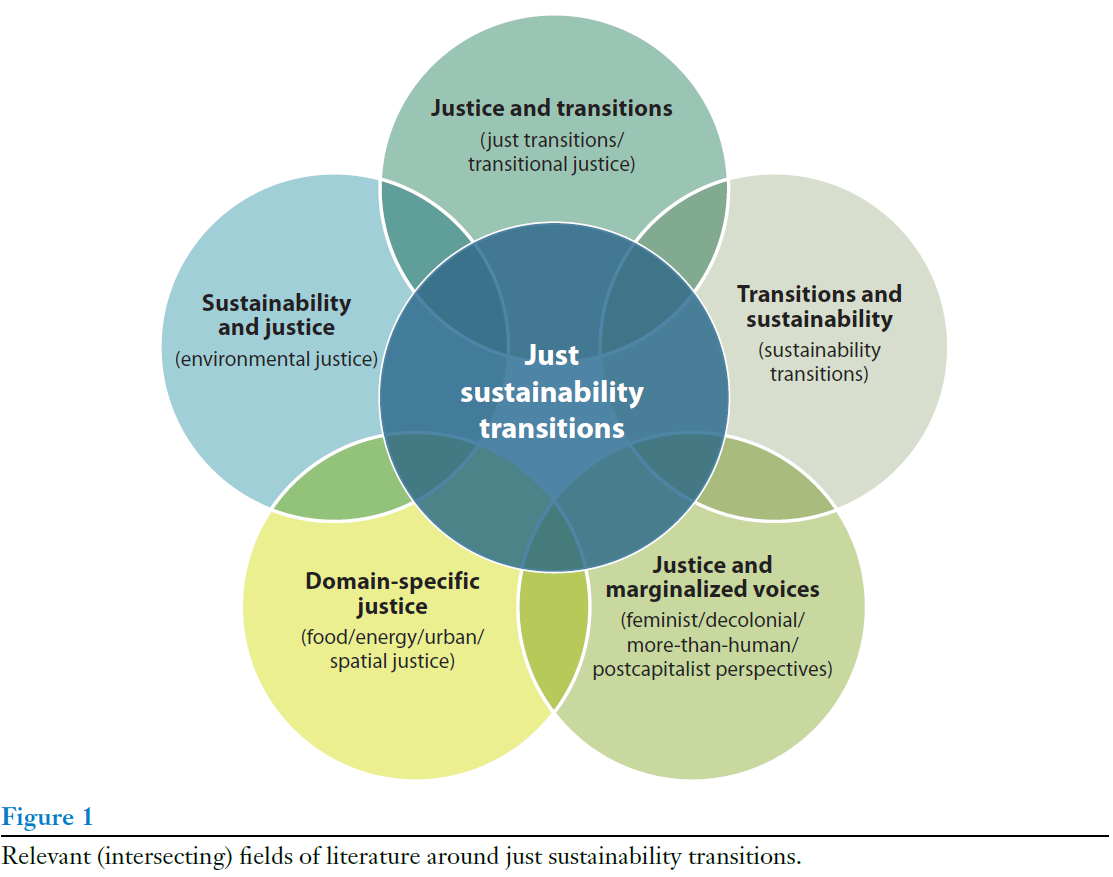
Three orthogonal lenses apply here.8 All extend across the species boundary, which the same work identifies as a blind spot but does not develop.
| Lens | Original formulation | Extension to more-than-human collectives |
|---|---|---|
| Politics | Who gets what, when and why; who is involved in decision-making; who is recognised as mattering, and when and why such recognition occurs | Recognition is the operative question: which beings count as parties rather than as conditions. Nonhuman politics includes refusal, non-compliance and resistance to human ordering, which is political action without representation40 |
| Power | "The (in)capacity of actors to mobilize other actors, resources, and/or institutions to achieve outcomes", distinguished as power to, power over, power with | Nonhumans hold substantial power to (ecosystem engineering literally mobilises resources and reorganises other actors) and power with (symbiosis, mutualism, facilitation), and almost no power over within human institutions. That asymmetry, not an absence of power, is the design problem19, 20 |
| Prefiguration | How, where and with whom future alternatives on justice and sustainability are imagined, embodied and practised | More-than-human collectives that already work otherwise are prefigurative sites: old-growth remnants, feral and abandoned ground, Country under Indigenous management, agroecological farms as more-than-human political communities41, 42 |
Cf. Power, Justice, Inclusion (Private), Ladder, Indigenous.
Critiques and Failure Modes
- Transformation as metaphor. If the material arrangements are untouched, transformation talk substitutes for the ruptural dismantling it claims to describe. Critique of epistemology is not a substitute for changing property, land and infrastructure.43
- Elite realignment. Growing enthusiasm for transdisciplinarity and transformation can realign elite power bases by co-opting language while subsuming radical innovation into existing patterns.6
- Epistemic inequity in assessments. Global assessments of transformative change reproduce the epistemic hierarchies they name, in language, in evidence standards, and in whose knowledge counts as assessable.44
- Anthropocentric residue. Naming human–nature relationships as a principle does not by itself displace humans as the sole agents of change; nonhuman participation remains largely representational.45, 46
- Directionality is not given. Transformation is a formal property of a system, not a value. Collapse, extinction debt and umwelt loss are transformations.5 Reversal can also be structural rather than accidental, where the configuration that suited expansion becomes untenable once expansion stops.58
- Baselines foreclose. A restoration target drawn from an imagined pristine state can remove the practices that sustained the system, so the protective intent produces the vulnerability.57 Ask what the baseline forbids before asking what it protects.
- Resilience–transformation confusion. Resilience frameworks can protect the regime that needs changing, and can shift the burden of absorbing shock onto those with the least capacity.47, 48, 49
- Latency and rigidity traps. Path-dependent systems generate increasing returns, discourses and entrepreneurial interests that lock in configurations and make transformation appear impossible rather than merely expensive.3
- Conceptual vagueness. Transformation is subjective and relative; users must be explicit about from what and to what, at which level, and on whose account.6
- Hijacking. Modular, controllable setpoints sitting above robust components make goal-rewriting an efficient design lever, and the same property makes collectives exploitable. The biological literature identifies parasites and cheaters as the expected users of it.53 Domestication, plantation forestry, lawn and biocontrol are all setpoint rewrites of more-than-human collectives, executed without consent and mostly to a single party's benefit. Check any design method built on retargeting against the deliberative integrity criteria in Measuring Design-Pathway Transformation rather than justifying it by its efficiency. Cf. Power.
- Agency inflation. If goal-directedness runs continuously from bowling balls upward, "agency" stops discriminating and cannot by itself carry the argument that particular nonhumans deserve recognition as parties.52 The framework is explicit that goal attribution is observer-relative and pragmatic, which is honest, but it means the recognition question in Justice and Ladder still has to be settled on other grounds. Treating diverse-intelligence work as if it resolved that question would be a category error. Cf. Intelligence on intelligence as an estimate made by an observer.
- Scale transfer is unproven. The multiscale competency and setpoint literature is grounded in cells, tissues and organisms. Its extension to ecological and institutional collectives is a hypothesis-generating analogy. The framework is also contested within its own field, and this note should not lean on it as settled.
Implications for More-than-Human Design
- State the level. Every transformation claim should specify the level that changed, the levels that held, and the coupling between them. Unspecified claims are unfalsifiable.
- Target constraints and feedbacks, not states. A designed state that is not self-maintaining reverts. Ask what would hold the new configuration once attention moves on.
- Design for inheritance. Niche construction and legacy structures are the mechanisms that carry change across generations. Substrate, soil, deadwood, hollows and old individuals do more transformative work than most interventions in fast variables.
- Site the engineers. Where a nonhuman ecosystem engineer can do the reorganising, the design task is enabling and protecting it rather than performing the reorganisation. Accept that outcomes will be weird relative to the brief.20
- Treat small irreversible decisions as high-leverage. Retention decisions about slow, hard-to-replace elements are inflection points even when they score low on depth, breadth and speed.
- Set targets, not blueprints, where competency is high. A collective with the capacity to reach a goal by many routes will do the assembly itself. Specify what it should be working towards and leave the means to it; conversely, where competency is low, retargeting achieves nothing and the parts must be managed directly.
- Expect competence to resist you. A failed intervention in a living collective is more often evidence of a conserved target than of insufficient effort. Diagnose the target before increasing the dose.
- Withdraw and check whether it holds. The test of a transformation is regeneration after perturbation without further input. Build a withdrawal-and-perturbation check into project evaluation rather than reporting on the state at handover.
- Ask whether the intervention enlarged or shrank the collective's light cone. Did it extend the spatial and temporal scope of what the collective can pursue and maintain, or narrow it? This is orthogonal to depth, breadth and speed, and it is often the thing that matters over long horizons.
- Instrument thresholds. Where regimes flip at thresholds, the threshold is the observable event. Build monitoring around threshold proximity rather than around aggregate condition.
- Design revolt and remember channels. Provide routes by which fast small-scale nonhuman signals can reach slow institutional levels, and by which slow structures survive fast disturbance.
- Keep the option set open. Under deep uncertainty, preserve reversibility and adjacency rather than optimising toward a specified end state. Cf. Uncertainty.
- Run the integrity check on nonhuman-led claims. Legibility, contestability, reversibility, non-coercion, temporal fit and accountability, as specified in Measuring Design-Pathway Transformation.
- Locate prefigurative sites and protect them. Collectives already working otherwise are more informative than designed pilots, and they are usually unprotected.
- State the politics. Ask who gets what, who is recognised, and who bears the cost of the transition. Ask it across species as well as within the human polity.45, 50
Open Questions
- Can an inflection point be identified prospectively with any reliability, or is the irreversibility ledger the only defensible prospective instrument?
- How should transformation be attributed when the transforming agent is nonhuman and the recording institution is human? Cf. Leadership.
- What is the more-than-human analogue of "views" in the IPBES triad? Umwelten, preferences, and learned repertoires are candidates, and each has a different evidentiary standard.
- Does level creation (a new self-maintaining unit composed of formerly independent parties) offer a defensible normative target for design, and how would it be distinguished from enclosure or capture?
- How do the criteria change when the timescales of the participating beings differ by orders of magnitude? Cf. Temporal.
- What does transformation mean where the desirable regime is not novel but historical, as in restoration and rewilding? Cf. Restoration and Rewilding.
- Do ecological and institutional collectives hold represented targets, or only attractors without representation? Retargeting as a design method presupposes the former, and the question is currently open.
- Can the cognitive light cone be operationalised above the organism, or does it remain a comparative schematic? If it can, it is the strongest candidate for a criterion that is neither anthropocentric nor size-based.
- Where a collective's competency is used against it, as in domestication and plantation, what distinguishes legitimate retargeting from hijacking? Consent is unavailable, so the criterion has to be built from something else.
Resources
Transformative change: the best chance for biodiversity?
Bibliography
Abson, David J., Joern Fischer, Julia Leventon, Jens Newig, Thomas Schomerus, Ulli Vilsmaier, Henrik von Wehrden, et al. "Leverage Points for Sustainability Transformation." Ambio 46, no. 1 (2017): 30–39. https://doi.org/10.1007/s13280-016-0800-y.
Avelino, Flor, Katinka Wijsman, Frank van Steenbergen, Shivant Jhagroe, Julia Wittmayer, Sanne Akerboom, Kristina Bogner, Esther F. Jansen, Niki Frantzeskaki, and Agni Kalfagianni. "Just Sustainability Transitions: Politics, Power, and Prefiguration in Transformative Change toward Justice and Sustainability." Annual Review of Environment and Resources 49, no. 2024 (2024): 519–47. https://doi.org/10/g9g7kf.
Barrett, M. J., Matthew Harmin, Bryan Maracle, Molly Patterson, Christina Thomson, Michelle Flowers, and Kirk Bors. "Shifting Relations with the More-than-Human: Six Threshold Concepts for Transformative Sustainability Learning." Environmental Education Research 23, no. 1 (2017): 131–43. https://doi.org/10.1080/13504622.2015.1121378.
Bennett, Elena M., Martin Solan, Reinette Biggs, Timon McPhearson, Albert V. Norström, Per Olsson, Laura Pereira, et al. "Bright Spots: Seeds of a Good Anthropocene." Frontiers in Ecology and the Environment 14, no. 8 (2016): 441–48. https://doi.org/10.1002/fee.1309.
Bennett, Elena, Reinette Biggs, Rafael Calderón-Contreras, Sevil Acar, Zühre Aksoy, Francisco Alpizar, David Lam, et al. IPBES Transformative Change Assessment: Chapter 3. How Transformative Change Occurs. Bonn: Intergovernmental Science-Policy Platform on Biodiversity and Ecosystem Services (IPBES) Secretariat, 2025.
Bluwstein, Jevgeniy. "Transformation Is Not a Metaphor." Political Geography 90 (2021): 102450. https://doi.org/10.1016/j.polgeo.2021.102450.
Bresnihan, Patrick. "The More-than-Human Commons: From Commons to Commoning." In Space, Power and the Commons, edited by Samuel Kirwan, Leila Dawney, and Julian Brigstocke, 93–112. Abingdon: Routledge, 2016.
Brozović, Danilo. "Societal Collapse: A Literature Review." Futures 145 (2023): 103075. https://doi.org/10/grc252.
Celermajer, Danielle, Anthony Burke, Stefanie Fishel, Erin Fitz-Henry, Nicole Rogers, David Schlosberg, and Christine Winter. Institutionalising Multispecies Justice. Cambridge: Cambridge University Press, 2025.
Chan, Kai M. A., David R. Boyd, Rachelle K. Gould, Jens Jetzkowitz, Jianguo Liu, Barbara Muraca, Robin Naidoo, et al. "Levers and Leverage Points for Pathways to Sustainability." People and Nature 2, no. 3 (2020): 693–717. https://doi.org/10.1002/pan3.10124.
Cloke, Paul, and Owain Jones. "Turning in the Graveyard: Trees and the Hybrid Geographies of Dwelling, Monitoring and Resistance in a Bristol Cemetery." Cultural Geographies 11, no. 3 (2004): 313–41. https://doi.org/10/cvzrxd.
Dijk, Jiska van, Juliette Young, Marie Vandewalle, Allan Watt, and Karla Locher. "Transformative Change for Biodiversity Requires More Inclusive and Participatory Framing of Research Agendas." Biodiversity and Conservation 32, no. 11 (2023): 3669–79. https://doi.org/10/gwkn56.
Donaldson, Jonan Phillip. “Why We Stay Stuck: A Complex Conceptual Systems Theory for Wicked Problems.” Systems 14, no. 4 (2026): 431. https://doi.org/10.3390/systems14040431.
Eckersley, Robyn. "Greening States and Societies: From Transitions to Great Transformations." In Trajectories in Environmental Politics, edited by Graeme Hayes, Sikina Jinnah, Prakash Kashwan, David M. Konisky, Sherilyn Macgregor, John M. Meyer, and Anthony R. Zito. New York: Routledge, 2022.
Edelblutte, Émilie, Roopa Krithivasan, and Matthew Nassif Hayek. “Animal Agency in Wildlife Conservation and Management.” Conservation Biology 37, no. 1 (2023): e13853. https://doi.org/10.1111/cobi.13853.
Erwin, Douglas H. "The Topology of Evolutionary Novelty and Innovation in Macroevolution." Philosophical Transactions of the Royal Society B: Biological Sciences 372, no. 1735 (2017): 20160422. https://doi.org/10.1098/rstb.2016.0422.
Fazey, Ioan, Peter Moug, Simon Allen, Kate Beckmann, David Blackwood, Mike Bonaventura, Kathryn Burnett, et al. "Transformation in a Changing Climate: A Research Agenda." Climate and Development 10, no. 3 (2018): 197–217. https://doi.org/10/gmhmmj.
Folke, Carl, Steve Carpenter, Brian Walker, Marten Scheffer, Thomas Elmqvist, Lance Gunderson, and C. S. Holling. "Regime Shifts, Resilience, and Biodiversity in Ecosystem Management." Annual Review of Ecology, Evolution, and Systematics 35 (2004): 557–81. https://doi.org/10.1146/annurev.ecolsys.35.021103.105711.
Franks, Nigel R., Anna Dornhaus, Jon P. Fitzsimmons, and Martin Stevens. "Speed versus Accuracy in Collective Decision Making." Proceedings of the Royal Society B: Biological Sciences 270, no. 1532 (2003): 2457–63. https://doi.org/10/fqxzpc.
Geels, Frank W. "Technological Transitions as Evolutionary Reconfiguration Processes: A Multi-Level Perspective and a Case-Study." Research Policy 31, nos. 8–9 (2002): 1257–74. https://doi.org/10.1016/S0048-7333(02)00062-8.
Ghosh, Bipashyee, Paula Kivimaa, Matias Ramirez, Johan Schot, and Jonas Torrens. "Transformative Outcomes: Assessing and Reorienting Experimentation with Transformative Innovation Policy." Science and Public Policy 48, no. 5 (2021): 739–56. https://doi.org/10.1093/scipol/scab045.
Gilbert, Scott F. "Evolutionary Transitions Revisited: Holobiont Evo-Devo." Journal of Experimental Zoology Part B: Molecular and Developmental Evolution 332, no. 8 (2019): 307–14. https://doi.org/10.1002/jez.b.22903.
Goldstein, Jenny E., Benjamin Neimark, Brian Garvey, and Jacob Phelps. "Unlocking 'Lock-in' and Path Dependency: A Review across Disciplines and Socio-Environmental Contexts." World Development 161 (2023): 106116. https://doi.org/10/g83j86.
Gordon, Bonnie J., and Stanislav Roudavski. "More-than-Human Infrastructure for Just Resilience: Learning from, Working with, and Designing for Bald Cypress Trees (Taxodium distichum) in the Mississippi River Delta." Global Environment 14, no. 3 (2021): 442–74. https://doi.org/10/gmxbh2.
Gunderson, Lance H., and C. S. Holling, eds. Panarchy: Understanding Transformations in Human and Natural Systems. Washington, DC: Island Press, 2002.
Herrmann-Pillath, Carsten. "The Earth's Living Infrastructure: Multispecies Niche Construction in the Gaian cité." In Cross-Disciplinary Dialogues with the Earth Sciences, edited by Martin Bohle and Cornelia E. Nauen, 187–213. Cham: Springer, 2025. https://doi.org/10.1007/978-3-031-97445-8_7.
Holling, C. S. "Resilience and Stability of Ecological Systems." Annual Review of Ecology and Systematics 4 (1973): 1–23. https://doi.org/10/bctp75.
Jentsch, Anke, and Peter White. "A Theory of Pulse Dynamics and Disturbance in Ecology." Ecology 100, no. 7 (2019): e02734. https://doi.org/10/gfz58m.
Jones, Clive G., John H. Lawton, and Moshe Shachak. "Organisms as Ecosystem Engineers." Oikos 69, no. 3 (1994): 373–86. https://doi.org/10.2307/3545850.
Laland, Kevin N., John Odling-Smee, and Marcus W. Feldman. "Niche Construction, Biological Evolution, and Cultural Change." The Behavioral and Brain Sciences 23, no. 1 (2000): 131–46. https://doi.org/10/c58hwb.
Lawrence, Michael, Thomas Homer-Dixon, Scott Janzwood, Johan Rockström, Ortwin Renn, and Jonathan F. Donges. "Global Polycrisis: The Causal Mechanisms of Crisis Entanglement." Global Sustainability 7 (2024): e6. https://doi.org/10/g8r3pb.
Levin, Michael. "Technological Approach to Mind Everywhere: An Experimentally-Grounded Framework for Understanding Diverse Bodies and Minds." Frontiers in Systems Neuroscience 16 (2022): 768201. https://doi.org/10.3389/fnsys.2022.768201.
Levin, Michael. "Darwin's Agential Materials: Evolutionary Implications of Multiscale Competency in Developmental Biology." Cellular and Molecular Life Sciences 80, no. 6 (2023): 142. https://doi.org/10.1007/s00018-023-04790-z.
Lyon, Pamela, Fred Keijzer, Detlev Arendt, and Michael Levin. "Reframing Cognition: Getting down to Biological Basics." Philosophical Transactions of the Royal Society B: Biological Sciences 376, no. 1820 (2021): 20190750. https://doi.org/10.1098/rstb.2019.0750.
Leventon, Julia, David J. Abson, and Daniel J. Lang. "Leverage Points for Sustainability Transformations: Nine Guiding Questions for Sustainability Science and Practice." Sustainability Science 16, no. 3 (2021): 721–26. https://doi.org/10.1007/s11625-021-00961-8.
Linnér, Björn-Ola, and Victoria Wibeck. Sustainability Transformations: Agents and Drivers across Societies. Cambridge: Cambridge University Press, 2019.
Longo, Giuseppe. "How Future Depends on Past and Rare Events in Systems of Life." Foundations of Science 23, no. 3 (2018): 443–74. https://doi.org/10/g8q6q7.
Lorimer, Jamie. "Worlding and Weirding with Beaver: A More-than-Human Political Ecology of Ecosystem Engineering." Transactions of the Institute of British Geographers 50 (2025): e12698. https://doi.org/10.1111/tran.12698.
MacKinnon, Danny, and Kate Driscoll Derickson. "From Resilience to Resourcefulness: A Critique of Resilience Policy and Activism." Progress in Human Geography 37, no. 2 (2013): 253–70. https://doi.org/10/f42csq.
Malkov, Sergey, Leonid Grinin, Anton Grinin, Jameelah Musieva, and Andrey Korotayev. “Modeling Social Self-Organization and Historical Dynamics: Global Phase Transitions.” In Reconsidering the Limits to Growth: A Report to the Russian Association of the Club of Rome, edited by Viktor Sadovnichy, Askar Akaev, Ilya Ilyin, Sergey Malkov, Leonid Grinin, and Andrey Korotayev, 387–417. Cham: Springer, 2023. https://doi.org/10.1007/978-3-031-34999-7_18.
Maran, Timo. "Umwelt Collapse: The Loss of Umwelt-Ecosystem Integration." Biosemiotics 16, no. 3 (2023): 479–87. https://doi.org/10.1007/s12304-023-09545-8.
Margulis, Lynn, and Dorion Sagan. Slanted Truths: Essays on Gaia, Symbiosis and Evolution. New York: Springer, 1997.
Massarella, Kate, Anja Nygren, Robert Fletcher, Bram Büscher, Wilhelm A. Kiwango, Sanna Komi, Judith E. Krauss, et al. "Transformation beyond Conservation: How Critical Social Science Can Contribute to a Radical New Agenda in Biodiversity Conservation." Current Opinion in Environmental Sustainability 49 (2021): 79–87. https://doi.org/10.1016/j.cosust.2021.03.005.
Maynard Smith, John, and Eörs Szathmáry. The Major Transitions in Evolution. Oxford: Oxford University Press, 1995.
McMillen, Patrick, and Michael Levin. "Collective Intelligence: A Unifying Concept for Integrating Biology across Scales and Substrates." Communications Biology 7, no. 1 (2024): 378. https://doi.org/10.1038/s42003-024-06037-4.
Meadows, Donella H. Thinking in Systems: A Primer. Edited by Diana Wright. White River Junction: Chelsea Green, 2008.
Meerow, Sara, and Joshua P. Newell. "Urban Resilience for Whom, What, When, Where, and Why?" Urban Geography 40, no. 3 (2019): 309–29. https://doi.org/10/gfpgfg.
Méndez, Pablo, Jaime Amezaga, and Luis Santamaría. "Explaining Path-Dependent Rigidity Traps: Increasing Returns, Power, Discourses, and Entrepreneurship Intertwined in Social-Ecological Systems." Ecology and Society 24, no. 2 (2019). https://doi.org/10/gkshvh.
Molas-Gallart, Jordi, Alejandra Boni, Sandro Giachi, and Johan Schot. "A Formative Approach to the Evaluation of Transformative Innovation Policies." Research Evaluation 30, no. 4 (2021): 431–42. https://doi.org/10.1093/reseval/rvab016.
Nelson, Valerie, and Scottish Government. Environment Strategy for Scotland: Transformative Changes for Sustainability. Edinburgh: Scottish Government, 2025.
O'Brien, Karen, Lucas Garibaldi, Arun Agrawal, Elena Bennett, Reinette Biggs, Rafael Calderón Contreras, Edward R. Carr, et al. Transformative Change Assessment: Summary for Policymakers. IPBES/11/12/Add.2. Bonn: Intergovernmental Science-Policy Platform on Biodiversity and Ecosystem Services (IPBES) Secretariat, 2025.
Odling-Smee, F. John, Kevin N. Laland, and Marcus W. Feldman. Niche Construction: The Neglected Process in Evolution. Princeton: Princeton University Press, 2003.
Otto, Ilona M., Jonathan F. Donges, Roger Cremades, Avit Bhowmik, Richard J. Hewitt, Wolfgang Lucht, Johan Rockström, et al. "Social Tipping Dynamics for Stabilizing Earth's Climate by 2050." Proceedings of the National Academy of Sciences 117, no. 5 (2020): 2354–65. https://doi.org/10.1073/pnas.1900577117.
Rockström, Johan, Louis Kotzé, Svetlana Milutinović, Frank Biermann, Victor Brovkin, Jonathan Donges, Jonas Ebbesson, et al. "The Planetary Commons: A New Paradigm for Safeguarding Earth-Regulating Systems in the Anthropocene." Proceedings of the National Academy of Sciences 121, no. 5 (2024): e2301531121. https://doi.org/10/gtfk3h.
Roudavski, Stanislav. “The Ladder of More-than-Human Participation: A Framework for Inclusive Design.” Cultural Science 14, no. 1 (2024): 110–19. https://doi.org/10.2478/csj-2024-0015.
Roudavski, Stanislav, and Douglas Brock. “From Dingoes to AI: Who Makes Decisions in More-than-Human Worlds?” TRACE ∴ Journal for Human-Animal Studies 11 (2025): 56–96. https://doi.org/10.23984/fjhas.145720.
Roudavski, Stanislav, and Alexander Holland. “Are You Blocking Nonhuman Leadership? Five Questions to Find Out.” PDC ’26: Proceedings of the 19th Participatory Design Conference (New York) 2 (2026): 372–81. https://doi.org/10.1145/3789492.3796416.
Schot, Johan, and Frank W. Geels. "Niches in Evolutionary Theories of Technical Change." Journal of Evolutionary Economics 17, no. 5 (2007): 605–22. https://doi.org/10.1007/s00191-007-0057-5.
Seeley, Thomas D. Honeybee Democracy. Princeton: Princeton University Press, 2010.
Sharpe, Bill, Anthony Hodgson, Graham Leicester, Andrew Lyon, and Ioan Fazey. "Three Horizons: A Pathways Practice for Transformation." Ecology and Society 21, no. 2 (2016). https://doi.org/10/gf636k.
Smessaert, Jacob, and Giuseppe Feola. "On the Practices of Autonomous More-than-Human Political Communities." Journal of Political Ecology 32 (2025).
Souza, Daniele Tubino de, Lena Hommes, Arjen Wals, Jaime Hoogesteger, Rutgerd Boelens, Bibiana Duarte-Abadía, Juan Pablo Hidalgo-Bastidas, et al. "River Co-Learning Arenas: Principles and Practices for Transdisciplinary Knowledge Co-Creation and Multi-Scalar (Inter)Action." Local Environment 30, no. 1 (2025): 58–80. https://doi.org/10.1080/13549839.2024.2428215.
Tschakert, Petra, David Schlosberg, Danielle Celermajer, Lauren Rickards, Christine Winter, Mathias Thaler, Makere Stewart-Harawira, and Blanche Verlie. "Multispecies Justice: Climate-Just Futures with, for and beyond Humans." WIREs Climate Change 12, no. 2 (2021): e699. https://doi.org/10/ghq9vw.
Turnhout, Esther, Peter Bridgewater, Josephine Chambers, Tim Forsyth, Qingxu Huang, Julia Leventon, Björn-Ola Linnér, et al. "Knowing and Unknowing Transformative Change: Epistemic Inequities and Epistemic Justice in the IPBES Transformative Change Assessment." Environmental Science and Policy 182 (2026): 104434. https://doi.org/10.1016/j.envsci.2026.104434.
Visseren-Hamakers, Ingrid J., Jona Razzaque, Pamela McElwee, Esther Turnhout, Eszter Kelemen, Graciela M. Rusch, Álvaro Fernández-Llamazares, et al. "Transformative Governance of Biodiversity: Insights for Sustainable Development." Current Opinion in Environmental Sustainability 53 (2021): 20–28. https://doi.org/10/gkx8t5.
Walker, Brian, Crawford S. Holling, Stephen Carpenter, and Ann Kinzig. "Resilience, Adaptability and Transformability in Social–Ecological Systems." Ecology and Society 9, no. 2 (2004): 1–9. https://doi.org/10.5751/es-00650-090205.
Walls, Matthew, and Petr Pokorný. "Cybernetics in the Anthropocene’s Wake: Reframing Global Transformations through the Emergent Human–Earth System." Complexity 2026, no. 1 (2026): 7539869. https://doi.org/10.1155/cplx/7539869.
Waters, Christopher M., and Bonnie L. Bassler. "Quorum Sensing: Cell-to-Cell Communication in Bacteria." Annual Review of Cell and Developmental Biology 21, no. 2005 (2005): 319–46. https://doi.org/10.1146/annurev.cellbio.21.012704.131001.
Wyborn, Carina, Federico Davila, Laura Pereira, Michelle Lim, Isis Alvarez, Gretchen Henderson, Amy Luers, et al. "Imagining Transformative Biodiversity Futures." Nature Sustainability 3, no. 9 (2020): 670–72. https://doi.org/10/gh8p4f.
Notes
Subnotes
Footnotes
Gunderson, Lance H., and C. S. Holling, eds. Panarchy: Understanding Transformations in Human and Natural Systems. Washington, DC: Island Press, 2002.˄
Goldstein, Jenny E., Benjamin Neimark, Brian Garvey, and Jacob Phelps. "Unlocking 'Lock-in' and Path Dependency: A Review across Disciplines and Socio-Environmental Contexts." World Development 161 (2023): 106116. https://doi.org/10/g83j86.˄
Méndez, Pablo, Jaime Amezaga, and Luis Santamaría. "Explaining Path-Dependent Rigidity Traps: Increasing Returns, Power, Discourses, and Entrepreneurship Intertwined in Social-Ecological Systems." Ecology and Society 24, no. 2 (2019). https://doi.org/10/gkshvh.˄
Folke, Carl, Steve Carpenter, Brian Walker, Marten Scheffer, Thomas Elmqvist, Lance Gunderson, and C. S. Holling. "Regime Shifts, Resilience, and Biodiversity in Ecosystem Management." Annual Review of Ecology, Evolution, and Systematics 35 (2004): 557–81. https://doi.org/10.1146/annurev.ecolsys.35.021103.105711.˄
Holling, C. S. "Resilience and Stability of Ecological Systems." Annual Review of Ecology and Systematics 4 (1973): 1–23. https://doi.org/10/bctp75.˄
Walker, Brian, Crawford S. Holling, Stephen Carpenter, and Ann Kinzig. "Resilience, Adaptability and Transformability in Social–Ecological Systems." Ecology and Society 9, no. 2 (2004): 1–9. https://doi.org/10.5751/es-00650-090205.˄
Levin, Michael. "Technological Approach to Mind Everywhere: An Experimentally-Grounded Framework for Understanding Diverse Bodies and Minds." Frontiers in Systems Neuroscience 16 (2022): 768201. https://doi.org/10.3389/fnsys.2022.768201.˄
Lyon, Pamela, Fred Keijzer, Detlev Arendt, and Michael Levin. "Reframing Cognition: Getting down to Biological Basics." Philosophical Transactions of the Royal Society B: Biological Sciences 376, no. 1820 (2021): 20190750. https://doi.org/10.1098/rstb.2019.0750.˄
Levin, Michael. "Darwin's Agential Materials: Evolutionary Implications of Multiscale Competency in Developmental Biology." Cellular and Molecular Life Sciences 80, no. 6 (2023): 142. https://doi.org/10.1007/s00018-023-04790-z.˄
McMillen, Patrick, and Michael Levin. "Collective Intelligence: A Unifying Concept for Integrating Biology across Scales and Substrates." Communications Biology 7, no. 1 (2024): 378. https://doi.org/10.1038/s42003-024-06037-4.˄
Brozović, Danilo. "Societal Collapse: A Literature Review." Futures 145 (2023): 103075. https://doi.org/10/grc252.˄
Maran, Timo. "Umwelt Collapse: The Loss of Umwelt-Ecosystem Integration." Biosemiotics 16, no. 3 (2023): 479–87. https://doi.org/10.1007/s12304-023-09545-8.˄
Fazey, Ioan, Peter Moug, Simon Allen, Kate Beckmann, David Blackwood, Mike Bonaventura, Kathryn Burnett, et al. "Transformation in a Changing Climate: A Research Agenda." Climate and Development 10, no. 3 (2018): 197–217. https://doi.org/10/gmhmmj.˄
O'Brien, Karen, Lucas Garibaldi, Arun Agrawal, Elena Bennett, Reinette Biggs, Rafael Calderón Contreras, Edward R. Carr, et al. Transformative Change Assessment: Summary for Policymakers. IPBES/11/12/Add.2. Bonn: Intergovernmental Science-Policy Platform on Biodiversity and Ecosystem Services (IPBES) Secretariat, 2025.˄
Avelino, Flor, Katinka Wijsman, Frank van Steenbergen, Shivant Jhagroe, Julia Wittmayer, Sanne Akerboom, Kristina Bogner, Esther F. Jansen, Niki Frantzeskaki, and Agni Kalfagianni. "Just Sustainability Transitions: Politics, Power, and Prefiguration in Transformative Change toward Justice and Sustainability." Annual Review of Environment and Resources 49, no. 2024 (2024): 519–47. https://doi.org/10/g9g7kf.˄
Linnér, Björn-Ola, and Victoria Wibeck. Sustainability Transformations: Agents and Drivers across Societies. Cambridge: Cambridge University Press, 2019.˄
Eckersley, Robyn. "Greening States and Societies: From Transitions to Great Transformations." In Trajectories in Environmental Politics, edited by Graeme Hayes, Sikina Jinnah, Prakash Kashwan, David M. Konisky, Sherilyn Macgregor, John M. Meyer, and Anthony R. Zito. New York: Routledge, 2022.˄
Dijk, Jiska van, Juliette Young, Marie Vandewalle, Allan Watt, and Karla Locher. "Transformative Change for Biodiversity Requires More Inclusive and Participatory Framing of Research Agendas." Biodiversity and Conservation 32, no. 11 (2023): 3669–79. https://doi.org/10/gwkn56.˄
Bennett, Elena, Reinette Biggs, Rafael Calderón-Contreras, Sevil Acar, Zühre Aksoy, Francisco Alpizar, David Lam, et al. IPBES Transformative Change Assessment: Chapter 3. How Transformative Change Occurs. Bonn: Intergovernmental Science-Policy Platform on Biodiversity and Ecosystem Services (IPBES) Secretariat, 2025.˄
Maynard Smith, John, and Eörs Szathmáry. The Major Transitions in Evolution. Oxford: Oxford University Press, 1995.˄
Gilbert, Scott F. "Evolutionary Transitions Revisited: Holobiont Evo-Devo." Journal of Experimental Zoology Part B: Molecular and Developmental Evolution 332, no. 8 (2019): 307–14. https://doi.org/10.1002/jez.b.22903.˄
Laland, Kevin N., John Odling-Smee, and Marcus W. Feldman. "Niche Construction, Biological Evolution, and Cultural Change." The Behavioral and Brain Sciences 23, no. 1 (2000): 131–46. https://doi.org/10/c58hwb.˄
Odling-Smee, F. John, Kevin N. Laland, and Marcus W. Feldman. Niche Construction: The Neglected Process in Evolution. Princeton: Princeton University Press, 2003.˄
Jones, Clive G., John H. Lawton, and Moshe Shachak. "Organisms as Ecosystem Engineers." Oikos 69, no. 3 (1994): 373–86. https://doi.org/10.2307/3545850.˄
Lorimer, Jamie. "Worlding and Weirding with Beaver: A More-than-Human Political Ecology of Ecosystem Engineering." Transactions of the Institute of British Geographers 50 (2025): e12698. https://doi.org/10.1111/tran.12698.˄
Donaldson, Jonan Phillip. "Why We Stay Stuck: A Complex Conceptual Systems Theory for Wicked Problems." Systems 14, no. 4 (2026): 431. https://doi.org/10.3390/systems14040431.˄
Visseren-Hamakers, Ingrid J., Jona Razzaque, Pamela McElwee, Esther Turnhout, Eszter Kelemen, Graciela M. Rusch, Álvaro Fernández-Llamazares, et al. "Transformative Governance of Biodiversity: Insights for Sustainable Development." Current Opinion in Environmental Sustainability 53 (2021): 20–28. https://doi.org/10/gkx8t5.˄
Waters, Christopher M., and Bonnie L. Bassler. "Quorum Sensing: Cell-to-Cell Communication in Bacteria." Annual Review of Cell and Developmental Biology 21, no. 2005 (2005): 319–46. https://doi.org/10.1146/annurev.cellbio.21.012704.131001.˄
Seeley, Thomas D. Honeybee Democracy. Princeton: Princeton University Press, 2010.˄
Franks, Nigel R., Anna Dornhaus, Jon P. Fitzsimmons, and Martin Stevens. "Speed versus Accuracy in Collective Decision Making." Proceedings of the Royal Society B: Biological Sciences 270, no. 1532 (2003): 2457–63. https://doi.org/10/fqxzpc.˄
Jentsch, Anke, and Peter White. "A Theory of Pulse Dynamics and Disturbance in Ecology." Ecology 100, no. 7 (2019): e02734. https://doi.org/10/gfz58m.˄
Otto, Ilona M., Jonathan F. Donges, Roger Cremades, Avit Bhowmik, Richard J. Hewitt, Wolfgang Lucht, Johan Rockström, et al. "Social Tipping Dynamics for Stabilizing Earth's Climate by 2050." Proceedings of the National Academy of Sciences 117, no. 5 (2020): 2354–65. https://doi.org/10.1073/pnas.1900577117.˄
Walls, Matthew, and Petr Pokorný. "Cybernetics in the Anthropocene's Wake: Reframing Global Transformations through the Emergent Human–Earth System." Complexity 2026, no. 1 (2026): 7539869. https://doi.org/10.1155/cplx/7539869.˄
Meadows, Donella H. Thinking in Systems: A Primer. Edited by Diana Wright. White River Junction: Chelsea Green, 2008.˄
Abson, David J., Joern Fischer, Julia Leventon, Jens Newig, Thomas Schomerus, Ulli Vilsmaier, Henrik von Wehrden, et al. "Leverage Points for Sustainability Transformation." Ambio 46, no. 1 (2017): 30–39. https://doi.org/10.1007/s13280-016-0800-y.˄
Chan, Kai M. A., David R. Boyd, Rachelle K. Gould, Jens Jetzkowitz, Jianguo Liu, Barbara Muraca, Robin Naidoo, et al. "Levers and Leverage Points for Pathways to Sustainability." People and Nature 2, no. 3 (2020): 693–717. https://doi.org/10.1002/pan3.10124.˄
Geels, Frank W. "Technological Transitions as Evolutionary Reconfiguration Processes: A Multi-Level Perspective and a Case-Study." Research Policy 31, nos. 8–9 (2002): 1257–74. https://doi.org/10.1016/S0048-7333(02)00062-8.˄
Schot, Johan, and Frank W. Geels. "Niches in Evolutionary Theories of Technical Change." Journal of Evolutionary Economics 17, no. 5 (2007): 605–22. https://doi.org/10.1007/s00191-007-0057-5.˄
Sharpe, Bill, Anthony Hodgson, Graham Leicester, Andrew Lyon, and Ioan Fazey. "Three Horizons: A Pathways Practice for Transformation." Ecology and Society 21, no. 2 (2016). https://doi.org/10/gf636k.˄
Ghosh, Bipashyee, Paula Kivimaa, Matias Ramirez, Johan Schot, and Jonas Torrens. "Transformative Outcomes: Assessing and Reorienting Experimentation with Transformative Innovation Policy." Science and Public Policy 48, no. 5 (2021): 739–56. https://doi.org/10.1093/scipol/scab045.˄
Molas-Gallart, Jordi, Alejandra Boni, Sandro Giachi, and Johan Schot. "A Formative Approach to the Evaluation of Transformative Innovation Policies." Research Evaluation 30, no. 4 (2021): 431–42. https://doi.org/10.1093/reseval/rvab016.˄
Bennett, Elena M., Martin Solan, Reinette Biggs, Timon McPhearson, Albert V. Norström, Per Olsson, Laura Pereira, et al. "Bright Spots: Seeds of a Good Anthropocene." Frontiers in Ecology and the Environment 14, no. 8 (2016): 441–48. https://doi.org/10.1002/fee.1309.˄
Nelson, Valerie, and Scottish Government. Environment Strategy for Scotland: Transformative Changes for Sustainability. Edinburgh: Scottish Government, 2025.˄
Longo, Giuseppe. "How Future Depends on Past and Rare Events in Systems of Life." Foundations of Science 23, no. 3 (2018): 443–74. https://doi.org/10/g8q6q7.˄
Erwin, Douglas H. "The Topology of Evolutionary Novelty and Innovation in Macroevolution." Philosophical Transactions of the Royal Society B: Biological Sciences 372, no. 1735 (2017): 20160422. https://doi.org/10.1098/rstb.2016.0422.˄
Edelblutte, Émilie, Roopa Krithivasan, and Matthew Nassif Hayek. “Animal Agency in Wildlife Conservation and Management.” Conservation Biology 37, no. 1 (2023): e13853. https://doi.org/10.1111/cobi.13853.˄
Cloke, Paul, and Owain Jones. "Turning in the Graveyard: Trees and the Hybrid Geographies of Dwelling, Monitoring and Resistance in a Bristol Cemetery." Cultural Geographies 11, no. 3 (2004): 313–41. https://doi.org/10/cvzrxd.˄
Smessaert, Jacob, and Giuseppe Feola. "On the Practices of Autonomous More-than-Human Political Communities." Journal of Political Ecology 32 (2025).˄
Herrmann-Pillath, Carsten. "The Earth's Living Infrastructure: Multispecies Niche Construction in the Gaian cité." In Cross-Disciplinary Dialogues with the Earth Sciences, edited by Martin Bohle and Cornelia E. Nauen, 187–213. Cham: Springer, 2025. https://doi.org/10.1007/978-3-031-97445-8_7.˄
Bluwstein, Jevgeniy. "Transformation Is Not a Metaphor." Political Geography 90 (2021): 102450. https://doi.org/10.1016/j.polgeo.2021.102450.˄
Turnhout, Esther, Peter Bridgewater, Josephine Chambers, Tim Forsyth, Qingxu Huang, Julia Leventon, Björn-Ola Linnér, et al. "Knowing and Unknowing Transformative Change: Epistemic Inequities and Epistemic Justice in the IPBES Transformative Change Assessment." Environmental Science and Policy 182 (2026): 104434. https://doi.org/10.1016/j.envsci.2026.104434.˄
Roudavski, Stanislav. “The Ladder of More-than-Human Participation: A Framework for Inclusive Design.” Cultural Science 14, no. 1 (2024): 110–19. https://doi.org/10.2478/csj-2024-0015.˄
Massarella, Kate, Anja Nygren, Robert Fletcher, Bram Büscher, Wilhelm A. Kiwango, Sanna Komi, Judith E. Krauss, et al. "Transformation beyond Conservation: How Critical Social Science Can Contribute to a Radical New Agenda in Biodiversity Conservation." Current Opinion in Environmental Sustainability 49 (2021): 79–87. https://doi.org/10.1016/j.cosust.2021.03.005.˄
Malkov, Sergey, Leonid Grinin, Anton Grinin, Jameelah Musieva, and Andrey Korotayev. "Modeling Social Self-Organization and Historical Dynamics: Global Phase Transitions." In Reconsidering the Limits to Growth: A Report to the Russian Association of the Club of Rome, edited by Viktor Sadovnichy, Askar Akaev, Ilya Ilyin, Sergey Malkov, Leonid Grinin, and Andrey Korotayev, 387–417. Cham: Springer, 2023. https://doi.org/10.1007/978-3-031-34999-7_18.˄
MacKinnon, Danny, and Kate Driscoll Derickson. "From Resilience to Resourcefulness: A Critique of Resilience Policy and Activism." Progress in Human Geography 37, no. 2 (2013): 253–70. https://doi.org/10/f42csq.˄
Meerow, Sara, and Joshua P. Newell. "Urban Resilience for Whom, What, When, Where, and Why?" Urban Geography 40, no. 3 (2019): 309–29. https://doi.org/10/gfpgfg.˄
Gordon, Bonnie J., and Stanislav Roudavski. "More-than-Human Infrastructure for Just Resilience: Learning from, Working with, and Designing for Bald Cypress Trees (Taxodium distichum) in the Mississippi River Delta." Global Environment 14, no. 3 (2021): 442–74. https://doi.org/10/gmxbh2.˄
Celermajer, Danielle, Anthony Burke, Stefanie Fishel, Erin Fitz-Henry, Nicole Rogers, David Schlosberg, and Christine Winter. Institutionalising Multispecies Justice. Cambridge: Cambridge University Press, 2025.˄
Backlinks