Redundancy
Across social–ecological, biological, cybernetic, organisational and design systems, redundancy names a family of overlapping strategies that keep functions viable under disturbance, uncertainty and change. These strategies work through substitutable parts, partial overlap, response diversity, slack, memory, exaptation, bricolage and protected room for experimentation. For more-than-human and nonhuman-led design, redundancy matters twice: many organisms and ecological processes generate it, while efficiency-driven design tends to strip it away, so the costs fall on the beings least able to absorb them.
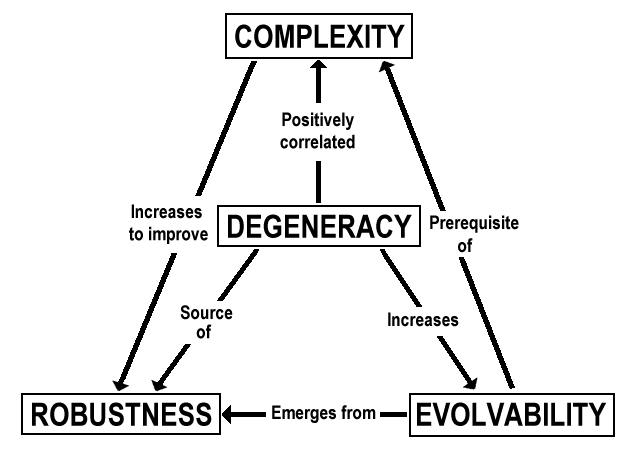
Degeneracy is a more common term, the image is as per 9. See here for the image source.
Degenerate biological systems suggest two lessons. First, parallel architectures can yield fitness benefits. Though not always useful, parallelism can serve critical functions. For example it can buffer against mutations and filter noise. Second, degeneracy is interpretable as something other than failed optimisation. It can allow evolutionary processes (mutation) to shape systems that depend on no single pathway (specificity). Such degenerate systems are often the most adaptable. Evolution thus rewards what we might call "the survival of the most degenerate".
Related Notes
- Resilience
- Robustness
- Biodiversity
- Disturbance Ecology
- Uncertainty
- Complexity
- Evolution
- Information
- Cognition
- Decision Making
- Agency
- Metabolism
- Biomimicry (on wastefulness, satisficing and suboptimality)
- Nature (on waste, excess and ecological limits)
- Justice (on who bears the cost of lost redundancy)
Approach
Optimisation often treats redundancy as waste to remove. Yet, redundancy, slack and degeneracy can be conditions of persistence, learning and evolvability. Under deep uncertainty and across plural worlds, robust and reversible strategies rest on overlap and spare capacity rather than on a single optimum (see Uncertainty). A more-than-human orientation then asks which beings generate redundancy, which depend on it, and who carries the loss when it is stripped away.
Cf.
Direct Redundancy Terms
- redundancy: excess or overlap relative to immediate demand; wasteful when read as mere duplication, but able to preserve function when conditions change.1, 2, 3
- structural redundancy: extra structural elements or modules that can absorb failure or support continuity; use with care, because structure alone does not guarantee functional substitution.3, 4
- functional redundancy: several species, processes, components or roles that deliver the same or a similar function; ecological accounts separate redundancy within a scale from reinforcement across scales (see Biodiversity).3, 5
- informational redundancy: repeated, overlapping or persistent information that reduces uncertainty, supports memory, or allows recovery when channels are noisy or partial (see Information).6, 7
- semantic redundancy: repeated or overlapping meaning-bearing signs, where redundancy is semiotic and interpretive rather than only physical.8, 6
- duplication: exact or near-exact repetition; weaker than degeneracy, because the copied elements stay identical in function and context.9, 10
- backup systems: engineered or organisational stand-ins for failure; close to duplication, yet often narrower than ecological redundancy, because they presume a known failure mode.
- distributed redundancy: robustness spread across many non-identical relations or pathways rather than concentrated in one backup element.10, 4
- pathway redundancy: alternative routes to a function, common in metabolic, material-flow and organisational processes.10, 11
- functional overlap: partial rather than complete interchangeability; the broad umbrella under which degeneracy, response diversity and pathway redundancy sit.9, 10
Slack, Spare Capacity and Buffers
- spare capacity: unused or underused capacity that stress can mobilise; close to reserve capacity and slack.
- reserve capacity: capacity held back from current throughput; useful when disturbance exceeds normal operating assumptions.1, 3
- slack: non-optimised room in a system; valuable for exploration, learning and adaptation, yet often treated as inefficient under optimisation.1, 12
- buffering: damping disturbance or reducing sensitivity, whether material, ecological, informational, developmental, organisational or cultural.10, 3
- environmental buffering: buffering achieved by modifying, choosing or stabilising surroundings; this overlaps with niche construction.13, 14
- shielding: a protective form of buffering that limits exposure to disturbance; note the danger of shielding that preserves maladaptive arrangements.15
Memory, Inheritance and Learning
- ecological memory: legacies in landscapes, species pools, material states or practices that shape later recovery and adaptation; closely related to ecological inheritance (see Memory).
- ecological inheritance: altered biotic or abiotic conditions that niche-constructing organisms bequeath to descendants or other populations, reshaping selection pressures.13
- nonhuman learning: learning, anticipation and decision-making extend beyond humans; cells, for example, infer noisy environments, weigh costs and benefits, and sometimes act probabilistically (see Cognition).7
- multiple realisation: one function or outcome reached through different structures or pathways; related to degeneracy, functional overlap and distributed robustness.9, 10
Degeneracy and Diversity
- degeneracy: partial redundancy, where structurally different components perform similar functions in some contexts while keeping distinct roles in others; degenerate systems can be far more evolvable than purely redundant ones (see Evolution).9, 10
- response diversity: variation in how members of a functional group respond to environmental change; a main reason functional redundancy supports resilience rather than mere duplication.3
- compensatory dynamics: decline or failure in some components offset by others, which ecological redundancy and response diversity can enable.2, 3
- insurance: a resilience value of diversity and redundancy; overlapping elements lower the chance that function is lost under disturbance, even when not every element matters at once.2, 3
- insurance hypothesis: the claim that biodiversity insures ecosystem functioning under environmental fluctuation, with functional redundancy and response diversity as key mechanisms.2, 3
- hedging: spreading risk across alternatives rather than committing to a single optimum; used where uncertainty is explicit (see Uncertainty).7, 16
- bet-hedging: phenotypic or life-history variation that lowers population-level variance in fitness under uncertain environments.7, 16
Complexity, Modularity and Control
- modularity: partial separability of components or subsystems; near-decomposability makes complex systems evolvable, legible and adaptable without full independence (see Complexity).4
- fault tolerance: continued operation after faults, which in biology rests on redundancy, degeneracy, distributed control or modularity rather than simple backup.10
- graceful degradation: declining performance without catastrophic collapse; related to distributed redundancy, modularity and response diversity.
- robustness: insensitivity of a function or state to specified perturbations; always state robustness of what, to what (see Robustness).9, 10, 3
- resilience: the disturbance a system can absorb before it shifts to an alternative stable state; in social–ecological work, resilience ties to change, thresholds, learning and transformation (see Resilience).1, 3
- requisite variety: a cybernetic principle that only sufficient variety in a regulator can absorb the variety that disturbance introduces.6
Against Optimisation: Good-Enoughness and Suboptimality
- satisficing: accepting good-enough performance rather than a global optimum; useful where search spaces are rugged, uncertain, path-dependent or too complex to optimise.4
- good-enoughness: persistence through adequacy rather than perfection, since near-decomposable and situated systems can work without global optimisation.4
- suboptimality: persistent non-optimal states from local search, decomposition, path dependence and access constraints; not automatically a failure.
- conditions of viability: the minimum conditions for persistence; redundancy can support viability, yet it also carries real costs.9, 1, 3
- real costs of persistence: the energetic, material, organisational, political, aesthetic or ecological costs paid to keep a function, practice, population or infrastructure going.1, 3, 11
Case:
- Sexual reproduction has an efficiency cost: resources are invested in males, who often contribute less directly to offspring production.
- In principle, a population composed only of reproducing females could grow faster, avoiding this ‘twofold cost’ of males.
- Despite this inefficiency, sex persists, indicating that it provides compensating advantages.
- Evolutionary biology identifies genetic variation as a key benefit: sexual reproduction produces diverse offspring, increasing the probability that some survive under uncertain conditions.
- In particular, the Red Queen hypothesis explains sex as an adaptation to ongoing co-evolutionary ‘arms races’ with parasites, which preferentially exploit common genotypes; recombination generates rare variants that can escape infection.
- This implies that what appears redundant at the individual level (males, recombination) can be adaptive at the population level under changing and adversarial conditions.
Thus, sex and males are a form of functional redundancy: an apparently suboptimal system maintained because it enhances robustness and evolvability in dynamic ecological contexts.26
Waste, Excess and Throughput
- waste: matter or energy a system rejects; ecological economics frames the economy as fed by low-entropy resources and bounded by sinks for high-entropy waste (see Metabolism).11
- surplus: excess beyond immediate need, which can be waste, reserve, display, investment or regenerative capacity, depending on context.17, 18
- excess: a central concern for aesthetics and evolution; in ecological design, unmanaged excess material flow drives degradation (see Aesthetics).17, 18
- one-way throughput: linear source-to-sink flow; regenerative-design accounts contrast such degenerative flows with regenerative cyclical ones.19
- sacrificial loss: tolerated loss of parts, material, individuals or capacity to preserve a larger function; reserve the framing for cases where evidence warrants it.
- destructive system logics: patterns such as growth fetishism, externalised costs, source-to-sink throughput and sink overloading that reproduce harm while appearing efficient.11, 18, 19
Adaptation, Maladaptation and Niche Dynamics
- maladaptation: adaptation that raises vulnerability, undermines resilience elsewhere, or costs more than it returns; also a trait-environment mismatch under changed conditions.3, 15
- niche construction: organisms modify biotic and abiotic environments through metabolism, activity and choice; the positive or neutral anchor for the more critical term niche destruction.13
- niche destruction: destructive or self-undermining niche modification, especially where constructed conditions reduce future viability.13, 18
Umwelt, Semiosis and Meaning-Worlds
- umwelt: an organism's world of perception and action, joining a perception world and an effect world into one functional unit (see Meaning).14, 8
- umwelt collapse: loss or breakdown of a viable perception–action world; use with care, as an extension from biosemiotics rather than a settled term.14, 8
Reuse, Making-Do and Historical Contingency
- exaptation: a structure shaped for one purpose taken up for another.20
- co-option: pressing existing things or structures into new service, a way to explain how artefacts, landscapes and designs are repurposed.20
- bricolage: making with whatever materials lie at hand, which likens technical change to organic tinkering (see Craft).20
- thriving: more than survival, since regenerative and resilience accounts ask how systems keep developing, renewing and co-evolving, not merely persisting.1, 19
Considerations for More-Than-Human Design
- Redundancy, diversity and slack carry real costs, yet resilience research values them where they protect key functions or guard against disturbance, and counts them as conditions of viability rather than waste.1
- Functional redundancy works best alongside response diversity, because overlapping elements protect a function when they do not all fail under the same disturbance.2, 3, 5
- Nonhumans build redundancy. Redundant ecosystem engineering can raise the temporal stability of species' niches, and, by reducing priority effects, it can support colonisation and community diversity.21, 22 Design can follow and protect this work rather than optimise it away.
- Through biodiversity or spatial trophic structure, functional redundancy can hedge against catastrophic loss of future productivity, in line with the insurance hypothesis.23 Its cost, measured as lost ecosystem function, stays context-dependent: it varies with the initial number of species, the order of extinctions and the clustering of species in trait space.5
- Degeneracy yields more than exact duplication, because partial overlap joins robustness to access to novelty and so supports evolvability.9
- Redundancy has an organisational analogue, since cultures that tolerate mistakes and hold overlapping knowledge support creativity and innovation.12
- The hard task is to tell costly but life-supporting slack from destructive excess, one-way throughput, maladaptation and niche destruction.15, 11, 18, 19
- A pluriversal orientation keeps asking who defines redundancy as waste, who benefits from removing it, and who bears the loss when buffers fail (see Uncertainty and Justice).
- The full set of reachable design options forms a possibility space, also called design potential (see Phase Space and Deliberation). A useful form of redundancy multiplies the options within this space and keeps them reachable. This supports nonhuman leadership. Nonhuman proposers reveal viable futures that humans cannot foresee, so a design that forecloses reachable options can block that leadership.24 It also mirrors resilience understood as pathway diversity: an agent is more resilient when more action pathways stay open now and into the future.25 Such reachable variety offers an alternative to optimising for a single best outcome.
- More options are not always better. Pathway diversity counts only pathways that stay genuinely reachable, so actions that run down shared capacity or foreclose others' futures do not add resilience.25 The questions that matter are who gains reachable options, who loses them, and whether today's design keeps nonhuman-led pathways open (see Innovation and Measuring Design-Pathway Transformation).
Further Reading
Laland, Kevin N., John Odling-Smee, and Marcus W. Feldman. “Niche Construction, Biological Evolution, and Cultural Change.” The Behavioral and Brain Sciences 23, no. 1 (2000): 131–46. https://doi.org/10/c58hwb.
Odling-Smee, F. John, Kevin N. Laland, and Marcus W. Feldman. Niche Construction: The Neglected Process in Evolution. Princeton: Princeton University Press, 2003.
Boogert, Neeltje J., David M. Paterson, and Kevin N. Laland. “The Implications of Niche Construction and Ecosystem Engineering for Conservation Biology.” BioScience 56, no. 7 (2006): 570–578. https://doi.org/10.1641/0006-3568(2006)56%255B570:tionca%255D2.0.co;2.
Sultan, Sonia E. Organism and Environment: Ecological Development, Niche Construction, and Adaption. New York: Oxford University Press, 2015.
Notes
Footnotes
Whitacre, James, and Axel Bender. “Degeneracy: A Design Principle for Achieving Robustness and Evolvability.” Journal of Theoretical Biology 263, no. 1 (2010): 143–53. https://doi.org/10.1016/j.jtbi.2009.11.008.˄
Biggs, Reinette, Maja Schlüter, and Michael L. Schoon, eds. Principles for Building Resilience: Sustaining Ecosystem Services in Social-Ecological Systems. Cambridge: Cambridge University Press, 2015.˄
Biggs, Christopher R., Lauren A. Yeager, Derek G. Bolser, Christina Bonsell, Angelina M. Dichiera, Zhenxin Hou, Spencer R. Keyser, et al. “Does Functional Redundancy Affect Ecological Stability and Resilience? A Review and Meta-Analysis.” Ecosphere 11, no. 7 (2020): e03184. https://doi.org/10.1002/ecs2.3184.˄
Angeler, David G., and Craig R. Allen. “Quantifying Resilience.” Journal of Applied Ecology 53, no. 3 (2016): 617–24. https://doi.org/10.1111/1365-2664.12649.˄
Callebaut, Werner, and Diego Rasskin-Gutman, eds. Modularity: Understanding the Development and Evolution of Natural Complex Systems. Cambridge, MA: MIT Press, 2005.˄
Oliver, Tom H., Matthew S. Heard, Nick J. B. Isaac, David B. Roy, Deborah Procter, Felix Eigenbrod, Rob Freckleton, et al. “Biodiversity and Resilience of Ecosystem Functions.” Trends in Ecology & Evolution 30, no. 11 (2015): 673–84. https://doi.org/10.1016/j.tree.2015.08.009.˄
Ashby, W. Ross. An Introduction to Cybernetics. London: Chapman & Hall, 1956.˄
Perkins, Theodore J., and Peter S. Swain. “Strategies for Cellular Decision‐making.” Molecular Systems Biology 5, no. 1 (2009): 326. https://doi.org/10.1038/msb.2009.83.˄
Favareau, Donald, ed. Essential Readings in Biosemiotics: Anthology and Commentary. Biosemiotics. Dordrecht: Springer, 2010.˄
Whitacre, James Michael. “Biological Robustness: Paradigms, Mechanisms, and Systems Principles.” Frontiers in Genetics 3 (2012): 00067. https://doi.org/10.3389/fgene.2012.00067.˄
Daly, Herman E., and Joshua C. Farley. Ecological Economics: Principles and Applications. 2003. 2nd ed. Washington: Island Press, 2010.˄
Auernhammer, Jan, and Hazel Hall. “Organizational Culture in Knowledge Creation, Creativity and Innovation: Towards the Freiraum Model.” Journal of Information Science 40, no. 2 (2014): 154–66. https://doi.org/10.1177/0165551513508356.˄
Odling-Smee, John, Douglas H. Erwin, Eric P. Palkovacs, Marcus W. Feldman, and Kevin N. Laland. “Niche Construction Theory: A Practical Guide for Ecologists.” The Quarterly Review of Biology 88, no. 1 (2013): 3–28. https://doi.org/10.1086/669266.˄
Michelini, Francesca, and Kristian Köchy, eds. Jakob von Uexküll and Philosophy: Life, Environments, Anthropology. Abingdon: Routledge, 2020.˄
Pelling, Mark. Adaptation to Climate Change: From Resilience to Transformation. London: Routledge, 2011.˄
Stearns, Stephen C. “Life-History Tactics: A Review of the Ideas.” The Quarterly Review of Biology 51, no. 1 (1976): 3–47. https://doi.org/10.1086/409052.˄
Hansen, Thomas Folkmann, David Houle, Mihaela Pavličev, and Christophe Pélabon, eds. Evolvability: A Unifying Concept in Evolutionary Biology? Cambridge, MA: The MIT Press, 2023.˄
Mandoki, Katya. The Indispensable Excess of the Aesthetic: Evolution of Sensibility in Nature. Lanham: Lexington Books, 2015.˄
Yeang, Ken. Saving the Planet by Design: Reinventing Our World through Ecomimesis. London: Routledge, 2020.˄
Mang, Pamela, Ben Haggard, and Regenesis. Regenerative Development and Design: A Framework for Evolving Sustainability. Newark: Wiley, 2016.˄
Ingold, Tim. The Perception of the Environment: Essays on Livelihood, Dwelling and Skill. London: Routledge, 2000.˄
Sanders, Dirk, and Enric Frago. “Ecosystem Engineers Shape Ecological Network Structure and Stability: A Framework and Literature Review.” Functional Ecology 38, no. 8 (2024): 1683–96. https://doi.org/10.1111/1365-2435.14608.˄
Yeakel, Justin D., Mathias M. Pires, Marcus A. M. de Aguiar, James L. O’Donnell, Paulo R. Guimarães, Dominique Gravel, and Thilo Gross. “Diverse Interactions and Ecosystem Engineering Can Stabilize Community Assembly.” Nature Communications 11, no. 1 (2020): 3307. https://doi.org/10.1038/s41467-020-17164-x.˄
Lerner, Joshua E., Rusty A. Feagin, Thomas P. Huff, Raymond G. Najjar, Astrid Layton, Maria Herrmann, and Jose D. Fuentes. “A Fundamental Trade-off among Resilience, Resistance, Efficiency, and Redundancy in Tidal Wetlands.” Ecology 107, no. 1 (2026): e70293. https://doi.org/10.1002/ecy.70293.˄
Roudavski, Stanislav, and Alexander Holland. “Are You Blocking Nonhuman Leadership? Five Questions to Find Out.” PDC ’26: Proceedings of the 19th Participatory Design Conference (New York) 2 (2026): 372–81. https://doi.org/10.1145/3789492.3796416.˄
Lade, Steven, Brian Walker, and L. Jamila Haider. “Resilience as Pathway Diversity: Linking Systems, Individual, and Temporal Perspectives on Resilience.” Ecology and Society 25, no. 3 (2020). https://doi.org/10.5751/ES-11760-250319.˄
Backlinks