Eel Chapter
This note compiles resources for the eel chapter in a book on pluriversal uncertainties.
Cf.
Key points:
- Relevant concepts and debates occur across multiple disciplines and communities of practice, including science, policy, and local knowledge systems (not only the humanities and anthropology). A more-than-human approach requires an integrative view that is pluriversal in practice, not only in claims.
Uncertainty, Risk and Related Concepts in More-Than-Human Worlds
See Uncertainty
Uncertainty is not just a novel condition brought about by the Anthropocene (such as weather, season and other changes brought about by the warming climate). It is a fundamental characteristic of many processes and complex systems. As such, all life forms, including humans, have evolved to cope with uncertainty via a range of strategies.
This differs from how human communities perceive uncertainty and from the psychological or managerial consequences discussed in human settings.1 A more-than-human approach requires nonhuman experiences and onto-epistemological constructs, understood as outcomes of nonhuman evolutionary, cultural, and technical processes.
"Our argument builds on two conceptual fields of uncertainty, namely: (a) uncertainty propagates porous engagements needed for negotiation of social actors’ recognition and agency in a socially and politically unstable context; (b) uncertainty hones the human capacity for immediate response to the unexpected and the unforeseen while building potential for resilience and adaptability."1
How do these effects apply to, or produce additional effects for, nonhuman agents such as plants, microbes, and animals, for example eels?
What can "embracing uncertainty" mean? Planetary or shared thriving is limited and contingent on worldviews, actions, space-taking, as well as energy and material use by other agents. In this context, an error-prone search for thriving within multidimensional ecological niches, together with niche construction in response to feedback, becomes a practical approach. Cf. the evolution of lifestyles in eels.
It may be useful to present a clear contrast, perhaps as a table, between how humans cope with uncertainty and how eels cope with uncertainty. Across levels, anthropology avoids assigning species-level traits to humans. The same principle should apply to eels: taxon, species (for example European eel), local populations, and sex- or stage-specific groups.
Local Expressions
Many species develop local cultures within geographically bounded populations. Evidence for such cultures is weaker in anguillid eels, but this should not prevent attention to the emergence of nonhuman or interspecies cultures, including human cultures in eel-related local multi-being communities. However, local responses to challenges, including uncertainty, still apply. For the best-studied species, such as European eel (Anguilla anguilla), American eel (A. rostrata), and Japanese eel (A. japonica), the literature supports panmixia or near-panmixia over large ranges. Local differences and responses at levels and dimensions more nuanced than species can be understood as follows:
- Taxonomic. Different species or subspecies, especially in tropical anguillids. 2 3
- Stock. Panmictic species-wide breeding stock in European and American eel, with species-wide stock structure but local phenotypic plasticity.4 5
- Regional/local habitat contingent. Freshwater, estuarine, coastal-marine, freshwater-resident, estuarine-resident, sea-resident, and habitat-shifting groups within the same species, including facultative catadromy.6 7 8
- Basin and microhabitat. Demographic groups by river basin or habitat type, for example tributary versus estuary, upstream versus downstream, and tidal versus non-tidal reaches within one basin.9 2
- Sex. Male-biased high-density habitats versus female-biased lower-density habitats, with local sex determination often shaped by environment and density rather than genetics.10 11
- Age/stage. Ontogenetic stages, including glass eel, elver, yellow eel, and silver eel, each with distinct movement and risk-response tactics.3 6
- Stressor-conditioned. Stress-conditioned tactics, including barrier response, contaminant response, parasite response, salinity response, and local acclimatization.12 13 14 5
This has consequences for the definition of "culture". If cultures are defined as "socially transmitted traditions," current evidence in eels is weak. However, if cultures are understood as "locally persistent ways of living," the evidence is strong. This creates an ontological challenge: should culture be defined by a specific mechanism (a form of information transmission) or by resulting onto-epistemological structures at the level of landscape and place (patterns of behaviour, distribution, and related dynamics)? The co-presence of these definitions, and the impossibility and lack of need to resolve them cleanly, are clear illustrations of pluriversality and uncertainty in action for nonhuman beings, as shown by eels.
Cf. that humans readily apply the term "culture," as in aquaculture, to sets of material conditions and practices that control fish such as eels in useful ways, without relying on non-genetic information transmission as the defining mechanism of culture.
Working Definition of Culture
Cf.
- naturecultures
- biocultural diversity
- multispecies ethnography
- Indigenous relationality
- cultural niche construction
Eel cultures are locally sustained, resilient, and imaginative shared ways of living, moving, sensing, assessing, deciding, remembering, harvesting, eating, feeding, sheltering, caring, and predating, while responding to uncertainties that emerge through relations among eels, waters, other beings, human communities, infrastructures, laws, seasonal events, anthropogenic changes, geological processes, cosmic events, and other disturbances.
This definition extends existing relational and multispecies interpretations of culture. It treats culture as a distributed pattern of life, practice, memory, and world-making, rather than as a bounded human symbolic system or a single mechanism such as social learning.
Plural Knowledges
Acknowledge the overlap of distinct knowledge systems, each with its own authorities, protocols, evidence standards, responsibilities, and limits, without aggregation and without adding one dominant form of knowledge.
Commit to comprehensive inclusion and to amplifying weak signals without prejudice. Implement bias-resisting protocols (for example, through diet studies, critical food studies, critical animal studies, and substantial alternative human lifestyle or governance propositions). Otherwise, pluriversal ontologies and epistemologies become a priori exclusionary and propagate epistemic violence.
The need for further research
- Much less is known about other eel species.
- There has been no intentional effort to study interspecies cultures.
The link to design
- Generic species-level responses are likely to be too crude. Scientific sampling will also likely be sparse. This creates an opening for "slow" local observation and co-design through traditional knowledge updated in response to change, citizen science and design, and other systemic or cultural innovations.
- A capabilities approach to design responses.
- Co-design through trial-and-error experimentation (prototypes, "provotypes").
- A search for novel and innovative interspecies cultural responses based on baseline plasticity.
- To consider alternative futures, memory of longer mutualistic co-histories is also important, including local and traditional knowledge and archaeological and palaeontological knowledge.
- In a link to compassionate conservation and other approaches that consider wellfare or organismic lives, design can help with the consideration of positive and negative experiences of eels.15
Research Questions Emerging from This Approach
Ways of working together
- What counts as eel knowledge when signals arise across eel movement, fisher practice, waterways, sediments, infrastructures, stories, data, models, sensing, and design trials?
- How can researchers, designers, and more-than-human governance collectives translate eel signals into design decisions as probabilistic pathway redirections, without reducing eel agency to human proxies or ventriloquism?
- How can eel absence, eel delay, and eel return as well as other detectable signals from eel lives inform design as readable eel contributions, signs of approval, gestures of resistance rather than mere monitoring data?
Ensuring justice
- How do human (Indigenous, traditional, fisher) and nonhuman (prey, parasites, plant responses, microhabitat reconfigurations) situated eel-related practices frame uncertainty differently from human-led, human-interpreted, and human-filtered conservation risk management, resource management, or economic frameworks (even when not explicitly human-serving)?
- What governance arrangements can protect knowledge sovereignty while enabling co-design across heterogeneous knowledge systems?
- How can eel-led design treat contaminants, barriers, parasites, and colonial infrastructures as transformable injustices rather than normal or tolerable background?
Enabling innovation
- Which failures become visible when human and more-than-human researchers and institutions treat eel pathways as primary design evidence or prototypical design action, and how can (and should) these findings redirect law, policy, and infrastructure?
- How can design support multiple eel life pathways (accepting the risks that come with experimentalism, self-determination, autonomy, and uncertainty) rather than enforce a single model of passage, habitat, or human-eel relations?
- Which new planetary futures become reachable when nonhuman-led pathways materially redirect decisions beyond what humans can imagine or hope to reach on their own?
Commodification, Dispossession, Exclusion, Displacement in Conservation
Consider oppression, dispossession, and exclusion across all practices and for all disempowered actors, including nonhuman actors. Inclusion (Private)
Acknowledge the efforts to improve the situation in light of current and emerging challenges. Examples:
- Efforts to include traditional and Indigenous leadership in conservation practice and science
- Indigenous veganism Inclusion (Private)
Pluriversality and Direct Inclusion of Nonhuman Actors
See Redundancy
Relationship between Uncertainty and Planetary Design
See Uncertainty
The Role of Eels
Eels have life-history characteristics that minimise mortality, starvation, and predation, while maximising opportunities for growth.
Under natural (and pre-industrial, pre-Anthropocene?) conditions, these characteristics enable enough individuals to survive, grow, and reproduce.
Anthropogenic activities have resulted in declining populations with reduced resilience.
Righton et al. argue that a greater understanding of the plasticity of the growth phase and the impacts of risks during the oceanic phase can lead to effective interventions.16
Is our argument that the whole relational network needs this kind of study?
To see what is and is not included in the current expert opinion on eels, see this Delphi-based study: Mukherjee, Nibedita, Anders Clarhäll, Henrik Scharin, Matilda Svensson, Arlie H. McCarthy, John Wyatt Greenlee, Ovidiu Alexa, et al. “Assessing the Conservation Challenges for the European Eel through the Delphi Technique.” Global Ecology and Conservation 68 (2026): e04257. https://doi.org/10.1016/j.gecco.2026.e04257.
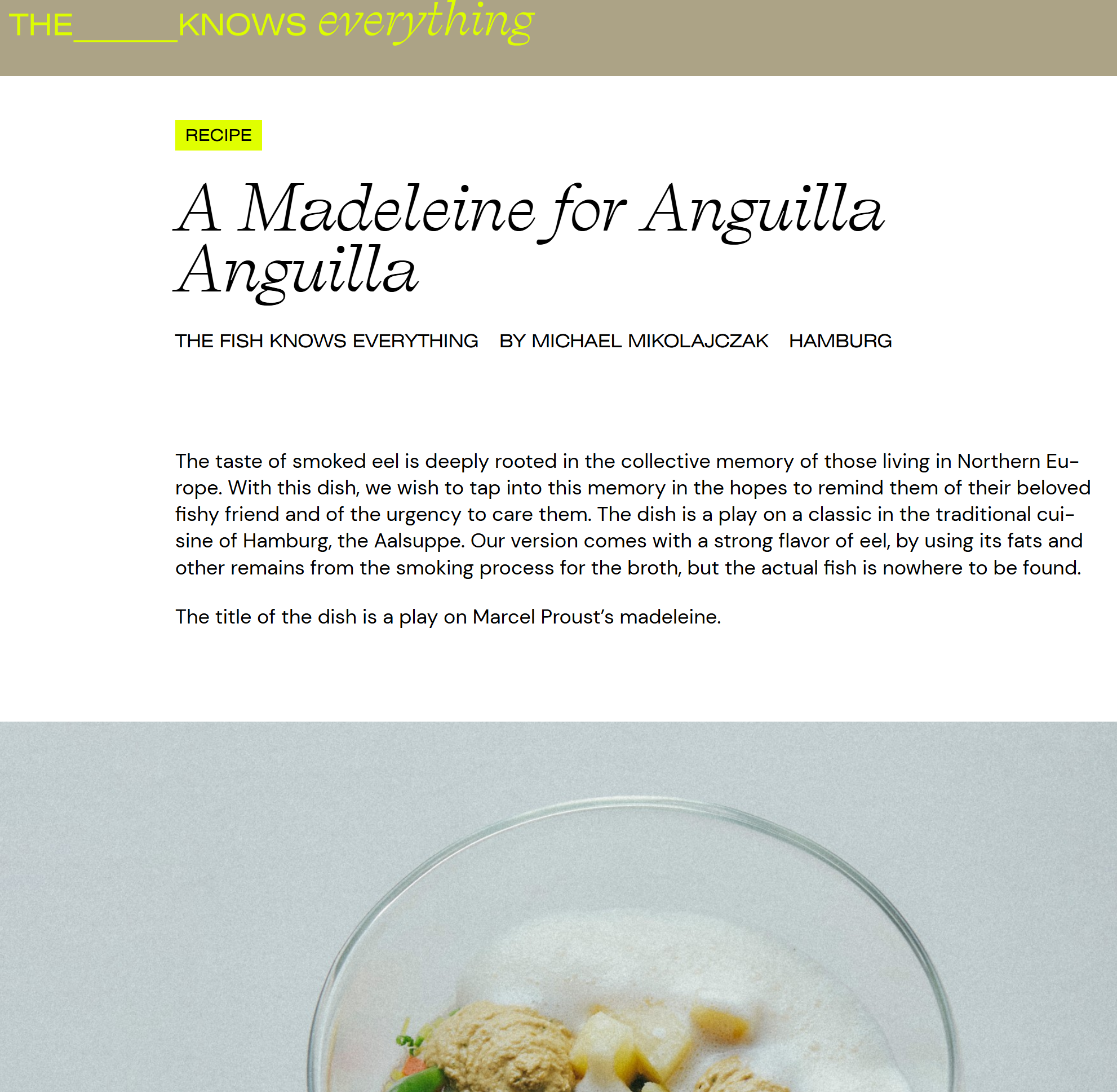
The Bauhaus of the Sea Sails runs a project called The Fish Knows Everything, but the contents are recipes for eating fish.17
Footnotes
E.g., as discussed here in terms of the contrast between climate models and human experience: Ulturgasheva, Olga, and Mally Stelmaszyk. “Embracing Uncertainty: Porous and Actionable Responses to Climate Change at the Borders of Indigenous and Scientific Expertise(s) in Siberia.” Journal of the Royal Anthropological Institute 31, no. 1 (2025): 63–81. https://doi.org/10.1111/1467-9655.14163.˄
Arai, Takaomi, Inn-Ju Chai, Yoshiyuki Iizuka, and Chih-Wei Chang. “Habitat Segregation and Migration in Tropical Anguillid Eels, Anguilla Bengalensis Bengalensis and A. Bicolor Bicolor.” Scientific Reports 10 (2020): 16890. https://doi.org/10.1038/s41598-020-72788-9.˄
Williamson, Michael J., Charlotte Pike, Matthew Gollock, David M. P. Jacoby, and Adam T. Piper. “Anguillid Eels.” Current Biology 33, no. 17 (2023): R888–93. https://doi.org/10.1016/j.cub.2023.07.044.˄
Enbody, Erik D., Mats E. Pettersson, C. Grace Sprehn, Stefan Palm, Håkan Wickström, and Leif Andersson. “Ecological Adaptation in European Eels Is Based on Phenotypic Plasticity.” Proceedings of the National Academy of Sciences of the United States of America 118, no. 4 (2021): e2022620118. https://doi.org/10.1073/pnas.2022620118.˄
Ulmo‐Diaz, Gabriela, Augustin Engman, William O. McLarney, Carlos A. Lasso Alcalá, Dean Hendrickson, Etienne Bezault, Eric Feunteun, et al. “Panmixia in the American Eel Extends to Its Tropical Range of Distribution: Biological Implications and Policymaking Challenges.” Evolutionary Applications 16, no. 12 (2023): 1872–88. https://doi.org/10.1111/eva.13599.˄
Tzeng, Wann-Nian, Jen-Chieh Shiao, and Y. Iizuka. “Use of Otolith Sr:Ca Ratios to Study the Riverine Migratory Behaviors of Japanese Eel Anguilla Japonica.” Marine Ecology Progress Series 245 (2002): 213–21.˄
Jessop, Brian M., Jen-Chieh Shiao, Yoshiyuki Iizuka, and Wann-Nian Tzeng. “Migratory Behaviour and Habitat Use by American Eels Anguilla Rostrata as Revealed by Otolith Microchemistry.” Marine Ecology Progress Series 233 (2002): 217–29. https://doi.org/10.3354/meps233217.˄
Arai, Takaomi, Aya Kotake, Madoka Ohji, Nobuyuki Miyazaki, and Katsumi Tsukamoto. “Migratory History and Habitat Use of Japanese Eel Anguilla Japonica in the Sanriku Coast of Japan.” Fisheries Science 69, no. 4 (2003): 813–18. https://doi.org/10.1046/j.1444-2906.2003.00691.x.˄
Moura, Ana, Ester Dias, Rodrigo López, and Carlos Antunes. “Regional Population Structure of the European Eel at the Southern Limit of Its Distribution Revealed by Otolith Shape Signature.” Fishes 7, no. 3 (2022): 135. https://doi.org/10.3390/fishes7030135.˄
Krueger, William H., and Kenneth Oliveira. “Evidence for Environmental Sex Determination in the American Eel, Anguilla Rostrata.” Environmental Biology of Fishes 55, no. 4 (1999): 381–89. https://doi.org/10.1023/A:1007575600789.˄
Bevacqua, Daniele, Paco Melià, Marcello Schiavina, Alain J. Crivelli, Giulio A. De Leo, and Marino Gatto. “A Demographic Model for the Conservation and Management of the European Eel: An Application to a Mediterranean Coastal Lagoon.” ICES Journal of Marine Science 76, no. 7 (2019): 2164–78. https://doi.org/10.1093/icesjms/fsz118.˄
Piper, Adam T., Costantino Manes, Fabio Siniscalchi, Andrea Marion, Rosalind M. Wright, and Paul S. Kemp. “Response of Seaward-Migrating European Eel (Anguilla Anguilla) to Manipulated Flow Fields.” Proceedings of the Royal Society B: Biological Sciences 282, no. 1811 (2015): 20151098. https://doi.org/10.1098/rspb.2015.1098.˄
Pujolar, Jose Martin, Ilaria AM Marino, Massimo Milan, Alessandro Coppe, Gregory E. Maes, Fabrizio Capoccioni, Eleonora Ciccotti, et al. “Surviving in a Toxic World: Transcriptomics and Gene Expression Profiling in Response to Environmental Pollution in the Critically Endangered European Eel.” BMC Genomics 13 (2012): 507. https://doi.org/10.1186/1471-2164-13-507.˄
Schneebauer, Gabriel, Reinhold Hanel, and Bernd Pelster. “Anguillicola Crassus Impairs the Silvering-Related Enhancements of the ROS Defense Capacity in Swimbladder Tissue of the European Eel (Anguilla Anguilla).” Journal of Comparative Physiology. B, Biochemical, Systemic, and Environmental Physiology 186, no. 7 (2016): 867–77. https://doi.org/10.1007/s00360-016-0994-0.˄
Mason, Georgia J., and J. Michelle Lavery. “What Is It like to Be a Bass? Red Herrings, Fish Pain and the Study of Animal Sentience.” Frontiers in Veterinary Science 9 (2022): 788289. https://doi.org/10.3389/fvets.2022.788289.˄
Righton, David, Pieterjan Verhelst, and Håkan Westerberg. “The Blueprint of the European Eel Life Cycle: Does Life-History Strategy Undermine or Provide Hope for Population Recovery?” Fish and Fisheries 26, no. 4 (2025): 505–19. https://doi.org/10.1111/faf.12894.˄
Light, Ann. More-than-Human, Sea-Facing, Eco-Social Change-Making Advice from the Bauhaus of the Seas Sails Project. EU Horizon Europe Grant Report D2.5. Malmö: Malmö University, 2026.˄