Microclimate Design
This note sets out an approach to designing the microclimates of habitat structures: nest boxes, roosts, hollows, shelters and other structures whose value to occupants depends on the temperatures and moisture they provide. The approach brings design, engineering and ecology into one cycle of physical and digital prototypes. Measurements of occupants and structures feed the models that shape the next version. Saunas and spas for the growling grass frog in northern Melbourne are the first case.
The evidence for each step is in Six Steps. The tools and data for each task are in Tools and Data.
Related Notes
- Six Steps: the evidence for each step of the cycle, with the organisms, places and studies.
- Tools and Data: what simulation can do at each stage, with the tools and data for each task.
- Frog Sauna: saunas and spas for the growling grass frog, the first case.
- Artificial Habitat Structur, Habitat Structure and Measurement: artificial habitat structures; the nature, measurement and replication of habitat structures.
- Housing and Zoos: housing as a system, and animal-led housing for animals in captivity.
- Modelling, Measurement and Sensing: modelling and simulation, measurement, and sensors.
- Lidar and Imaging: lidar and other imaging of the physical features of ecosystems.
- Lifecycle: the lifecycles of structures, with their servicing and replacement.
- Biomaterials, Bioreceptive and Clay-Printed Habitats: biomaterials, bioreceptive design and a proposed project on habitat structures of robotically printed clay.
- Design Potential (Private): design potential in more-than-human terms, and how nonhuman participation expands it.
- More than Human Design, Leadership, Capabilities and Thriving: more-than-human design, collective and more-than-human leadership, capabilities, and thriving.
Designers, Engineers and Ecologists in One Cycle
- Design and engineering can balance many requirements at once. Designers and engineers weigh interacting requirements such as an occupant's needs, a site's climate, structural loads, cost, transport and assembly. They find a workable balance through repeated rounds of computer modelling and physical prototyping.
- Trial and error improves results. A review of prototyping research found that design teams that iterated met their requirements better than teams that did not. In controlled experiments, groups that built several prototypes in parallel also produced better designs than groups that built only one. The review links iteration with meeting difficult requirements and parallel prototyping with finding new ideas. It reports no effect sizes and notes that researchers have studied complex-system prototyping only lightly.1 Habitat design shows a similar pattern. In Kāneʻohe Bay, Oʻahu, Hawaiʻi, a team iteratively developed seven clay settlement modules for coral larvae from the sizes and angles of reef recesses where larvae settle in nature. The team printed the modules and compared them over a year at two reef sites, with at least five modules of each design at each site. Compared with flat control cones, modules with helix recesses increased settlement about 80-fold and one-year survival 20- to 50-fold. The survival counts, however, pooled recruits from several coral genera, mainly Montipora and Pocillopora.2
- Computation makes trade-offs explicit. In one engineering study, a team simulated 44 designs for a truss built partly from reused members. It scored each design for environmental impact, cost, the number of deconstruction sites that could supply members and the number of joints to build. No design was best on every measure. The recommended design cut environmental impacts by 35% but cost 37% more than the benchmark. The stock of reused members was simulated, and the study involved no animals.3
- A habitat prototype shows both the capacity and the gap. For FloaTree, a tree-like pavilion that served as a prototype bird habitat in Melbourne, the team ran several optimisation rounds and built three physical prototypes in parallel. The structure had to travel to Zurich in six checked bags and be assembled within two days by workers with limited specialist skills. The rounds reduced simulated maximum displacement from 25.02 to 3.13 cm and replaced load-stretched jute cables with steel. One prototype collapsed overnight when a strut failed under rain, temperature swings and higher loads than calculated. The team dropped a wavy strut edge intended to help birds perch because it added machining time and waste. The study leaves bird use for future fieldwork.4
- Conservation structures use little of this capacity. Most conservation structures come from catalogues of stock designs or from field changes made after a failure, as the examples below show. For example, nest boxes sold online for powerful owls (Ninox strenua) have no recorded success in attracting them.5
- Design projects rarely model outcomes for occupants. Among the 24 studies closest to this approach, all 9 led by designers used digital fabrication, but only 2 modelled any outcome for occupants. Both used fixed temperature limits for bees. All 11 led by ecologists modelled an occupant's energy, water use, behaviour or access, but none used digital fabrication or fed results into a later version. A computational study ranked 122 building-envelope designs by their benefits for humans, plants and animals. It represented benefits for animals with proxies such as vegetated climbing paths from ground to roof. The authors identify "the lack of external calibration or empirical benchmarks" as a limitation.6
- The two communities can take larger steps together. In one cycle of physical and digital prototypes, ecologists define occupants' requirements and measures of outcome. Designers and engineers provide ways to make, test and change structures in response to those measures. Microclimate offers a useful starting field because it is a major way a structure affects its occupants, and both communities can measure it. The frog sauna is the first case (Frog Sauna).
- DDL's projects follow this logic. For powerful owls in Melbourne, DDL fitted artificial cavities to lidar scans of host trees, then tested small-scale models and full-scale installations. It assembled printed modules with augmented reality and logged cavity temperatures in the field for 172 days.7 For boreal owls (Aegolius funereus) in a storm-damaged forest in the Paneveggio-Pale di San Martino Natural Park in northern Italy, DDL designed an adjustable hollow based on black woodpecker (Dryocopus martius) hollows. The team built it in laser-cut plywood, printed plastic and mycelium. DDL placed the hollow's moisture-retaining pores by simulating runoff and solar irradiation.8 Neither project modelled an outcome for the owls. DDL's agent-based model of perching birds at Barrer Hill, a degraded box-gum woodland in Canberra, compared living trees, relocated dead trees and utility poles fitted with perches over 240 years. The model used lidar scans of trees but involved no fabrication.9
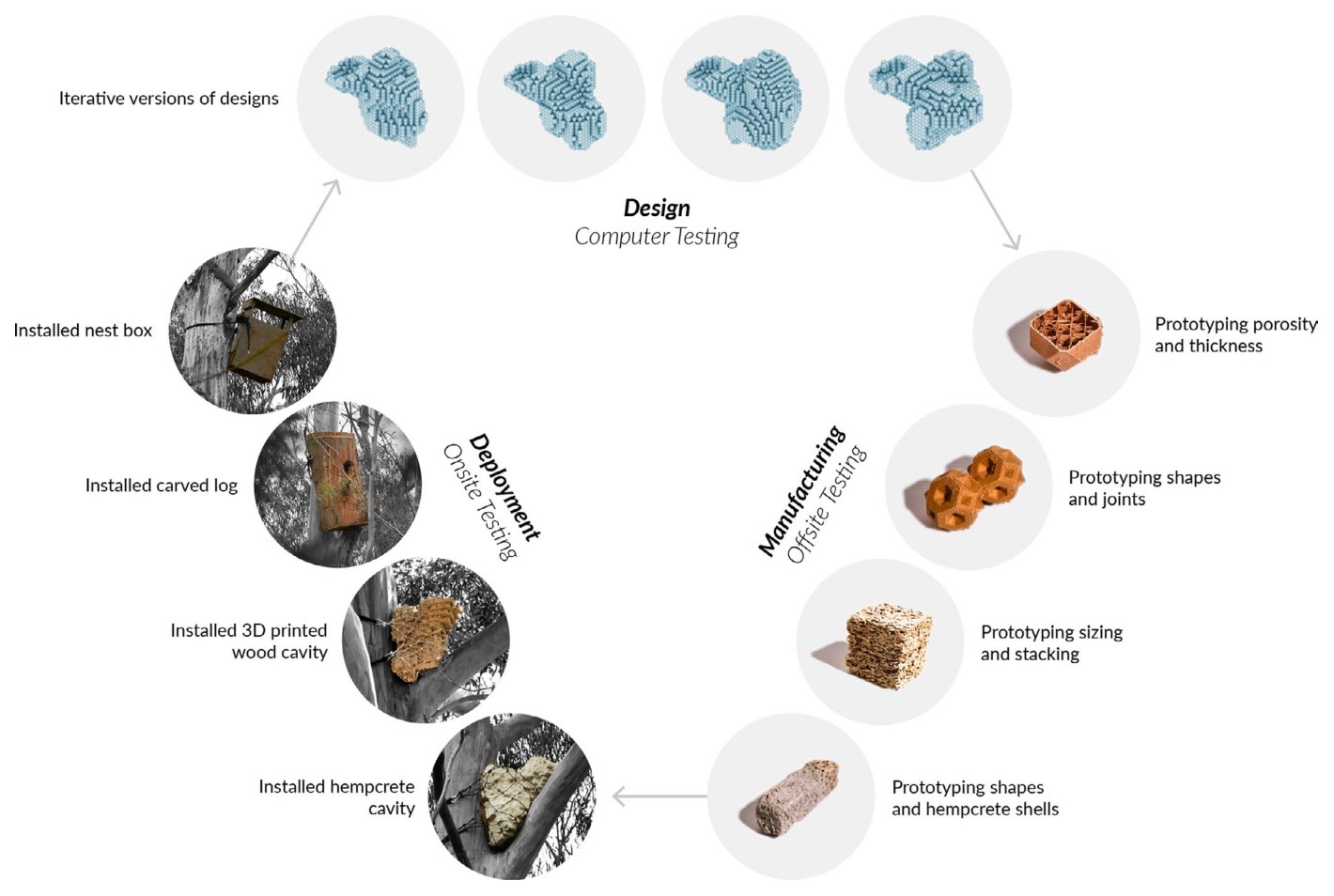
DDL's process for assessing and redesigning artificial cavities for powerful owls: design versions tested on computer (top), components prototyped offsite (right), and cavities installed and tested onsite (left).7
How Microclimate Affects Occupants
- Nest boxes and tree hollows differ. In the Strathbogie Ranges, Victoria, 40 dark-green plywood nest boxes stood within 17 m of a tree hollow. Their average summer daily maxima were 8.0 °C higher than those in the hollows, and the boxes peaked at 52.1 °C. A biophysical model considered four arboreal marsupials: the common brushtail possum (Trichosurus vulpecula), mountain brushtail possum (Trichosurus cunninghami), greater glider (Petauroides volans) and common ringtail possum (Pseudocheirus peregrinus). It estimated that occupants of the boxes would need 1.5 to 2.4 times as much evaporative cooling as occupants of the hollows. The authors attribute the difference mainly to the hollows' thicker walls.10
- Warm shelters reduce infection. At Macquarie University Fauna Park in Sydney, each outdoor mesocosm for juvenile green and golden bell frogs (Litoria aurea) contained a pile of black bricks beneath a small greenhouse. Researchers covered some greenhouses with 90% shade cloth. Unshaded piles reached daily maxima about 4.5 °C higher than shaded piles. Frogs in mesocosms with unshaded greenhouses were 3.1 °C warmer at capture and carried lighter infections of the chytrid fungus Batrachochytrium dendrobatidis. In the laboratory, frogs that had cleared an infection survived a second exposure far more often than frogs exposed for the first time (86% compared with 22%).11
- Heat can kill occupants. On two roof terraces in Matera, southern Italy, in 2021 and 2022, researchers fitted ventilated plywood sunshades to brick nest boxes for lesser kestrels (Falco naumanni). They shaded one box at random in each group of boxes at the same breeding stage. During heatwaves, unshaded boxes reached average daily maxima of 45.7 °C, compared with 41.8 °C in shaded boxes. In unshaded boxes, 61 of 110 nestlings died or disappeared, compared with 15 of 157 in shaded boxes. In unshaded boxes, the fitted probability of nestling death exceeded 50% once the daily maximum passed 44 °C.12
- One shelter design performed differently at two sites. Brick-pile shelters beneath small greenhouses stayed above 25 °C for at least an hour on 33 of 40 winter days (82.5%) inside mesocosm tubs in Sydney in 2021. They reached that threshold on 8 of 61 days (13.1%) on open ground at the University of Melbourne's Werribee campus in 2022. The study monitored the sites in different years and recorded no frogs. The authors made no statistical comparison between sites. They suggest that, in cool places, such shelters could warm frogs into a range where the fungus grows faster, creating an ecological trap.13
How Such Structures Are Designed Now
- By trial in the field. In pilot studies for the Sydney mesocosms, sunlit black brick piles ran hot, but most potential refuges stayed below 30 °C on cool days. The designers therefore added greenhouses.11 In Canberra in 2022, wind wrecked two replicas of that design within days. The team replaced them with twin-wall polycarbonate pyramids, which lasted nearly three years at urban wetlands. Heat mats beneath the bricks did not significantly increase time between 28 and 36 °C, partly because their inverters failed repeatedly.14
- From catalogues of stock designs. An online survey examined 51 commercial bat-box designs for temperate-zone bats, priced from USD 19.49 to 350. It found that 32 were shorter than 50 cm and 19 had no vents. The authors describe many boxes for sale as untested and report misleading thermal advice, such as a black, unvented box sold to provide warmth. They recommend that practitioners test boxes without bats before deploying them.15 Measurements of stock models also found overheating. At 12 stations across Catalonia in the summers of 2014 and 2015, 48 of 90 bat boxes across 11 models, most of them commercial, exceeded 40 °C, a temperature that soprano pipistrelles (Pipistrellus pygmaeus) avoid.16
- Rarely with measurements or controls. A systematic review covered 224 English-language field studies of artificial refuges for land vertebrates published up to November 2018, most of them on birds and bats. Of these studies, 219 recorded whether animals used the refuges, but only 40 recorded internal temperature, 9 recorded humidity and 87 used controls.17
- By logging shelter temperature alone. Four studies of amphibian shelters reported only internal temperatures: in brick holes in Canberra and at Werribee;14, 13 beneath concrete and timber covers for robust whistling frogs (Austrochaperina robusta) in rainforest in Queensland's Paluma Range;18 and in the water of heated floating shelters for common toad (Bufo bufo) tadpoles near Budapest.19 None reported humidity, evaporative water loss, wind or the temperature an occupant-sized object would reach inside the shelter.
- Without heat-transfer models. No published heat-transfer model of a frog shelter has come to light. One model estimates disease transmission among green and golden bell frogs in sunlit and shaded shelter groups using Sydney mesocosm data. It uses no temperature measurements and appears in a working paper without peer review.20
- In DDL's own work, simulation and logging run side by side. DDL placed the pores in a hollow for boreal owls by simulating runoff and solar irradiation.8 Its loggers in cavities for powerful owls ran for 172 days.7 No DDL paper yet calibrates a simulation against its own logs or measures the thermal properties of a material.
The Cycle and Its Six Steps
The six steps form a cycle of physical and digital prototypes. Physical prototypes range from material samples and components, through partial sections tested in climate chambers or on test rigs, to full structures in use. Digital prototypes range from simple models, through models calibrated against measurements, to generative models that propose variants. Measurements, scans and observations of use from each test round feed the models. Generative routines, such as parametric models with automated search, then produce variants for the models to rank.7, 21 The models also return fabrication data and assembly instructions for the next round. Each round starts with the requirements of occupants and site. It ends with a site test and, once that is safe, a test with occupants. The steps below follow the order of a first round; later rounds repeat them.
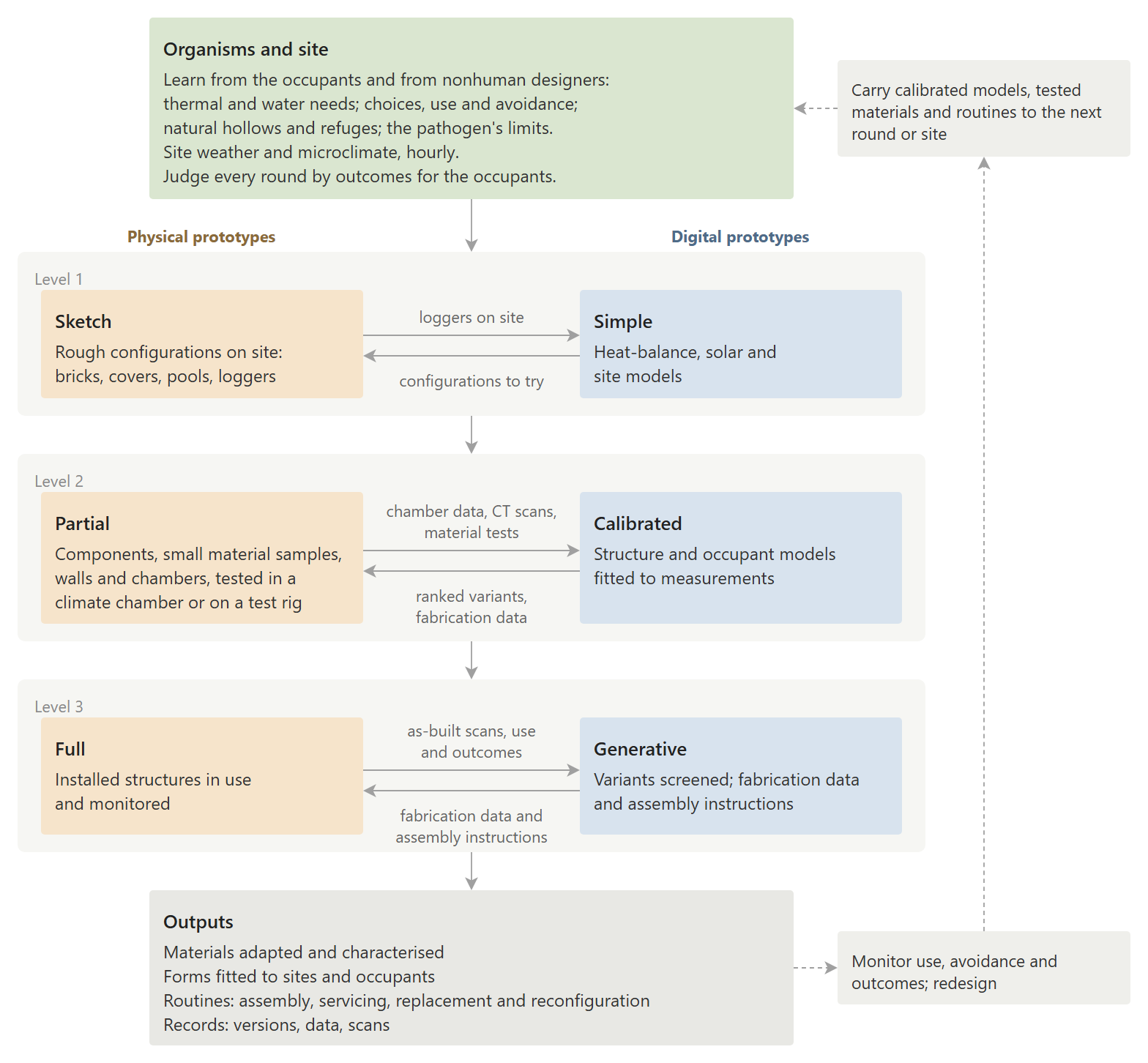
The cycle of physical and digital prototypes. Physical prototypes (sketch, partial and full) and digital prototypes (simple, calibrated and generative) inform one another. Occupants and sites shape both ends of the cycle; its outputs are materials, forms, routines and records.
Step 1. Learn the requirements from the occupants and from nonhuman designers
DDL treats design as the capacity to respond to novelty, a capacity that does not require humans. Trees, microorganisms and animals can therefore act as designers. A structure's occupants act as its clients.22, 23 Trees and microorganisms make the hollows where birds raise their chicks. Where artificial hollows are needed, natural hollows provide a reference.23 Occupants show what they need through the conditions they choose, use and avoid, and they change designs through their actions. This step states requirements as exposure over time and as a range of conditions from which occupants can choose. It measures conditions where occupants spend time, including within structures, at entrances and in the surroundings they cross or use.
- What it changes. Designs offer a range of conditions from which occupants can choose. Comparison with structures made by nonhuman designers shows where a design departs from conditions occupants already use.
- Status for frogs. One study compared frog shelters with the air, leaf litter and soil around them;18 stating requirements as exposure over time is new for frog shelters.
- Evidence. Six Steps
Step 2. Model the occupants and the structure together, in both directions
Models estimate an occupant's body temperature, water balance and energy use from a structure's microclimate. For frogs, they can also estimate infection and survival. The same models must add the heat and moisture produced by occupants, from a single animal to a huddle or colony, because occupied structures differ from empty ones. The occupant models then need to be checked against occupants inside real structures. Animals with a choice can offset modest differences between designs, as the limits below describe.
- What it changes. Designs are judged by what they do for the occupants, and predictions apply to occupied structures.
- Status for frogs. Studies have measured the heat and moisture that possums add, and the heat that bees add. Both effects remain untested for frogs, as does the link from shelter microclimate to infection.
- Evidence. Six Steps
Step 3. Prototype in rounds, from samples to full structures, and check the models in every round
Prototypes do two jobs. They test model predictions and reveal problems or ideas that no one predicted. Each round calibrates models with some measurements and checks them against others. Rounds without occupants can identify extremes before occupants encounter them.
- What it changes. Materials, forms and routines fit occupants and sites better with each round. Failures appear before occupants encounter them.
- Status. No study has fed measured temperatures into a thermal model that then shaped the next version. A bumblebee nest-box team came closest. After logging temperature swings in the first version, it used a steady, one-dimensional conduction calculation with handbook values for the plastic and air to develop a double wall for the second version. Its finite-element model was fitted to the final version and checked against the week that supplied its weather data, but it did not guide any version.24
- Evidence. Six Steps
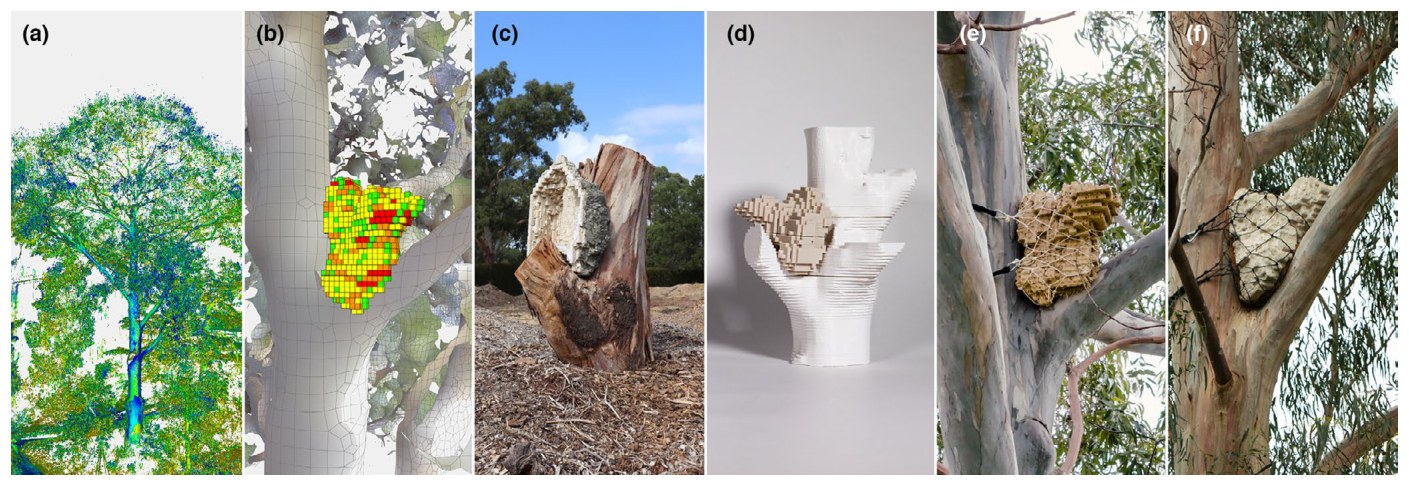
From a scan to installed cavities for powerful owls: a 3D-scanned point cloud of the site (a), a cavity fitted to the surface of the host tree (b), a full-scale prototype (c), a small-scale prototype (d), and installed 3D-printed (e) and hempcrete (f) cavities.7
Step 4. Test the design options: materials, shapes, colours, sizes, openings and siting
Every design choice changes the microclimate. Tests of components, prototypes and models show by how much. Options include material and finish, colour, wall shape and layering, internal chambers, size, openings, ground contact, siting and shade. Heating is also an option where power and upkeep are secure. Measurements of material properties, recorded by batch and direction, supply the model inputs that dominate prediction errors: conductivity, heat capacity, solar absorptance, emissivity, porosity, moisture storage, and durability in water and salt.
- What it changes. Designers base each choice on measured evidence, models get the inputs that dominate their errors, and each option can be fitted to the task.
- Status for frogs. Paint colour and concrete have been tested. DDL's own materials remain uncharacterised, and none of the 24 closest studies measured the conductivity or heat capacity of their walls.
- Evidence. Six Steps
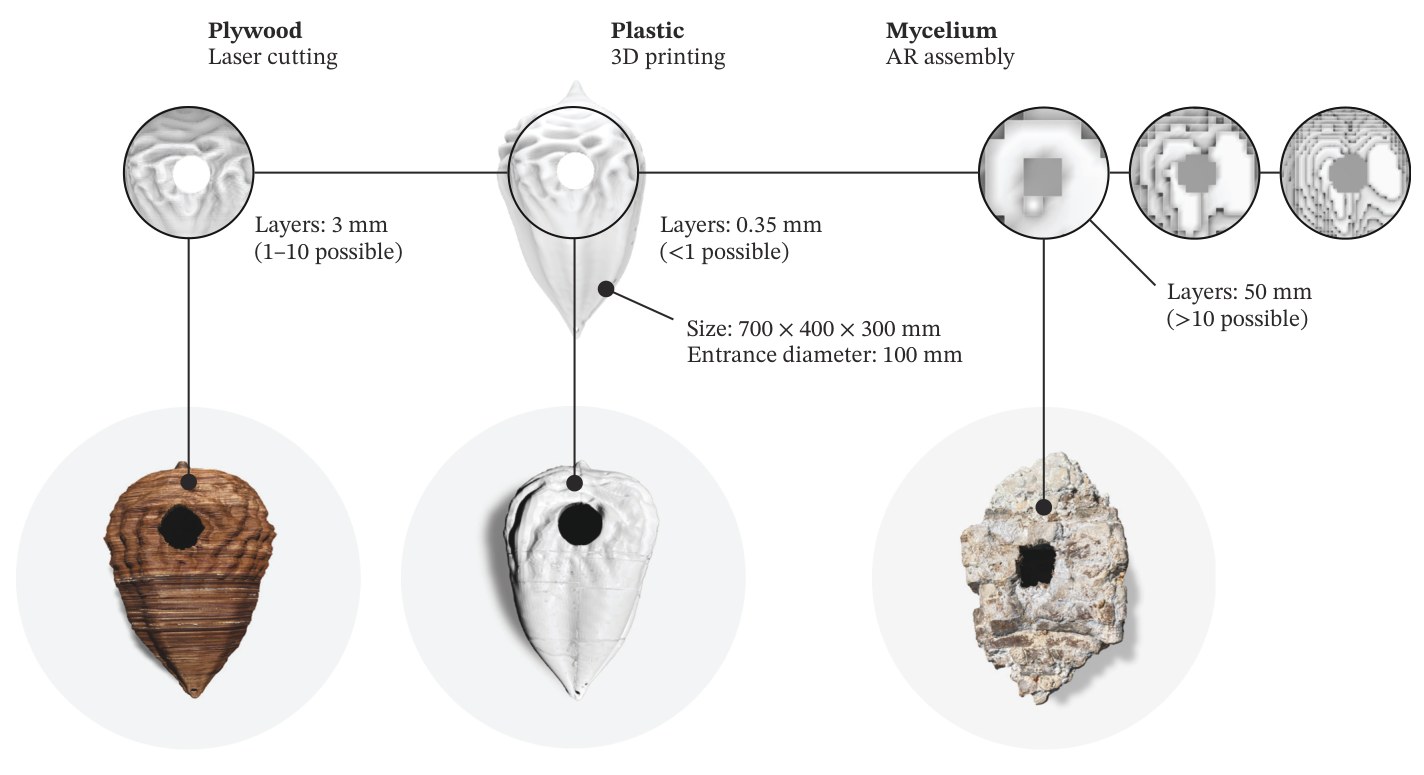
One hollow for boreal owls in three materials and manufacturing methods: plywood from laser-cut sheets, 3D-printed plastic, and mycelium composites assembled with augmented reality, with the computer models above the built prototypes.8
Step 5. Plan fabrication, transport, assembly and upkeep together with the form
Digital fabrication and guided assembly allow each unit to be fitted to its site or host. Designers plan transport, assembly, servicing, replacement and reconfiguration together with the form. They test these plans on prototypes because a structure that cannot be serviced or replaced loses value over its life.
- What it changes. Structures stay effective and safe over their life. Others can build and maintain them.
- Status. Strong for forms and assembly, weak for servicing, replacement and reconfiguration; untested for frogs.
- Evidence. Six Steps
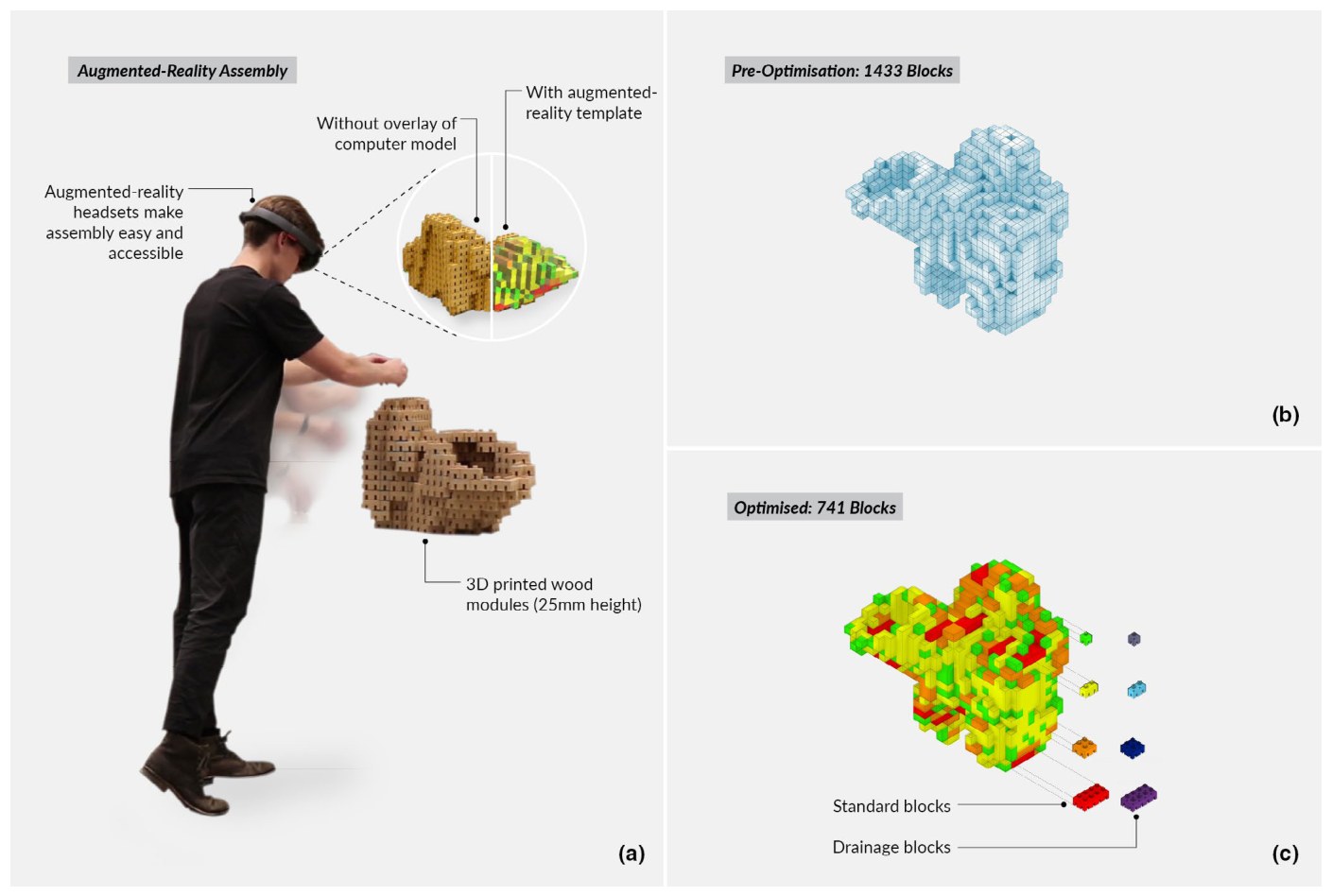
Assembly of a computationally designed cavity with an augmented-reality overlay (a), the cavity's 1,433 blocks before optimisation (b), and its 741 blocks after optimisation (c).7
Step 6. Model each site, check models before reuse elsewhere, and record every version
Hourly microclimates calculated from gridded weather data show how a design may perform at each site before anyone builds it. A model calibrated at one site needs checking at the next. Records preserve design files, as-built scans, fabrication data, sensor logs, observations of occupant use and the design change prompted by each result. Later rounds and other projects can then reuse them.
- What it changes. Site models find in advance the sites that would turn a refuge into a trap. Others can reuse the method and its data.
- Status. The tools exist; untested for frog shelters.
- Evidence. Six Steps
What No Study Has Yet Combined
The approach combines six practices: (1) simulating a structure's microclimate, (2) checking the simulation against measurements, (3) measuring the thermal or moisture properties of materials, (4) modelling outcomes for occupants, (5) digital fabrication, and (6) physical prototypes whose results change the next version. The table below records which practices the 24 studies closest to the approach used, based on their full texts.
| Group | Studies | Simulated the microclimate | Checked it against measurements | Measured material properties | Modelled outcomes for occupants | Used digital fabrication | Returned results to a next version |
|---|---|---|---|---|---|---|---|
| Led by designers | 9 | 6, mostly sunlight on geometry | 1, against the week that supplied its weather data; 1 more checked geometry by scans | 3, none thermal | 2, fixed temperature limits for bees | 9 | 5; 1 was thermal, using logged temperature swings and a steady one-dimensional calculation with handbook values |
| Led by ecologists | 11 | 6 | 7 | 2 | 11 | 0 | 0 |
| Models of structures without occupants | 4 | 4 | 4 | 1 | 0 | 0 | 0 |
The table covers nine studies led by designers,24, 25, 26, 27, 7, 8, 28, 29, 30 eleven led by ecologists31, 32, 10, 33, 34, 35, 9, 36, 37, 38, 39 and four models of structures without occupants.40, 41, 42, 43
- No study used more than four of the six practices, and none fed measured microclimate back into a thermal model that then shaped the next version.
- No study predicted a structure's microclimate from weather, checked that prediction and then checked the predicted outcome for occupants. One field study tested whether modified roost designs and placement in sun or shade changed occupant behaviour. Neither design nor sun exposure changed the torpor of 13 Indiana bats, which switched roosts as the season changed. The authors recommend offering varied designs and placements.44
- Several studies claimed more than their data showed. The bumblebee nest-box authors called their model validated against the week that supplied its weather inputs.24 The authors of the silk-nest model called it accurate despite mean absolute errors of 4.31 to 5.25 °C.41 This note states what each study measured.
The frog sauna could be the first case to combine all six practices and feed measured microclimates back into design. Field trials can measure infection and survival. A transmission model in a non-peer-reviewed working paper estimates the effects of shelters.20 DDL can contribute simulation, measured materials, digital fabrication and rounds of prototypes, joined by calibration.
Benefits and How to Test Them
| Benefit | Measure | Baseline | Why it is plausible |
|---|---|---|---|
| Outcomes improve with each round | Outcome per accepted design and round | Field trial and error11, 14 | At the Azraq refugee camp in Jordan, a model calibrated with one monitored shelter predicted six built variants better than uncalibrated models did.45 |
| Fewer harmful trials | Extreme conditions and traps found in rounds without occupants; occupant exposures per accepted design | Frog shelters peaked at 46.0 °C in Sydney;13 61 of 110 lesser kestrel nestlings died or disappeared in unshaded nest boxes during heatwaves in Matera, Italy.12 | In Stuttgart, tests without bees found a dry panel's nesting tube at 44.9 °C on a sunny loggia. A climate chamber replayed those temperatures and kept a water-supplied panel at or below 35.0 °C.30 |
| Transfer to new sites and species | Prediction error at a new site before and after local recalibration | No baseline for frogs | A model calibrated in one solar greenhouse near Beijing had an error of 3.3 K in a second greenhouse.43 An uncalibrated model, driven by air temperatures logged beside each cavity, predicted conditions in 70 tree cavities and den boxes used by American martens (Martes americana) and fishers (Pekania pennanti) in Minnesota and Michigan. Over several months, mean errors were 1.02 °C in den boxes and 1.77 °C in tree cavities.40 |
| Design options fitted to the task | Properties for each material, batch and direction; designs fitted to each site or host | Catalogue values; stock bricks, boxes and covers | DDL fitted each cavity for powerful owls to a lidar scan of its host tree.7 Printed clay was about half as strong parallel to its layers and lost bending strength with a new batch, falling from 11.2 to 8.8 N/mm².29 |
| Routines and logistics | Mass, assembly time, crew size, deviation between the built structure and its model, service interval, replacements and reconfigurations | 0.25 days to assemble a nest box;7 AU$124 in materials per frog cover in 2022 or AU$69 in bulk in 2024, with assembly using a saw, mallet and drill14 | DDL's printed and hempcrete cavities weighed 15 to 40 kg, compared with more than 250 kg for carved logs.7 A 50-year lifecycle model estimated inspection and replacement costs for 741 hollows by material.8 |
| Cumulative knowledge | A shared record of measured materials, calibrated models and versions with outcomes | Each study starts again | The records described in step 6. |
Each row records the method that could produce the change and how to test the claim that design and engineering can make progress faster when joined with ecology. Frog-specific benefits, including winter hours in the target band, harmful hours and spa water within its target band, are in Frog Sauna.
Limits
- Precise-looking models can be wrong. A model of pine processionary moth silk nests in France correlated above 0.9 with measurements but still had mean errors of 4.31 to 5.25 °C.41 Loggers also err. In sun, unshielded iButtons on an open lawn in Cornwall read air temperature up to 26 °C too high, while shaded readings and readings in contact with a surface were easier to measure accurately.46
- Shelter temperature shows possible exposure, not body temperature. Behaviour, aggregation, posture and wet skin change an occupant's body temperature. A structure's temperature therefore shows only the exposure an occupant could reach.13
- A thermal match does not ensure use. At Lac du Bois Grasslands near Kamloops, British Columbia, two artificial hibernacula used rock and soil salvaged from dens destroyed by a pipeline project. They kept overwintering Great Basin gophersnakes (Pituophis catenifer deserticola) as warm as natural dens, with mean humidity of 99.5%. Even so, only 6 of 93 displaced snakes overwintered in the artificial hibernacula in the first year, and none did so in the second.47
- Occupants can offset modest design differences. Indiana bats switched roosts as the season changed, and neither roost design nor sun exposure changed their torpor. The study followed 13 bats over 43 bat-days. Its 2021 test did not include the roost design with a water jacket.44
- Optimisation handles only a few objectives at once. A review of 99 publications on building envelopes and ecological planning found that studies using multi-objective optimisation most often set two objectives and never more than six.48 The FloaTree team optimised only the structure. It handled transport, cost and assembly through prototypes and judgement.4
- Evidence for designed routines is thin. Evidence for servicing, replacement and reconfiguration comes from models or single cases. The developers of the mixed-reality tools ran the assembly tests themselves.49, 50
- One source lacks peer review. The model of disease transmission among frogs in shelters comes from a working paper and is cited with that caution.20
Fit with the Lab's Aims
- Animal-led design and nonhuman leadership. Occupants lead through the conditions they choose and through their patterns of use, avoidance and recovery. Their responses shape the next design, as in the cycle of proposing, building, assessing, measuring and revising in Zoos. Trees, fungi and animals that make or alter structures also take part as designers (Leadership; More than Human Design).
- Expansion of design potential. The cycle makes more admissible designs reachable with less effort, the condition described in Design Potential (Private). Occupants' responses eliminate designs that fail them. The cycle measures gains through effects on occupants' thriving. It also checks effects on non-target species and, for frogs, effects on the fungus.
- The next step for DDL's own workflow. DDL's cavities have already passed through several kinds of prototype, with lidar fitting, augmented-reality assembly and field logs.7 DDL placed pores in its hollow for boreal owls by simulating runoff and solar irradiation. Its lifecycle work modelled servicing and replacement.8 For birds that perch and nest in remnant yellow box (Eucalyptus melliodora) woodland at Molonglo, Canberra, DDL proposed a cycle that scans tree canopies with lasers, predicts use from statistical models of bird observations and generates canopy structures scored by those predictions. Its models omit microclimate, and field tests are in preparation.51 The missing link is thermal: a calibrated model from sunlight to heat and moisture, fed by measured material properties and logs returned by prototypes. Frog shelters offer a small, fast case in which to build this link. Artificial hollows for Leadbeater's possum provide a ready second case.33
References
Subnotes
Footnotes
Camburn, Bradley, Vimal Viswanathan, Julie S. Linsey, David Anderson, Daniel Jensen, Richard H. Crawford, Kevin N. Otto, and Kristin L. Wood. “Design Prototyping Methods: State of the Art in Strategies, Techniques, and Guidelines.” Design Science 3 (2017): e13. https://doi.org/10.1017/dsj.2017.10.˄
Reichert, Jessica, Hendrikje Jorissen, Crawford Drury, Joshua R. Hancock, Corryn Haynes, Allison D. Nims, Lomani H. Rova, Nina M. D. Schiettekatte, and Joshua S. Madin. “Helix Recesses Boost Coral Larvae Settlement and Survival.” Biological Conservation 311 (2025): 111407. https://doi.org/10.1016/j.biocon.2025.111407.˄
Küpfer, Célia, Numa Bertola, Jan Brütting, and Corentin Fivet. “Decision Framework to Balance Environmental, Technical, Logistical, and Economic Criteria When Designing Structures with Reused Components.” Frontiers in Sustainability 2 (2021): 689877. https://doi.org/10.3389/frsus.2021.689877.˄
Pugnale, Alberto, Gabriele Mirra, Jack Halls, Michael Minghi Park, Michael Mack, and Sofia Colabella. “Deploying FloaTree: Computational Design-to-Construction Workflow of a Low-Tech Tensegrity System.” Architectural Intelligence 5, no. 1 (2026): 2. https://doi.org/10.1007/s44223-025-00112-4.˄
Parker, Dan, Kylie Soanes, and Stanislav Roudavski. “Interspecies Cultures and Future Design.” Transpositiones 1, no. 1 (2022): 183–236. https://doi.org/10.14220/trns.2022.1.1.183.˄
Selvan, Surayyn Uthaya, Laura Windorfer, Soultana Tanya Saroglou, Mariasole Calbi, Victoria Culshaw, Enrica Roccotiello, Jacob Yasha Grobman, and Shany Barath. “Multispecies Design Decision-Making: A Hybrid Computational Model for Ecological Building Envelope Optimization and Evaluation.” Journal of Building Engineering 108 (2025): 112565. https://doi.org/10.1016/j.jobe.2025.112565.˄
Parker, Dan, Stanislav Roudavski, Therésa M. Jones, Nick Bradsworth, Bronwyn Isaac, Martin T. Lockett, and Kylie Soanes. “A Framework for Computer-Aided Design and Manufacturing of Habitat Structures for Cavity-Dependent Animals.” Methods in Ecology and Evolution 13, no. 4 (2022): 826–41. https://doi.org/10.1111/2041-210x.13806.˄
Parker, Dan, Stanislav Roudavski, Chiara Bettega, Luigi Marchesi, Paolo Pedrini, Mattia Brambilla, and Kylie Soanes. “Which Design Is Better? A Lifecycle Approach to the Sustainable Management of Artificial Habitat-Structures.” Conservation Science and Practice 7, no. 8 (2025): e70084. https://doi.org/10.1111/csp2.70084.˄
Holland, Alexander, Philip Gibbons, Jason Thompson, and Stanislav Roudavski. “Modelling and Design of Habitat Features: Will Manufactured Poles Replace Living Trees as Perch Sites for Birds?” Sustainability 15, no. 9 (2023): 7588. https://doi.org/10.3390/su15097588.˄
Rowland, Jessica A., Natalie J. Briscoe, and Kathrine A. Handasyde. “Comparing the Thermal Suitability of Nest-Boxes and Tree-Hollows for the Conservation-Management of Arboreal Marsupials.” Biological Conservation 209 (2017): 341–48. https://doi.org/10.1016/j.biocon.2017.02.006.˄
Waddle, Anthony W., Simon Clulow, Amy Aquilina, Erin L. Sauer, Shannon W. Kaiser, Claire M. Miller, Jennifer A. Flegg, et al. “Hotspot Shelters Stimulate Frog Resistance to Chytridiomycosis.” Nature 631, no. 8020 (2024): 344–49. https://doi.org/10.1038/s41586-024-07582-y.˄
Corregidor-Castro, Alejandro, Jennifer Morinay, Susan E. McKinlay, Samuele Ramellini, Giacomo Assandri, Gaia Bazzi, Alexandra Glavaschi, et al. “Experimental Nest Cooling Reveals Dramatic Effects of Heatwaves on Reproduction in a Mediterranean Bird of Prey.” Global Change Biology 29, no. 19 (2023): 5552–67. https://doi.org/10.1111/gcb.16888.˄
Holmes, Madeleine L., Shannon W. Kaiser, Sneha S. Basu, Lee Berger, Lee F. Skerratt, Richard Shine, and Anthony W. Waddle. “Disease Refuge or Ecological Trap: Location-Specific Performance of Amphibian Hotspot Shelters.” Ecology and Evolution 16, no. 4 (2026): e72590. https://doi.org/10.1002/ece3.72590.˄
Lawler, Ewen K., Richard P. Duncan, Jarrod Sopniewski, Ben C. Scheele, and Simon Clulow. “A Simple, Robust, and Inexpensive Design for Creating Thermal Refugia to Protect Amphibians from Batrachochytrium dendrobatidis in the Field.” Conservation Science and Practice, 2026, e70424. https://doi.org/10.1111/csp2.70424.˄
Crawford, Reed D., and Joy M. O’Keefe. “Avoiding a Conservation Pitfall: Considering the Risks of Unsuitably Hot Bat Boxes.” Conservation Science and Practice 3, no. 6 (2021): e412. https://doi.org/10.1111/csp2.412.˄
Martin Bideguren, Garazi, Adrià López-Baucells, Xavier Puig-Montserrat, Maria Mas, Xavier Porres, and Carles Flaquer. “Bat Boxes and Climate Change: Testing the Risk of over-Heating in the Mediterranean Region.” Biodiversity and Conservation 28, no. 1 (2019): 21–35. https://doi.org/10.1007/s10531-018-1634-7.˄
Cowan, Mitchell A., Michael N. Callan, Maggie J. Watson, David M. Watson, Tim S. Doherty, Damian R. Michael, Judy A. Dunlop, et al. “Artificial Refuges for Wildlife Conservation: What Is the State of the Science?” Biological Reviews 96, no. 6 (2021): 2735–54. https://doi.org/10.1111/brv.12776.˄
Groffen, Jordy, Lyanne Brouwer, Myles H. M. Menz, and Conrad J. Hoskin. “Artificial Shelters as a Monitoring and Conservation Tool for Terrestrial Breeding Frogs.” Ecology and Evolution 16, no. 3 (2026): e73215. https://doi.org/10.1002/ece3.73215.˄
Kásler, Andrea, János Ujszegi, Dávid Herczeg, Dóra Holly, Zsanett Mikó, and Attila Hettyey. “Heated Aquatic Shelters Reduce Infection Intensity but Not Prevalence of a Fungal Pathogen in Common Toad Tadpoles.” Animal Conservation 28, no. 6 (2025): 844–53. https://doi.org/10.1111/acv.70012.˄
Miller, Claire M., Michael J. Lydeamore, Jennifer A. Flegg, Lee Berger, Lee F. Skerratt, Anthony W. Waddle, and Patricia T. Campbell. Sunlight-Heated Refugia Protect Frogs from Chytridiomycosis: A Mathematical Modelling Study. Working Paper No. 06/25. Melbourne: Monash University, 2025. https://doi.org/10.26180/32527080.v1.˄
Mirra, Gabriele, Alexander Holland, Stanislav Roudavski, Jasper S. Wijnands, and Alberto Pugnale. “An Artificial Intelligence Agent That Synthesises Visual Abstractions of Natural Forms to Support the Design of Human-Made Habitat Structures.” Frontiers in Ecology and Evolution 10 (2022): 806453. https://doi.org/10.3389/fevo.2022.806453.˄
Roudavski, Stanislav, and Alexander Holland. “Are You Blocking Nonhuman Leadership? Five Questions to Find Out.” In PDC ’26: Proceedings of the 19th Participatory Design Conference, vol. 2, edited by Laura Galluzzo, Anna Meroni, Daniela Selloni, Davide Fassi, Daniela de Sainz, Andrea Botero, Stefana Broadbent, et al., 372–81. New York: Association for Computing Machinery, 2026. https://doi.org/10.1145/3789492.3796416.˄
Roudavski, Stanislav, and Douglas Brock. “From Dingoes to AI: Who Makes Decisions in More-than-Human Worlds?” TRACE ∴ Journal for Human-Animal Studies 11 (2025): 56–96. https://doi.org/10.23984/fjhas.145720.˄
Roberts, Jenny, Philip Donkersley, Grace Kelly, Stephen Quayle, and Allan Rennie. “Engineering Design and Development of an Artificial Bumblebee Nestbox (BeeBox).” International Journal of Sustainable Engineering 19, no. 1 (2026): 2735277. https://doi.org/10.1080/19397038.2026.2735277.˄
Donkersley, Philip, and Jenny Roberts. “BeeBox: A Novel Artificial Nestbox for Bumblebee Research, Conservation and Engagement.” Methods in Ecology and Evolution 16, no. 8 (2025): 1636–43. https://doi.org/10.1111/2041-210X.70095.˄
Valverde Rojas, Maria Claudia, Doris Österreicher, Leonie K. Fischer, and Jan Knippers. “Thermal Regulation in Urban Surfaces: Evaluating 3D-Printed Porous Geometries for Wild Bee Nesting Aids.” Biotechnology Design 4 (2026): e7. https://doi.org/10.1017/S2977905726100079.˄
Callan, Michael N., Alexander Johnson, and David M. Watson. “Influence of Nest Box Design on Internal Microclimate: Comparisons of Plastic Prototypes.” Austral Ecology 48, no. 2 (2023): 374–87. https://doi.org/10.1111/aec.13272.˄
Larikova, Iuliia, Julia Fleckenstein, Ata Chokhachian, Thomas Auer, Wolfgang W. Weisser, and Kathrin Dörfler. “Additively Manufactured Urban Multispecies Façades for Building Renovation.” Journal of Facade Design and Engineering 10, no. 2 (2022): 105–26. https://doi.org/10.47982/jfde.2022.powerskin.7.˄
Larikova, Julia, Sofia Tsiotou, Alexander Haynack, David Briels, Fabio Sweet, Wolfgang Weisser, and Kathrin Dörfler. “Additively Manufactured Ceramic Façades for Biodiversity and Climatic Performance Integration: A Full-Scale Case Study.” Additive Manufacturing 130 (2026): 105395. https://doi.org/10.1016/j.addma.2026.105395.˄
Valverde Rojas, Maria Claudia, Joel Kimmich, Doris Österreicher, Leonie K. Fischer, and Jan Knippers. “Designing More-than-Human Thermal Comfort: Bio-Inspired Evaporative Cooling in Porous Facade Components for Cavity-Nesting Wild Bees.” Frontiers in Built Environment 12 (2026): 1750586. https://doi.org/10.3389/fbuil.2026.1750586.˄
Crawford, Reed D., Luke E. Dodd, Francis E. Tillman, and Joy M. O’Keefe. “Evaluating Bat Boxes: Design and Placement Alter Bioenergetic Costs and Overheating Risk.” Conservation Physiology 10, no. 1 (2022): coac027. https://doi.org/10.1093/conphys/coac027.˄
Fontaine, Amélie, Anouk Simard, Bryan Dubois, Julien Dutel, and Kyle H. Elliott. “Using Mounting, Orientation, and Design to Improve Bat Box Thermodynamics in a Northern Temperate Environment.” Scientific Reports 11, no. 1 (2021): 7728. https://doi.org/10.1038/s41598-021-87327-3.˄
McComb, Leo, Pia E. Lentini, Dan K. P. Harley, Lindy F. Lumsden, Arabella Eyre, and Natalie J. Briscoe. “Climate and Behaviour Influence Thermal Suitability of Artificial Hollows for a Critically Endangered Mammal.” Animal Conservation 25, no. 3 (2022): 401–13. https://doi.org/10.1111/acv.12750.˄
Kearney, Michael R., Emma Ferguson, Sarah Fumei, Anthony Gallacher, Peter Mitchell, Romy Woodford, and Kathrine A. Handasyde. “A Cost-Effective Method of Assessing Thermal Habitat Quality for Endotherms.” Austral Ecology 36, no. 3 (2011): 297–302. https://doi.org/10.1111/j.1442-9993.2010.02150.x.˄
Griffiths, Stephen R., Jessica A. Rowland, Natalie J. Briscoe, Pia E. Lentini, Kathrine A. Handasyde, Linda F. Lumsden, and Kylie A. Robert. “Surface Reflectance Drives Nest Box Temperature Profiles and Thermal Suitability for Target Wildlife.” PLOS ONE 12, no. 5 (2017): e0176951. https://doi.org/10.1371/journal.pone.0176951.˄
Lennon, Ox, Heiko U. Wittmer, and Nicola J. Nelson. “Modelling Three-Dimensional Space to Design Prey Refuges Using Video Game Software.” Ecosphere 12, no. 1 (2021): e03321. https://doi.org/10.1002/ecs2.3321.˄
Thorkelson, Jeffrey, and Robert K. Maxwell. “Design and Testing of a Heat Transfer Model of a Raccoon (Procyon lotor) in a Closed Tree Den.” Ecology 55, no. 1 (1974): 29–39. https://doi.org/10.2307/1934615.˄
Lu, Yuntao, Wei Hong, Wei Wu, Jie Zhang, Shijuan Li, Baohua Xu, Kun Wei, and Shengping Liu. “The Impact of Temperature Regulation Measures on the Thermodynamic Characteristics of Bee Colonies Based on Finite Element Simulation.” Biosystems Engineering 250 (2025): 306–16. https://doi.org/10.1016/j.biosystemseng.2025.01.012.˄
Mitchell, Derek Morville. “Are Man-Made Hives Valid Thermal Surrogates for Natural Honey Bee Nests (Apis mellifera)?” Journal of Thermal Biology 122 (2024): 103882. https://doi.org/10.1016/j.jtherbio.2024.103882.˄
Velander, Taylor B., Michael J. Joyce, Angela M. Kujawa, Robert L. Sanders, Paul W. Keenlance, and Ron A. Moen. “A Dynamic Thermal Model for Predicting Internal Temperature of Tree Cavities and Nest Boxes.” Ecological Modelling 478 (2023): 110302. https://doi.org/10.1016/j.ecolmodel.2023.110302.˄
Poitou, Laura, Christelle Robinet, Christelle Suppo, Jérôme Rousselet, Mathieu Laparie, and Sylvain Pincebourde. “When Insect Pests Build Their Own Thermal Niche: The Hot Nest of the Pine Processionary Moth.” Journal of Thermal Biology 98 (2021): 102947. https://doi.org/10.1016/J.JTHERBIO.2021.102947.˄
De Castro, Manuela, Noorullah Kuchai, Sukumar Natarajan, Kemi Adeyeye, Daniel Fosas, Francis Moran, Nick McCullen, Zu Wang, and David Coley. “ShelTherm: An Aid-Centric Thermal Model for Shelter Design.” Journal of Building Engineering 44 (2021): 102579. https://doi.org/10.1016/J.JOBE.2021.102579.˄
Liu, Ran, Mengzhe Li, José Luis Guzmán, and Francisco Rodríguez. “A Fast and Practical One-Dimensional Transient Model for Greenhouse Temperature and Humidity.” Computers and Electronics in Agriculture 186 (2021): 106186. https://doi.org/10.1016/j.compag.2021.106186.˄
Crawford, Reed D., Luke E. Dodd, and Joy M. O’Keefe. “Do Artificial Roost Design and Placement Alter the Torpor Expression of Indiana Bats?” Journal of Thermal Biology 136 (2026): 104372. https://doi.org/10.1016/j.jtherbio.2026.104372.˄
Fosas, Daniel, Francis Moran, Sukumar Natarajan, John Orr, and David Coley. “The Importance of Thermal Modelling and Prototyping in Shelter Design.” Building Research & Information 48, no. 4 (2020): 379–400. https://doi.org/10.1080/09613218.2019.1691489.˄
Maclean, Ilya M. D., James P. Duffy, Stef Haesen, Sanne Govaert, Pieter De Frenne, Thomas Vanneste, Jonathan Lenoir, Jonas J. Lembrechts, Marcus W. Rhodes, and Koenraad Van Meerbeek. “On the Measurement of Microclimate.” Methods in Ecology and Evolution 12, no. 8 (2021): 1397–410. https://doi.org/10.1111/2041-210X.13627.˄
McKelvey, Veronica M. L., Lily Ragsdale, Leigh Anne Isaac, and Karl W. Larsen. “Artificial Snake Hibernacula Provide Suitable Microclimate but Are Not Immediately Adopted.” Journal of Environmental Management 396 (2025): 128095. https://doi.org/10.1016/j.jenvman.2025.128095.˄
Selvan, Surayyn Uthaya, Soultana Tanya Saroglou, Jens Joschinski, Mariasole Calbi, Verena Vogler, Shany Barath, and Yasha J. Grobman. “Toward Multi-Species Building Envelopes: A Critical Literature Review of Multi-Criteria Decision-Making for Design Support.” Building and Environment 231 (2023): 110006. https://doi.org/10.1016/j.buildenv.2023.110006.˄
Jahn, Gwyllim, Cameron Newnham, Nick van den Berg, and Matthew Beanland. “Making in Mixed Reality: Holographic Design, Fabrication, Assembly and Analysis of Woven Steel Structures.” In Recalibration: On Imprecision and Infidelity: Proceedings of the 38th Annual Conference of the Association for Computer Aided Design in Architecture (ACADIA), edited by Phillip Anzalone, Marcella del Signore, and Andrew John Wit, 88–97. Mexico City: ACADIA, 2018. https://doi.org/10.52842/conf.acadia.2018.088.˄
Jahn, Gwyllim, Cameron Newnham, Nick van den Berg, Melissa Iraheta, and Jackson Wells. “Holographic Construction.” In Impact: Design with All Senses, edited by Christoph Gengnagel, Olivier Baverel, Jane Burry, Mette Ramsgaard Thomsen, and Stefan Weinzierl, 314–24. Cham: Springer, 2020. https://doi.org/10.1007/978-3-030-29829-6_25.˄
Holland, Alexander, and Stanislav Roudavski. “Participatory Design for Multispecies Cohabitation: By Trees, for Birds, with Humans.” In Designing More-than-Human Smart Cities: Beyond Sustainability, towards Cohabitation, edited by Sara Heitlinger, Marcus Foth, and Rachel Clarke, 93–128. Oxford: Oxford University Press, 2024. https://doi.org/10.1093/9780191980060.003.0007.˄
Backlinks