Six Steps
This note presents evidence for each of the six steps in Microclimate Design, in the order used in a first cycle. Each example identifies the organisms, place and study. The parent note states each step, what it changes and the strength of the evidence.
Related Notes
- Microclimate Design: the approach, its claim, the cycle and the six steps.
- Tools and Data: the tools and data for each task.
- Frog Sauna: the first case.
The Cycle
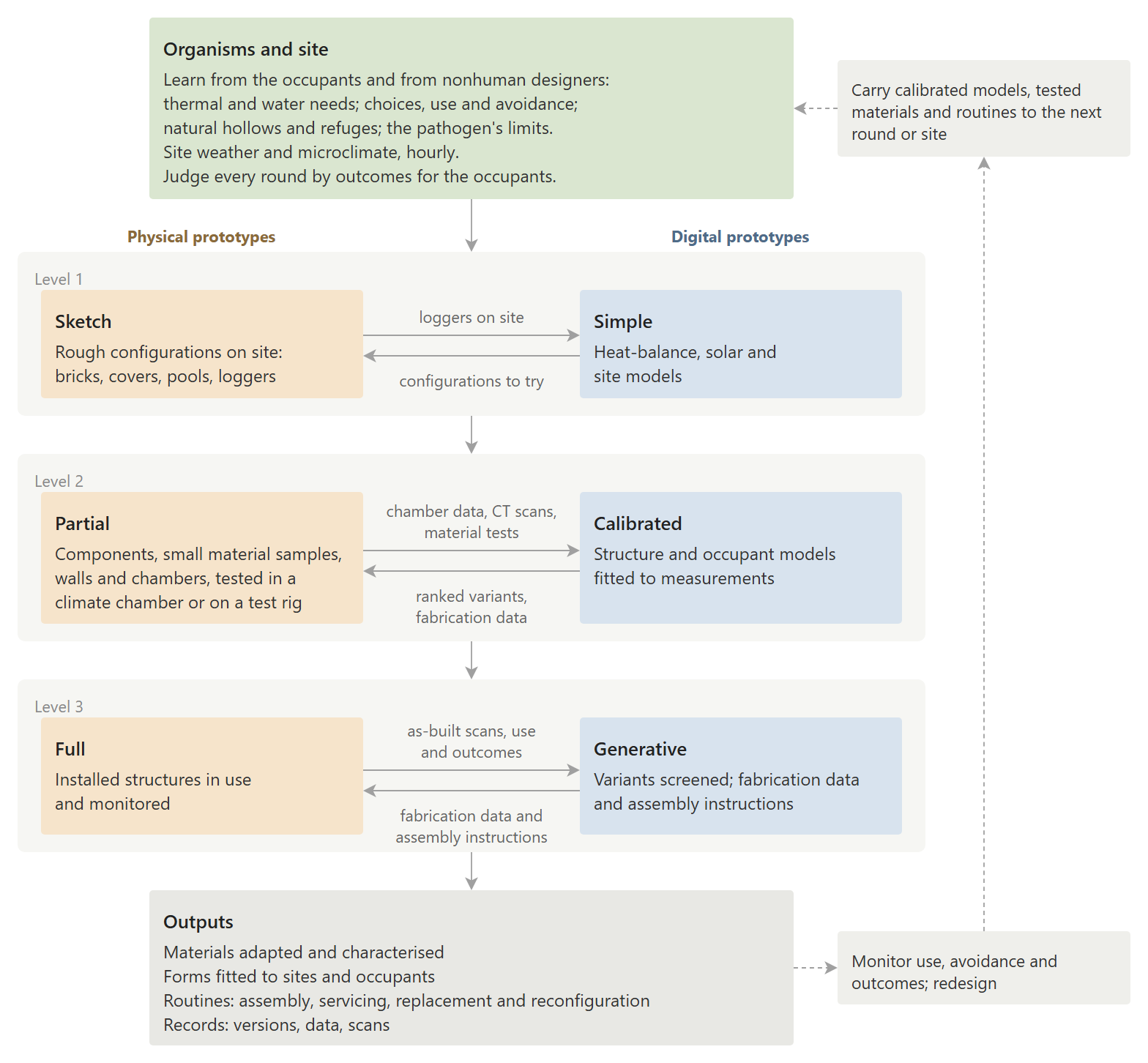
The cycle of physical and digital prototypes. Physical prototypes (sketch, partial and full) and digital prototypes (simple, calibrated and generative) inform one another. Organisms and sites shape both ends of the cycle; its outputs are materials, forms, routines and records.
Step 1. Learn the requirements from the occupants and from nonhuman designers
- Nonhuman designers work over centuries. Australia has no vertebrates that excavate tree hollows. Fungi, bacteria and termites form hollows there over one to several centuries: 190 to 220 years in mountain ash forest1 and several hundred years for cavities large enough for powerful owls.2 In northern Italy, black woodpeckers excavate hollows with decay fungi.3
- Natural cavities buffer the climate. A meta-analysis of 36 studies of natural tree cavities found that cavity maxima averaged 2.7 °C below outside maxima and 4.1 °C below when outside maxima reached 30 °C or more. Cavity minima averaged 2.8 °C above outside minima. Bats, birds and other mammals used most cavities. Of the studies, 42% came from Australia and New Zealand, but only 31% shielded their outside sensors. Unshielded sensors can read too high in the sun.4 Vacant tree cavities used by marsh tits (Poecile palustris) in Białowieża National Park, Poland, reduced the daily temperature swing to 8.8 °C compared with 13.3 °C outside and stayed at about 91% relative humidity. Vacant nest boxes logged in another year at Monks Wood, England, tracked the outside air and stayed at 67%.5
- Occupants with a choice adjust. In the laboratory, infection loads fell faster in green and golden bell frogs that could move within a thermal gradient of 10 to 38 °C than in frogs held at their preferred temperature.6 At two sites in Indiana and Kentucky, researchers radio-tracked 13 female Indiana bats as the season changed. The bats switched among roosts, moving from shaded to sunlit roosts after the trees leafed out. Neither roost design nor sun exposure changed their use of torpor, so the authors recommend offering varied designs and placements.7
- Requirements differ between day and night. In Vigo County, Indiana, researchers analysed four empty roost boxes using generic metabolic curves for a mother bat and a nursing pup. At night, a box with a water jacket had 18% lower predicted metabolic cost and 20.6% faster predicted pup development. By day, the same box raised metabolic cost by 9% and slowed development by 8%. Whole-day averages therefore showed a 3.5% lower cost and a change in development of less than 1%.8
- Occupants and trees change what designers build. At Lancaster, UK, buff-tailed bumblebees (Bombus terrestris) plugged the entrances of their printed nest boxes with grass, so the team changed the door in the next version.9 At the National Zoo in Santiago, Chile, a chimpanzee (Pan troglodytes) received an enrichment device for extracting honey. She tried three sticks and kept the thinnest, which the authors describe as her own prototyping. The designers then worked through three prototypes and ended with an open device that imposed no route of use.10 In six reserves around Melbourne, living trees closed all 174 fissures carved into 83 trees as bat roosts. Wound wood and sap closed the fissures within 41 to 63 months. The surveys found no bats in any fissure while it remained open, although the surveys covered only the first year.11
The step in the parent note: Microclimate Design.
Step 2. Model the occupants and the structure together, in both directions
- Occupants warm and humidify their dens. In Victoria, recycled-plastic nest boxes occupied by colonies of two to seven Leadbeater's possums (Gymnobelideus leadbeateri) were warmer than empty boxes. The difference was greatest in winter. Occupied boxes also had 88% relative humidity compared with 83% in empty boxes. In the same study, a heat-balance model showed that four possums huddling in an insulated nest remained thermoneutral down to 11.4 °C, compared with 26.5 °C for a lone possum.1
- A heated proxy measures an occupant's effect. In the Strathbogie Ranges, researchers used a heated jar the size of a common ringtail possum. It produced about 0.5 W, or one seventh of the basal heat expected from a 1 kg eutherian mammal. The jar raised insulated nest boxes to 3 °C above the air and uninsulated boxes to 0.8 °C above it, a difference that was not statistically significant.12
- Colonies and larvae differ. At Lancaster, one bumblebee-occupied nest box had a daily temperature range 2.03 °C narrower than that of an identical empty box.13 By contrast, silk winter nests of pine processionary moth (Thaumetopoea pityocampa) larvae near Orléans, France, showed no detectable heat from the larvae.14
- Wet skin ties frogs to the shelter's moisture. A copper model in a wet cotton sleeve reproduced the rate of water loss in live western toads (Anaxyrus boreas) from Idaho within about 14%.15 Among 12 tree frog species from around Darwin, frogs with higher skin resistance to water loss chose warmer temperatures in a gradient.16 In an experiment with juvenile green and golden bell frogs at the University of Newcastle, New South Wales, researchers soaked a pile of red bricks before each run, keeping humidity inside at 92 to 100%.17
The step in the parent note: Microclimate Design.
Step 3. Prototype in rounds, from samples to full structures, and check the models in every round
- Trials reveal what models miss. Wind wrecked greenhouses over frog shelters in Canberra within days.18 Bumblebees plugged the entrances of printed nest boxes.9 Robot-printed clay tiles in a Munich façade, designed for house sparrows, black redstarts and common pipistrelle bats, deformed as they dried. The next tiles therefore gained stiffening bridges.19
- Calibration improves forecasts for variants. At the Azraq refugee camp in Jordan, EnergyPlus models calibrated with one monitored transitional shelter predicted six built and monitored variants better than uncalibrated models. All models nevertheless predicted higher temperatures than observed in the two variants with added thermal mass.20 A model calibrated in one solar greenhouse near Beijing had an error of 2.6 K there and 3.3 K in a second greenhouse.21
- A climate chamber can replay field conditions. In Stuttgart, researchers tested printed wood-composite panels for cavity-nesting wild bees on a sunny loggia during an August 2025 heatwave. The nesting tube in a dry panel peaked at 44.9 °C. A climate chamber then replayed the recorded temperatures, using setpoints above 40 °C, and kept a water-supplied panel at 31.7 to 35.0 °C. These tests used no bees and no solar radiation.22
- Design projects already use rounds of prototypes. DDL's cavities for powerful owls progressed through small-scale models, full-scale installation tests, a four-day offsite thermal check in June 2019 and 172 days of field monitoring.2 A team designed a façade of 85 printed ceramic tiles at a children's centre in Munich, with cavities for house sparrows (Passer domesticus), black redstarts (Phoenicurus ochruros) and European hedgehogs (Erinaceus europaeus). It worked through five prototype stages and fed 3D scans and clay-shrinkage measurements back into the model.23
The step in the parent note: Microclimate Design.
Step 4. Test the design options: materials, shapes, colours, sizes, openings and siting
- Colour. West-facing, single-chamber plywood bat boxes in five reserves around Melbourne had mean daily maxima of 32.5 °C in dark green, 27.3 °C in light green and 24.6 °C in white. The dark-green box, with 5.9% solar reflectance, peaked at 53.0 °C.24 Dark boxes can help in winter. In an outdoor aviary at Armidale, New South Wales, Gould's long-eared bats (Nyctophilus gouldi) chose black plywood boxes over white ones on 93 to 100% of bat-nights. Fed bats in black boxes spent less of the day torpid. The authors advise offering boxes in several colours because dark boxes can overheat in hot months.25
- Material. In upland rainforest in Queensland's Paluma Range, chambered concrete shelters for robust whistling frogs had daily maxima 1.0 °C above those of split-timber shelters on average. The concrete shelters accounted for 610 of 805 frog records. Twelve months of shelter logs did not explain the number of frogs, and the timber shelters decayed.26
- Walls and linings. At five urban bushland remnants near Lake Macquarie, New South Wales, in the summer of 2018-19, researchers covered the entrances of 91 plywood nest boxes with fly mesh to keep out sugar gliders (Petaurus breviceps) and squirrel gliders (Petaurus norfolcensis). The 44 boxes wrapped on the outside with 4 mm foam faced with reflective foil averaged daily maxima of 28.8 to 29.0 °C. The 47 unwrapped boxes averaged 31.9 to 32.1 °C, while outside air averaged 29.3 °C. On 23 heatwave days, wrapped boxes exceeded 35.1 °C on 5.2 days on average, compared with 13.4 days for unwrapped boxes. The authors selected 35.1 °C from the thermoneutral zone of the feathertail glider (Acrobates pygmaeus).27 In a temperature-controlled laboratory at Charles Sturt University in Bathurst, a double-height, double-walled printed nest box with a timber-lined chamber, made for small hollow users such as the striated pardalote (Pardalotus striatus), peaked 7.3 °C below room air under rapidly fluctuating conditions. Boxes with heartwood bedding stayed at 76 to 92% humidity.28
- Surface shape. On an east-facing seawall in Plymouth, UK, complex concrete panels about 55 cm across had mean surface temperatures 2 to 3 °C below those of flat controls. These results came from three days with air temperatures of 20 to 29 °C, before intertidal organisms had colonised the panels. Maximum temperatures did not differ.29
- Floor and ground contact. Researchers tested a heat-transfer model of a raccoon (Procyon lotor) in a closed tree den at Cedar Creek, Minnesota, using a heated, fur-covered cylinder. The den floor provided 94% of the resistance to heat loss beneath the animal, while fur provided 57 to 65% of the resistance through the sides.30
- Size and depth. In the Imperial Valley of south-eastern California in 2010, researchers adjusted 19 unoccupied artificial burrows for burrowing owls (Athene cunicularia) to depths of 15 to 76 cm and compared them with 17 burrows that owls already occupied. Each additional metre of depth cooled the chambers by about 3 °C. Deeper burrows more often fell below 25 °C, the lower critical temperature of adult owls. Modelled occupancy peaked above 0.80 at depths of 28 to 40 cm. Depth showed no clear link with breeding success, and the occupancy curve partly reflects the burrows that owls had chosen before the study.31
- Shade and crevice width. On sandstone outcrops in Morton National Park, New South Wales, 128 concrete pavers with 4 or 8 mm crevices, including 60 beneath shade cloth, matched the temperatures of natural rocks 4 cm thick. Over five December days, an exposed paver had mean daily maxima of 49.3 °C, compared with 34.4 °C for a shaded paver. From autumn to spring, velvet geckos (Oedura lesueurii) used exposed pavers and narrow crevices more often. The authors considered thin, exposed rocks too hot in summer.32
- Openings and air leakage. When researchers calibrated the Azraq shelter model, air leakage affected predicted temperatures more than any other parameter, including the conductivity of the insulation and soil.20 In Pennsylvania, changes to the entrances of six bat hibernacula, including additional entrances, a gate, sealed openings and an earth mound, lowered temperatures beside hibernating bats by an average of 2.10 °C. Numbers of little brown bats (Myotis lucifugus) and tricoloured bats (Perimyotis subflavus) rose in later years. The study compared each site with its own record before the works but had no unchanged sites for comparison.33
- Active heating. Near Budapest, mains-powered heaters kept floating shelters measuring 28 × 16 × 6 cm near 30 °C in outdoor tubs of common toad tadpoles. This reduced infection intensity but left prevalence unchanged.34 In Canberra, heat mats beneath black bricks produced no significant gain, partly because their inverters failed.18
- Material properties. Printed clay for the Munich façade tiles was about half as strong parallel to its layers. With a new clay batch, its bending strength parallel to the layers fell from 11.2 to 8.8 N/mm².23 Porous printed blocks for the Stuttgart bee panels retained 23 to 30% of the water applied to them.22
The step in the parent note: Microclimate Design.
Step 5. Plan fabrication, transport, assembly and upkeep together with the form
- Fitted units can be lighter and quicker to install. DDL's printed and hempcrete cavities for powerful owls weighed 15 to 40 kg, compared with more than 250 kg for carved logs. They took 0.1 days to install, compared with 0.2 days for nest boxes and 0.3 days for logs. The one printed cavity, however, took 45 days to make on one printer. DDL assembled the printed modules with augmented reality.2
- Lifecycle models estimate upkeep costs. For boreal owls in northern Italy, DDL's 50-year lifecycle model compared the costs of inspecting and replacing 741 hollows made from different materials.3
- Prototypes reveal upkeep problems. A full-scale, nine-tile prototype of the Munich dormitory façade deformed as it dried. The extra fasteners needed to manage this deformation made it laborious to remove a tile for cleaning.19
The step in the parent note: Microclimate Design.
Step 6. Model each site, check models before reuse elsewhere, and record every version
- Sites differ in the conditions that predict performance. Frog-shelter temperatures depended on solar exposure and air temperature in Sydney, but on solar exposure alone at Werribee. The authors question whether these two variables are enough to predict performance.35
- Site models can cover any place. NicheMapR, combined with microclima, uses global weather and elevation data to calculate hourly, terrain-corrected microclimates for any site on Earth from 1957 onwards.36 Across Australia, without site-specific calibration, its microclimate model explained about 85% of the variation in hourly soil temperature at 43 weather stations over ten years.37
- Records of results that changed designs are rare. A few studies report individual results that changed a later version: bumblebees plugged nest-box entrances,9 drying deformation led to stiffening bridges in printed tiles,19 and retention tests informed the pore structure of bee panels.22 None records every version alongside the result that prompted each change, although the Munich façade study comes closest.23
The step in the parent note: Microclimate Design.
References
Footnotes
McComb, Leo, Pia E. Lentini, Dan K. P. Harley, Lindy F. Lumsden, Arabella Eyre, and Natalie J. Briscoe. “Climate and Behaviour Influence Thermal Suitability of Artificial Hollows for a Critically Endangered Mammal.” Animal Conservation 25, no. 3 (2022): 401–13. https://doi.org/10.1111/acv.12750.˄
Parker, Dan, Stanislav Roudavski, Therésa M. Jones, Nick Bradsworth, Bronwyn Isaac, Martin T. Lockett, and Kylie Soanes. “A Framework for Computer-Aided Design and Manufacturing of Habitat Structures for Cavity-Dependent Animals.” Methods in Ecology and Evolution 13, no. 4 (2022): 826–41. https://doi.org/10.1111/2041-210x.13806.˄
Parker, Dan, Stanislav Roudavski, Chiara Bettega, Luigi Marchesi, Paolo Pedrini, Mattia Brambilla, and Kylie Soanes. “Which Design Is Better? A Lifecycle Approach to the Sustainable Management of Artificial Habitat-Structures.” Conservation Science and Practice 7, no. 8 (2025): e70084. https://doi.org/10.1111/csp2.70084.˄
Cotten, Katrina A., Reed D. Crawford, and Joy M. O’Keefe. “A Global Review of the Capacity of Tree Cavities to Buffer Temperature Extremes.” Forest Ecology and Management 620 (2026): 124180. https://doi.org/10.1016/j.foreco.2026.124180.˄
Maziarz, Marta, Richard K. Broughton, and Tomasz Wesołowski. “Microclimate in Tree Cavities and Nest-Boxes: Implications for Hole-Nesting Birds.” Forest Ecology and Management 389 (2017): 306–13. https://doi.org/10.1016/j.foreco.2017.01.001.˄
Waddle, Anthony W., Simon Clulow, Amy Aquilina, Erin L. Sauer, Shannon W. Kaiser, Claire M. Miller, Jennifer A. Flegg, et al. “Hotspot Shelters Stimulate Frog Resistance to Chytridiomycosis.” Nature 631, no. 8020 (2024): 344–49. https://doi.org/10.1038/s41586-024-07582-y.˄
Crawford, Reed D., Luke E. Dodd, and Joy M. O’Keefe. “Do Artificial Roost Design and Placement Alter the Torpor Expression of Indiana Bats?” Journal of Thermal Biology 136 (2026): 104372. https://doi.org/10.1016/j.jtherbio.2026.104372.˄
Bakken, George S., Francis E. Tillman, and Joy M. O’Keefe. “Methods for Assessing Artificial Thermal Refuges: Spatiotemporal Analysis More Informative than Averages.” Journal of Thermal Biology 105 (2022): 103150. https://doi.org/10.1016/j.jtherbio.2021.103150.˄
Donkersley, Philip, and Jenny Roberts. “BeeBox: A Novel Artificial Nestbox for Bumblebee Research, Conservation and Engagement.” Methods in Ecology and Evolution 16, no. 8 (2025): 1636–43. https://doi.org/10.1111/2041-210X.70095.˄
Tironi, Martín, and Pablo Hermansen. “Cosmopolitical Encounters: Prototyping at the National Zoo in Santiago, Chile.” Journal of Cultural Economy 11, no. 4 (2018): 330–47. https://doi.org/10.1080/17530350.2018.1433705.˄
Griffiths, Stephen R., Pia E. Lentini, Kristin Semmens, and Kylie A. Robert. “‘Set and Forget’ Does Not Work When It Comes to Fissure Roosts Carved into Live Trees for Bats.” Restoration Ecology 31, no. 1 (2023): e13751. https://doi.org/10.1111/rec.13751.˄
Kearney, Michael R., Emma Ferguson, Sarah Fumei, Anthony Gallacher, Peter Mitchell, Romy Woodford, and Kathrine A. Handasyde. “A Cost-Effective Method of Assessing Thermal Habitat Quality for Endotherms.” Austral Ecology 36, no. 3 (2011): 297–302. https://doi.org/10.1111/j.1442-9993.2010.02150.x.˄
Roberts, Jenny, Philip Donkersley, Grace Kelly, Stephen Quayle, and Allan Rennie. “Engineering Design and Development of an Artificial Bumblebee Nestbox (BeeBox).” International Journal of Sustainable Engineering 19, no. 1 (2026): 2735277. https://doi.org/10.1080/19397038.2026.2735277.˄
Poitou, Laura, Christelle Robinet, Christelle Suppo, Jérôme Rousselet, Mathieu Laparie, and Sylvain Pincebourde. “When Insect Pests Build Their Own Thermal Niche: The Hot Nest of the Pine Processionary Moth.” Journal of Thermal Biology 98 (2021): 102947. https://doi.org/10.1016/J.JTHERBIO.2021.102947.˄
Bartelt, Paul E., and Charles R. Peterson. “Physically Modeling Operative Temperatures and Evaporation Rates in Amphibians.” Journal of Thermal Biology 30, no. 2 (2005): 93–102. https://doi.org/10.1016/J.JTHERBIO.2004.07.007.˄
Tracy, Christopher R., and Keith A. Christian. “Preferred Temperature Correlates with Evaporative Water Loss in Hylid Frogs from Northern Australia.” Physiological and Biochemical Zoology 78, no. 5 (2005): 839–46. https://doi.org/10.1086/432151.˄
Hamer, Andrew J., Simon J. Lane, and Michael Mahony. “Retreat Site Selection during Winter in the Green and Golden Bell Frog, Litoria aurea Lesson.” Journal of Herpetology 37, no. 3 (2003): 541–45. https://doi.org/10.1670/85-02an.˄
Lawler, Ewen K., Richard P. Duncan, Jarrod Sopniewski, Ben C. Scheele, and Simon Clulow. “A Simple, Robust, and Inexpensive Design for Creating Thermal Refugia to Protect Amphibians from Batrachochytrium dendrobatidis in the Field.” Conservation Science and Practice, 2026, e70424. https://doi.org/10.1111/csp2.70424.˄
Larikova, Iuliia, Julia Fleckenstein, Ata Chokhachian, Thomas Auer, Wolfgang W. Weisser, and Kathrin Dörfler. “Additively Manufactured Urban Multispecies Façades for Building Renovation.” Journal of Facade Design and Engineering 10, no. 2 (2022): 105–26. https://doi.org/10.47982/jfde.2022.powerskin.7.˄
Fosas, Daniel, Francis Moran, Sukumar Natarajan, John Orr, and David Coley. “The Importance of Thermal Modelling and Prototyping in Shelter Design.” Building Research & Information 48, no. 4 (2020): 379–400. https://doi.org/10.1080/09613218.2019.1691489.˄
Liu, Ran, Mengzhe Li, José Luis Guzmán, and Francisco Rodríguez. “A Fast and Practical One-Dimensional Transient Model for Greenhouse Temperature and Humidity.” Computers and Electronics in Agriculture 186 (2021): 106186. https://doi.org/10.1016/j.compag.2021.106186.˄
Valverde Rojas, Maria Claudia, Joel Kimmich, Doris Österreicher, Leonie K. Fischer, and Jan Knippers. “Designing More-than-Human Thermal Comfort: Bio-Inspired Evaporative Cooling in Porous Facade Components for Cavity-Nesting Wild Bees.” Frontiers in Built Environment 12 (2026): 1750586. https://doi.org/10.3389/fbuil.2026.1750586.˄
Larikova, Julia, Sofia Tsiotou, Alexander Haynack, David Briels, Fabio Sweet, Wolfgang Weisser, and Kathrin Dörfler. “Additively Manufactured Ceramic Façades for Biodiversity and Climatic Performance Integration: A Full-Scale Case Study.” Additive Manufacturing 130 (2026): 105395. https://doi.org/10.1016/j.addma.2026.105395.˄
Griffiths, Stephen R., Jessica A. Rowland, Natalie J. Briscoe, Pia E. Lentini, Kathrine A. Handasyde, Linda F. Lumsden, and Kylie A. Robert. “Surface Reflectance Drives Nest Box Temperature Profiles and Thermal Suitability for Target Wildlife.” PLOS ONE 12, no. 5 (2017): e0176951. https://doi.org/10.1371/journal.pone.0176951.˄
Doty, Anna C., Clare Stawski, Shannon E. Currie, and Fritz Geiser. “Black or White? Physiological Implications of Roost Colour and Choice in a Microbat.” Journal of Thermal Biology 60 (2016): 162–70. https://doi.org/10.1016/j.jtherbio.2016.07.015.˄
Groffen, Jordy, Lyanne Brouwer, Myles H. M. Menz, and Conrad J. Hoskin. “Artificial Shelters as a Monitoring and Conservation Tool for Terrestrial Breeding Frogs.” Ecology and Evolution 16, no. 3 (2026): e73215. https://doi.org/10.1002/ece3.73215.˄
Honey, Reannan, Chris McLean, Brad R. Murray, and Jonathan K. Webb. “Insulated Nest Boxes Provide Thermal Refuges for Wildlife in Urban Bushland during Summer Heatwaves.” Journal of Urban Ecology 7, no. 1 (2021): juab032. https://doi.org/10.1093/jue/juab032.˄
Callan, Michael N., Alexander Johnson, and David M. Watson. “Influence of Nest Box Design on Internal Microclimate: Comparisons of Plastic Prototypes.” Austral Ecology 48, no. 2 (2023): 374–87. https://doi.org/10.1111/aec.13272.˄
Bauer, Franz, Antony M. Knights, Mick E. Hanley, John N. Griffin, Andy Foggo, Austin Brown, Melanie J. Bishop, Katherine A. Dafforn, Mariana Mayer-Pinto, and Louise B. Firth. “Thermal Patterns on Eco-Engineered Coastal Infrastructure Depend on Topographic Complexity and Spatial Scale.” Ecological Engineering 215 (2025): 107596. https://doi.org/10.1016/j.ecoleng.2025.107596.˄
Thorkelson, Jeffrey, and Robert K. Maxwell. “Design and Testing of a Heat Transfer Model of a Raccoon (Procyon lotor) in a Closed Tree Den.” Ecology 55, no. 1 (1974): 29–39. https://doi.org/10.2307/1934615.˄
Nadeau, Christopher P., Courtney J. Conway, and Nathan Rathbun. “Depth of Artificial Burrowing Owl Burrows Affects Thermal Suitability and Occupancy.” Journal of Field Ornithology 86, no. 4 (2015): 288–97. https://doi.org/10.1111/JOFO.12119.˄
Webb, Jonathan K., and Richard Shine. “Paving the Way for Habitat Restoration: Can Artificial Rocks Restore Degraded Habitats of Endangered Reptiles?” Biological Conservation 92, no. 1 (2000): 93–99. https://doi.org/10.1016/S0006-3207(99)00056-7.˄
Turner, Gregory G., Brent J. Sewall, Michael R. Scafini, Thomas M. Lilley, Daniel Bitz, and Joseph S. Johnson. “Cooling of Bat Hibernacula to Mitigate White-Nose Syndrome.” Conservation Biology 36, no. 2 (2022): e13803. https://doi.org/10.1111/cobi.13803.˄
Kásler, Andrea, János Ujszegi, Dávid Herczeg, Dóra Holly, Zsanett Mikó, and Attila Hettyey. “Heated Aquatic Shelters Reduce Infection Intensity but Not Prevalence of a Fungal Pathogen in Common Toad Tadpoles.” Animal Conservation 28, no. 6 (2025): 844–53. https://doi.org/10.1111/acv.70012.˄
Holmes, Madeleine L., Shannon W. Kaiser, Sneha S. Basu, Lee Berger, Lee F. Skerratt, Richard Shine, and Anthony W. Waddle. “Disease Refuge or Ecological Trap: Location-Specific Performance of Amphibian Hotspot Shelters.” Ecology and Evolution 16, no. 4 (2026): e72590. https://doi.org/10.1002/ece3.72590.˄
Kearney, Michael R., Phillipa K. Gillingham, Isobel Bramer, James P. Duffy, and Ilya M. D. Maclean. “A Method for Computing Hourly, Historical, Terrain-Corrected Microclimate Anywhere on Earth.” Methods in Ecology and Evolution 11, no. 1 (2020): 38–43. https://doi.org/10.1111/2041-210X.13330.˄
Kearney, Michael R., Alireza Shamakhy, Reid Tingley, David J. Karoly, Ary A. Hoffmann, Peter R. Briggs, and Warren P. Porter. “Microclimate Modelling at Macro Scales: A Test of a General Microclimate Model Integrated with Gridded Continental-Scale Soil and Weather Data.” Methods in Ecology and Evolution 5, no. 3 (2014): 273–86. https://doi.org/10.1111/2041-210x.12148.˄
Backlinks