Frog Sauna
This note sets out a project to design saunas (sun-warmed shelters) and spas (salty pools) that help growling grass frogs (Litoria raniformis) in northern Melbourne suppress the chytrid fungus Batrachochytrium dendrobatidis (Bd). It also uses this case to develop the reusable approach described in Microclimate Design.
A University of Melbourne pilot is testing whether saunas and spas can act as disease refuges for the growling grass frog in northern Melbourne. The project page notes that both designs have worked in New South Wales but remain untested in Victoria's cooler conditions (public page). In the winter of 2022, a study logged shelter temperatures at the University of Melbourne's Werribee campus but did not measure frogs or disease outcomes.1
Status: working draft of 18 November 2026. Each block is a short section, so the plan can change as prototypes return results.
Related Notes
- Microclimate Design: the approach this project tests, with its six steps.
- Six Steps: the evidence for each step.
- Tools and Data: the tools and data for each task.
- Amphibians, Melbourne and Health: amphibians; Melbourne; health, thriving and wellbeing.
Warm Shelters
- Brick piles under greenhouses. In outdoor mesocosms at Macquarie University Fauna Park in Sydney, juvenile green and golden bell frogs (Litoria aurea) were 3.1 °C warmer at capture (20.0 °C compared with 16.9 °C) when greenhouses over black brick piles were unshaded. Frogs in shaded greenhouses under 90% shade cloth carried heavier infections. Across all mesocosms, frogs used the piles four times more often than expected by chance (74% of captures). In a laboratory challenge, frogs that had cleared an infection survived a second exposure far more often (86% compared with 22%).2
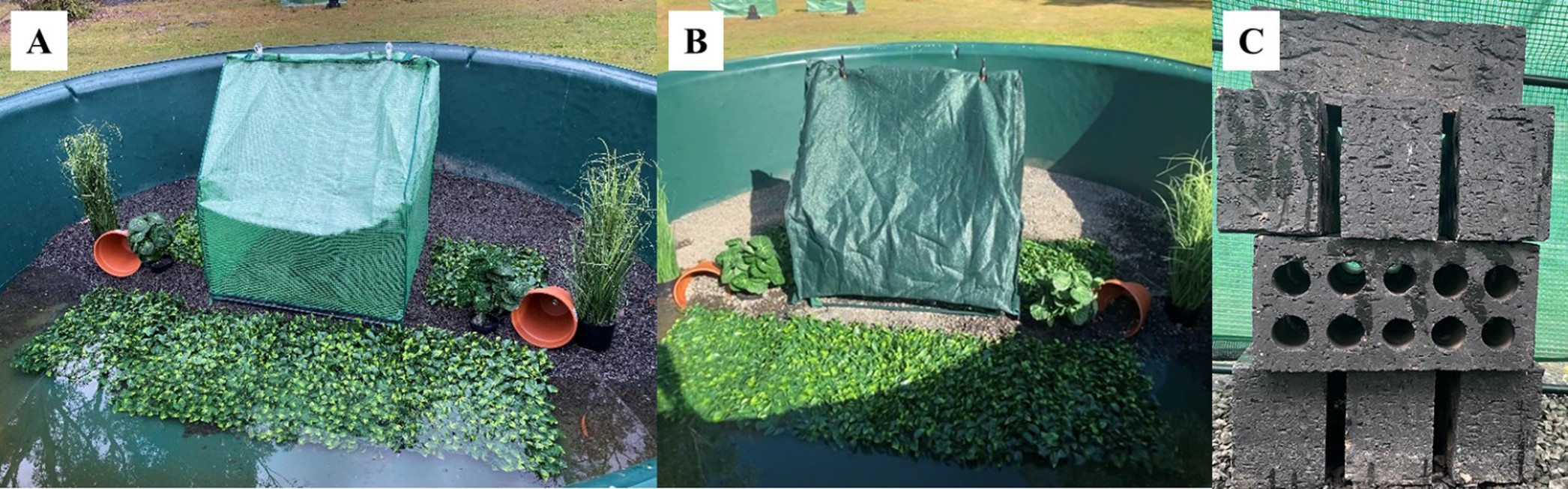
A mesocosm at the Macquarie University Fauna Park in Sydney with an unshaded greenhouse (A), a greenhouse under shade cloth (B) and the pile of black ten-hole bricks under it (C).2
- Follow-up designs. In Canberra, pyramids of twin-wall polycarbonate replaced greenhouses wrecked by wind. A trial compared sunny and shaded shelters for green and golden bell frogs.3
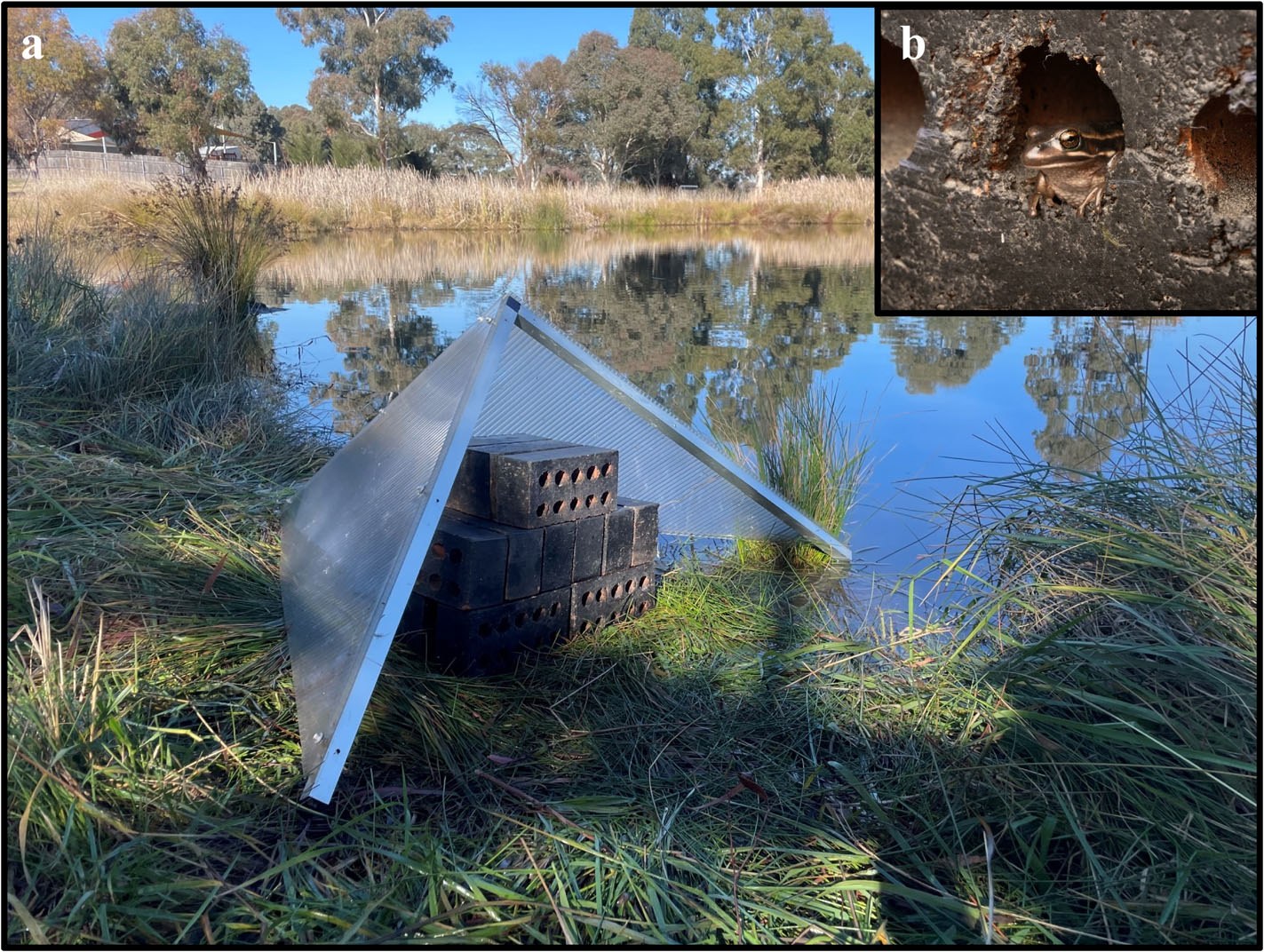
A pyramid of twin-wall polycarbonate over 15 black bricks at a wetland in Canberra, and a newly metamorphosed frog in a brick.3
- A cool site against a warm one. A study compared shelter temperatures at Werribee in 2022 with those in Sydney in 2021.1
- Other shelters. In upland rainforest in Queensland's Paluma Range, a study compared concrete and timber shelters for robust whistling frogs.4 Near Budapest, mains-powered heaters warmed floating shelters for common toad tadpoles.5
Salt
- In the laboratory, salt slowed Bd and lowered loads. Sodium chloride above 3 ppt slowed Bd growth and zoospore movement in culture without killing the fungus. At the University of Newcastle in New South Wales, juvenile Peron's tree frogs (Litoria peronii) survived infection better at 3 and 4 ppt than at 0 and 1 ppt, although loads rose again at 5 ppt.6 Striped marsh frog (Limnodynastes peronii) tadpoles kept at 2 to 5 ppt carried lower loads than tadpoles at 0 ppt.7
- In the field, the evidence is weaker. On Kooragang Island in the lower Hunter, New South Wales, loads in eastern dwarf tree frogs (Litoria fallax) fell as pond salinity rose across ten water bodies with mean salinity of up to 3.1 ppt.7 In created ponds at the Hunter Wetland Centre, salt improved the survival of released green and golden bell frogs but did not change their loads.8 In a created habitat on Kooragang Island, salinity showed no link with infection or load.9 In outdoor mesocosms near the mouth of the Hunter River in 2013, salinity of 3.5 to 4.5 ppt reduced the odds of infection by 22%, but the result was not statistically clear (p = 0.09), and the treatment cured no frogs. Survival rose because frogs released without infection survived better (0.34 compared with 0.20). All survivors cleared infection as mean weekly water temperature rose from about 13 to 25 °C. The paper's abstract reverses the overall survival values.10
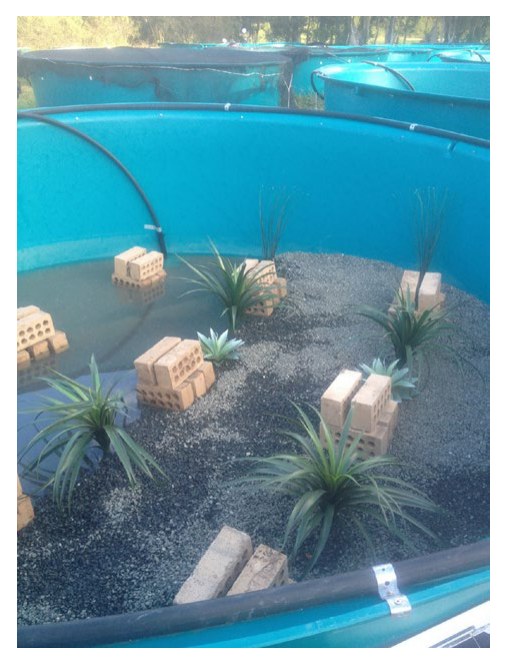
An experimental mesocosm near the mouth of the Hunter River, New South Wales, with refuges of brick piles and plastic plants beside the water.10
- Salt and heat together. A review suggests combining salt with heat, but the combined treatment has not been tested.11 Warmth clears infection, so a sauna beside or over a spa would offer both.
The Species and the Region
- Infection falls in warmer water. From 2004 to 2006, researchers studied stream pools and a quarry in the Merri Creek catchment on Melbourne's northern outskirts. At the freshest site, the probability that a sub-adult or adult growling grass frog was infected fell from 0.78 in 13 °C water to 0.20 at 27 °C.12
- Populations persist where prevalence stays low. Researchers surveyed 214 wetlands north of Melbourne over 11 seasons, from 2001/02 to 2011/12. Annual persistence exceeded 0.93 where predicted prevalence stayed below one third. In cool, low-salinity wetlands with the highest predicted prevalence, persistence fell to 0.29.13
- The decline continues. At sites in the Darebin, Merri and Moonee Ponds catchments on Melbourne's northern fringe, the number of occupied sites fell from 82 to 51 of 211 (38%) over 20 years. In the simulation, Bd and urbanisation together reduced equilibrium occupancy by 69%.14
- Management. By 2021, no field experiment had manipulated habitat for the species.15 A 30-year simulation of four Melbourne metapopulations found that up to five new refuge wetlands could reduce extinction probability by 85% under Melbourne's climate, compared with 32% for changes to up to five existing wetlands. The new wetlands were up to 3 m deep, lacked tree or shrub cover and matched the salinity of the nearest groundwater-fed site. Under a highland climate like that of Cooma at 778 m, the reductions were 41% and 4% respectively. The authors also suggest thermal ponds or hot rocks as small-scale options.16 A review of chytridiomycosis management for Australian frogs argues that targeted local interventions can buy time.11
The Pathogen's Temperatures
- Growth stops near 28 °C in culture. In culture at the University of Maine, Bd isolates grew fastest at 17 to 25 °C and stopped growing at 28 °C. Eight days at 30 °C killed half the cultures.17
- Heat clears infection, at a dose. In environmental chambers at Tulane University, Louisiana, 10 days at 30 °C, with frog water averaging 28.5 °C, cleared naturally infected American bullfrogs (Rana catesbeiana) and northern cricket frogs (Acris crepitans). Six days after treatment, 27 of 28 frogs tested negative on a single swab.18 Daily heat pulses, like those a frog might experience during visits to a warm shelter, also cleared infection in the laboratory. Researchers exposed juvenile spotted tree frogs (Litoria spenceri) to daily four-hour pulses from 18 to 29 °C, based on the body temperatures of wild green-eyed tree frogs (Litoria serrata). By day 36, the pulsed frogs carried far lighter loads than frogs held at 18 °C (means of 4,649 compared with 73,740 zoospore genome equivalents). Of the 11 frogs followed to day 76, 10 tested negative twice. The six most heavily infected frogs in each regime had been removed on day 36 for another study. The authors propose artificial heat sources for wild frogs.19
- Infection can return. In captivity at Macquarie University, infection returned in 4 of 13 Australian green tree frogs (Litoria caerulea) 30 days after several weeks in rooms at 28 to 34 °C. During treatment, the frogs' temperatures were 3.9 °C below room temperature.20
The Melbourne Problem
- The Sydney design falls short at Werribee. The shelter exceeded 25 °C for an hour on 8 of 61 winter days at Werribee in 2022. It reached that threshold on only 2 of the 14 days when air temperature peaked above 15.5 °C and solar exposure exceeded 7 MJ/m². Under those conditions, the same design inside mesocosm tubs in Sydney exceeded 25 °C for an hour on 33 of 34 days in 2021. This comparison spans two years and two settings without statistical testing. The authors suggest that Werribee was windier but had no wind data.1
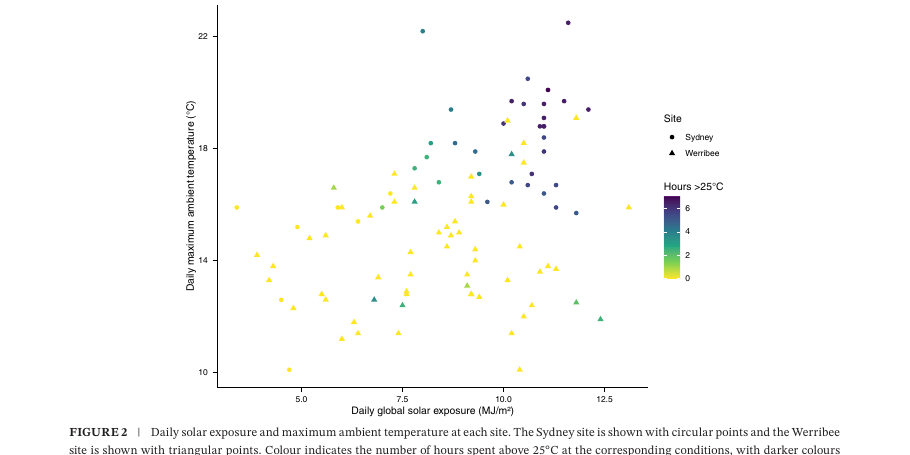
Daily solar exposure against the daily maximum air temperature in Sydney and at Werribee, with each day coloured by the hours the shelter spent above 25 °C.1
Where to Place the Units
- Human-made habitats. Most core breeding sites for growling grass frogs around Melbourne are human-made. In the Pakenham growth corridor on Melbourne's south-eastern fringe in 2005/06, occupied waterbodies, mostly farm dams, averaged 32% submerged vegetation cover compared with 6% at unoccupied waterbodies. Of the occupied waterbodies, 64% lay within 200 m of another occupied waterbody.21
- Wetland networks. Design standards from the Victorian environment department specify new wetlands of at least 3000 m², spaced 200 to 300 m apart, for seven corridors on Melbourne's urban fringe. An occupancy model selected among candidate sites.22 In a simulation of growling grass frog metapopulations in Melbourne, connectivity correlated more strongly with extinction than wetland size did (r = −0.85 compared with −0.55).16 Units should therefore sit within connected networks near occupied water.
Biological Specification
- Targets. Targets come from records of water temperature and infection in this species.12 Upper limits can initially draw on 1970 measurements of five frogs that were probably growling grass frogs, as described below. Until measurements exist for growling grass frogs, preferred temperatures must come from their relative, the green and golden bell frog.
- Preferences in a relative. In thermal gradients, 73 green and golden bell frogs selected 29.0 ± 3.9 °C.2 A range of 28 to 36 °C has been proposed for that species, although the authors call its required range unknown.3
- Upper thermal limits. A 1970 study heated wild-caught frogs listed as Hyla aurea. It recorded the temperature at which each frog could no longer right itself and the temperature at which it began to spasm.23 After acclimation at 10 °C, five frogs from Gosford, New South Wales, reached these limits at 33.6 °C and 35.1 °C. Four frogs from Wilson's Promontory, Victoria, reached them at 34.5 °C and 35.6 °C. After acclimation at 30 °C, frogs from Wilson's Promontory reached them at 36.2 °C and 37.0 °C. Single frogs from Buchan and Warrenbayne, Victoria, could no longer right themselves at 34.2 °C and 30.0 °C, respectively, after acclimation at 10 °C.23 A 1975 revision separated the growling grass frog (Litoria raniformis) from the green and golden bell frog (L. aurea).24 It recorded the green and golden bell frog in Victoria only in East Gippsland, near Orbost and Cann River.24 The frogs from Wilson's Promontory and Warrenbayne were therefore probably growling grass frogs. The Buchan frog, from East Gippsland, could have been either species. The Gosford frogs were green and golden bell frogs. The AmphiTherm database lists the Gosford and Wilson's Promontory values under the green and golden bell frog.25 It adds an onset of spasms at 36.7 °C after acclimation at 25 °C from a second study that placed the frogs near Adelaide, South Australia.26 A global study predicts upper thermal limits for 4,679 species that have not been measured.27
- Warmth and infection in relatives. At the University of Newcastle in New South Wales, juvenile green and golden bell frogs exposed to Bd survived to day 48 far more often at 24 °C than at 12 °C (90% compared with 30%, with 20 frogs per group). At 24 °C, their loads stayed level rather than clearing.28 Along four rainforest streams in north Queensland in 2004 and 2005, 128 tracked frogs from three species, Litoria lesueuri, L. serrata and L. nannotis, were less likely to carry Bd as the share of their body-temperature readings above 25 °C increased. The fitted model predicted little infection where three quarters of readings exceeded 25 °C. Each frog was swabbed once, before its temperatures were recorded. The authors therefore leave cause and effect unresolved.29
In and Around the Units
- Where frogs are. Along the Merri Creek corridor in late summer 2003, growling grass frogs were found at night on bare soil or bank-side rock near water, while avoiding dense ground vegetation. At stream sites, they mostly used floating or submerged mats (60% of observations).30 At 90 drought refuges across regional Victoria from 2006 to 2008, occupancy fell as conductivity increased and tended to rise with aquatic vegetation.31 Frogs must cross the ground and water's edge between a pool and a sauna to reach a unit.
- Water and the frogs' own moisture. Frogs exchange water with a shelter's air and substrate, yet no study of hotspot shelters has reported humidity or water loss. One study used a middle-layer logger that could record humidity, but the paper reports none.3 A heat-and-water model of the northern leopard frog (Rana pipiens), checked against live frogs in a University of Wisconsin laboratory, predicted that a 60 g frog on a dry surface in full summer sun, at 25 °C and 30% humidity, would reach assumed lethal dehydration of 35% within 206 minutes in air moving at 0.1 m/s. At 3 m/s, it would reach that point within 87 minutes. Saturated soil prevented death in every case. In the same model, full June sun raised the frog's core temperature only 2.5 °C above that in shade but doubled its evaporation. The author notes that wet soil stays cool as it evaporates.32 A soaked brick pile stayed at 92 to 100% humidity.33 A copper model in a wet sleeve tracks evaporation.34 Among 12 tree frog species from around Darwin, frogs with higher skin resistance selected warmer temperatures.35 A sauna therefore needs a wet base or contact with water. It also needs humid, still air, checked with wet and dry models.
- Wet refuges can raise infection. At ten sites in central Victoria in 2022 and 2023, across two seasons without drought, Bibron's toadlets (Pseudophryne bibronii) beneath drip-watered stacks of roof tiles were infected with Bd more often than toadlets in unwatered tiles or natural refuges. Infection rose with soil moisture, while soil temperature showed no clear effect.36 It remains untested whether a warm, wet base offsets this risk.
Salt Band for Spas, by Species
- Green and golden bell frogs. In created ponds at the Hunter Wetland Centre, salinity of 2 and 4 ppt increased survival (75% and 67% compared with 46% at 0 ppt).8 On Kooragang Island, wild frogs left salted ponds once salinity exceeded 5 ppt.9
- Growling grass frogs. Surveys of adults at 90 drought refuges across regional Victoria found none above about 4000 µS/cm.31 For Melbourne's northern outskirts, one study identifies moderately saline wetlands, up to 5000 µS/cm, as possible refuges worth protecting. It advises managers to address water temperature first and to trial salt, such as bore water, only as a management experiment. One study population occupied a warm, spring-fed quarry in Campbellfield at 4922 µS/cm.12
- The conversion. Using the endpoints of one study's conversion, 4000 to 5000 µS/cm is roughly 2 to 3 ppt.13 Doses of 3.5 to 4.5 ppt used for green and golden bell frogs10 would therefore exceed the salinity at which growling grass frogs are known to occur.
- The specification. Specify spas by conductivity, below about 4000 to 5000 µS/cm, while recognising that eggs and larvae may have lower tolerance.37 Keep salt from leaking into nearby fresh water.
Spa, Neighbours and Materials
- A spa is a microclimate. Depth, lining colour, cover, shading and inflow determine its temperature and salinity. Salted ponds on Kooragang Island rose from about 3 to 9.1 ppt in summer, then fell below 5 ppt after autumn rain.9 At the Hunter Wetland Centre, 2000 L troughs overshot their target salinity, whereas ponds 1.2 to 1.7 m deep did not.8 Heating whole outdoor mesocosms increased their temperature by no more than 0.5 °C.10 By contrast, heaters kept a 448 cm² floating shelter near 29.8 °C while its 120 L tub warmed by only 0.7 °C.5 A spa can therefore contain a small warm zone.
- Non-target species. Common eastern froglets (Crinia signifera), a reservoir host of Bd,9 used the shelters in Canberra.3 A review reports a study in which exposure to 0.75 to 5 ppt for four weeks did not change Bd levels in the froglets.37 At the Hunter Wetland Centre, 4 ppt reduced numbers of eastern dwarf tree frogs, dragonfly larvae and damselfly larvae.8
- Materials in water. On a test bench using tank rainwater from northern Sydney, a new concrete pipe raised the water's pH from 6.3 to 8.0 within 100 minutes, while an epoxy coating kept it at 6.7.38 In climate-chamber cycles with sodium sulfate, salt crystallisation in pores damaged Portland limestone.39 The durability of brick, concrete and printed clay in sodium chloride is therefore a material-library test.
- Design variables. Saunas: cover shape and material, thermal mass and colour, layers and internal chambers, entrances, moisture sources, ground contact, night insulation, siting, seasonal shading or venting. Spas: depth and buffer volume, lining colour and material, cover, shading, inflow, salt dose and top-up, overflow and leakage to fresh water, distance to the sauna.
Plan
The plan runs in eight phases:
- Measure a baseline at candidate sites.
- Build sketch prototypes on site without frogs: instrumented replicas of the Sydney and Canberra designs and a first spa.
- Test small samples of each material for conductivity, reflectance, salt damage and leaching into water. Test components and partial sections in a climate chamber that replays the temperatures recorded in the field.
- Model the shelter and pool parametrically so routines can vary form, material, orientation and arrangement automatically. Calibrate the thermal models against logs from prototypes heated in a set sequence.
- Generate variants with computational design techniques that DDL has used for habitat structures: generative design with parametric modelling,40 artificial intelligence that abstracts natural forms,41 and configurators with adjustable parameters.42 Screen the variants with the calibrated models. Score each by the thermal choice it offers frogs over a winter day. Retain a varied set of high-scoring variants for field trials.
- Fabricate full prototypes, scan each one, keep an empty twin beside each occupied prototype, and design inspections that leave the pile intact.
- Test in the field, first without frogs and then with frogs under animal ethics approval.
- Evaluate with transmission models and with data on infection and survival. Record what each result changed, then redesign.
Replica dimensions differ between the source papers.2, 1 An empty twin can isolate an occupant's effect.43 Inspections in Canberra required the pile to be dismantled,3 whereas chambered concrete shelters in Queensland had removable plugs for viewing frogs and nests.4 Chamber replays lack solar radiation.44
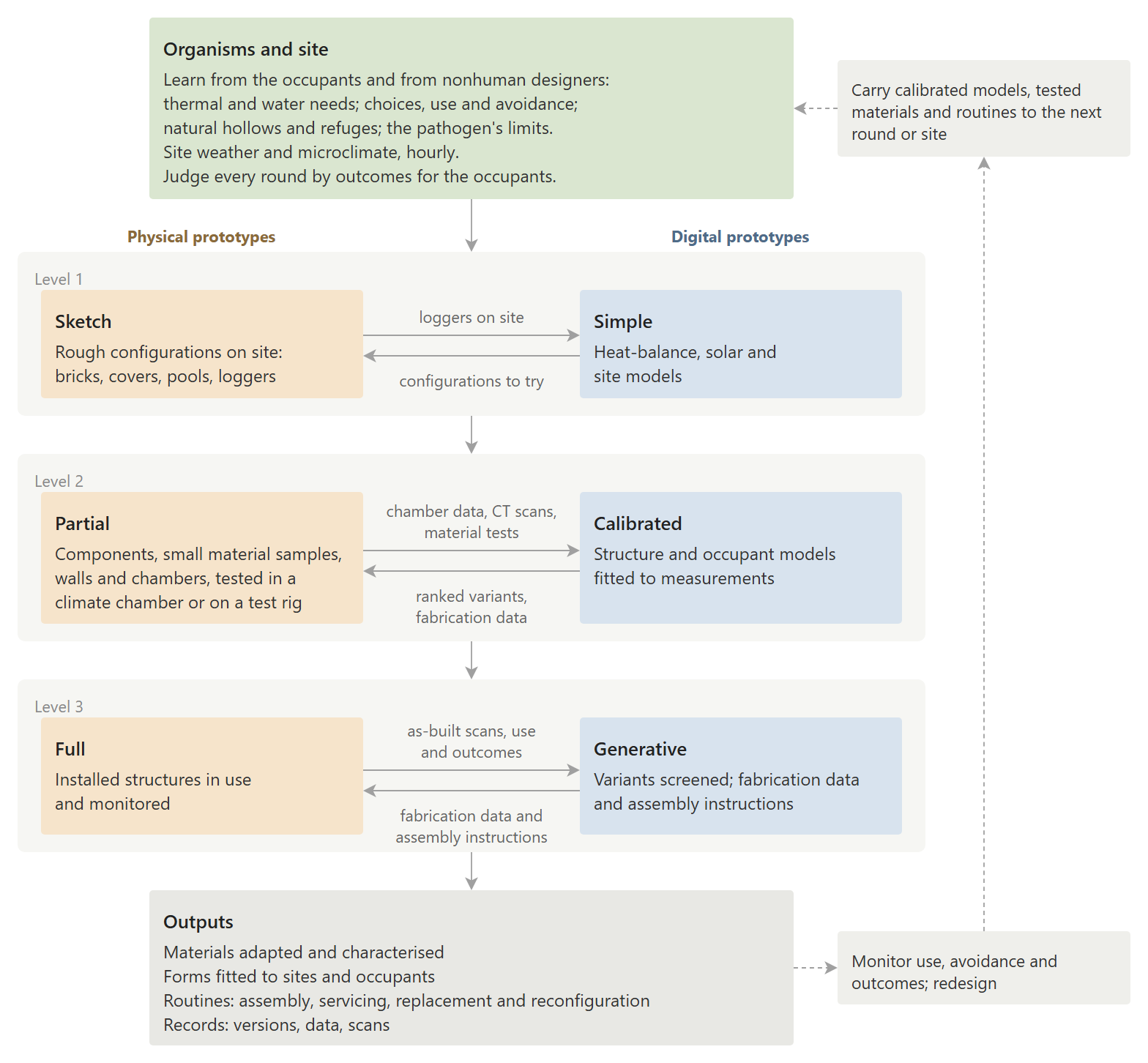
The cycle of physical and digital prototypes that the plan follows, from Microclimate Design.
- Generative design. Computational design can explore more options with less effort than drafting by hand. That capacity supports the expansion of design potential described in Design Potential (Private). Designs that fail the frogs in the field drop out of the next round, so the designs can evolve with the frogs and other species at the sites. Once DDL recalibrates the models with field results, it can quickly run new rounds for another site, thermal environment or species. Shared design variables, outcome measures, open data and open standards would let other teams reuse and retest designs, build them at larger scales or use them in teaching. DDL's online configurator already lets residents and community groups adjust habitat structures to their sites.42 The benefits table in Microclimate Design sets out how to test these claims.
- Measurement. Inside each unit, record temperature at every layer, use fine thermocouples for air in the sun, and track humidity with paired wet and dry frog models. Around each unit, measure the ground and the water's edge between pool and sauna. Use a reference station in the open and keep an empty twin beside each occupied unit. Also record pool temperature, conductivity and level; as-built scans; occupancy by camera or PIT tag, with counts for every species; and infection and survival through capture-recapture. Paired agar models tracked three rainforest frog species in north-eastern Queensland.45 Copper-sleeve models log water loss.34 Check loggers against a reference thermometer, as in a study of treefrogs (Scinax) in south-eastern Brazil.46
- What the pilot could measure. To test whether more frogs reach temperatures that suppress Bd in winter, measure the share of winter days with at least N hours in the target band, compared with 13.1% at Werribee for the Sydney design. To test whether harmful conditions decrease, measure hours above the upper limit without a cooler zone and minimum humidity where frogs occur. For spa water, measure hours in the target temperature band and days within the conductivity range.1
- Routines. Test each routine on prototypes before frogs use the units: add salt in stages while stirring and topping up; clean units and follow Bd biosecurity; vent or shade seasonally; replace covers after wind; and swap loggers. Wind wrecked covers in Canberra.3 An overdose in a large water body can be difficult to reverse, so add salt in stages.8
- Limits. The heat dose that clears Bd in the field is unknown;3, 20 most evidence for the salt band comes from green and golden bell frogs; and Bd biosecurity, animal ethics and permit requirements constrain trials.
References
Footnotes
Holmes, Madeleine L., Shannon W. Kaiser, Sneha S. Basu, Lee Berger, Lee F. Skerratt, Richard Shine, and Anthony W. Waddle. “Disease Refuge or Ecological Trap: Location-Specific Performance of Amphibian Hotspot Shelters.” Ecology and Evolution 16, no. 4 (2026): e72590. https://doi.org/10.1002/ece3.72590.˄
Waddle, Anthony W., Simon Clulow, Amy Aquilina, Erin L. Sauer, Shannon W. Kaiser, Claire M. Miller, Jennifer A. Flegg, et al. “Hotspot Shelters Stimulate Frog Resistance to Chytridiomycosis.” Nature 631, no. 8020 (2024): 344–49. https://doi.org/10.1038/s41586-024-07582-y.˄
Lawler, Ewen K., Richard P. Duncan, Jarrod Sopniewski, Ben C. Scheele, and Simon Clulow. “A Simple, Robust, and Inexpensive Design for Creating Thermal Refugia to Protect Amphibians from Batrachochytrium dendrobatidis in the Field.” Conservation Science and Practice, 2026, e70424. https://doi.org/10.1111/csp2.70424.˄
Groffen, Jordy, Lyanne Brouwer, Myles H. M. Menz, and Conrad J. Hoskin. “Artificial Shelters as a Monitoring and Conservation Tool for Terrestrial Breeding Frogs.” Ecology and Evolution 16, no. 3 (2026): e73215. https://doi.org/10.1002/ece3.73215.˄
Kásler, Andrea, János Ujszegi, Dávid Herczeg, Dóra Holly, Zsanett Mikó, and Attila Hettyey. “Heated Aquatic Shelters Reduce Infection Intensity but Not Prevalence of a Fungal Pathogen in Common Toad Tadpoles.” Animal Conservation 28, no. 6 (2025): 844–53. https://doi.org/10.1111/acv.70012.˄
Stockwell, Michelle P., John Clulow, and Michael Mahony. “Sodium Chloride Inhibits the Growth and Infective Capacity of the Amphibian Chytrid Fungus and Increases Host Survival Rates.” PLoS ONE 7, no. 5 (2012): e36942. https://doi.org/10.1371/journal.pone.0036942.˄
Stockwell, Michelle P., John Clulow, and Michael Mahony. “Evidence of a Salt Refuge: Chytrid Infection Loads Are Suppressed in Hosts Exposed to Salt.” Oecologia 177, no. 3 (2015): 901–10. https://doi.org/10.1007/s00442-014-3157-6.˄
Stockwell, Michelle P., Lachlan James Storrie, Carla Jean Pollard, John Clulow, and Michael Mahony. “Effects of Pond Salinization on Survival Rate of Amphibian Hosts Infected with the Chytrid Fungus.” Conservation Biology 29, no. 2 (2015): 391–99. https://doi.org/10.1111/cobi.12402.˄
Klop-Toker, Kaya L., Jose W. Valdez, Michelle P. Stockwell, Matthew E. Edgar, Loren Fardell, Simon Clulow, John Clulow, and Michael Mahony. “Assessing Host Response to Disease Treatment: How Chytrid-Susceptible Frogs React to Increased Water Salinity.” Wildlife Research 44, no. 8 (2017): 648–59. https://doi.org/10.1071/wr16145.˄
Clulow, Simon, John Gould, Hugh James, Michelle P. Stockwell, John Clulow, and Michael Mahony. “Elevated Salinity Blocks Pathogen Transmission and Improves Host Survival from the Global Amphibian Chytrid Pandemic: Implications for Translocations.” Journal of Applied Ecology 55, no. 2 (2018): 830–40. https://doi.org/10.1111/1365-2664.13030.˄
Berger, Lee, Lee F. Skerratt, Tiffany A. Kosch, Laura A. Brannelly, Rebecca J. Webb, and Anthony W. Waddle. “Advances in Managing Chytridiomycosis for Australian Frogs: Gradarius firmus victoria.” Annual Review of Animal Biosciences 12, no. 1 (2024): 113–33. https://doi.org/10.1146/annurev-animal-021122-100823.˄
Heard, Geoffrey W., Michael P. Scroggie, Nick Clemann, and David S. L. Ramsey. “Wetland Characteristics Influence Disease Risk for a Threatened Amphibian.” Ecological Applications 24, no. 4 (2014): 650–62. https://doi.org/10.1890/13-0389.1.˄
Heard, Geoffrey W., Chris D. Thomas, Jenny A. Hodgson, Michael P. Scroggie, David S. L. Ramsey, and Nick Clemann. “Refugia and Connectivity Sustain Amphibian Metapopulations Afflicted by Disease.” Ecology Letters 18, no. 8 (2015): 853–63. https://doi.org/10.1111/ele.12463.˄
Heard, Geoffrey W., Peter Robertson, Michael P. Scroggie, Kirsten M. Parris, Michael A. McCarthy, Claire Keely, Matt West, and Ben C. Scheele. “Synergies between Disease and Urbanization Drive the Decline of Threatened Amphibian Metapopulations.” Ecological Applications 36, no. 2 (2026): e70217. https://doi.org/10.1002/eap.70217.˄
Brannelly, Laura A., Hamish I. McCallum, Laura F. Grogan, Cheryl J. Briggs, Maria P. Ribas, Matthijs Hollanders, Thais Sasso, Mariel Familiar López, David A. Newell, and Auston M. Kilpatrick. “Mechanisms Underlying Host Persistence Following Amphibian Disease Emergence Determine Appropriate Management Strategies.” Ecology Letters 24, no. 1 (2021): 130–48. https://doi.org/10.1111/ele.13621.˄
Heard, Geoffrey W., Michael P. Scroggie, David S. L. Ramsey, Nick Clemann, Jenny A. Hodgson, and Chris D. Thomas. “Can Habitat Management Mitigate Disease Impacts on Threatened Amphibians?” Conservation Letters 11, no. 2 (2018): e12375. https://doi.org/10.1111/conl.12375.˄
Piotrowski, Jeffrey S., Seanna L. Annis, and Joyce E. Longcore. “Physiology of Batrachochytrium dendrobatidis, a Chytrid Pathogen of Amphibians.” Mycologia 96, no. 1 (2004): 9–15. https://doi.org/10.1080/15572536.2005.11832990.˄
Chatfield, Matthew W. H., and Corinne L. Richards-Zawacki. “Elevated Temperature as a Treatment for Batrachochytrium dendrobatidis Infection in Captive Frogs.” Diseases of Aquatic Organisms 94, no. 3 (2011): 235–38. https://doi.org/10.3354/dao02337.˄
Greenspan, Sasha E., Deborah S. Bower, Rebecca J. Webb, Elizabeth A. Roznik, Lisa A. Stevenson, Lee Berger, Gerry Marantelli, David A. Pike, Lin Schwarzkopf, and Ross A. Alford. “Realistic Heat Pulses Protect Frogs from Disease under Simulated Rainforest Frog Thermal Regimes.” Functional Ecology 31, no. 12 (2017): 2274–86. https://doi.org/10.1111/1365-2435.12944.˄
Holmes, Madeleine L., Richard Shine, and Anthony W. Waddle. “Spontaneous Reoccurrence of Batrachochytrium dendrobatidis Infections in Australian Green Tree Frogs (Litoria caerulea) Following Apparently Successful Heat Therapy: Case Report.” Veterinary Research Communications 48, no. 5 (2024): 3229–37. https://doi.org/10.1007/s11259-024-10449-2.˄
Hamer, Andrew J., and Aaron Organ. “Aspects of the Ecology and Conservation of the Growling Grass Frog Litoria raniformis in an Urban-Fringe Environment, Southern Victoria.” Australian Zoologist 34, no. 3 (2008): 393–407. https://doi.org/10.7882/az.2008.017.˄
Scroggie, Michael P., Kathy Preece, Emily Nicholson, Michael A. McCarthy, Kirsten M. Parris, and Geoffrey W. Heard. “Optimizing Habitat Management for Amphibians: From Simple Models to Complex Decisions.” Biological Conservation 236 (2019): 60–69. https://doi.org/10.1016/j.biocon.2019.05.022.˄
Brattstrom, Bayard H. “Thermal Acclimation in Australian Amphibians.” Comparative Biochemistry and Physiology 35, no. 1 (1970): 69–103. https://doi.org/10.1016/0010-406X(70)90915-1.˄
Courtice, Gillian P., and Gordon C. Grigg. “A Taxonomic Revision of the Litoria aurea Complex (Anura: Hylidae) in South-Eastern Australia.” Australian Zoologist 18, no. 3 (1975): 149–63.˄
Pottier, Patrice, Rachel R. Y. Oh, Pietro Pollo, Aquetzalli Nayelli Rivera-Villanueva, Yefeng Yang, Sarah Varon, Ana V. Longo, et al. “AmphiTherm: A Comprehensive Database of Amphibian Thermal Tolerance and Preference.” Scientific Data 12, no. 1 (2025): 1987. https://doi.org/10.1038/s41597-025-06286-w.˄
Johnson, C. R. “Thermal Relations in Some Southern and Eastern Australian Anurans.” Proceedings of the Royal Society of Queensland 82 (1971): 87–94.˄
Pottier, Patrice, Michael R. Kearney, Nicholas C. Wu, Alex R. Gunderson, Julie E. Rej, Aquetzalli Nayelli Rivera-Villanueva, Pietro Pollo, Samantha Burke, Szymon M. Drobniak, and Shinichi Nakagawa. “Vulnerability of Amphibians to Global Warming.” Nature 639, no. 8056 (2025): 954–61. https://doi.org/10.1038/s41586-025-08665-0.˄
Campbell, Lachlan, Deborah S. Bower, Simon Clulow, Michelle P. Stockwell, John Clulow, and Michael Mahony. “Interaction between Temperature and Sublethal Infection with the Amphibian Chytrid Fungus Impacts a Susceptible Frog Species.” Scientific Reports 9, no. 1 (2019): 83. https://doi.org/10.1038/s41598-018-35874-7.˄
Rowley, Jodi J. L., and Ross A. Alford. “Hot Bodies Protect Amphibians against Chytrid Infection in Nature.” Scientific Reports 3, no. 1 (2013): 1515. https://doi.org/10.1038/srep01515.˄
Heard, Geoffrey W., Peter Robertson, and Michael P. Scroggie. “Microhabitat Preferences of the Endangered Growling Grass Frog Litoria raniformis in Southern Victoria.” Australian Zoologist 34, no. 3 (2008): 414–25. https://doi.org/10.7882/az.2008.019.˄
Clemann, Nick, Michael P. Scroggie, Michael J. Smith, Garry N. L. Peterson, and David A. Hunter. “Characteristics of Refugia Used by the Threatened Australian Growling Grass Frog (Litoria raniformis) during a Prolonged Drought.” Wildlife Research 40, no. 5 (2013): 385–92. https://doi.org/10.1071/wr13058.˄
Tracy, C. Richard. “A Model of the Dynamic Exchanges of Water and Energy between a Terrestrial Amphibian and Its Environment.” Ecological Monographs 46, no. 3 (1976): 293–326. https://doi.org/10.2307/1942256.˄
Hamer, Andrew J., Simon J. Lane, and Michael Mahony. “Retreat Site Selection during Winter in the Green and Golden Bell Frog, Litoria aurea Lesson.” Journal of Herpetology 37, no. 3 (2003): 541–45. https://doi.org/10.1670/85-02an.˄
Bartelt, Paul E., and Charles R. Peterson. “Physically Modeling Operative Temperatures and Evaporation Rates in Amphibians.” Journal of Thermal Biology 30, no. 2 (2005): 93–102. https://doi.org/10.1016/J.JTHERBIO.2004.07.007.˄
Tracy, Christopher R., and Keith A. Christian. “Preferred Temperature Correlates with Evaporative Water Loss in Hylid Frogs from Northern Australia.” Physiological and Biochemical Zoology 78, no. 5 (2005): 839–46. https://doi.org/10.1086/432151.˄
Driscoll, Don A., Muhammad Jawad Jilani, and Laura Stanic. “Environmental Watering Elevates Chytrid Infection Probability in Frogs.” Ecosphere 17, no. 3 (2026): e70447. https://doi.org/10.1002/ecs2.70447.˄
Relyea, Rick A., and Emily Le Sage. “Creating Salt Refuges to Protect Amphibians from Chytridiomycosis: First, Do No Harm.” Frontiers in Amphibian and Reptile Science 2 (2024): 1465754. https://doi.org/10.3389/famrs.2024.1465754.˄
Grella, Chiara, Ian A. Wright, Sophia J. Findlay, and Olof J. Jonasson. “Geochemical Contamination of Urban Water by Concrete Stormwater Infrastructure: Applying an Epoxy Resin Coating as a Control Treatment.” Urban Water Journal 13, no. 2 (2016): 212–19. https://doi.org/10.1080/1573062x.2014.951660.˄
Flatt, Robert J., Francesco Caruso, Asel Maria Aguilar Sanchez, and George W. Scherer. “Chemo-Mechanics of Salt Damage in Stone.” Nature Communications 5, no. 1 (2014): 4823. https://doi.org/10.1038/ncomms5823.˄
Parker, Dan, Stanislav Roudavski, Therésa M. Jones, Nick Bradsworth, Bronwyn Isaac, Martin T. Lockett, and Kylie Soanes. “A Framework for Computer-Aided Design and Manufacturing of Habitat Structures for Cavity-Dependent Animals.” Methods in Ecology and Evolution 13, no. 4 (2022): 826–41. https://doi.org/10.1111/2041-210x.13806.˄
Mirra, Gabriele, Alexander Holland, Stanislav Roudavski, Jasper S. Wijnands, and Alberto Pugnale. “An Artificial Intelligence Agent That Synthesises Visual Abstractions of Natural Forms to Support the Design of Human-Made Habitat Structures.” Frontiers in Ecology and Evolution 10 (2022): 806453. https://doi.org/10.3389/fevo.2022.806453.˄
Parker, Dan, Kylie Soanes, Chiara Bettega, Luigi Marchesi, Paolo Pedrini, Chiara Fedrigotti, Mattia Brambilla, and Stanislav Roudavski. “An Online Tool to Design Custom Habitat-Structures with and for Tree-Dwelling Species.” In Proceedings of the International Conference on Construction, Energy, Environment and Sustainability, edited by Julieta António, Nuno Simões, and Michael A. Lacasse, 1–9. Funchal: Itecons, 2023. https://doi.org/10.5281/zenodo.14619371.˄
Roberts, Jenny, Philip Donkersley, Grace Kelly, Stephen Quayle, and Allan Rennie. “Engineering Design and Development of an Artificial Bumblebee Nestbox (BeeBox).” International Journal of Sustainable Engineering 19, no. 1 (2026): 2735277. https://doi.org/10.1080/19397038.2026.2735277.˄
Valverde Rojas, Maria Claudia, Joel Kimmich, Doris Österreicher, Leonie K. Fischer, and Jan Knippers. “Designing More-than-Human Thermal Comfort: Bio-Inspired Evaporative Cooling in Porous Facade Components for Cavity-Nesting Wild Bees.” Frontiers in Built Environment 12 (2026): 1750586. https://doi.org/10.3389/fbuil.2026.1750586.˄
Roznik, Elizabeth A., and Ross A. Alford. “Using Pairs of Physiological Models to Estimate Temporal Variation in Amphibian Body Temperature.” Journal of Thermal Biology 45 (2014): 22–29. https://doi.org/10.1016/j.jtherbio.2014.07.005.˄
Navas, Carlos A., and Cybele Araujo. “The Use of Agar Models to Study Amphibian Thermal Ecology.” Journal of Herpetology 34, no. 2 (2000): 330. https://doi.org/10.2307/1565438.˄
Backlinks