River
This note is about rivers as agents. It compares six conceptions of a river, from an ecosystem that scientists describe from outside to a plural living community whose members help to decide what the river is for. It then states the sixth conception in full, lists the capacities that this conception claims with the evidence for each, and applies the tests for agency that other notes in this vault set out. Birrarung applies the concept to one river. Multifunctionality explains how the choice of conception affects who benefits from a landscape. Water collects further sources on water.
Related Notes
- Agent, Water, Personhood, Anguillid Eels, Beaver
- Birrarung, Po, Multifunctionality, Econormativity
- Agency, Functional Account of Agency, Biological Individuality, Self
- Agentic Stair, Process Ontology, Design Potential (Private), Capabilities, Rights
- Niche, Collective Memory, Leadership, Deliberation, Indigenous
Six Conceptions of a River
Research and law describe rivers in at least six ways. Each later conception in the table attributes more to the river and to its members. The figure shows which conceptions three accounts use: the established concept of multifunctional landscapes, Birrarung (Yarra River) in Victorian law, and the proposal of this note.
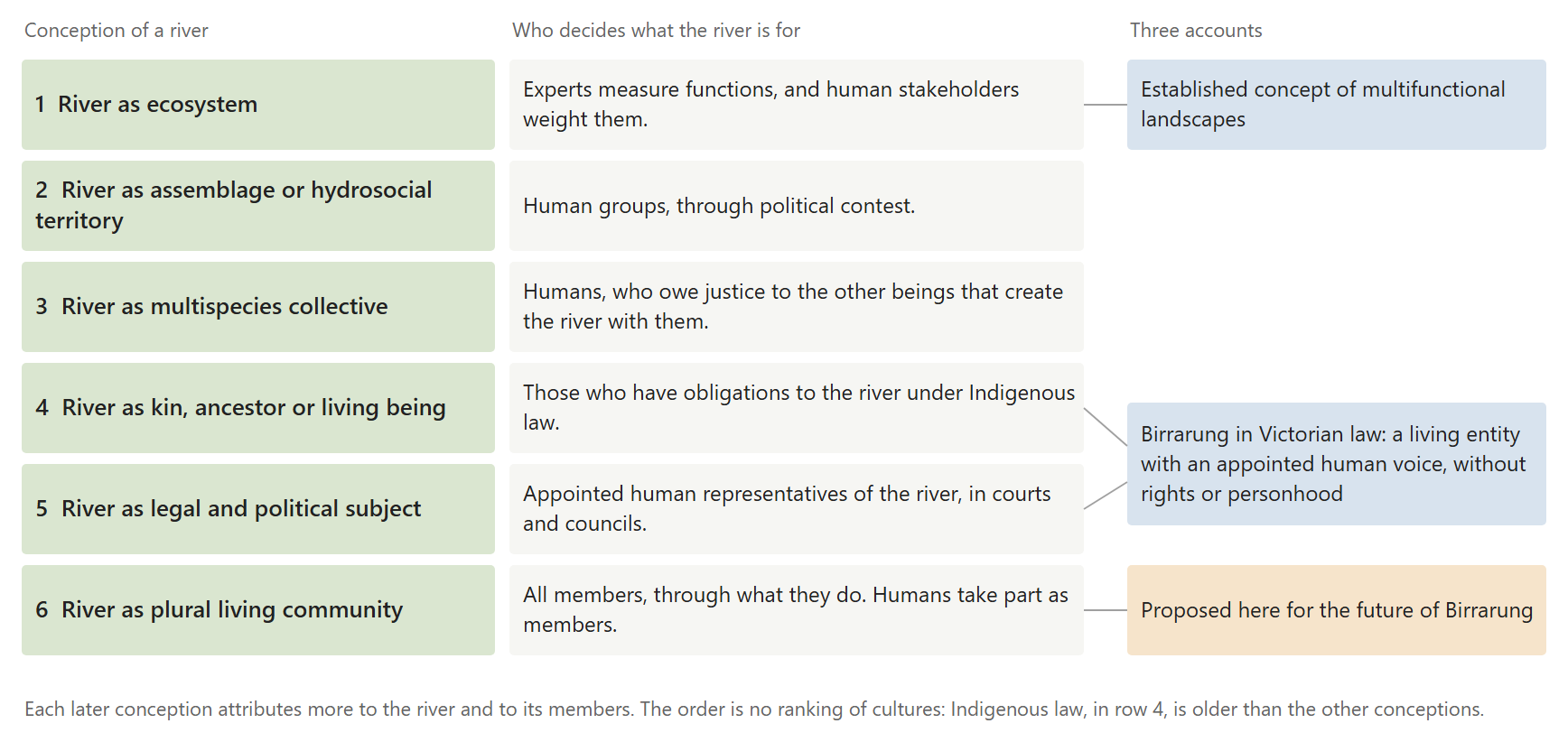
| Conception | What the river is | Who decides what the river is for | Example |
|---|---|---|---|
| 1 River as ecosystem | Living and non-living components that interact. Scientists describe them from outside. | Experts measure functions, and human stakeholders weight them. | Ecologists who measure ecosystem services define multifunctionality as the supply of services relative to human demand.1 |
| 2 River as assemblage or hydrosocial territory | A network in which water, organisms, dams, pipes, laws, money and cultural practices shape one another. No natural river exists apart from society. | Human groups, through political contest. | Political ecology defines hydrosocial territories as spatial configurations of humans, institutions, water flows, hydraulic technology and the biophysical environment that revolve around the control of water.2 Later work in the same tradition, on movements for water justice, treats rivers as arenas in which material, social and symbolic processes produce the river together.3 |
| 3 River as multispecies collective | A living territory that humans and other beings create, inhabit and reshape together. | Humans, who owe justice to the other beings that create the river with them. | A proposal for multispecies justice in river territories.4 |
| 4 River as kin, ancestor or living being | A relative or an ancestor. Human identity and the river constitute each other. Humans have obligations to the river. | Those who have the obligations, under Indigenous law. | Wiradjuri relations with three rivers.5 The First Law of the Martuwarra (Fitzroy River), which recognises the river as a living ancestral being from source to sea.6 |
| 5 River as legal and political subject | An indivisible living whole that law treats as a person, with rights, duties and appointed human representatives. | Appointed human representatives of the river, in courts and councils. | Te Awa Tupua, the Whanganui River in Aotearoa New Zealand.7 |
| 6 River as plural living community | Many agents, human and nonhuman, linked by their tendencies and life goals. They keep forming a collective as beings and processes join and leave it. | All members, through what they do. Humans take part as members. | Proposed in this note. |
Several points qualify the table.
- The order is no ranking of cultures. Indigenous law is older than the other conceptions. Within Wiradjuri law, legal personhood is a partial translation of obligations that precede it.5 In the Whanganui case, the Act mainly recognises Indigenous rights and the authority of Indigenous law.7
- Water planning can translate the fourth conception into the first. Researchers who worked with Traditional Owners of the Martuwarra and with state water planners drew two models of the same river. In one model, water is a resource for humans, and custodians are stakeholders. In the other model, called Living Waters, humans, plants, animals, ancestral beings and waters owe each other care. The planners fitted those relationships into a category of cultural values.8
- Kinship with a river also occurs outside Indigenous law. In interviews, about 70 residents of seven villages in the East Black Sea Region of Turkey described their relations with rivers. Resistance to small hydropower plants is strong in these villages, although the villagers need no river water for their crops or households. One villager called the river a neighbour and a relative. A newspaper quoted another villager, who called it a spouse.9 The study describes human experience and leaves open what other members of those rivers do.
- The fifth conception depends on human representatives. Law can recognise a river as living and still give it no rights. Worldwide, law recognises rivers as living in 16 cases, and five of these cases give the river no rights or personhood.10 Victorian law is one of the five. It takes the living entity from the fourth conception and the appointed human voice from the fifth (Birrarung). Where a river is a legal person, appointed humans speak for it. Personhood compares the legal tests for personhood. Ventriloquism Risk and Audit Requirements lists safeguards against the risk that representatives speak for themselves.
- Several conceptions can serve one study. Research with movements for water justice uses four ontologies together: the river as ecosociety, as territory, as subject and as movement.3
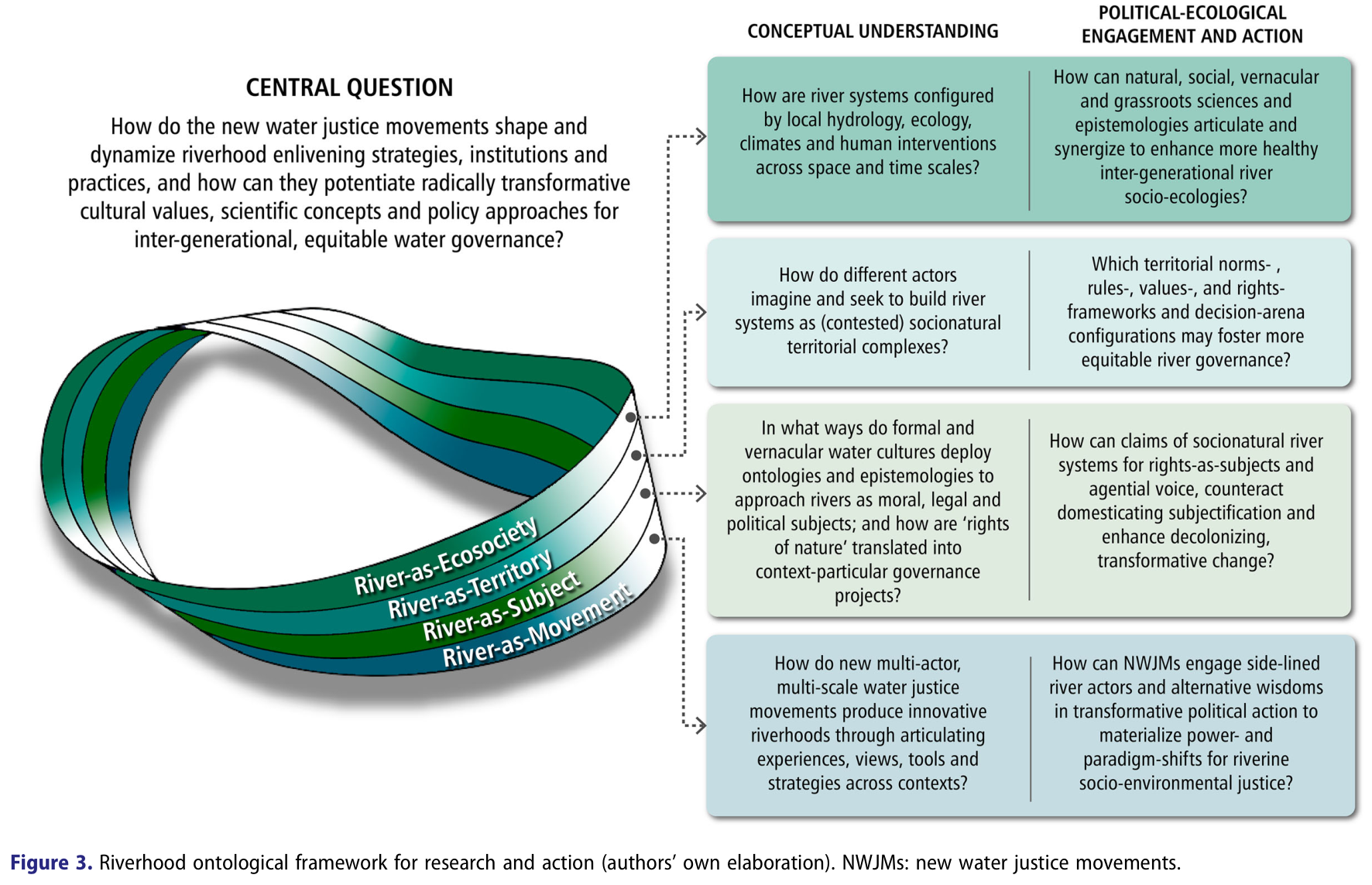
Boelens et al., 2023, figure 3, 1145.3
The River as a Plural Living Community
The sixth conception treats a river as a dynamical living being that is extended, distributed and plural. The working definition of Deep Design Lab is:
A river is a recursively constituted more-than-human collective that individuates through time, sometimes acquiring capacities to sense, remember, act and make claims through the heterogeneous beings and processes that compose it.
The collective in this definition is plural. The members of a river are many agents, and each has its own tendencies and life goals: to move, to feed, to grow, to breed and to persist. These goals link the members wherever they depend on the same water, sediment and seasons. The goals align only in part, so the collective has no single will. Agency gives the general account: parts form one agent while they work toward a shared target, and the goals of parts are not always aligned.
The terms of the definition have plain meanings.
- Collective. Many beings and processes act together. No single member is the river, and no single voice speaks for all members.
- Recursively constituted. Each member is a collective, and the river is a member of larger collectives. A bacterium can be an agent within an eel, the eel within a river, the river within its catchment, and the catchment within atmospheric and oceanic systems.
- Individuates through time. The river becomes a distinct entity through a process that continues and never ends. Individuality as a Running Test describes individuality in organisms in the same way, as a test that cells, groups and observers keep running.
- Sometimes. The capacities are claims about particular rivers at particular times. Each claim needs evidence.
- Heterogeneous beings and processes. Members include waters, sediments, plants, fungi, animals, microorganisms, humans, structures, institutions and laws. Birrarung lists the kinds of members of one river.
Several consequences follow.
- The river is larger than the watercourse. Rain, roofs, roads and stormwater drains are river, because they carry its water. In eastern Melbourne, for example, streams lose base flow and receive more frequent storm flows where sealed surfaces cover as little as 5 to 10% of a catchment and drain through pipes.11 Billabongs and wetlands that are dry, buried or lost are river too, because water, seeds and animals return to them.
- Members take part for different lengths of time and to different degrees. A migrating eel takes part in the collective for some years, a river red gum for centuries, a storm for a day and a human visitor for an hour. A stormwater pipe is a persistent built member. A bay can lie outside a river and still shape what the river can become.
- Scale is recursive. One body belongs to several collectives at once. A claim about a river therefore has to state its level, as Agency asks of every claim about agency.
- Humans are inside. Humans belong to the collective as members. Twelve interviews and fieldwork in one small catchment of the Peruvian Andes suggest that human identity, agency and moral responsibility can emerge through relations among humans, water, territory and nonhuman beings.12
- Members include the built and the damaged. Weirs, drains, introduced species and pollutants take part in a river as it is now. A list of members that admitted only the natural or the healthy would exclude many of the agents that shape the river.
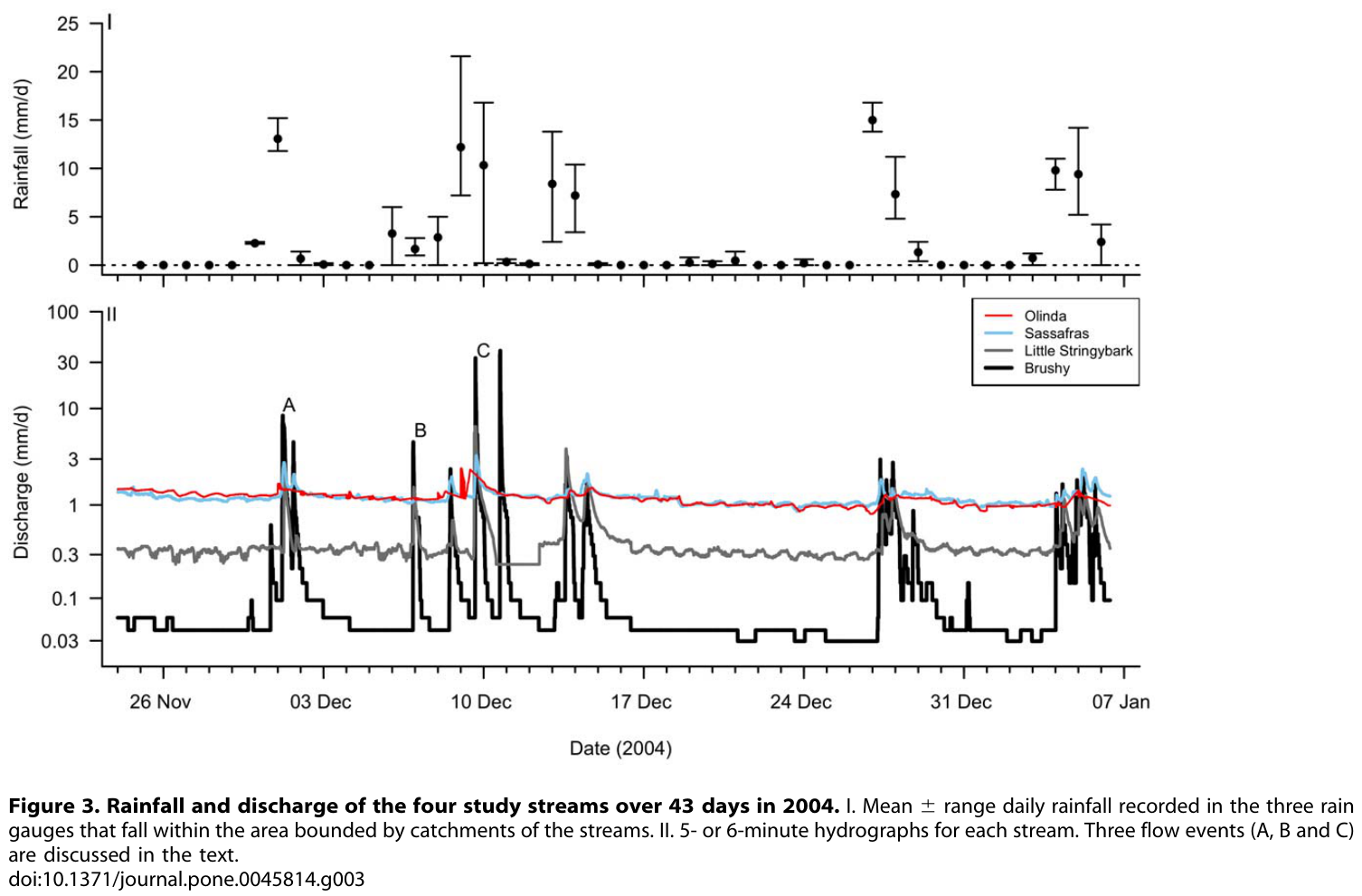
Walsh, Fletcher and Burns, 2012, figure 3, 4.11 The four streams lie in eastern Melbourne. Two have almost no hard surfaces that drain to them through pipes, and two receive the drainage of urban areas through conventional pipes.
This concept presumes neither the individual nor the collective as the starting unit. That feature distinguishes it from the river as a person, as an assemblage and as a multispecies community. The research question changes with it. The question of which entities make up the river becomes a question about relations: through which relations does a river become, for a time, an entity that can sense, remember, act, coordinate and change other collectives?
Process accounts in biology support this starting point. Process philosophy of biology proposes that the living world is a hierarchy of processes, which are stabilised and actively maintained at different timescales.13 Process Ontology gives further sources.
Capacities and Evidence
The definition lists four capacities: to sense, to remember, to act and to make claims. The fuller statement of the concept adds two: to coordinate and to maintain itself. Each capacity is an empirical claim. The table states what each capacity means for a river. It then gives evidence, mostly from rivers in Victoria, and says what that evidence supports. Birrarung describes the cases from Birrarung in full.
| Capacity | What it means for a river | Evidence | What the evidence supports |
|---|---|---|---|
| Sense | Members register changes in water, in light, in temperature and in each other. They then respond. | In one coastal river of Victoria, pulses of water that managers released for the river raised the catch of young common galaxias (Galaxias maculatus) six-fold. In a second river, the catch of juvenile short-finned eels (Anguilla australis) doubled during one release while it fell at control sites, which gives a 26-fold difference relative to those sites.14 At six billabongs of Birrarung, river red gums (Eucalyptus camaldulensis) were in better condition where floods had come in more of the previous three years.15 | The studies show responses of members. Whether the collective registers anything that its members do not register is an open question. |
| Remember | Past events persist in materials and in bodies. They shape what happens next. | The sediments of Bolin Billabong contain a record of Birrarung from about AD 1120. European settlement appears in this record as a thirty-fold rise in the rate of sedimentation.16 | Shown as material memory for sediments. The [[agentic stair |
| Act | Members build, move and change the river and each other. | A review of sixty years of research concludes that plants in river corridors both affect and respond to the processes of rivers. Experiments in flumes show that vegetation determines whether a channel has one thread or several.17 Catchments of old-growth mountain ash (Eucalyptus regnans) yield almost twice as much water as catchments of 25-year-old regrowth.18 Superb lyrebirds (Menura novaehollandiae) in the Central Highlands of Victoria turn over about 156 tonnes of litter and soil per hectare each year.19 | Shown. Ecologists call such work niche construction and ecosystem engineering (Niche). |
| Coordinate | The timing of one activity sets the timing of others. | The strategic plan for Birrarung states that changes to natural flows, above all through dams, have removed the natural cues and conditions for fish and platypus (Ornithorhynchus anatinus) to breed.20 Managers use the responses of river red gums and wetland plants when they plan where, when and how often to water billabongs.15 | Stated in a plan for the cues, without data. Shown for the watering. Coordination by the collective as a whole would need evidence of feedback at the level of the collective. |
| Make claims | Members express needs and refusals that other members have to register. | In 2003, grey-headed flying-foxes (Pteropus poliocephalus) did not settle at the roost that managers had prepared for them at Ivanhoe. A colony formed at Yarra Bend Park, and the Victorian Government then decided to secure it there.21 Human members make claims in words. A statement by Wurundjeri Woi-wurrung Traditional Owners describes Birrarung as a living relation with her own agency, will and future. It says that Birrarung speaks through her waters, through the winds that move through the river red gums and in the songs of animals.22 | Shown for members. Law registers few such claims. Legal reasoning about the rights of nature leads to a further step: if rivers have rights, the fish that live in them have rights too.23 |
| Maintain itself | The collective partly reproduces the conditions of its own existence. | Plants, flow and sediment form feedbacks that build the landforms of rivers.17 In a study in foothill forests north-east of Melbourne, foraging by lyrebirds reduced litter fuel loads by 25% in nine months, and modelling of fire behaviour showed a lower likelihood of fire. The authors propose a feedback through which lyrebirds maintain the open forest floor that suits them.24 | Proposed. This capacity is the strictest, because it requires feedback that closes at the level of the collective (Functional Account of Agency). |
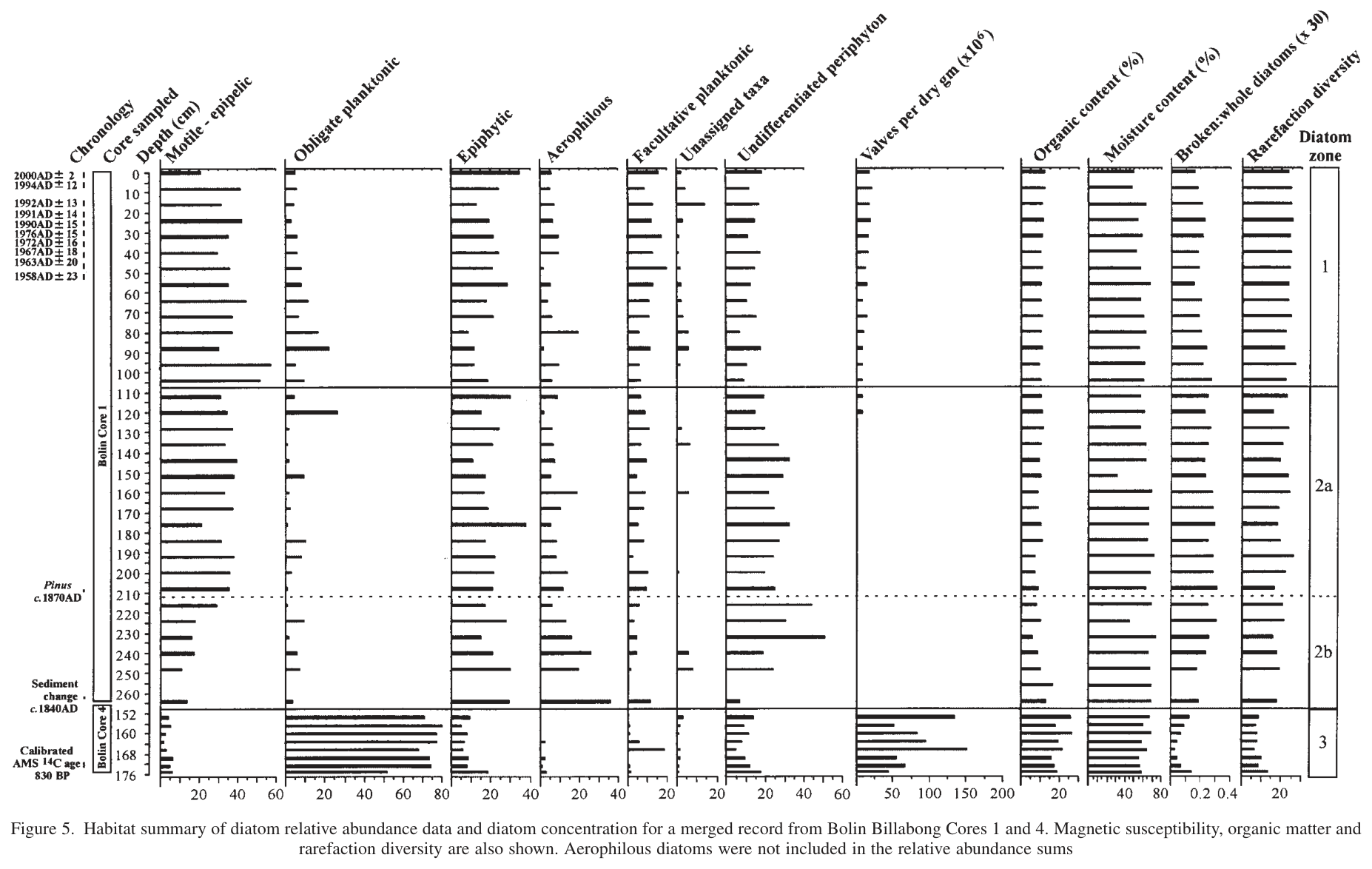
Leahy et al., 2005, figure 5, 140.16 The dates at the left of the diagram start at about 830 years before 1950, which is about AD 1120, at the bottom. They end at AD 2000, at the top.
Design research describes similar capacities as the design potential of a more-than-human community, which is its ability to sense, absorb, generate and coordinate variety when it meets novelty.25 Design Potential (Private) develops that concept.
Tests and Cautions
Other notes in this vault set tests for any claim about agency. This section applies them to rivers.
- Declare the agent. Declaring the Agent asks five questions of every claim. The table gives the questions for a river, with examples from Birrarung.
| Declaration | Question for a river | Example from Birrarung |
|---|---|---|
| Boundary | Which collective shares the goal, and who is inside? | The corridor that the law protects; the catchment with its roofs and drains; or the range of short-finned eels, which researchers tracked from south-western Victoria as far as the Coral Sea26 |
| Variable | Which condition does the collective keep in range? | A candidate to test: the flooding of billabongs in at least two years of three, which river red gums need and which regulation has interrupted |
| Horizon | How far back, ahead and out does its concern reach? | Sediments that record almost nine centuries; forests that can need 150 years to yield water as they did before a fire |
| Perspective | Who observes, with what instrument, at what scale? | Ecologists with nets and loggers; Traditional Owners with law and long observation; managers with gauges |
| Beneficiaries and costs | Who gains and who pays when design serves it? | Birrarung compares the functions of nine parts of the river for human institutions and for other members |
- Look for feedback that closes at the level of the collective. The agentic stair warns that collective agency requires such feedback and that the summed responses of members do not suffice.
- Separate the watercourse from the community. Water that flows downhill changes a valley without a goal. Functional Account of Agency therefore records causal influence apart from agency. The concept of a plural living community concerns the composite of water, sediment, plants, animals, structures and institutions. The stair makes the same distinction. It gives abiotic flows the lowest level of agency, and it counts them at other levels as parts of composite agents.
- Treat readings of intention with care. The stair classes readings of floods as refusals of infrastructure as interpretive proposals. The evidence is stronger where the behaviour of members changed a human decision.
- Test institutions by decisions that changed. The stair asks for one decision that reversed because of the input of a river or of its advocates. Birrarung records one decision that changed because of what members did: the site of the flying-fox camp. The decision to move the camp out of the gardens stood.
- Keep observers in view. Each observer registers some members and misses others. The study of the fishways at Dights Falls on Birrarung, for example, measured their effect through common galaxias. It left eels out of its hypotheses, because eels can climb and were already common upstream. Its catch records showed no rise in the number of eels.27
- Indigenous law belongs to its peoples. The fourth conception belongs to the peoples whose law it is. This note reports published statements and adds no interpretation of that law.
- Expect legal and political limits. Legal scholars dispute whether nature can hold rights at all (Personhood). The representatives of a river are human. The river cannot authorise them or hold them to account.28 A third party therefore has to authorise them. Such representation can fail through impersonation, through lack of power and through ventriloquism, in which representatives pursue their own interests while they speak for the river.29
- Watch for econormativity. If the members supply the standards for what a river should do, those standards need scrutiny too. A standard of the natural or the healthy can exclude weirs, drains, introduced species and damaged members, although they take part in the river as it is now. Econormativity collects the arguments for standards that come from the life of a community and the arguments against them.
Implications for More-than-Human Design
- A brief has to declare which river it serves. The corridor, the catchment and the range of the members that migrate give three different briefs.
- Goals become capabilities of members. For eels, the goals include moving between the ocean and a creek, sheltering and feeding at each stage of life. Deep Design Lab listed 12 capabilities of powerful owls (Ninox strenua) and found that cities diminish many of them.30 The capability approach can also describe a river as a whole. Applied to the Whanganui River, the capability approach reserves capabilities for beings with purposeful agency and treats the river as a being without it. It therefore describes the wellbeing of that river in terms of functionings, which harm can undermine for a time or for good.31 This note differs on one point: it treats the agency of a river as an open question. See Capabilities.
- Responses of members can redirect design. Nonhuman leadership "occurs when living beings redirect design toward desirable futures, with human designers engaged as learners and supporters".32 Leadership here means influence on shared decisions. It requires no consciousness or deliberation, and it can work through changes to the environment, through signals or through learned traditions.25 See Leadership.
- Interventions stay reversible where possible. Human designers ask whether a being can now do something that it could not do before, and they plan to minimise possible harm or to make each intervention withdrawable.32
- Rights can secure these practices. Rights and Personhood give the legal options.
Open Questions
- Which capacities of a river exceed the summed capacities of its members, and which measurements could show the difference?
- For how long does a river remember, and in which materials?
- Which members make claims that current institutions cannot register?
- How should a brief treat members whose needs conflict, such as flying-foxes and the trees of a heritage garden in which they roost?
- Which standards for a river come from its members, and whom do those standards exclude?
References
Footnotes
Manning, Peter, Fons van der Plas, Santiago Soliveres, Eric Allan, Fernando T. Maestre, Georgina Mace, Mark J. Whittingham, and Markus Fischer. “Redefining Ecosystem Multifunctionality.” Nature Ecology & Evolution 2, no. 3 (2018): 427–36. https://doi.org/10.1038/s41559-017-0461-7.˄
Boelens, Rutgerd, Jaime Hoogesteger, Erik Swyngedouw, Jeroen Vos, and Philippus Wester. “Hydrosocial Territories: A Political Ecology Perspective.” Water International 41, no. 1 (2016): 1–14. https://doi.org/10.1080/02508060.2016.1134898.˄
Boelens, Rutgerd, Arturo Escobar, Karen J. Bakker, Lena Hommes, Erik Swyngedouw, Barbara Hogenboom, Edward H. Huijbens, et al. “Riverhood: Political Ecologies of Socionature Commoning and Translocal Struggles for Water Justice.” The Journal of Peasant Studies 50, no. 3 (2023): 1125–56. https://doi.org/10.1080/03066150.2022.2120810.˄
Houart, Carlota, Jaime Hoogesteger, and Rutgerd Boelens. “Power and Politics across Species Boundaries: Towards Multispecies Justice in Riverine Hydrosocial Territories.” Environmental Politics 34, no. 1 (2025): 49–69. https://doi.org/10.1080/09644016.2024.2345561.˄
Rogers, Jessa. “People of Three Rivers: Rematriating Wiradjuri Living Waters.” Australian Feminist Studies, 2026, 1–18. https://doi.org/10.1080/08164649.2026.2744992.˄
RiverOfLife, Martuwarra, Anne Poelina, Donna Bagnall, and Michelle Lim. “Recognizing the Martuwarra’s First Law Right to Life as a Living Ancestral Being.” Transnational Environmental Law 9, no. 3 (2020): 541–68. https://doi.org/10.1017/s2047102520000163.˄
Cribb, Miriama, Elizabeth Macpherson, and Axel Borchgrevink. “Beyond Legal Personhood for the Whanganui River: Collaboration and Pluralism in Implementing the Te Awa Tupua Act.” The International Journal of Human Rights, ahead of print, 2024. https://doi.org/10.1080/13642987.2024.2314532.˄
Laborde, Sarah, and Sue Jackson. “Living Waters or Resource? Ontological Differences and the Governance of Waters and Rivers.” Local Environment 27, no. 3 (2022): 357–74. https://doi.org/10.1080/13549839.2022.2044298.˄
Yaka, Özge. “More-than-Human Lifeworlds: Ethics, Ontology and Relationality in Local Environmental Struggles.” Society & Natural Resources 37, no. 5 (2024): 678–94. https://doi.org/10.1080/08941920.2023.2238230.˄
Hooft Toomey, Ebba, and Tineke Lambooy. “Legally Living Rivers: A Global Review Enriched by a Case Study of the Yarra River Protection (Wilip-gin Birrarung murron) Act 2017.” Journal of Property, Planning and Environmental Law 18, no. 2 (2026): 121–46. https://doi.org/10.1108/JPPEL-02-2025-0015.˄
Walsh, Christopher J., Tim D. Fletcher, and Matthew J. Burns. “Urban Stormwater Runoff: A New Class of Environmental Flow Problem.” PLOS ONE 7, no. 9 (2012): e45814. https://doi.org/10.1371/journal.pone.0045814.˄
Oré Gálvez, Saríah Fanny, Alex Foyams Molina Linares, Jherry Lobaton Phocco Minaya, Alex Quispe Quispe, Solón Dante Carhuallanqui Ibarra, Juan Carlos Terres León, Rubén Ñaupari Molina, Crispin H. W. Barnes, and Luis De Los Santos Valladares. “Beyond the Autonomous Individual: Hydrosocial Relations and the Constitution of the Relational Hydrosocial Self in an Andean Conflict.” Frontiers in Sociology 11 (2026): 1856916. https://doi.org/10.3389/fsoc.2026.1856916.˄
Dupré, John, and Daniel J. Nicholson. “A Manifesto for a Processual Philosophy of Biology.” In Everything Flows: Towards a Processual Philosophy of Biology, edited by Daniel J. Nicholson and John Dupré, 3–45. Oxford: Oxford University Press, 2018. https://doi.org/10.1093/oso/9780198779636.003.0001.˄
Amtstaetter, Frank, Zeb Tonkin, Justin O’Connor, Ivor G. Stuart, and Wayne M. Koster. “Environmental Flows Stimulate the Upstream Movement of Juvenile Diadromous Fishes.” Marine & Freshwater Research 72, no. 7 (2021): 1019–26. https://doi.org/10.1071/MF20222.˄
Greet, Joe, Rephael Lankri, Sarah Gaskill, Sarah Fischer, Delta Lucille Freedman, Tiana Preston, and Narrap Unit Rangers. “Urban Billabong Restoration Benefits from Traditional Owner Involvement and Regular Flooding.” Marine and Freshwater Research 74, no. 4 (2023): 398–408. https://doi.org/10.1071/MF22195.˄
Leahy, Paul J., John Tibby, A. Peter Kershaw, Henk Heijnis, and John S. Kershaw. “The Impact of European Settlement on Bolin Billabong, a Yarra River Floodplain Lake, Melbourne, Australia.” River Research and Applications 21, nos. 2–3 (2005): 131–49. https://doi.org/10.1002/rra.837.˄
Gurnell, Angela M. “Plants as River System Engineers.” Earth Surface Processes and Landforms 39, no. 1 (2014): 4–25. https://doi.org/10.1002/esp.3397.˄
Vertessy, Robert A., Fred G. R. Watson, and Sharon K. O’Sullivan. “Factors Determining Relations between Stand Age and Catchment Water Balance in Mountain Ash Forests.” Forest Ecology and Management 143, nos. 1–3 (2001): 13–26. https://doi.org/10.1016/S0378-1127(00)00501-6.˄
Maisey, Alex C., Angie Haslem, Steven W. J. Leonard, and Andrew F. Bennett. “Foraging by an Avian Ecosystem Engineer Extensively Modifies the Litter and Soil Layer in Forest Ecosystems.” Ecological Applications 31, no. 1 (2021): e02219. https://doi.org/10.1002/eap.2219.˄
Melbourne Water Corporation. Burndap Birrarung Burndap Umarkoo: Yarra Strategic Plan. Melbourne: Melbourne Water, 2022.˄
Crocker, Robin, David Abbott, and Lincoln Kern. Flying-Fox Campsite Management Plan: Yarra Bend Park. East Melbourne: Department of Sustainability and Environment, 2005.˄
Department of Transport and Planning. Planning for Birrarung (the Yarra River). Planning Practice Note No. 101. Melbourne: Department of Transport and Planning, 2026.˄
Bernet Kempers, Eva. “If Rivers Have Rights, Do Fish Have Rights Too? Examining the Relationship between Rights of Nature and Animal Rights.” Journal of Animal Law, Ethics and One Health, 2026, 4–22. https://doi.org/10.58590/leoh.2026.005.˄
Nugent, Daniel T., Steven W. J. Leonard, and Michael F. Clarke. “Interactions between the Superb Lyrebird (Menura novaehollandiae) and Fire in South-Eastern Australia.” Wildlife Research 41, no. 3 (2014): 203–11. https://doi.org/10.1071/wr14052.˄
Roudavski, Stanislav, and Alexander Holland. “Are You Blocking Nonhuman Leadership? Five Questions to Find Out.” In PDC ’26: Proceedings of the 19th Participatory Design Conference, vol. 2, edited by Laura Galluzzo, Anna Meroni, Daniela Selloni, Davide Fassi, Daniela de Sainz, Andrea Botero, Stefana Broadbent, et al., 372–81. New York: Association for Computing Machinery, 2026. https://doi.org/10.1145/3789492.3796416.˄
Koster, Wayne M., Kim Aarestrup, Kim Birnie-Gauvin, Ben Church, David Dawson, Jarod Lyon, Justin O’Connor, et al. “First Tracking of the Oceanic Spawning Migrations of Australasian Short-Finned Eels (Anguilla australis).” Scientific Reports 11, no. 1 (2021): 22976. https://doi.org/10.1038/s41598-021-02325-9.˄
Amtstaetter, Frank, Justin O’Connor, Dan Borg, Lauren Johnson, and Paul Moloney. “Fishways Provide Catchment-Scale Improvements to Common Galaxias (Galaxias maculatus) Upstream of a Barrier in South-Eastern Australia.” New Zealand Journal of Marine and Freshwater Research 58, no. 4 (2024): 591–606. https://doi.org/10.1080/00288330.2023.2287200.˄
O’Neill, John. “Representing People, Representing Nature, Representing the World.” Environment and Planning C: Government and Policy 19, no. 4 (2001): 483–500. https://doi.org/10.1068/c12s.˄
Brito Vieira, Mónica, and Sean Fleming. “Ecological Personhood: A Bridging Approach.” American Political Science Review 120, no. 1 (2026): 332–45. https://doi.org/10.1017/S0003055425100762.˄
Parker, Dan, Kylie Soanes, and Stanislav Roudavski. “Interspecies Cultures and Future Design.” Transpositiones 1, no. 1 (2022): 183–236. https://doi.org/10.14220/trns.2022.1.1.183.˄
Kramm, Matthias. “When a River Becomes a Person.” Journal of Human Development and Capabilities 21, no. 4 (2020): 307–19. https://doi.org/10.1080/19452829.2020.1801610.˄
Roudavski, Stanislav. “The Case for Nonhuman Leadership.” Interactions 33, no. 6 (2026): 64–67. https://doi.org/10.1145/3849465.˄
Backlinks