Birrarung
This note is about Birrarung (Yarra River) in Victoria, Australia. It describes the river as a place and as a plural living community of human and nonhuman members. The note lists the kinds of members and compares what parts of the river are for, from the positions of different members. It then describes cases in which nonhuman members build the river or redirect human decisions, summarises who decides at present, and proposes futures. The concept of a river as an agent has its own note, River. Multifunctionality explains why the choice of functions is a question of justice. Eels in Victoria, Australia gives the evidence on eels in Melbourne.
Related Notes
- River, Water, Personhood, Eels in Victoria, Australia, Anguillid Eels, Owl
- Melbourne, Port Philip Bay, Tromgin, Budj Bim
- Multifunctionality, Niche, Leadership, Deliberation, Oppression, Econormativity
- Capabilities, Agentic Stair, Design Potential (Private), Rights, Restoration
- Indigenous, Colonialism, Eel Project
Names
- Birrarung. The Boon wurrung and the Woi wurrung know the river as Birrarung, a name often translated as "river of mists".1
- Yarra. In 1835, a surveyor for the Port Phillip Association named the river "Yarra Yarra". He took the name from words that members of the Kulin Nations used for a waterfall.1
- The Act. The Yarra River Protection (Wilip-gin Birrarung murron) Act 2017 protects the river. Its Woi-wurrung title means "keep the Birrarung alive".2 The Act is the first Victorian legislation with a title and a preamble in the Woi-wurrung language.3
- Usage. This note writes Birrarung without an article.
The River in Brief
- Course. Birrarung flows for 242 km from Mount Baw Baw through forests, farmland, townships and suburbs to the centre of Melbourne and Port Phillip Bay.3
- Country. Most of the catchment is Country for which the Wurundjeri Woi-wurrung corporation is the Registered Aboriginal Party. The Bunurong Land Council has that role near the river mouth.4
- What human institutions list. Planning guidance lists what Birrarung provides: about 70% of Melbourne's drinking water, as well as biodiversity, recreation, flood mitigation, urban cooling, cultural practices, connection to nature and community health.4
- Reaches. The strategic plan for the river divides its corridor into four reaches.3
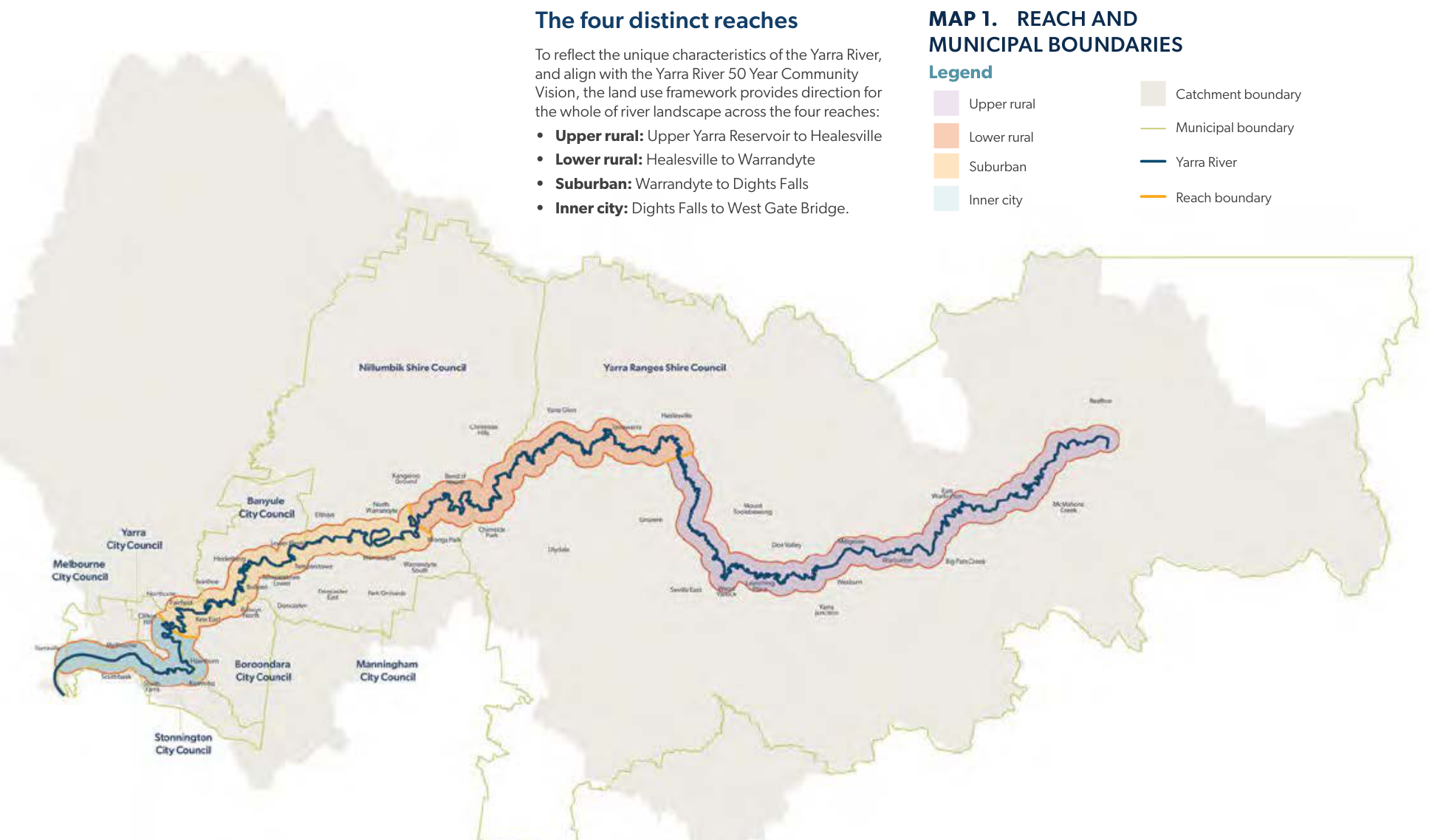
Melbourne Water Corporation, 2022, map 1, 75.3
- Extent. The river is larger than this corridor. Rain reaches it from roofs, roads and drains across the catchment. Its eels belong to a species that migrates toward the Coral Sea to spawn, although the spawning grounds remain unconfirmed. Researchers tracked short-finned eels (Anguilla australis) that they had tagged in south-western Victoria for up to about 2,620 km, as far as the Coral Sea.5
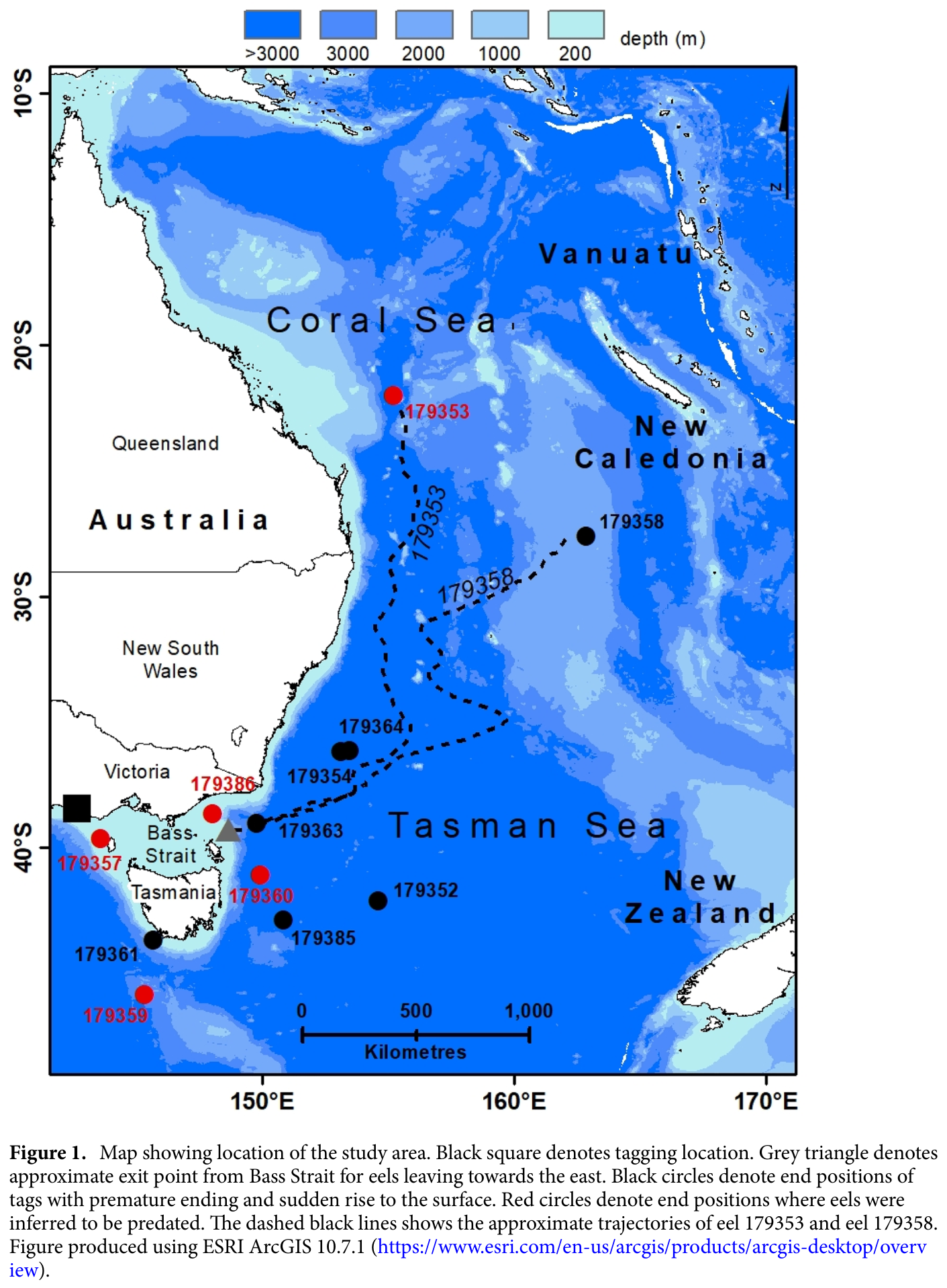
Koster et al., 2021, figure 1, 3.5
Living Communities and Their Histories
- Communities. The parklands along the river contain wetlands, billabongs, floodplains, treed gorges, woodlands, rainforests, coastal marshes and an estuary.3
- Deep history. After the last glacial maximum ended about 15,000 years ago, the sea rose, and the shoreline reached its present position about 6,000 years ago. At the start of the nineteenth century, a clear river ran over a rock fall into an estuary lined with paperbarks, among billabongs and swamps full of waterbirds, eels and frogs.6
- Human presence. First Peoples have lived in Victoria for 40,000 to 60,000 years.1
- Changes since 1835. Colonists and their successors have diverted, widened, dredged and dammed the river. They have also cleared land for agriculture and covered ground with roofs, pavements and roads.3
- A record of the change. The sediments of Bolin Billabong contain a record from about AD 1120. After European contact, sediment accumulated about 30 times faster than before, and the record suggests that the river was not turbid before that time.7
Members
The members of Birrarung are of many kinds. A statement by the Wurundjeri Woi-wurrung Cultural Heritage Aboriginal Corporation says that Birrarung speaks through her waters, through the winds that move through the river red gums and in the songs of animals. The same statement says that Birrarung lives within Country and as Country. It adds that she shapes the landscape while the landscape shapes her.4 The table follows this lead and lists kinds of members with examples. The list is provisional.
| Kind of member | Examples at Birrarung | How they take part |
|---|---|---|
| Waters | The main flow, tributaries and creeks, groundwater, floods, billabongs and the estuary | They carry organisms, sediment, nutrients and pollutants. They also connect places that are otherwise apart |
| Landforms and sediments | The channel, banks, floodplains, mud and gravel | The river has changed its course over time. Its sediments record that history |
| Plants and fungi | River red gums, mountain ash, paperbarks, wetland plants | They yield water, shade the channel and form habitat when they fall |
| Aquatic animals | Short-finned eels, common galaxias, platypus, frogs, macroinvertebrates | They move between the ocean, the river, creeks and drains |
| Animals of land and air | Powerful owls, grey-headed flying-foxes, waterbirds, lyrebirds | They move beyond the corridor. Flying-foxes, for example, bring seeds of local plants to their camp8 |
| Microorganisms | Microbes in water, sediment, soil and bodies | They transform nutrients and organic matter. The sources of this note say little about them |
| Traditional Owners | The Wurundjeri Woi-wurrung and the Bunurong | Custodians with obligations to a living relation |
| Other humans | Residents, visitors, farmers, scientists, managers and councils | Participants whose degree of membership varies |
| Built structures | The weir at Dights Falls, dams, drains, pipes, bridges and pumps | They change what water, sediment, animals and humans can do |
| Weather, light and fire | Rain, wind, heat and fire | They set the conditions for all other members. Wind is among the ways in which Birrarung speaks, according to the statement cited above |
Three points follow from the table.
- Members take part for different lengths of time and to different degrees. A migrating eel is a mobile member for some years. A river red gum is a fixed member for centuries. A storm takes part for a day, and a human visitor for an hour. Port Phillip Bay lies outside the river and still shapes what the river can become. River develops this point.
- The list includes the built and the damaged. The weir and the drains harm some members. They are also durable participants in the river as it is now. A list that admitted only natural or healthy members would repeat the exclusions that Econormativity examines.
- The list does not speak for Country. The first paragraph reports a published statement. The table is an analytical device of this note, and it makes no claim about Wurundjeri Woi-wurrung or Bunurong law.
Members and Functions
The same parts of Birrarung have different functions for different members. The table compares nine parts of the river from two positions and states what has happened to each.
| Part of Birrarung | Function for human institutions | Function for other members | What has happened |
|---|---|---|---|
| Water in the channel | About 70% of Melbourne's drinking water.4 | A route to the ocean for short-finned eels. A source of cues for fish and platypus (Ornithorhynchus anatinus). | The strategic plan states that changes to natural flows have removed the natural cues and conditions for fish and platypus to breed.3 |
| Forests of the upper catchment | The source of the water that reservoirs store. | Home ground of superb lyrebirds (Menura novaehollandiae), which turn over about 156 tonnes of litter and soil per hectare each year in the Central Highlands.9 | The trees set the supply. Catchments of old-growth mountain ash (Eucalyptus regnans) yield almost twice as much water as catchments of 25-year-old regrowth.10 |
| Floods | A hazard to reduce. | Water for river red gums (Eucalyptus camaldulensis), which do best when flooded in at least two years of three.11 Water also for waterbirds, which are more diverse and abundant at flooded billabongs.12 | Billabongs flood less often. Managers now pump water into some of them.11 |
| Fallen trees in the river | An obstruction that river works removed to carry floodwater. | Pools, riffles and shelter for fish. | By 1984, eight of at least 14 native freshwater fish species were known to remain. The report lists the removal of fallen trees among several possible causes.13 |
| Weir at Dights Falls | Built in the nineteenth century to supply a flour mill.14 | A barrier for common galaxias (Galaxias maculatus) and a wall that small eels appear to climb. | After fishways opened in 2012, catch rates of galaxias upstream rose by 7.6 to 28.1 times by 2017.14 |
| Large old trees in parklands | Public open space for access and enjoyment.2 | Nest hollows and seclusion for powerful owls (Ninox strenua). | Builders put a boardwalk under a nest tree during the breeding season, and the breeding attempt failed. The owls later moved to a more secluded hollow and raised two young.15 |
| Riverside gardens | A heritage plant collection. | A camp that grey-headed flying-foxes (Pteropus poliocephalus) occupied all year from 1986. It held between 20,000 and 30,000 bats by 2003.16 | Managers dispersed the camp in 2003 to protect the gardens. The bats did not settle at the roost prepared for them.8 |
| Roofs, roads and drains | Drainage that removes rain quickly. | Tributaries of the river. Radio-tracked platypus used earth-lined drainage channels as well as creeks.17 | Where sealed surfaces cover as little as 5 to 10% of a catchment and drain through pipes, streams lose base flow and receive more frequent storm flows.18 |
| Dry and lost billabongs | Land that river regulation has left dry. | Places where wetland life returns with water. One billabong had been dry for almost ten years. After managers pumped water into it in two successive years, native wetland plants became dominant.11 | Before 1835, eels moved each year into wetlands along the river, where Aboriginal groups gathered to harvest them.19 |
The table suggests several observations.
- Nonhuman members do much of the work that human lists of functions record as supply. River red gums build fish habitat when they fall. Old forests yield more of the water that the city drinks. Lyrebirds turn over the forest floor. Niche gives the terms that ecologists use for such work, niche construction and ecosystem engineering.
- Nonhuman members respond to human decisions and sometimes overrule them. Small eels appear to have climbed the weir, the owls left the tree, and the flying-foxes did not settle at the roost that managers had prepared for them.
- Plans describe these members in human terms. The strategic plan reports that "habitat suitability models for instream values (aquatic macroinvertebrates, fish, and platypus)" informed the planning of works.3 The plan uses the term once and gives no further definition. The word "value" describes these beings from the position of the humans who value them.
What Members Need to Be Able to Do
The capability approach asks what each being is able to do and to be (Capabilities). The table states one or two such needs for nine members of the river, with the evidence for each. Deep Design Lab listed 12 capabilities for powerful owls alone.20 A full list for each member of the river is a task for further research.
| Member | What the member needs to be able to do | Evidence |
|---|---|---|
| Short-finned eel | Move between the ocean and fresh water to complete its life cycle | The strategic plan states this need.3 Tagged eels travelled as far as the Coral Sea.5 |
| Common galaxias | Move upstream past the weir as young fish | Catch rates upstream rose after the fishways opened.14 |
| Platypus | Forage along creeks and channels | Radio-tracked platypus used earth-lined drainage channels as well as creeks.17 In models of survey records, females become scarce as sealed surfaces connected to drains rise from 0 to 10% of a catchment.21 |
| River red gum | Stand in floodwater in at least two years of three | Trees were in better condition where floods had come more often.11 |
| Waterbirds | Find flooded billabongs | Waterbirds were more diverse and abundant at flooded billabongs.12 |
| Powerful owl | Nest in the hollows of large old trees, in seclusion | A breeding attempt failed after builders worked under the nest tree.15 |
| Grey-headed flying-fox | Choose a roost, and feed on trees across the city | The bats did not settle at a roost that managers had prepared.8 Trees planted along streets have greatly increased the food available to them.22 |
| Superb lyrebird | Forage on an open forest floor | An exclusion experiment and a conceptual model suggest that lyrebirds maintain this floor through their own foraging.23 |
| Mountain ash | Remain standing for more than a century | After fire, a forest can need 150 years to yield water as it did before.10 |
Nonhuman Builders and Leaders
Each case states what the members do, what humans decided, what the response of the members changed and what remains open.
River Red Gums and the Watering of Billabongs
- What the members do. Over three years, wetland ecologists and Wurundjeri Woi-wurrung Narrap rangers surveyed billabongs along the lower river. Regular floods, in at least two years of three, and longer floods, of up to eight months, promoted native wetland plants and suppressed weeds. They also improved the condition and the reproductive output of river red gums.11
- What humans decided. Regulation of the river reduced flooding. Managers now pump water into some billabongs.11
- What the response changed. Melbourne Water already uses the findings of the surveys when it plans where, when and how often to water billabongs.11
- What remains open. Humans still decide how much water the billabongs receive. No rule requires that the watering follow the trees.
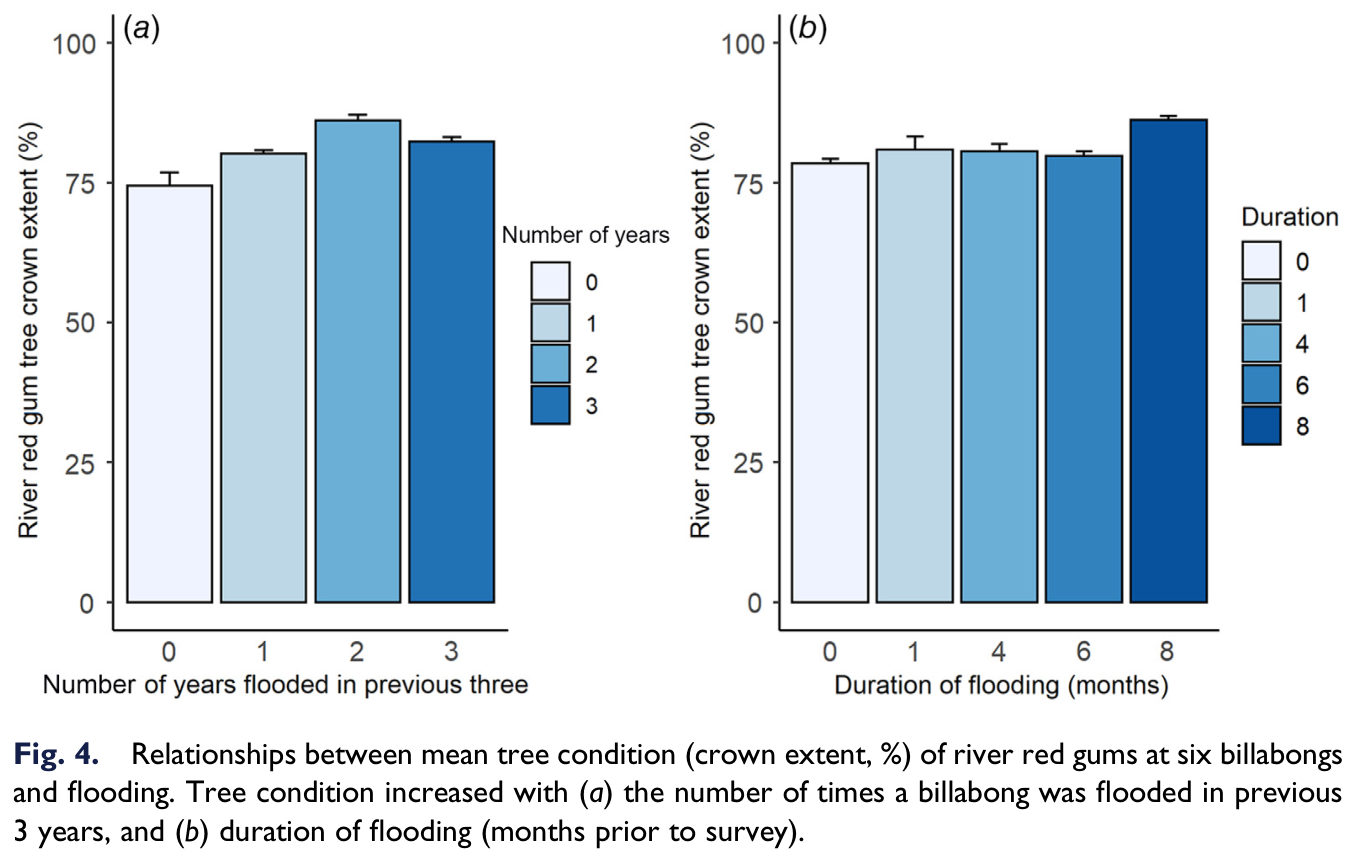
Greet et al., 2023, figure 4, 404.11
Fish and the Weir at Dights Falls
- What the members do. Common galaxias and eels move between the estuary and the freshwater reaches. The weir is three metres high, and it stands at the upper limit of the tide.24
- What humans decided. Humans built the weir in the nineteenth century to supply a flour mill. Two sources date it to the 1840s,14, 3 and one dates it to 1895.24 Managers built the present fishways in 2012 and modified the entrance of one fishway in 2020.24
- What the response changed. By 2017, catch rates of common galaxias in tributaries upstream were 7.6 to 28.1 times those of 2012, while catch rates at control sites tripled. The study left eels out of its hypotheses, because eels can climb and were already common upstream. Its catch records showed no rise in the number of eels. The authors suggest that small eels could climb the weir before the fishways existed.14
- What remains open. How young eels pass the weir is unknown (Gaps in the Evidence).
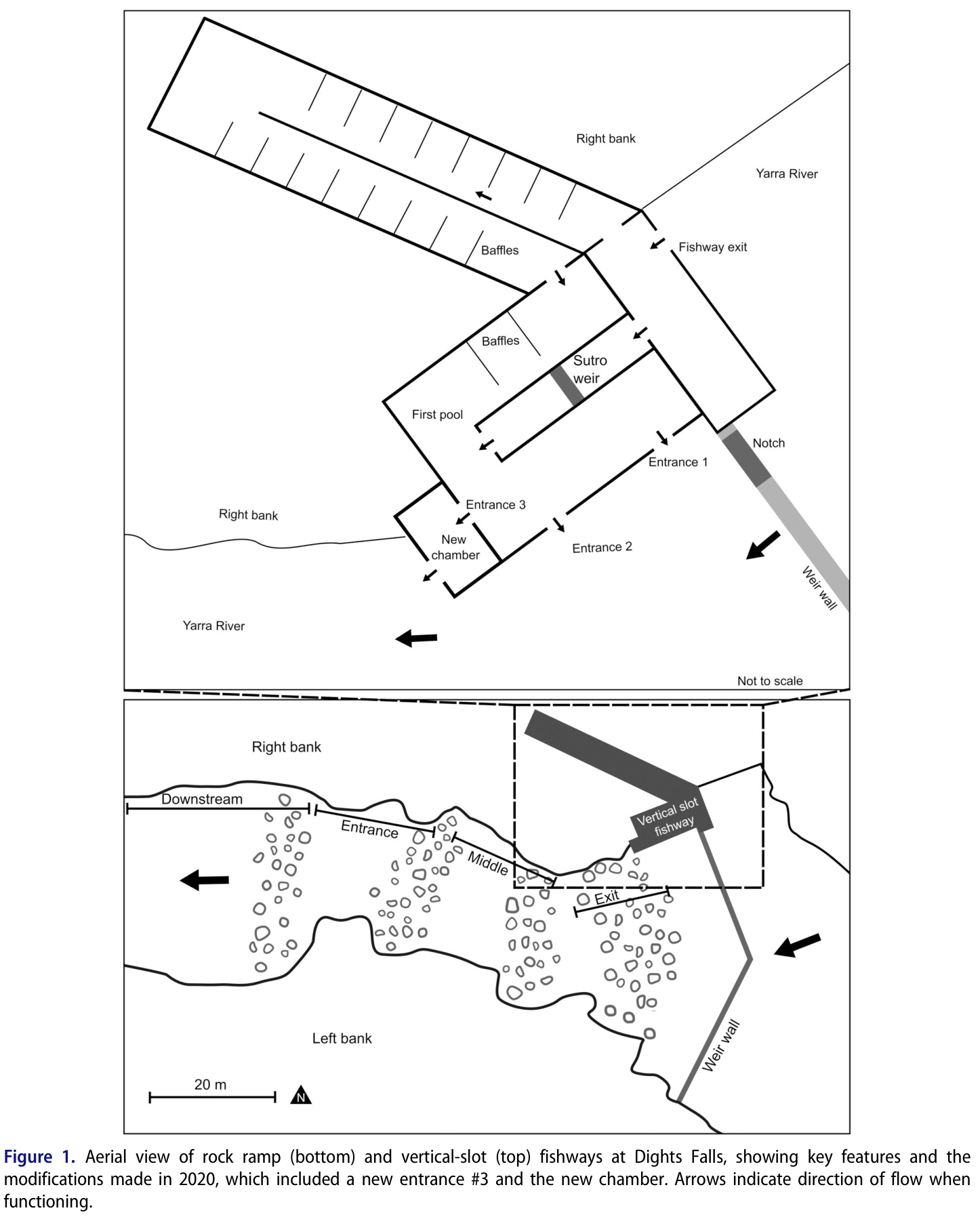
O'Connor et al., 2026, figure 1, 36.24
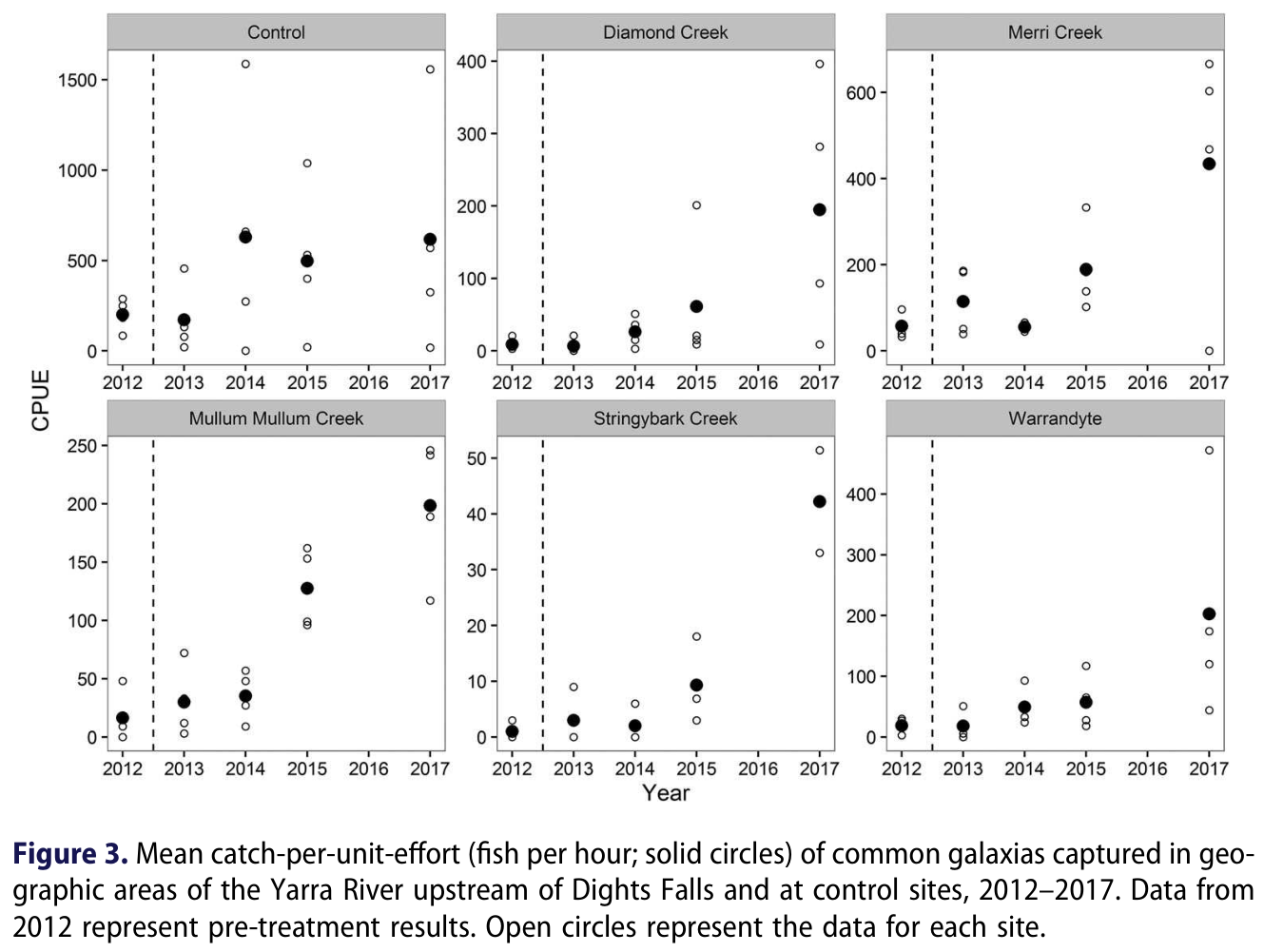
Amtstaetter et al., 2024, figure 3, 597.14
Powerful Owls and Old Trees
- What the members do. Researchers tracked ten powerful owls in eastern Melbourne with GPS loggers and recorded 10,870 positions over 306 nights. The owls flew 4.4 km a night on average. Early in the night, they moved in short, twisting steps in or near riverside vegetation, a pattern that the authors read as hunting and eating. To reach the next patch of trees, the owls crossed cleared land and built surfaces in long, straight flights.25
- What humans decided. In one of the busiest parklands beside the river, builders put a boardwalk under a nest tree during the breeding season.15 In interviews, 19 humans with long experience of powerful owls reported that urban decisions give the owls too little consideration.26
- What the response changed. The pair at the boardwalk raised no young in that year or the next. A pair presumed to be the same then nested in a more secluded hollow and raised two young.15 No human decision changed.
- What remains open. The tracking study mentions no river by name, so the tracked owls cannot yet be tied to Birrarung. The study of the capabilities of powerful owls by Deep Design Lab found that cities diminish many of them.20
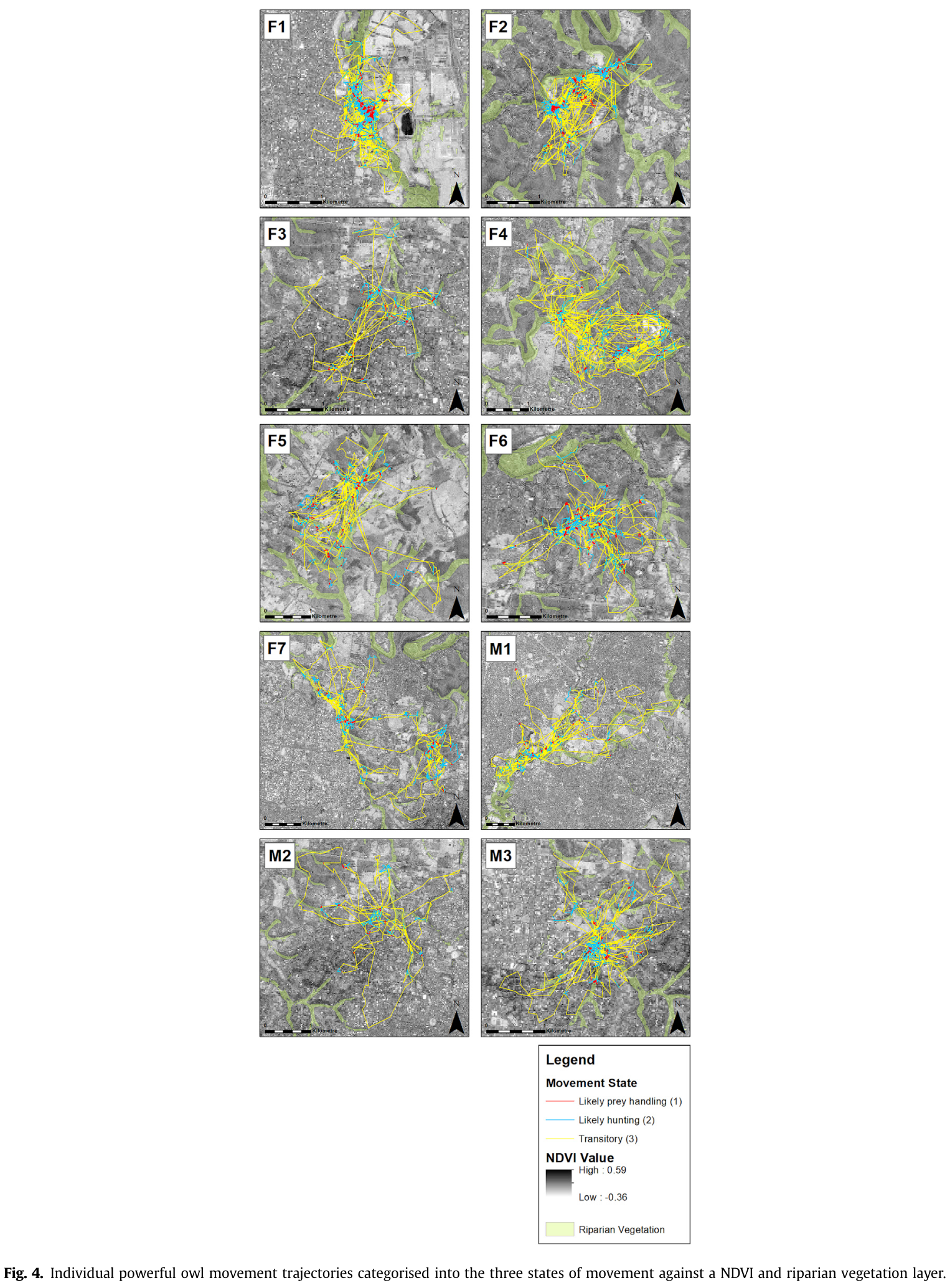
Carter et al., 2019, figure 4, 9.25
Grey-Headed Flying-Foxes and the Camp at Yarra Bend
- What the members do. Trees planted along Melbourne's streets have greatly increased the food available to the flying-foxes and extended it through the year.22 From 1986, the bats occupied a camp in the Royal Botanic Gardens all year.16
- What humans decided. Managers trapped bats to stock cages with individuals that would attract others to a new roost.16 They had selected a site on the river at Ivanhoe for that roost. In March 2003, they began to disperse the camp from the gardens.8
- What the response changed. The bats left the gardens, as the managers intended, and they did not settle at Ivanhoe. They camped in several inner-city parks while the programme moved them on. A colony then formed at Yarra Bend Park, and it had remained there from September 2003 until the management plan appeared in 2005. The Victorian Government decided to secure the colony at that site. Its reasons included the suitability of the site and the difficulty of controlling where dispersed bats go.8
- What the plan then did. The management plan designs for the preferences of the bats. It proposes wetlands and two kinds of artificial roost structure, which should draw the colony away from houses. It calls the structures experimental and states that knowledge of roosting preferences is limited. The plan also bounds the colony. It sets a management area of 26 hectares, allows the pruning of roost trees to stop the colony from spreading toward houses, and warns that an attempt to move the bats from the core of the camp could make the colony leave the park.8
- What remains open. Humans still decided, and the refusal of the bats changed what they decided about the site. Whether the bats used the wetlands and the roost structures is a question for the later review of the plan.
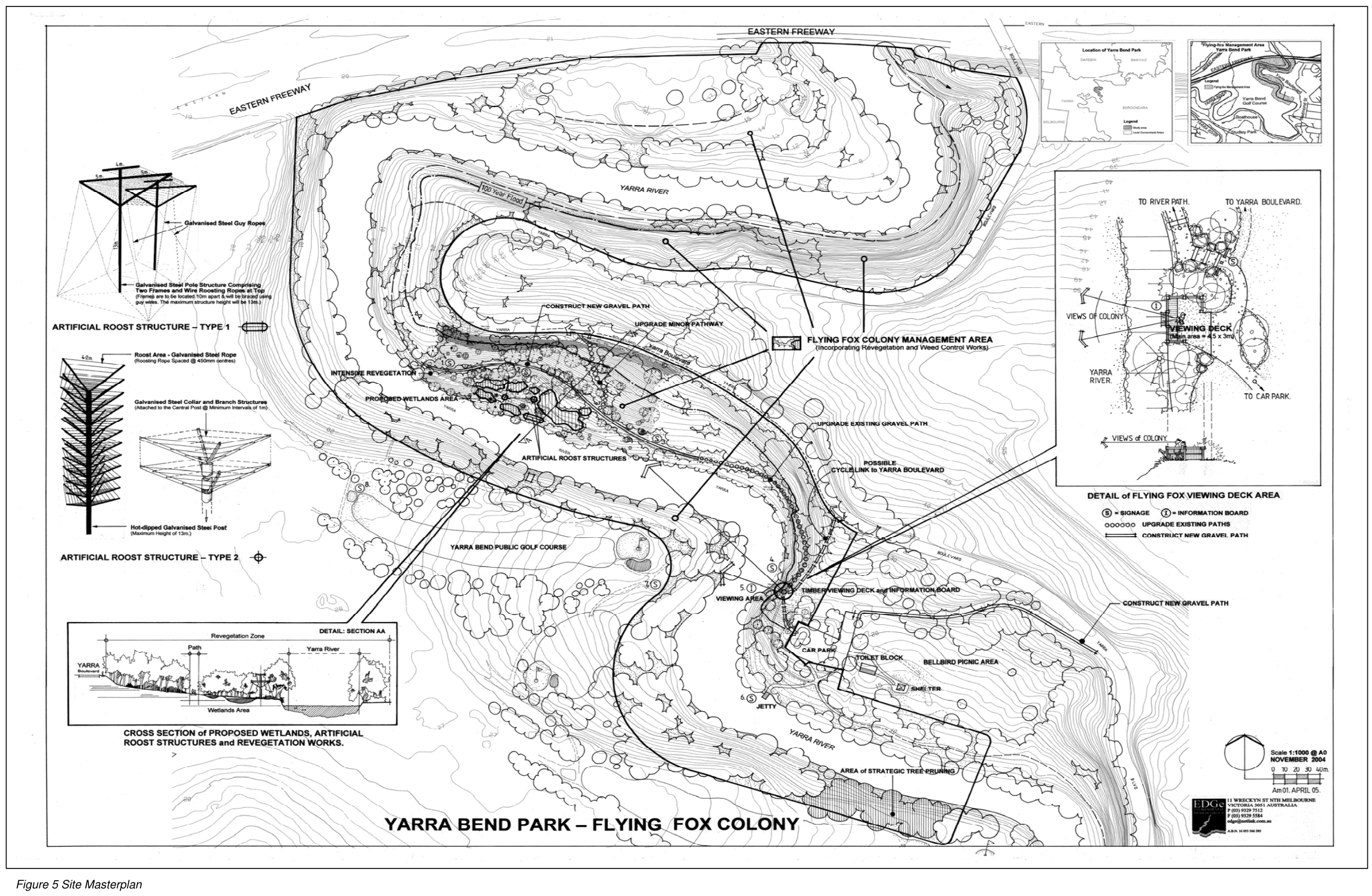
Crocker, Abbott and Kern, 2005, figure 5, 19.8
Platypus, Roofs and Drains
- What the members do. Radio-tracked platypus used earth-lined drainage channels as well as creeks.17
- What humans decided. Pipes carry rain from roofs and roads to streams.18 The Act and its programmes cover the river corridor and leave out the wider catchment.27
- What the response changed. In models of survey records, female platypus become scarce as sealed surfaces connected to drains rise from 0 to 10% of a catchment.21 No rule yet follows this response.
- What remains open. River argues that roofs, roads and drains are part of the river. Plans that treat them as headwaters could test that claim.
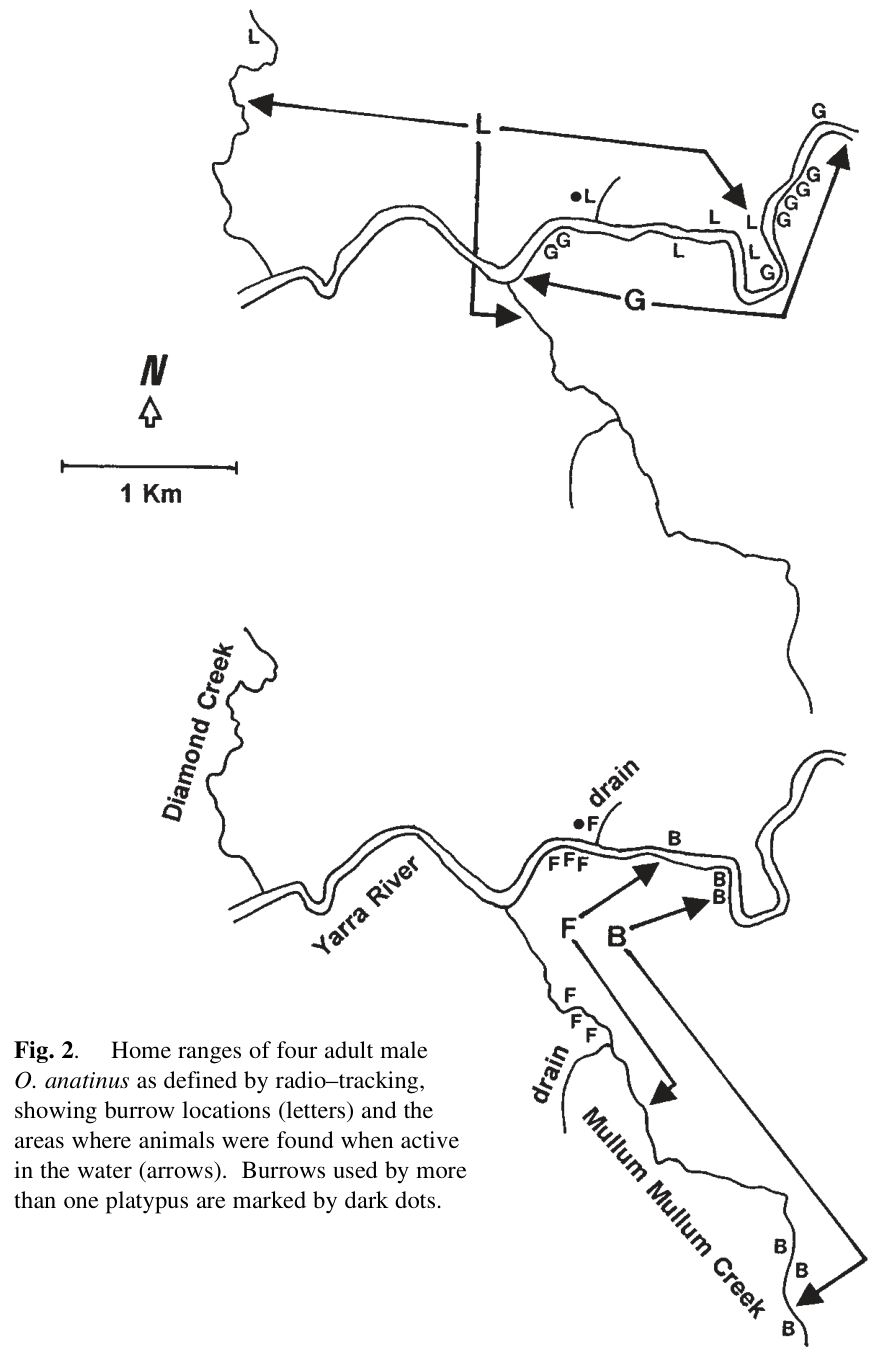
Serena et al., 1998, figure 2, 273.17
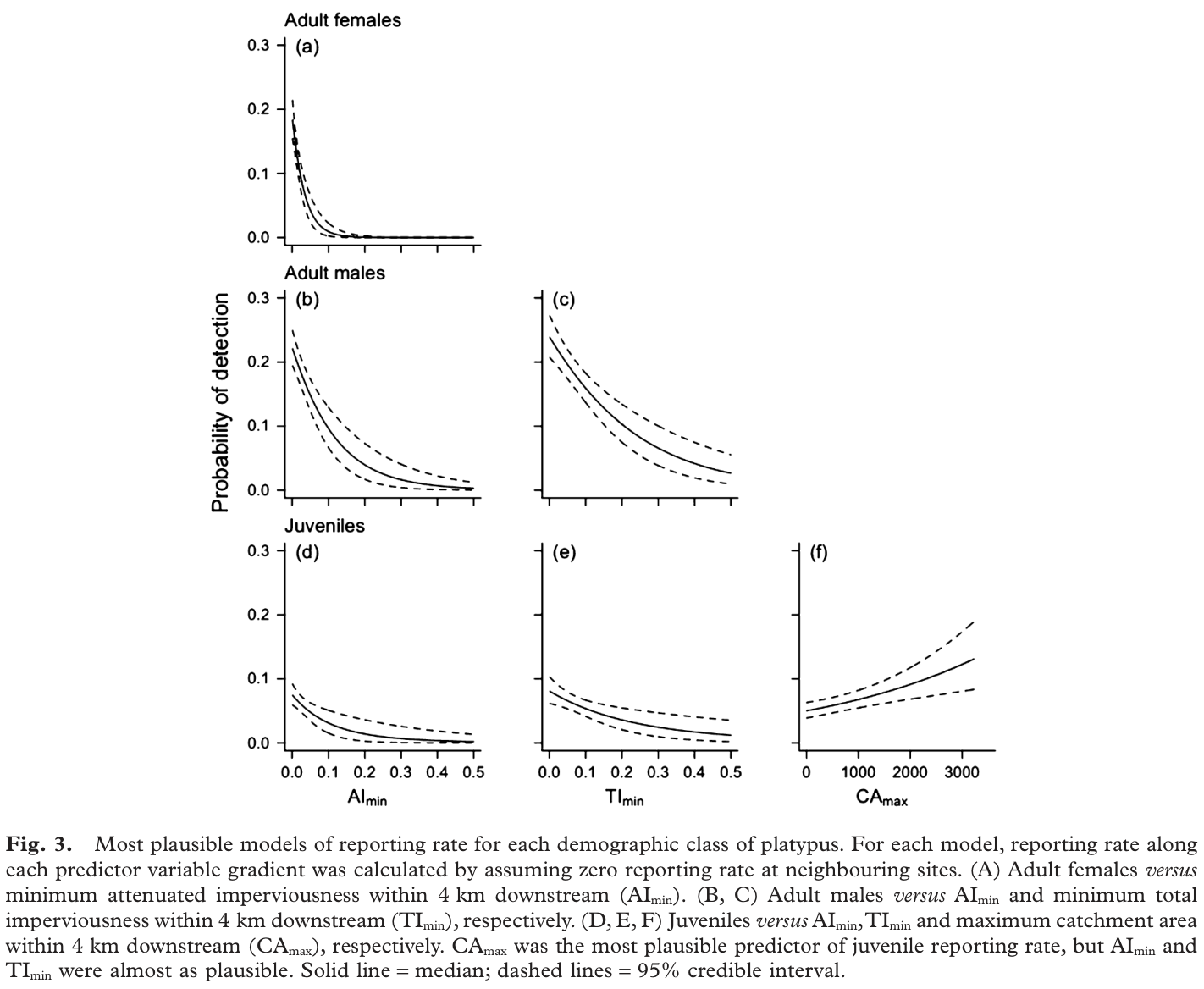
Martin et al., 2014, figure 3, 342.21
Lyrebirds and Mountain Ash
- What the members do. In the Central Highlands, lyrebirds turn over about 156 tonnes of litter and soil per hectare each year.9 In foothill forests north-east of Melbourne, their foraging reduced litter fuel loads by 25% in nine months.23 In the catchments that supply the city, old-growth mountain ash forests yield almost twice as much water as young regrowth.10
- What humans decided. Reservoirs store the water of these forests for the city.
- What remains open. The link between the two members is fire: a severe fire replaces old forest with regrowth, which yields far less water for decades. Multifunctionality shows the figures and asks who benefits from this work.
Eels between the River and the Coral Sea
- What the members do. Before 1835, eels moved each year into wetlands along the river, where Aboriginal groups gathered to harvest them.19 The strategic plan lists Bolin Bolin Billabong as a traditional eel-fishing ground and Garambi Baan (Laughing Waters) as a site of eel traps that the Wurundjeri Woi-wurrung corporation maintains with Parks Victoria.3
- What humans decided. Drainage, the weir and river regulation changed the routes of the eels.
- What remains open. Eels in Victoria, Australia lists the places in Melbourne with records of eels and the gaps in that evidence.
Who Decides Now
- The law protects one living entity. In 2017, the Parliament of Victoria passed an Act that protects the river and nearby public land "as one living and integrated natural entity".2 Planning guidance of 2026 states that "Birrarung has an inherent right to exist, be respected and be cared for".4
- Traditional Owners speak for Country. The same guidance publishes a statement by the Wurundjeri Woi-wurrung Cultural Heritage Aboriginal Corporation, which describes Birrarung as "a living relation, with her own agency, will, and a future". The guidance itself affirms that only the recognised Traditional Owners have the authority to speak for their Country.4 In 2018, the corporation launched a water policy, Nhanbu narrun ba ngargunin twarn Birrarung (Ancient Spirit and Lore of the Yarra), which defines its ambitions for planning, policy and decisions.3
- A council advises and advocates. The Act creates the Birrarung Council, which advises the Minister and advocates for the river. The Minister appoints up to 12 members. At least two are nominees of the Wurundjeri corporation, and others represent environment groups, agriculture and local communities or bring skills such as aquatic ecology. No member may belong to a responsible public entity, and the Council is subject to written directions of the Minister.2 The Act gave Traditional Owners a mandated voice in the management of a Victorian river, which no Victorian law had done before.28
- The river has no rights. The Act gives Birrarung no rights, no legal personality and no standing in court. The Council is not the legal guardian of the river and cannot bring proceedings on its behalf.29 Worldwide, law recognises rivers as living in 16 cases, and five of these cases, Birrarung included, give the river no rights or personhood.30 Legal comparison with the Whanganui River concludes that personhood with a guardian would not necessarily meet the aspirations of Traditional Owners in Victoria.28
- A statutory body holds water for the environment. In 2010, Victoria created the Victorian Environmental Water Holder, a body with its own legal personality, as the single voice for environmental water rights. An environmental entitlement for the Yarra dates from 2006.31
- Every voice is human. The seats of the Council belong to human groups and human skills. No member has a brief to speak for eels, owls or river red gums.
- The protected entity is the corridor. The Act and its programmes cover the river corridor and leave out the wider catchment,27 although the members of the river range far beyond the corridor.
- Reform is under discussion. In its report for 2025, the Council records that the Yoorrook Justice Commission recommended the recognition of all waterways as living entities, with Traditional Owners as a unique voice for them. The Council also notes that the Victorian Government had not yet responded to the recommendations of a 2023 report on the state of the river.32
Why Human Voices Are Not Enough
Human spokespersons are necessary in the current situation of human dominance, and Traditional Owners hold knowledge and authority that no other human group can replace. Even so, human voices cannot be sufficient. The reasons include the following.
- Humans know too little. The managers of Dights Falls built and monitored a route for fish, while small eels appear to have climbed the weir itself.14 Builders put a boardwalk under the nest tree of a pair of owls at a time when nobody had established what a nesting owl tolerates.15 These cases show a general risk: when affected beings cannot contribute, human designers set criteria on incomplete assumptions, and failures follow.33
- No river appoints its representatives. A river cannot authorise those who speak for it or hold them to account. Their claim depends on their knowledge and care, which others can contest.34 A third party therefore has to authorise them, and such representation can fail through impersonation, through lack of power and through ventriloquism.35
- Human institutions have other duties. The agencies that care for Birrarung also supply water, reduce floods and build transport. The planning guidance notes that declared major transport projects may be exempt from the principles of the Act.4
- Other members already take part. Anthropological research on water leads to a proposal for pan-species democracy, in which every decision represents the needs and interests of human and nonhuman kinds alike. This research stresses that nonhuman beings already have a political presence and do not wait for human voices to represent them.36 The proposal still relies on human experts as interlocutors. The remaining step is to let the responses of nonhuman members change decisions.
Futures
- Existing visions. The Act requires a long-term vision of the human community, for at least 50 years.2 Current visions aim for a river that humans can enjoy, such as the City of Melbourne's Swimmable Birrarung. A collaboration across sectors advocated for a river in which humans can swim by 2030. Action research on that collaboration describes its aim as the wellbeing of the river and of its interconnected human and nonhuman systems.37 Futures for Melbourne's Waterways lists further plans, trials and proposals.
If Birrarung is a plural living community, more ambitious futures become possible. The list gives examples.
- All members have standing. The Birrarung Council gains briefs for nonhuman members, and each agency states how it sought and followed their responses.
- Operations follow members. Weirs, pumps, lights, paths and mowing change when eels, owls, fish and plants show what they need.
- Floods, fallen trees and wetlands return. Billabongs fill from the river in most years, fallen trees stay in the channel, and drained wetlands regain water. Human managers commit to follow these builders for decades, including floods that cut new channels and red gums that spread across the floodplain.
- The city becomes headwaters. Roofs, streets and drains hold and clean rain before it reaches a creek, so that every suburb acts as part of the river.
- The living entity reaches from the forests to the Coral Sea. Plans follow the routes of eels, floods and birds beyond the corridor.
- Members hold rights, water and land. The river and its beings hold legal rights, a share of the water and places from which humans withdraw. Populations hold entitlements, such as a share of silver eels that must reach the bay each year.
- Success is measured in capabilities. A river that humans can swim in is one goal. A river that eels can climb, floods can reach and owls can nest beside is the larger goal.
Implications for More-than-Human Design
- Design can start from what members already do. The cases give four kinds of evidence: work that members perform, responses to human decisions, refusals, and returns after long absence.
- Leadership needs a way to affect decisions. Nonhuman leadership "occurs when living beings redirect design toward desirable futures, with human designers engaged as learners and supporters".33 At Birrarung, the watering of billabongs and the camp at Yarra Bend show two such ways. Both depended on humans who chose to follow.
- A checklist can test a project. One of five questions for designers asks whether nonhuman members can influence outcomes directly, without human representation or interpretation.38 See Leadership and the agentic stair.
- Other studies of the lab describe nonhuman builders elsewhere. Bald cypress trees (Taxodium distichum) build land in the Mississippi River Delta.39 Large old trees in Tasmania act as designers of their environments.40
Open Questions
- Which powerful owls live beside Birrarung at present, and which trees and crossings do they use?
- Did the flying-foxes at Yarra Bend use the wetlands and the artificial roost structures?
- How do young eels pass the weir at Dights Falls, and do silver eels from Birrarung reach the sea?
- When was the weir at Dights Falls built: in the 1840s or in 1895?
- What would a brief for a nonhuman member of the Birrarung Council contain, and who could hold it?
- Which operations of the river could follow the behaviour of its members first: flows, fishways, lights, paths or mowing?
References
Footnotes
Norris, Jack. “The Naming of the Yarra River as an Act of Colonialism.” Agora 56, no. 3 (2021): 59–67.˄
Yarra River Protection (Wilip-gin Birrarung murron) Act 2017 (Vic), No 49 (2017).˄
Melbourne Water Corporation. Burndap Birrarung Burndap Umarkoo: Yarra Strategic Plan. Melbourne: Melbourne Water, 2022.˄
Department of Transport and Planning. Planning for Birrarung (the Yarra River). Planning Practice Note No. 101. Melbourne: Department of Transport and Planning, 2026.˄
Koster, Wayne M., Kim Aarestrup, Kim Birnie-Gauvin, Ben Church, David Dawson, Jarod Lyon, Justin O’Connor, et al. “First Tracking of the Oceanic Spawning Migrations of Australasian Short-Finned Eels (Anguilla australis).” Scientific Reports 11, no. 1 (2021): 22976. https://doi.org/10.1038/s41598-021-02325-9.˄
Flannery, Tim, ed. The Birth of Melbourne. 2002; Melbourne: Text, 2004.˄
Leahy, Paul J., John Tibby, A. Peter Kershaw, Henk Heijnis, and John S. Kershaw. “The Impact of European Settlement on Bolin Billabong, a Yarra River Floodplain Lake, Melbourne, Australia.” River Research and Applications 21, nos. 2–3 (2005): 131–49. https://doi.org/10.1002/rra.837.˄
Crocker, Robin, David Abbott, and Lincoln Kern. Flying-Fox Campsite Management Plan: Yarra Bend Park. East Melbourne: Department of Sustainability and Environment, 2005.˄
Maisey, Alex C., Angie Haslem, Steven W. J. Leonard, and Andrew F. Bennett. “Foraging by an Avian Ecosystem Engineer Extensively Modifies the Litter and Soil Layer in Forest Ecosystems.” Ecological Applications 31, no. 1 (2021): e02219. https://doi.org/10.1002/eap.2219.˄
Vertessy, Robert A., Fred G. R. Watson, and Sharon K. O’Sullivan. “Factors Determining Relations between Stand Age and Catchment Water Balance in Mountain Ash Forests.” Forest Ecology and Management 143, nos. 1–3 (2001): 13–26. https://doi.org/10.1016/S0378-1127(00)00501-6.˄
Greet, Joe, Rephael Lankri, Sarah Gaskill, Sarah Fischer, Delta Lucille Freedman, Tiana Preston, and Narrap Unit Rangers. “Urban Billabong Restoration Benefits from Traditional Owner Involvement and Regular Flooding.” Marine and Freshwater Research 74, no. 4 (2023): 398–408. https://doi.org/10.1071/MF22195.˄
Byrne, Ella, Jack Pascoe, Joe Greet, and Narrap Unit Rangers. “Hydrological Variability in Floodplain Wetlands Promotes Bird Diversity and Abundance.” Ecohydrology 18, no. 8 (2025): e70146. https://doi.org/10.1002/eco.70146.˄
Glenane, T. J. The Freshwater Fishes of the Yarra River. Melbourne: Melbourne & Metropolitan Board of Works, 1984.˄
Amtstaetter, Frank, Justin O’Connor, Dan Borg, Lauren Johnson, and Paul Moloney. “Fishways Provide Catchment-Scale Improvements to Common Galaxias (Galaxias maculatus) Upstream of a Barrier in South-Eastern Australia.” New Zealand Journal of Marine and Freshwater Research 58, no. 4 (2024): 591–606. https://doi.org/10.1080/00288330.2023.2287200.˄
Cooke, Raylene, Robert Wallis, and Alan Webster. “Urbanisation and the Ecology of Powerful Owls in Outer Melbourne, Victoria.” In Ecology and Conservation of Owls, edited by Ian Newton, Rodney P. Kavanagh, Jerry Olsen, and Iain Taylor, 100–106. Melbourne: CSIRO Publishing, 2002.˄
Ree, Rodney van der, Mark J. McDonnell, Ian Temby, John E. Nelson, and E. Whittingham. “The Establishment and Dynamics of a Recently Established Urban Camp of Flying Foxes (Pteropus poliocephalus) Outside Their Geographic Range.” Journal of Zoology 268, no. 2 (2006): 177–85. https://doi.org/10.1111/j.1469-7998.2005.00005.x.˄
Serena, Melody, Janelle L. Thomas, Geoff A. Williams, and R. C. E. Officer. “Use of Stream and River Habitats by the Platypus, Ornithorhynchus anatinus, in an Urban Fringe Environment.” Australian Journal of Zoology 46, no. 3 (1998): 267–82. https://doi.org/10.1071/ZO98034.˄
Walsh, Christopher J., Tim D. Fletcher, and Matthew J. Burns. “Urban Stormwater Runoff: A New Class of Environmental Flow Problem.” PLOS ONE 7, no. 9 (2012): e45814. https://doi.org/10.1371/journal.pone.0045814.˄
Boyce, James. 1835: The Founding of Melbourne and the Conquest of Australia. 3rd ed. Melbourne: Black Inc., 2013.˄
Parker, Dan, Kylie Soanes, and Stanislav Roudavski. “Interspecies Cultures and Future Design.” Transpositiones 1, no. 1 (2022): 183–236. https://doi.org/10.14220/trns.2022.1.1.183.˄
Martin, Elizabeth H., Christopher J. Walsh, Melody Serena, and J. Angus Webb. “Urban Stormwater Runoff Limits Distribution of Platypus.” Austral Ecology 39, no. 3 (2014): 337–45. https://doi.org/10.1111/aec.12083.˄
Williams, Nicholas S. G., Mark J. McDonnell, Gemma K. Phelan, Lauren D. Keim, and Rodney van der Ree. “Range Expansion Due to Urbanization: Increased Food Resources Attract Grey-Headed Flying-Foxes (Pteropus poliocephalus) to Melbourne.” Austral Ecology 31, no. 2 (2006): 190–98. https://doi.org/10.1111/j.1442-9993.2006.01590.x.˄
Nugent, Daniel T., Steven W. J. Leonard, and Michael F. Clarke. “Interactions between the Superb Lyrebird (Menura novaehollandiae) and Fire in South-Eastern Australia.” Wildlife Research 41, no. 3 (2014): 203–11. https://doi.org/10.1071/wr14052.˄
O’Connor, Justin, Matthew J. Jones, Frank Amtstaetter, Gabriel Cornell, Al Danger, Thomas Ewing, Ben Fanson, and Ivor G. Stuart. “Remediating a Fishway Entrance to Improve Fish Attraction: A Framework for Success.” Journal of Ecohydraulics 11, no. 1 (2026): 34–44. https://doi.org/10.1080/24705357.2025.2489950.˄
Carter, Nicholas, Raylene Cooke, John G. White, Desley A. Whisson, Bronwyn Isaac, and Nick Bradsworth. “Joining the Dots: How Does an Apex Predator Move through an Urbanizing Landscape?” Global Ecology and Conservation 17 (2019): e00532. https://doi.org/10.1016/j.gecco.2019.e00532.˄
Parker, Dan, Kylie Soanes, and Stanislav Roudavski. “Learning with Owls: Human–Wildlife Coexistence as a Guide for Urban Design.” People and Nature 7, no. 7 (2025): 1619–38. https://doi.org/10.1002/pan3.70067.˄
Bush, Judy, and Andréanne Doyon. “Planning a Just Nature-Based City: Listening for the Voice of an Urban River.” Environmental Science & Policy 143 (2023): 55–63. https://doi.org/10.1016/j.envsci.2023.02.023.˄
O’Bryan, Katie. “The Changing Face of River Management in Victoria: The Yarra River Protection (Wilip-gin Birrarung murron) Act 2017 (Vic).” Water International 44, nos. 6–7 (2019): 769–85. https://doi.org/10.1080/02508060.2019.1616370.˄
Rochford, Francine. “‘Rights of Nature’ in a Water Market.” In Rights of Nature: A Re-examination, edited by Daniel P. Corrigan and Markku Oksanen, 51–68. Abingdon: Routledge, 2021. https://doi.org/10.4324/9780367479589-4.˄
Hooft Toomey, Ebba, and Tineke Lambooy. “Legally Living Rivers: A Global Review Enriched by a Case Study of the Yarra River Protection (Wilip-gin Birrarung murron) Act 2017.” Journal of Property, Planning and Environmental Law 18, no. 2 (2026): 121–46. https://doi.org/10.1108/JPPEL-02-2025-0015.˄
O’Donnell, Erin. Legal Rights for Rivers: Competition, Collaboration and Water Governance. Abingdon: Routledge, 2019.˄
Birrarung Council. Birrarung Council Annual Report 2025: To Parliament on the Implementation of Burndap Birrarung Burndap Umarkoo, Yarra Strategic Plan. Melbourne: Birrarung Council, 2025.˄
Roudavski, Stanislav. “The Case for Nonhuman Leadership.” Interactions 33, no. 6 (2026): 64–67. https://doi.org/10.1145/3849465.˄
O’Neill, John. “Representing People, Representing Nature, Representing the World.” Environment and Planning C: Government and Policy 19, no. 4 (2001): 483–500. https://doi.org/10.1068/c12s.˄
Brito Vieira, Mónica, and Sean Fleming. “Ecological Personhood: A Bridging Approach.” American Political Science Review 120, no. 1 (2026): 332–45. https://doi.org/10.1017/S0003055425100762.˄
Strang, Veronica. Water Beings: From Nature Worship to the Environmental Crisis. London: Reaktion Books, 2023.˄
Bellato, Loretta, Niki Frantzeskaki, and Christian Andi Nygaard. “Creating Protected Spaces for Regenerative Development: Lessons from the Swimmable Birrarung/Yarra River Initiative, Melbourne, Australia.” Sustainability Science 21, no. 3 (2026): 1243–57. https://doi.org/10.1007/s11625-026-01799-8.˄
Roudavski, Stanislav, and Alexander Holland. “Are You Blocking Nonhuman Leadership? Five Questions to Find Out.” In PDC ’26: Proceedings of the 19th Participatory Design Conference, vol. 2, edited by Laura Galluzzo, Anna Meroni, Daniela Selloni, Davide Fassi, Daniela de Sainz, Andrea Botero, Stefana Broadbent, et al., 372–81. New York: Association for Computing Machinery, 2026. https://doi.org/10.1145/3789492.3796416.˄
Gordon, Bonnie J., and Stanislav Roudavski. “More-than-Human Infrastructure for Just Resilience: Learning from, Working with, and Designing for Bald Cypress Trees (Taxodium distichum) in the Mississippi River Delta.” Global Environment 14, no. 3 (2021): 442–74. https://doi.org/10.3197/ge.2021.140302.˄
Rutten, Julian, Alexander Holland, and Stanislav Roudavski. “Plants as Designers of Better Futures: Can Humans Let Them Lead?” Plant Perspectives 2, no. 1 (2024): 92–139. https://doi.org/10.3197/whppp.63845494909729.˄
Backlinks