Multifunctionality
This note is about multifunctionality: the supply of several functions or services by one ecosystem or landscape. Ecologists and planners use the concept to manage land for many purposes at once. The note asks a question that the concept usually leaves to human stakeholders: who decides which functions to recognise? It states the established definitions, compares functions from the positions of different beings, and proposes a hypothesis. According to this hypothesis, a multifunctional landscape exploits its nonhuman members when humans alone define its functions. Birrarung gives a worked case, and River gives a concept of a river as a plural living community, which this note extends to landscapes.
Related Notes
- Ecosystem Services, Nature Based Solutions, Supply, Success, Ecosystem
- Oppression, Justice, Work, Anthropocentrism, Econormativity
- Niche, Capabilities, Ladder, Leadership, Deliberation, Participation
- Birrarung, River
Terms
- Communities. A human community consists of humans. A nonhuman community consists of other beings. A more-than-human community includes both.
- Members. Members are the beings and processes that take part in a landscape.
- Contributors. Contributors are the members whose activity produces a function.
Origins and Definitions
Two groups of humans developed the concept, for different reasons. Ecologists wanted to understand how ecosystems perform several functions at once. Land-use scientists, foresters, agronomists and policy-makers needed to use the same land for several purposes, so that it could satisfy several demands of human societies.1 The table lists four uses of the concept and states who chooses the functions in each.
| Use | What multifunctionality means | Who chooses and weights the functions |
|---|---|---|
| Ecology, as a measure of functions | The overall performance of an ecosystem across several functions, with no judgement about the desired level or type of function.2 | The researchers who select the functions to measure |
| Ecology, as a measure of services | The supply of ecosystem services relative to human demand.2 | Human stakeholder groups, who select the services and weight them |
| Landscape research | The joint supply of several ecosystem services at the scale of a landscape. One review lists three principles: interconnectedness, spatial integration and co-management.1 | Managers together with diverse stakeholders and communities |
| Design of farmland | A landscape that provides abundant food together with other contributions to a good quality of life for humans. The design restores habitat in areas with a low opportunity cost, such as areas with low crop yields, or where humans appreciate nature, such as areas near houses.3 | Managers, who refine the design with stakeholders through cost-benefit analysis |
Several observations follow.
- Humans decide in every case. Under all four uses, humans decide which functions to recognise. The beings that perform many of those functions have no part in the choice. The review of landscape research asks future work to link multifunctionality with socially inclusive conservation, and the participants that it mentions are human groups, such as Indigenous peoples, women and youth.1
- The view is from the third person. A human observer stands outside the landscape and measures what it supplies.
- The choice is political. The weighting of functions affects who can live in a place and how. A concept that leaves the weighting to human stakeholders excludes most members of a landscape. It also excludes their knowledge, their practices and their innovations, as well as their ability to contribute and to support each other. Research on water governance describes a similar pattern, in which groups can take part only if they accept the dominant account of what a river is, namely a natural resource.4
- Researchers report confusion. Interdisciplinary analysis of research on multifunctional landscapes finds that this research has produced both insight and confusion. The analysis asks researchers to state their aims and to examine their assumptions.5
Law can use the same logic. One principle of the Act that protects Birrarung (Yarra River) asks that public open space be designed and managed for "compatible multiple uses that optimise community benefit".6 The community that this principle means is human.
Functions for Whom
A function is always a function for someone, and its meaning can change with the identity of the agent that takes part. A fallen river red gum (Eucalyptus camaldulensis), for example, is an obstruction for a flood engineer but a welcome shelter for a fish. The table compares three parts of Birrarung from two positions. Birrarung gives the full comparison.
| Part of the river | Function for human institutions | Function for other members |
|---|---|---|
| Forests of the upper catchment | The source of the water that reservoirs store | Home ground of superb lyrebirds (Menura novaehollandiae), which turn over about 156 tonnes of litter and soil per hectare each year7 |
| Floods | A hazard to reduce | Water for river red gums, which do best when flooded in at least two years of three.8 Water also for waterbirds, which are more diverse and abundant at flooded billabongs9 |
| Roofs, roads and drains | Drainage that removes rain quickly | Tributaries of the river. In models of survey records, female platypus (Ornithorhynchus anatinus) become scarce as sealed surfaces connected to drains rise from 0 to 10% of a catchment10 |
Several points explain why the position matters.
- Plans describe other beings as values. The strategic plan for Birrarung reports that "habitat suitability models for instream values (aquatic macroinvertebrates, fish, and platypus)" informed the planning of works.11 The word "value" describes these beings from the position of the humans who value them. It omits what the beings themselves value, choose and do.
- The concept of ecosystem services describes a one-way flow. Research with traditional and Indigenous societies shows that humans also maintain and enhance ecosystems, which the concept of ecosystem services leaves out. This research proposes a second concept, services to ecosystems, with cases from Amazonia and from the Pacific Northwest of North America.12 Ecological economics offers a second critique: a later concept, called nature's contributions to people, keeps a dualistic, anthropocentric and utilitarian account of relations between humans and nature. The critique proposes a morality of care, a reallocation of property rights and a community of justice that includes nonhuman entities.13 Ecological economics also supplies a redefinition: ecosystem services are the benefits of nature to the biotic community, of which humans are a part.14 Anthropology of water describes an anthropocentric vision of rivers as assets or as suppliers of ecosystem services for human purposes.15
- Planners fit other accounts into their own categories. In work on the Martuwarra (Fitzroy River), water planners fitted the relationships of care that Traditional Owners described into a category of cultural values.16
- Capabilities reverse the view. The capability approach asks what each being is able to do and to be, such as moving, feeding, nesting, learning or playing. Planning researchers have used this approach to shift attention from the functions that humans want to the functionings of nonhuman beings.17 Deep Design Lab has used it to list twelve capabilities of powerful owls (Ninox strenua) and to show how cities diminish many of them.18 See Capabilities.
The Exploitation Hypothesis
- Definitions. Exploitation is the steady transfer of the results of one group's labour to benefit another group. Powerlessness is the condition of those over whom others exercise power while they exercise none themselves.19 Feminist theory of oppression extends the terms exploitation and powerlessness to nonhuman animals. In that theory, farmed animals are exploited, and wild animals are powerless when the loss of habitat leaves them less able to do what they would choose.20 Marxist political theory adds that social groups can form within and across species.21 Oppression lists labour extraction without return among the forms of exploitation.
- Nonhuman members do work that lists of functions record as supply. Ecologists describe such work in two ways. In niche construction, organisms modify their own and each other's environments.22 In ecosystem engineering, organisms create, modify or maintain habitats.23 Niche gives further sources. The two figures show examples. The first comes from the forests that supply Melbourne, and the second from foothill forests north-east of the city.
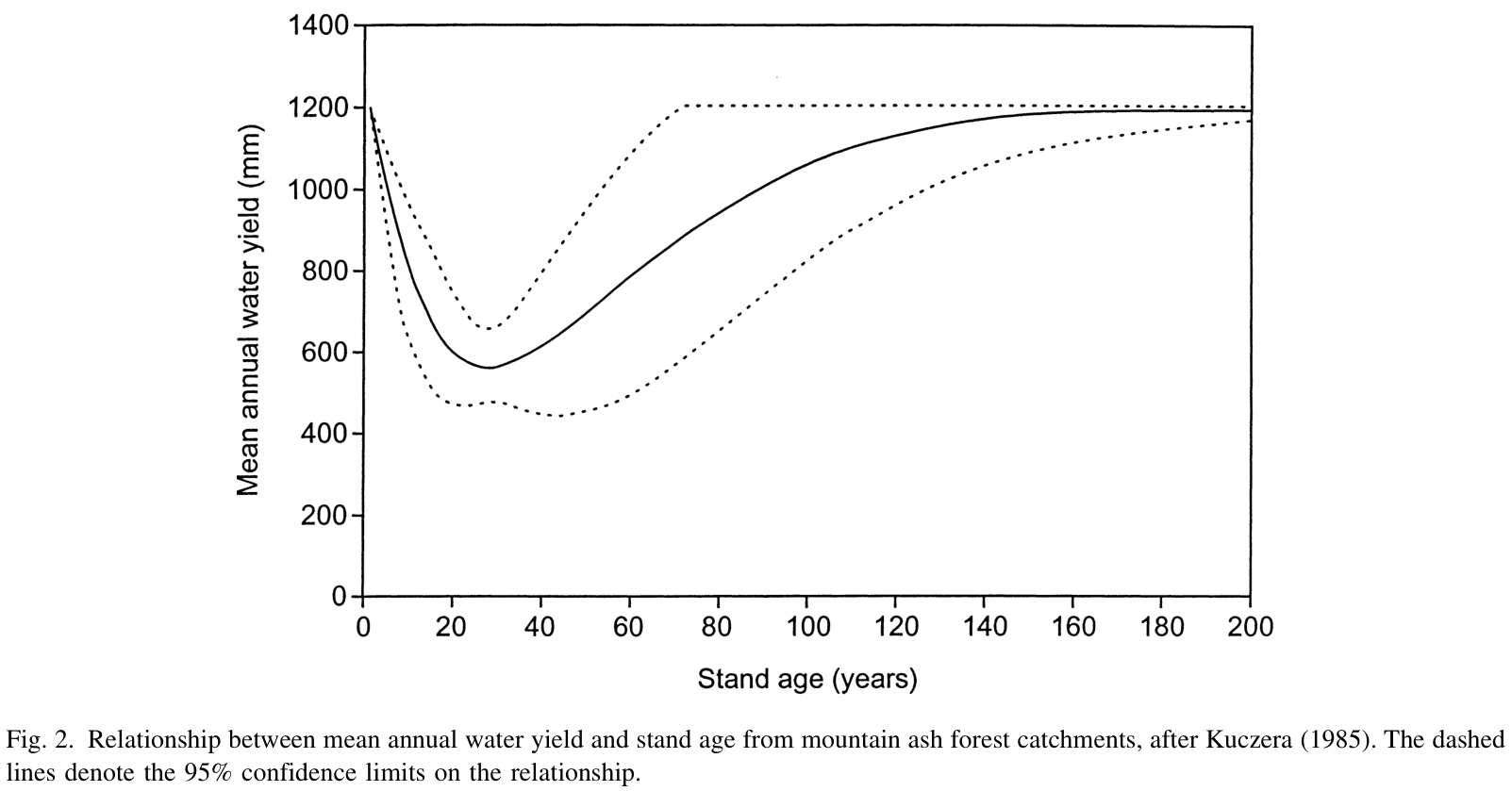
Vertessy, Watson and O'Sullivan, 2001, figure 2, 15.24 The figure reproduces an idealised curve from earlier research, for forest of pure mountain ash (Eucalyptus regnans) where about 1,800 mm of rain falls a year. On this curve, large old-growth catchments yield about 1,195 mm of water a year. After fire and regrowth, the yield falls to about 580 mm by an age of 27 years and can take 150 years to recover.
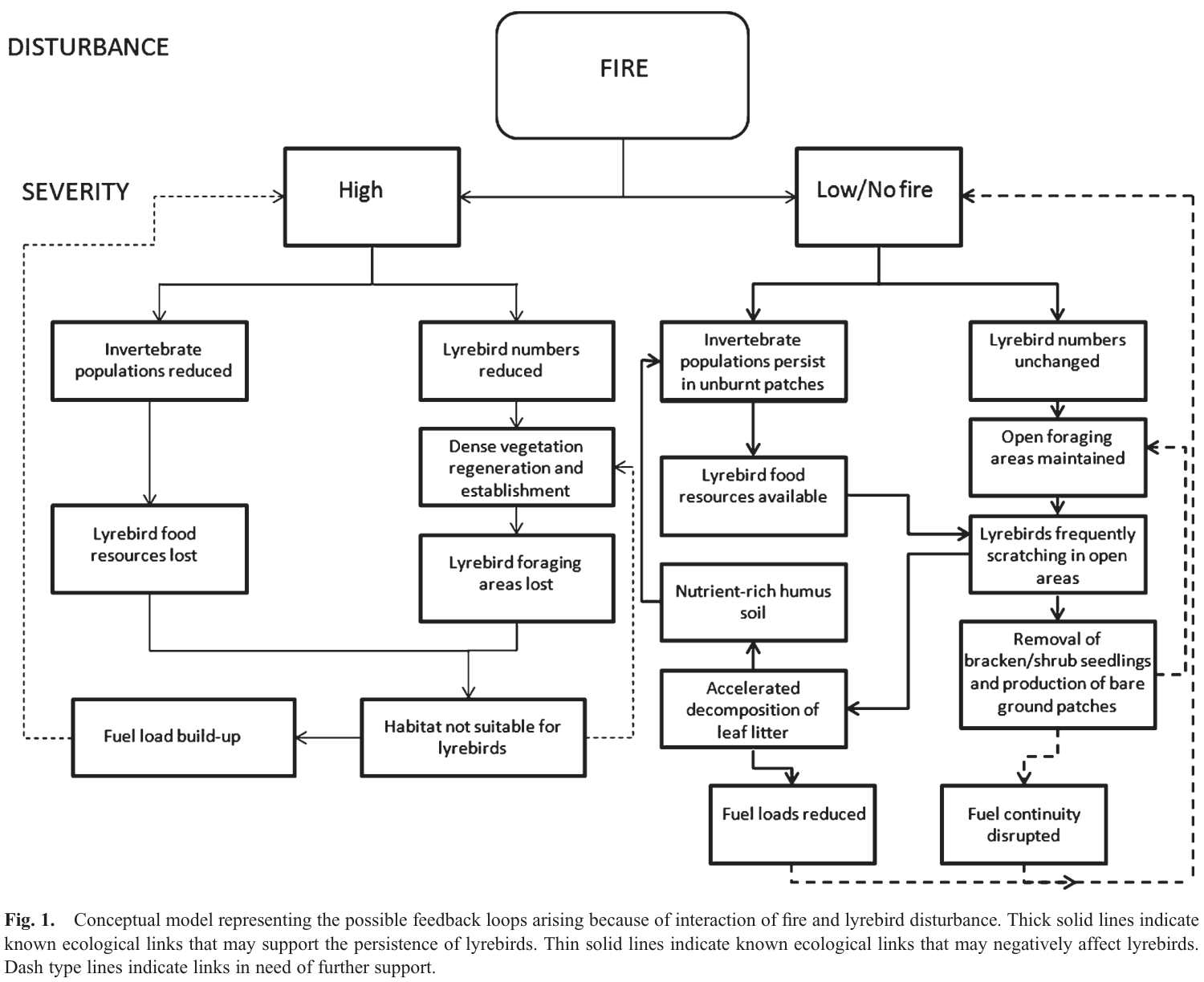
Nugent, Leonard and Clarke, 2014, figure 1, 208.25 In this study, foraging by lyrebirds reduced litter fuel loads by 25% in nine months, and modelling of fire behaviour showed a lower likelihood of fire.
- Research on nonhuman labour describes this work as labour. A Marxist critique within conservation biology concludes that the description of ecosystem functions as economic services obscures the biota that perform those functions, as commodification obscures the labour of human workers. The critique calls these biota ecosystem workers.26 More-than-human geography develops the concept of animal work and shows how metabolic, ecological and affective labour becomes a productive economic force.27 Feminist political theory proposes the term hybrid labour for the work of nature, understood as a collective and distributed undertaking of humans and nonhumans.28 A study of beaver restoration in California finds three ways in which humans work with beavers (Castor canadensis): the beaver as labourer, as coworker and as community.29 Geographical analysis of nature-based solutions describes a mode of governance that deploys animals as levers on geomorphic processes and geochemical cycles. It separates solutions that maintain the existing order from solutions that transform it.30
- The hypothesis. A multifunctional landscape fits the definition of exploitation and the definition of powerlessness when humans alone define its functions. It fits the definition of exploitation because the results of nonhuman labour pass to humans. Trees, eels, lyrebirds and floods build habitat, connect waters, supply the water of a city and reduce the risk of fire. Human institutions record such results as services to humans. It fits the definition of powerlessness because the contributors take no part in the decisions, and they often bear the costs. If the hypothesis holds, then the addition of biodiversity to a list of functions leaves the injustice in place. The remedy is participation: the beings that do the work help to decide what the work is for.
- Participation in a wider sense. The feminist theory of animal oppression treats participation in social decisions as a goal for humans that does not apply to nonhuman animals.20 The remedy therefore needs a wider concept. In this note, participation means that the responses of nonhuman members change decisions, which requires no deliberation in words (Leadership).
- Standing. The works cited here apply these terms to animals, to labour and to ecosystem services. The Marxist critique of ecosystem services is the closest to the hypothesis. It argues that commodification hides the worker, and it uses neither term. None of the works tests the terms on a multifunctional landscape. The statement is therefore a hypothesis.
- A possible test. For one landscape, record who performs each function that humans recognise, who receives its results, who bears the costs of management, and whether any response of the contributors has changed a decision. Birrarung takes a first step. It compares nine parts of one river from two positions, and it describes cases in which the responses of nonhuman members did or did not change decisions.
Frameworks for Participation
Frameworks for the participation of nonhuman members already exist. The list gives examples.
- A ladder of more-than-human participation. Deep Design Lab has proposed a ladder that starts from a well-known ladder of citizen participation and orders the degrees to which design includes nonhuman beings.31 See Ladder.
- Five questions. A second proposal of the lab gives five questions that test whether a project blocks nonhuman leadership. One question asks whether nonhuman members can influence outcomes directly, without human representation or interpretation.32
- A ladder of multispecies participation. Researchers of urban planning in northern Norway use a ladder to describe how kittiwakes (Rissa tridactyla) that move into towns can take part in planning, from passive subjects that humans manage to active agents.33
- A spectrum of nonhuman agency. An analysis of 38 nature-inclusive design cases and of four case studies found that nonhuman actors often enter the early phases of design as sources of ecological data. Their influence frequently diminishes during implementation and long-term stewardship.34
Standards from the Community
If humans alone do not define the functions, humans need another source of standards. One candidate is the life of the community itself: what each member needs in order to continue its life, and what the members need from each other. Deep Design Lab studies such standards under the name econormativity (Econormativity). Two cautions apply.
- Standards from a community can exclude. A standard of the natural or the healthy can leave out damaged, introduced or built members, although they take part in the landscape as it is now.
- Standards from a community can be conservative. Patterns that have lasted are no proof that they are fair to every member, or that they suit new conditions.
Justice across Species
Research on multispecies justice treats related questions.
- The subject of justice widens. Multispecies justice, a field of environmental political theory, broadens the conception of the subject of justice and of the means of recognition.35
- Planning needs wider concepts. Applied to nature-based solutions and to urban sustainability planning, multispecies justice offers wider conceptions of representation, distribution and agency than the dominant accounts provide.36
- Trade-offs are politics between species. The same approach questions four common assumptions about trade-offs in nature-based solutions: instrumentalism, the neutrality of science, collaborative consensus and a single timescale. It treats the handling of trade-offs as a form of interspecies politics.37
Alternatives
| Alternative | What changes | Related note |
|---|---|---|
| Capabilities | Goals state what each being can do and be | Capabilities |
| Services to ecosystems | Accounts include what humans give to ecosystems as well as what they take12 | Ecosystem Services |
| Benefits to the biotic community | Ecosystem services become benefits to all members of the biotic community, humans among them14 | Ecosystem Services |
| Care, property and community of justice | Morality shifts from utility to care. Humans reallocate property rights. Nonhuman entities join the community of justice13 | Justice |
| Hybrid labour | Accounts treat the work of nature as work and as a political matter28 | Work |
| Plural living community | The landscape is a community of many agents, who help to decide what it is for | River |
| Nonhuman leadership | Responses of nonhuman members redirect decisions, and human designers act as learners and supporters38 | Leadership |
Propositions
Deep Design Lab proposes the following statements. They are provisional. The first group says what a biodiverse multifunctional landscape is or should be.
- A biodiverse multifunctional landscape is a plural living community of human and nonhuman members, extended and distributed beyond any mapped boundary.
- The functions of such a landscape are what its members do and need, as seen from their own positions.
- Such a landscape recognises the work of its nonhuman members and gives these members a part in deciding what that work is for.
The second group says how to achieve such landscapes.
- Human planners must state goals as the capabilities of the beings that live there.
- Human planners must let the responses of nonhuman members test, redirect and, when necessary, stop human interventions.
- Human institutions must give up some control by returning water, land, fallen wood and floods.
- Human institutions must plan every intervention so that they can withdraw it.
- Human institutions must follow the authority of Traditional Owners over their Country.
One sentence summarises the statements: every landscape is already multifunctional for the human and nonhuman beings that live in it and construct it; a biodiverse multifunctional landscape is one in which nonhuman beings, as well as humans, can lead decisions about the functions that humans recognise and about the futures of all the beings that live there.
References
Footnotes
Jay, Marion, and Tobias Plieninger. “Addressing Landscape Multifunctionality in Conservation and Restoration.” Nature Reviews Biodiversity 1, no. 11 (2025): 717–32. https://doi.org/10.1038/s44358-025-00091-4.˄
Manning, Peter, Fons van der Plas, Santiago Soliveres, Eric Allan, Fernando T. Maestre, Georgina Mace, Mark J. Whittingham, and Markus Fischer. “Redefining Ecosystem Multifunctionality.” Nature Ecology & Evolution 2, no. 3 (2018): 427–36. https://doi.org/10.1038/s41559-017-0461-7.˄
Garibaldi, Lucas A., Paula F. Zermoglio, Esteban G. Jobbágy, Lucas Andreoni, Alejo Ortiz de Urbina, Ingo Grass, and Facundo J. Oddi. “How to Design Multifunctional Landscapes?” Journal of Applied Ecology 60, no. 12 (2023): 2521–27. https://doi.org/10.1111/1365-2664.14517.˄
Rickard, Thomas, and David Ludwig. “Rivers across Worlds: A Conceptual Framework for Ontological Inclusion & Exclusion in Participatory Water Governance.” Environment and Planning E: Nature and Space 8, no. 1 (2025): 251–77. https://doi.org/10.1177/25148486241280157.˄
Fors, Hanna, Anna Berlin, Uliana Gottlieb, Mari Kågström, James Weldon, and Jasmine Zhang. “Interdisciplinary Insights into Navigating the Maze of Landscape Multifunctionality.” People and Nature 6, no. 2 (2024): 519–34. https://doi.org/10.1002/pan3.10610.˄
Yarra River Protection (Wilip-gin Birrarung murron) Act 2017 (Vic), No 49 (2017).˄
Maisey, Alex C., Angie Haslem, Steven W. J. Leonard, and Andrew F. Bennett. “Foraging by an Avian Ecosystem Engineer Extensively Modifies the Litter and Soil Layer in Forest Ecosystems.” Ecological Applications 31, no. 1 (2021): e02219. https://doi.org/10.1002/eap.2219.˄
Greet, Joe, Rephael Lankri, Sarah Gaskill, Sarah Fischer, Delta Lucille Freedman, Tiana Preston, and Narrap Unit Rangers. “Urban Billabong Restoration Benefits from Traditional Owner Involvement and Regular Flooding.” Marine and Freshwater Research 74, no. 4 (2023): 398–408. https://doi.org/10.1071/MF22195.˄
Byrne, Ella, Jack Pascoe, Joe Greet, and Narrap Unit Rangers. “Hydrological Variability in Floodplain Wetlands Promotes Bird Diversity and Abundance.” Ecohydrology 18, no. 8 (2025): e70146. https://doi.org/10.1002/eco.70146.˄
Martin, Elizabeth H., Christopher J. Walsh, Melody Serena, and J. Angus Webb. “Urban Stormwater Runoff Limits Distribution of Platypus.” Austral Ecology 39, no. 3 (2014): 337–45. https://doi.org/10.1111/aec.12083.˄
Melbourne Water Corporation. Burndap Birrarung Burndap Umarkoo: Yarra Strategic Plan. Melbourne: Melbourne Water, 2022.˄
Comberti, Claudia, Thomas F. Thornton, Victoria Wyllie de Echeverria, and Trista M. Patterson. “Ecosystem Services or Services to Ecosystems? Valuing Cultivation and Reciprocal Relationships between Humans and Ecosystems.” Global Environmental Change 34 (2015): 247–62. https://doi.org/10.1016/j.gloenvcha.2015.07.007.˄
Muradian, Roldan, and Erik Gómez-Baggethun. “Beyond Ecosystem Services and Nature’s Contributions: Is It Time to Leave Utilitarian Environmentalism Behind?” Ecological Economics 185 (2021): 107038. https://doi.org/10.1016/j.ecolecon.2021.107038.˄
Farley, Joshua, Rigo E. M. Melgar, Danish Hasan Ansari, Matthew J. Burke, Julia Danielsen, Megan Egler, Lizah Makombore, et al. “Rethinking Ecosystem Services from the Anthropocene to the Ecozoic: Nature’s Benefits to the Biotic Community.” Ecosystem Services 67 (2024): 101624. https://doi.org/10.1016/j.ecoser.2024.101624.˄
Strang, Veronica. “Re-Imagining the River: New Environmental Ethics in Human Engagements with Water.” One Earth 2, no. 3 (2020): 204–6. https://doi.org/10.1016/j.oneear.2020.02.011.˄
Laborde, Sarah, and Sue Jackson. “Living Waters or Resource? Ontological Differences and the Governance of Waters and Rivers.” Local Environment 27, no. 3 (2022): 357–74. https://doi.org/10.1080/13549839.2022.2044298.˄
Pineda-Pinto, Melissa, Mick Lennon, Christopher Kennedy, Mairéad O’Donnell, Erik Andersson, Katinka Wijsman, and Marcus J. Collier. “Realizing Multispecies Justice through a Capability Approach to Promote Nature-Based Solutions.” npj Urban Sustainability 5, no. 1 (2025): 31. https://doi.org/10.1038/s42949-025-00205-z.˄
Parker, Dan, Kylie Soanes, and Stanislav Roudavski. “Interspecies Cultures and Future Design.” Transpositiones 1, no. 1 (2022): 183–236. https://doi.org/10.14220/trns.2022.1.1.183.˄
Young, Iris Marion. Justice and the Politics of Difference. Princeton: Princeton University Press, 1990.˄
Gruen, Lori. “The Faces of Animal Oppression.” In Dancing with Iris: The Philosophy of Iris Marion Young, edited by Ann Ferguson and Mechthild Nagel, 161–72. Oxford: Oxford University Press, 2009. https://doi.org/10.1093/oso/9780195389128.003.0013.˄
Dubeau, Mathieu. “Species-Being for Whom? The Five Faces of Interspecies Oppression.” Contemporary Political Theory 19, no. 4 (2020): 596–620. https://doi.org/10.1057/s41296-019-00363-7.˄
Odling-Smee, F. John, Kevin N. Laland, and Marcus W. Feldman. Niche Construction: The Neglected Process in Evolution. Princeton: Princeton University Press, 2003.˄
Jones, Clive G., John H. Lawton, and Moshe Shachak. “Organisms as Ecosystem Engineers.” Oikos 69, no. 3 (1994): 373–86. https://doi.org/10.2307/3545850.˄
Vertessy, Robert A., Fred G. R. Watson, and Sharon K. O’Sullivan. “Factors Determining Relations between Stand Age and Catchment Water Balance in Mountain Ash Forests.” Forest Ecology and Management 143, nos. 1–3 (2001): 13–26. https://doi.org/10.1016/S0378-1127(00)00501-6.˄
Nugent, Daniel T., Steven W. J. Leonard, and Michael F. Clarke. “Interactions between the Superb Lyrebird (Menura novaehollandiae) and Fire in South-Eastern Australia.” Wildlife Research 41, no. 3 (2014): 203–11. https://doi.org/10.1071/wr14052.˄
Peterson, Markus J., Damon M. Hall, Andrea M. Feldpausch-Parker, and Tarla Rai Peterson. “Obscuring Ecosystem Function with Application of the Ecosystem Services Concept.” Conservation Biology 24, no. 1 (2010): 113–19. https://doi.org/10.1111/j.1523-1739.2009.01305.x.˄
Barua, Maan. “Animating Capital: Work, Commodities, Circulation.” Progress in Human Geography 43, no. 4 (2019): 650–69. https://doi.org/10.1177/0309132518819057.˄
Battistoni, Alyssa. “Bringing in the Work of Nature: From Natural Capital to Hybrid Labor.” Political Theory 45, no. 1 (2017): 5–31. https://doi.org/10.1177/0090591716638389.˄
Welden, Emma A. “Conceptualising Multispecies Collaboration: Work, Animal Labour, and Nature-Based Solutions.” Transactions of the Institute of British Geographers 48, no. 3 (2023): 541–55. https://doi.org/10.1111/tran.12593.˄
Lorimer, Jamie. “Governing through Gaia: The Biopolitics of Delivering Nature-Based Solutions with Ecosystem Engineers.” Progress in Environmental Geography 5, no. 3 (2026): 226–50. https://doi.org/10.1177/27539687261457154.˄
Roudavski, Stanislav. “The Ladder of More-than-Human Participation: A Framework for Inclusive Design.” Cultural Science 14, no. 1 (2024): 110–19. https://doi.org/10.2478/csj-2024-0015.˄
Roudavski, Stanislav, and Alexander Holland. “Are You Blocking Nonhuman Leadership? Five Questions to Find Out.” In PDC ’26: Proceedings of the 19th Participatory Design Conference, vol. 2, edited by Laura Galluzzo, Anna Meroni, Daniela Selloni, Davide Fassi, Daniela de Sainz, Andrea Botero, Stefana Broadbent, et al., 372–81. New York: Association for Computing Machinery, 2026. https://doi.org/10.1145/3789492.3796416.˄
Førde, Anniken, Tone K. Reiertsen, Cecilie Sachs Olsen, Ingeborg Solvang, and Helen F. Wilson. “The Ladder of Multispecies Participation: Moving towards a More Convivial Urban Planning.” Nordic Journal of Urban Studies 6, no. 1 (2026): 1–18. https://doi.org/10.18261/njus.6.1.1.˄
Gualtieri, Giulia, Oana Druta, Pieter van Wesemael, and Evert-Jan Velzing. “The Spectrum of Non-Human Agency: Rethinking Participation in Multispecies Placemaking.” Design Studies 106 (2026): 101422. https://doi.org/10.1016/j.destud.2026.101422.˄
Celermajer, Danielle, David Schlosberg, Lauren Rickards, Makere Stewart-Harawira, Mathias Thaler, Petra Tschakert, Blanche Verlie, and Christine J. Winter. “Multispecies Justice: Theories, Challenges, and a Research Agenda for Environmental Politics.” Environmental Politics 30, nos. 1–2 (2021): 119–40. https://doi.org/10.1080/09644016.2020.1827608.˄
Raymond, Christopher M., Pauliina Rautio, Nora Fagerholm, Valtteri A. Aaltonen, Erik Andersson, Danielle Celermajer, Mike Christie, et al. “Applying Multispecies Justice in Nature-Based Solutions and Urban Sustainability Planning: Tensions and Prospects.” npj Urban Sustainability 5, no. 1 (2025): 2. https://doi.org/10.1038/s42949-025-00191-2.˄
Wijsman, Katinka, Melissa Pineda-Pinto, Simo Sarkki, Charlotte Stijnen, Janneke den Dekker-Arlain, and Christopher M. Raymond. “Rethinking Trade-Offs in Nature-Based Solutions from a Multispecies Justice Perspective.” npj Urban Sustainability 5, no. 1 (2025): 67. https://doi.org/10.1038/s42949-025-00261-5.˄
Roudavski, Stanislav. “The Case for Nonhuman Leadership.” Interactions 33, no. 6 (2026): 64–67. https://doi.org/10.1145/3849465.˄
Backlinks