Photography
This note sets out how the lab uses photographs and video in research. Images do three jobs: they record evidence that others can check, they supply data for counting and measuring, and they show readers outside the research what the research saw. The principles below come from studies that tested image methods, mostly in water and with fish. Anguillid eels come first, because the lab's eel project depends on these methods. Each principle gives one or two examples, and the child notes develop the methods, the evidence and the templates.
Status: working draft of 10 November 2026. Each principle is a short section, so a principle, an example or a child note can be extended, moved or replaced.
Related Notes
- Sensing: photographs and video combined with sonar, telemetry, eDNA and other sensors, with eel studies first.
- Co-production: observation with Indigenous people, fishers, anglers and community monitors.
- Dissemination: images in deep maps, data stories, citizen science and investigations, and their measured effects on viewers.
- Templates: shot lists, field sheets, captions, metadata, permissions and file names.
- Craft: composition, light, photographing through water and glass, processing and figures.
- Video: the lab's rules for video (voiceover, no captions, no music).
- Photography: tutorials and software, including focus stacking.
- Mapping: deep maps and spatial narratives.
- Field Work, Walking and Data Collection: fieldwork methods that images accompany.
- More than Human Design: the design approach these methods serve.
- File Structure (Private): where image files go.
- Eel Capabilities: Student Brief, Anguillid Eels and Measurement: the eel project, eels themselves and the measurement of habitat structures.
What Images Do in Research
One image can do all three jobs, but each job asks something different of it.
- Evidence. A photograph or a video clip shows that something happened at a place and time, and other researchers can check it later. A motion-activated camera on an eel ladder, for example, photographed each eel that climbed, so the counts could be checked against physical counts.1
- Data. Images also support measurement. The same eel-ladder photographs gave lengths that agreed with lengths measured on a board.1 Photographs from fixed positions measure shorelines,2 the greening of vegetation3 and the extent of floods.4
- Communication. Images show readers what the research saw. Their effects on viewers are real but mixed, as principle 10 explains.
The jobs pull in different directions. Evidence and data need standard positions, settings and records, while communication favours composition and selection. Principle 9 describes how one image stream can still serve both.
Principles
1. Start from the question and choose the sensor that can answer it
The question decides what must be detected, at what size, in what light and in what water, and these conditions decide the sensor. Researchers who asked at what size Japanese eels begin to climb river structures filmed a low vertical weir with infrared video, which works in darkness, and logged water temperature and rainfall beside it. The video recorded every eel that climbed, all at night and all between 60 and 140 mm long, and the logs linked climbing to water temperature and rain.5
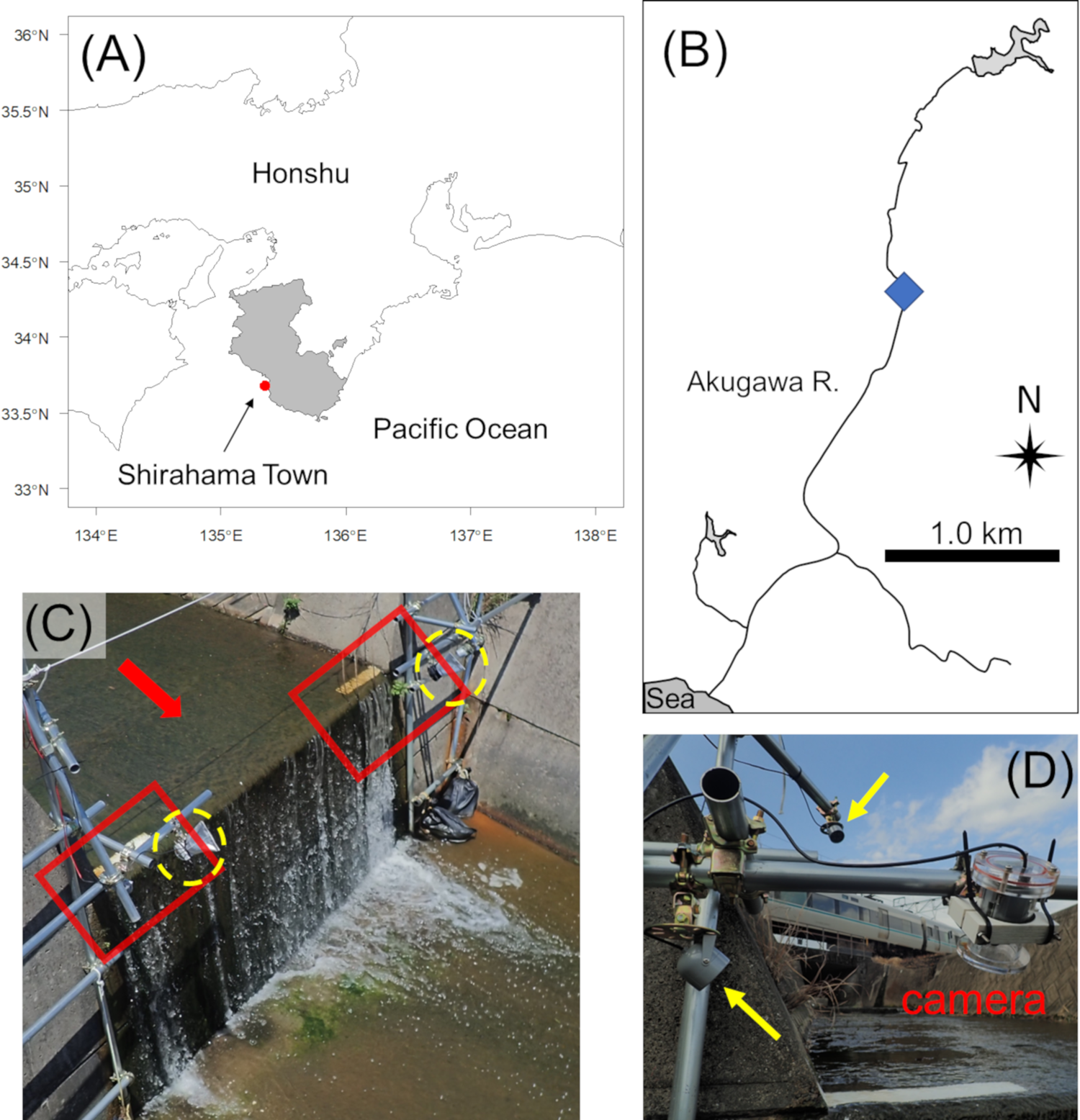
The study site on the Akugawa River, Japan: maps, the low weir and the infrared camera set-up that recorded climbing eels.5
Where water is dark or turbid, optical cameras see little, so a different sensor answers the same kind of question. At a weir on the River Shannon, an acoustic camera and mark-recapture recorded which of two routes silver eels took; the share of eels in each route followed the share of the flow.6
Developed in Sensing.
2. Combine images with other sensing, because each method detects what the others miss
Every sensor misses some animals, and the misses differ between sensors, so combinations detect more. In a small river in Bavaria, an acoustic camera counted 63 per cent of the fish that a net caught after they passed, and an action camera counted 45 per cent; the camera worked best in clear water by day.7 At 48 sites in Western Australia, eDNA and baited underwater video together found over 30 per cent more fish genera than either method alone, because each method detected taxa that the other missed.8
Developed in Sensing.
3. Treat images as situated evidence, keep them open to reinterpretation and pair them with notes
A photograph records one moment from one position, chosen by someone for a reason, so its meaning depends on that context. Researchers who studied robotic milking on dairy farms compared field notes, still photographs and video. Video let the cows' actions enter the research record and stay open to interpretation by later viewers, which weakened the researchers' hold over the account.9 Video also lets researchers slow behaviour down for detailed analysis or speed it up in time-lapse, and a study of encounters between elephants and humans used such clips to witness and make sense of what happened between them.10 In the lab's study of powerful owls in Melbourne, walking interviews in owl territories combined photographs, participants' own images and documents to identify how humans and owls coexist in the city.11
A note of who took each image, where, when and why lets later readers judge what it shows. Templates gives the fields.
4. Choose viewpoints deliberately, including animal-level and animal-borne ones, and say what the camera cannot sense
Camera height, angle and light decide whose world an image shows. The makers of a documentary about Moscow's street dogs filmed from the height of a dog, and interviews with them show how this choice shaped the film's perspective and narration.12
Some subjects need the viewpoint built into the experiment. Glass eels are transparent and migrate in the dark, so researchers marked them with fluorescent elastomer tags that glow under ultraviolet light. Two cameras then followed four tagged eels at once in a flume whose current reversed with a simulated tide.13
Every viewpoint leaves things out: darkness outside the infrared range, water below the field of view, sounds and smells. A short statement of what the camera could not sense keeps viewers from reading an absence in the image as an absence in the world.
Developed in Sensing and Craft.
5. Standardise and repeat: photo points, fixed camera cradles, time-lapse
Images become comparable when the camera returns to the same position, direction and settings. The PhenoCam network has recorded vegetation with fixed cameras across North America, almost 750 site-years of images, and each shift in a camera's field of view requires a redrawn region of interest before the series can continue.3 Smartphone cradles solve the same problem at the coast: the cradle fixes the camera position, so the photographs that passers-by share become measurements of the shoreline.2
Developed in Templates.
6. Know what the camera misses: turbidity, darkness, detection bias and bias in reading images
Cameras miss animals in turbid water, in darkness and beyond the field of view, and the people who read the images add errors of their own. Two experienced operators counted European eels in acoustic-camera video almost identically, but both underestimated the eels' lengths, by 4 to 7 per cent on average.14 For camera traps on land, a review assembled the factors that change detection, from an animal's size and behaviour to the camera's position and settings, and recommended reporting them so that studies can be compared and their data reused.15
Developed in Sensing.
7. Expect cameras and photographers to change what they record
Cameras emit light and sound, and photographers approach, bait and call animals, so recording changes the behaviour it records. Wild dogs, foxes, feral cats and spotted-tailed quolls in New South Wales reacted to camera traps by day and by night: some individuals retreated and others approached, which may bias detection rates.16 A review of photography for social media found that photographers disturb breeding and feeding, use call playback, drones and bait, and trample plants; rare, sessile species with small ranges face the greatest risk.17
8. Respect people, Country and consent
Images of people, places and knowledge come with rights and responsibilities. Camera traps set for snow leopards also recorded people, and the researchers proposed a code of conduct that weighs the privacy of those recorded against a duty to report crimes.18 In two photovoice projects with Aboriginal groups in northern Australia, participants photographed their own concerns about water. The method proved culturally appropriate and engaging, and it revealed values and knowledge that other participatory approaches might have missed.19 Research with Aboriginal and Torres Strait Islander peoples in Australia follows a national code of ethics built on Indigenous self-determination and leadership.20
Developed in Co-production.
9. Compose for the question, and let one image stream serve both data and communication where it can
A sequence planned for measurement can also show the measured change to the public. Time-lapse cameras on the Platte River measured inundation and the seasonal growth of plants alongside records of streamflow and water chemistry, and the same sequences made these changes visible to public audiences.4 Panoramic underwater imagery of 500 km of coral reef gave kilometre-scale measurements of reef health, and the same images went online for anyone to explore.21
Developed in Craft and Dissemination.
10. Check what images teach viewers
Images can teach viewers the opposite of what the photographer intended, and captions may not correct them. In an online experiment, the closer a human stood to a zoo animal in a photograph, the more likely viewers were to judge the animal's behaviour unnatural and, among members of the public, to think the animal would make a good pet.22 Captions that framed images of humans touching primates as research made nearly 3,000 respondents more likely to see the images as research, but did not change their wish to keep primates as pets: over half said they would keep a gorilla or a loris.23
Developed in Dissemination.
11. Keep processing honest and figures legible
Adjustments that make an image clearer can also change what it shows. Twelve guidelines for processing scientific images separate acceptable adjustments from manipulations that alter the data, and explain the technical reason behind each.24 A survey of image figures in 580 papers on plant science, cell biology and physiology found missing scale bars, colours that colour-blind readers cannot tell apart, and colours and labels left unexplained; few papers met every criterion of good practice.25
Developed in Craft.
12. Record metadata and plan for reuse by crowds and machines
Images outlive the project that made them when their records travel with them. On Snapshot Serengeti, volunteers classified 1.2 million sets of camera-trap images online,26 and their combined answers matched experts' identifications for 98 per cent of images, with most errors on rare species.27 Explicit rules retired each image once volunteers had marked it blank, agreed on it or disagreed.
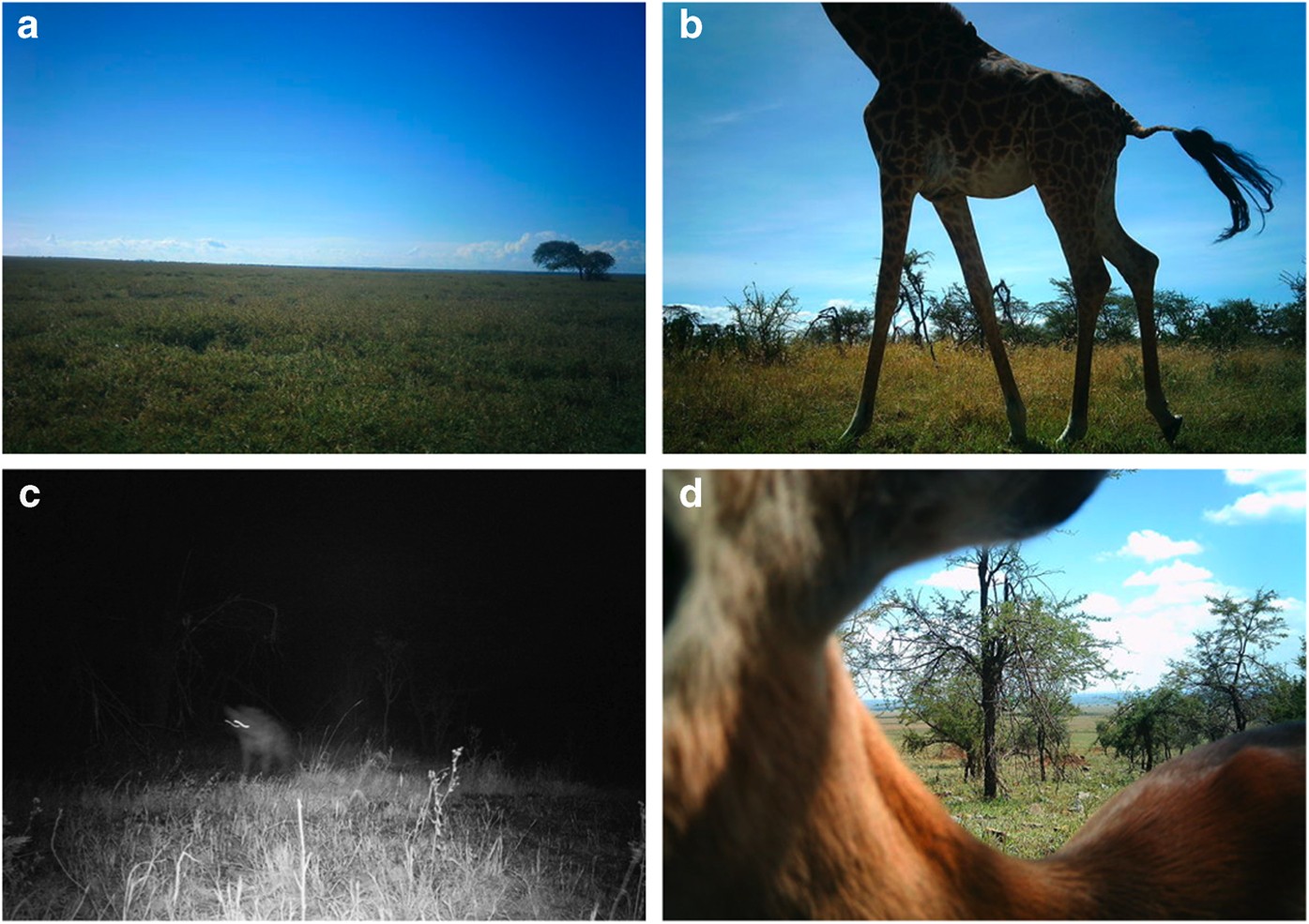
Snapshot Serengeti images retired as blank, as consensus or as disagreement among volunteers.26
An open standard for camera-trap data, Camtrap DP, specifies how deployments, media files and observations are recorded so that datasets can be exchanged and archived.28
Developed in Templates and Dissemination.
13. Work with the people who already watch the water
Fishers, Traditional Owners and community monitors observe rivers over decades and at places that no research camera covers, and their records extend the reach of image-based methods. On the River Minho, fishers' daily records of glass-eel catches from 1990 to 2022, some handed over after the fishers retired, were modelled with experimental catches to describe seasonal and year-to-year trends in recruitment.29 At Rotoroa in Nelson Lakes National Park, families of Ngāti Apa ki te Rā Tō took part in the design, fieldwork and interpretation of a customary tuna (eel) harvest, and monitoring showed that the harvest stayed within conservative ecological limits.30
Developed in Co-production.
14. Layer present-day images over historical drawings, archaeological plans and elevation models
Photographs of present practice gain depth when they appear beside older records of the same place. A history of the Gunditjmara eel fishery, written with a Gunditjmara co-author, set photographs of fishers drying and setting nets in 2007 and 2008 beside drawings of weirs and eel baskets made in 1841, archaeological plans of stone fish traps and photographs of excavations.31 At Budj Bim, elevation models from lidar, processed in several visualisations, picked out Gunditjmara channels, weirs and ponds across the lava flow; the Gunditj Mirring Traditional Owners Corporation is among the authors.32
Developed in Co-production and Mapping.
Critical Aspects
- Images select. Photographers choose subjects, places and moments, and the selection shapes what audiences believe about nature. In an analysis of 1,333 photographs from a major wildlife competition, the winning photographs covered fewer taxonomic groups than the others, and colourful organisms were more likely to win.33
- Cameras intrude. They affect animals (principle 7), and they also record people who never consented. Researchers who review observation video meet unexpected information about animals and people and need guidance on how to handle it.34
- Images of Country have colonial histories. A collective of Indigenous and non-Indigenous artists and art historians reread colonial photographs of place and proposed ways of photographing place that follow Indigenous ontologies and respect colonial trauma.35
- Effects on viewers are often smaller than expected. Several experiments found no effect of maps, photographs or local video on readers' engagement or perception of risk; Dissemination gives the details.
How the Lab Works with Images
- Plan a shot list from the research question before fieldwork.
- Record at capture the date, place, coordinates, species, event, photographer and rights.
- Name each folder by date, site name and site code, as in
2026-03-14 Site Name CODE, and keep the camera's file names inside it. - Write the record into each file's metadata with ExifTool, in the IPTC and Darwin Core fields, so that the record travels with the file.
- License the lab's images under CC BY 4.0 unless a project agreement says otherwise, with Deep Design Lab as the rights holder and the photographer named.
- List each batch in the project's image catalogue.
- Follow Video for video.
Templates gives the shot list, the field sheet, the metadata fields and the naming rules.
Implications for More-than-Human Design
- Images can register the actions of other species as evidence for design. Infrared video showed juvenile eels approaching and climbing studded surfaces more often than other surfaces, so the eels' own choices became the measure of a passage design.36
- Viewpoints at animal level, or carried by animals, can move a design brief from what humans see to what other species meet (principle 4).
- Records made with Traditional Owners and fishers bring knowledge of long relations between people and eels into design decisions (principles 13 and 14).
- Habitat structures need images before and after installation, from fixed points, to show whether and how other species use them; Measurement describes what to measure.
Open Questions
- How can the lab record eels in turbid urban drains, where optical cameras see little and acoustic cameras cost more?
- Which metadata standard suits both design documentation and ecological reuse: the IPTC and Darwin Core fields used now, or Camtrap DP for camera data?
- How should images of Country and of Indigenous knowledge appear in a vault that is published as a website?
- Do images of eels change what viewers think and do, given the null results for other species and media?
References
Subnotes
Footnotes
Welsh, Stuart A., and Joni L. Aldinger. “A Semi-Automated Method for Monitoring Dam Passage of Upstream Migrant Yellow-Phase American Eels.” North American Journal of Fisheries Management 34, no. 4 (2014): 702–9. https://doi.org/10.1080/02755947.2014.910580.˄
Harley, Mitchell D., and Michael A. Kinsela. “CoastSnap: A Global Citizen Science Program to Monitor Changing Coastlines.” Continental Shelf Research 245 (2022): 104796. https://doi.org/10.1016/j.csr.2022.104796.˄
Richardson, Andrew D., Koen Hufkens, Tom Milliman, Donald M. Aubrecht, Min Chen, Josh M. Gray, Miriam R. Johnston, et al. “Tracking Vegetation Phenology across Diverse North American Biomes Using PhenoCam Imagery.” Scientific Data 5, no. 1 (2018): 180028. https://doi.org/10.1038/sdata.2018.28.˄
Brinley Buckley, Emma M., Craig R. Allen, Michael Forsberg, Michael Farrell, and Andrew J. Caven. “Capturing Change: The Duality of Time-Lapse Imagery to Acquire Data and Depict Ecological Dynamics.” Ecology and Society 22, no. 3 (2017): 30. https://doi.org/10.5751/es-09268-220330.˄
Kume, Manabu, Yudai Yoshikawa, Tomoichiro Tanaka, Shun Watanabe, Hiromichi Mitamura, and Yoh Yamashita. “Water Temperature and Precipitation Stimulate Small-Sized Japanese Eels to Climb a Low-Height Vertical Weir.” PLOS ONE 17, no. 12 (2022): e0279617. https://doi.org/10.1371/journal.pone.0279617.˄
Lenihan, Eamonn S., T. Kieran McCarthy, and Colin Lawton. “Assessment of Silver Eel (Anguilla anguilla) Route Selection at a Water-Regulating Weir Using an Acoustic Camera.” Marine and Freshwater Research 72, no. 6 (2021): 754–65. https://doi.org/10.1071/mf20230.˄
Egg, Leonhard, Joachim Pander, Melanie Mueller, and Juergen Geist. “Comparison of Sonar-, Camera- and Net-Based Methods in Detecting Riverine Fish-Movement Patterns.” Marine and Freshwater Research 69, no. 12 (2018): 1905–12. https://doi.org/10.1071/mf18068.˄
Stat, Michael, Jeffrey John, Joseph D. DiBattista, Stephen J. Newman, Michael Bunce, and Euan S. Harvey. “Combined Use of eDNA Metabarcoding and Video Surveillance for the Assessment of Fish Biodiversity.” Conservation Biology 33, no. 1 (2019): 196–205. https://doi.org/10.1111/cobi.13183.˄
Bear, Christopher, Katy Wilkinson, and Lewis Holloway. “Visualizing Human-Animal-Technology Relations: Field Notes, Still Photography, and Digital Video on the Robotic Dairy Farm.” Society & Animals 25, no. 3 (2017): 225–56. https://doi.org/10.1163/15685306-12341405.˄
Lorimer, Jamie. “Moving Image Methodologies for More-than-Human Geographies.” Cultural Geographies 17, no. 2 (2010): 237–58. https://doi.org/10.1177/1474474010363853.˄
Parker, Dan, Kylie Soanes, and Stanislav Roudavski. “Learning with Owls: Human–Wildlife Coexistence as a Guide for Urban Design.” People and Nature 7, no. 7 (2025): 1619–38. https://doi.org/10.1002/pan3.70067.˄
Turnbull, Jonathon, and Adam Searle. “Filmmaking Practice and Animals’ Geographies: Attunement, Perspective, Narration.” Cultural Geographies 29, no. 3 (2022): 453–64. https://doi.org/10.1177/14744740211035471.˄
Delcourt, Johann, Marc Ylieff, Valérie Bolliet, Pascal Poncin, and Agnès Bardonnet. “Video Tracking in the Extreme: A New Possibility for Tracking Nocturnal Underwater Transparent Animals with Fluorescent Elastomer Tags.” Behavior Research Methods 43, no. 2 (2011): 590–600. https://doi.org/10.3758/s13428-011-0060-5.˄
Lagarde, Raphaël, Jason Peyre, Elsa Amilhat, Manon Mercader, François Prellwitz, Gaël Simon, and Elisabeth Faliex. “In situ Evaluation of European Eel Counts and Length Estimates Accuracy from an Acoustic Camera (ARIS).” Knowledge & Management of Aquatic Ecosystems, no. 421 (2020): 44. https://doi.org/10.1051/kmae/2020037.˄
Hofmeester, Tim R., Joris P. G. M. Cromsigt, John Odden, Henrik Andrén, Jonas Kindberg, and John D. C. Linnell. “Framing Pictures: A Conceptual Framework to Identify and Correct for Biases in Detection Probability of Camera Traps Enabling Multi-Species Comparison.” Ecology and Evolution 9, no. 4 (2019): 2320–36. https://doi.org/10.1002/ece3.4878.˄
Meek, Paul, Guy Ballard, Peter Fleming, and Greg Falzon. “Are We Getting the Full Picture? Animal Responses to Camera Traps and Implications for Predator Studies.” Ecology and Evolution 6, no. 10 (2016): 3216–25. https://doi.org/10.1002/ece3.2111.˄
Davis, Robert A., Claire Greenwell, Belinda J. Davis, and Philip W. Bateman. “Liked to Death: The Impacts of Social Media and Photography on Biodiversity.” Science of The Total Environment 949 (2024): 175106. https://doi.org/10.1016/j.scitotenv.2024.175106.˄
Sharma, Koustubh, Matthias Fiechter, Todd George, Juliette Young, Justine Shanti Alexander, Ajay Bijoor, Kulbhushansingh Suryawanshi, and Charudutt Mishra. “Conservation and People: Towards an Ethical Code of Conduct for the Use of Camera Traps in Wildlife Research.” Ecological Solutions and Evidence 1, no. 2 (2020): e12033. https://doi.org/10.1002/2688-8319.12033.˄
Maclean, Kirsten, and Emma Woodward. “Photovoice Evaluated: An Appropriate Visual Methodology for Aboriginal Water Resource Research.” Geographical Research 51, no. 1 (2013): 94–105. https://doi.org/10.1111/j.1745-5871.2012.00782.x.˄
AIATSIS. AIATSIS Code of Ethics for Aboriginal and Torres Strait Islander Research. Canberra: Australian Institute of Aboriginal and Torres Strait Islander Studies, 2020.˄
González-Rivero, Manuel, Pim Bongaerts, Oscar Beijbom, Oscar Pizarro, Ariell Friedman, Alberto Rodriguez-Ramirez, Ben Upcroft, et al. “The Catlin Seaview Survey – Kilometre-Scale Seascape Assessment, and Monitoring of Coral Reef Ecosystems.” Aquatic Conservation: Marine and Freshwater Ecosystems 24, no. S2 (2014): 184–98. https://doi.org/10.1002/aqc.2505.˄
Shaw, Meghan N., Emily M. McLeod, William T. Borrie, and Kelly K. Miller. “Human Positioning in Close-Encounter Photographs and the Effect on Public Perceptions of Zoo Animals.” Animals 12, no. 1 (2021): 11. https://doi.org/10.3390/ani12010011.˄
Freund, Cathryn A., Katherine A. Cronin, Michelle Huang, Natalie J. Robinson, Boaz Yoo, and Andrea L. DiGiorgio. “Effects of Captions on Viewers’ Perceptions of Images Depicting Human-Primate Interaction.” Conservation Biology 38, no. 3 (2024): e14199. https://doi.org/10.1111/cobi.14199.˄
Cromey, Douglas W. “Avoiding Twisted Pixels: Ethical Guidelines for the Appropriate Use and Manipulation of Scientific Digital Images.” Science and Engineering Ethics 16, no. 4 (2010): 639–67. https://doi.org/10.1007/s11948-010-9201-y.˄
Jambor, Helena, Alberto Antonietti, Bradly Alicea, Tracy L. Audisio, Susann Auer, Vivek Bhardwaj, Steven J. Burgess, et al. “Creating Clear and Informative Image-Based Figures for Scientific Publications.” PLOS Biology 19, no. 3 (2021): e3001161. https://doi.org/10.1371/journal.pbio.3001161.˄
Swanson, Alexandra, Margaret Kosmala, Chris Lintott, Robert Simpson, Arfon Smith, and Craig Packer. “Snapshot Serengeti, High-Frequency Annotated Camera Trap Images of 40 Mammalian Species in an African Savanna.” Scientific Data 2, no. 1 (2015): 150026. https://doi.org/10.1038/sdata.2015.26.˄
Swanson, Alexandra, Margaret Kosmala, Chris Lintott, and Craig Packer. “A Generalized Approach for Producing, Quantifying, and Validating Citizen Science Data from Wildlife Images.” Conservation Biology 30, no. 3 (2016): 520–31. https://doi.org/10.1111/cobi.12695.˄
Bubnicki, Jakub W., Ben Norton, Steven J. Baskauf, Tom Bruce, Francesca Cagnacci, Jim Casaer, Marcin Churski, et al. “Camtrap DP: An Open Standard for the FAIR Exchange and Archiving of Camera Trap Data.” Remote Sensing in Ecology and Conservation 10, no. 3 (2024): 283–95. https://doi.org/10.1002/rse2.374.˄
Stratoudakis, Yorgos, Isabel Domingos, and Carlos Antunes. “Glass Eels at the Continental Edge of Europe: Revisiting Catchment Recruitment at the International River Minho/Miño.” Hydrobiologia 851, no. 11 (2024): 2591–607. https://doi.org/10.1007/s10750-023-05459-1.˄
Skilton, Jennifer E., Simon D. Stewart, Tim Harwood, and Catriona Sinclair. “Understanding Population Sustainability and Safe Consumption Limits to Inform Cultural Harvest of Tuna within Nelson Lakes National Park.” New Zealand Journal of Marine and Freshwater Research 60, no. 1 (2026): e70029. https://doi.org/10.1002/nzm2.70029.˄
McNiven, Ian J., and Damein Bell. “Fishers and Farmers: Historicising the Gunditjmara Freshwater Fishery, Western Victoria.” La Trobe Journal, no. 85 (2010): 83–105.˄
Armstrong, Brian J., Zexian Huang, Gunditj Mirring Traditional Owners Corporation, Bill Bell, Micko Bell, Tyson Lovett-Murray, Evelyn Nicholson, Adam Black, and Martin Tomko. “LiDAR-Derived High-Resolution Geomorphological Analysis for Archaeology: Case Study of the Gunditjmara Aquaculture Engineering Systems at Budj Bim, Australia.” Australian Archaeology 92, no. 1 (2026): 57–74. https://doi.org/10.1080/03122417.2026.2655731.˄
Ruiz-Villar, Héctor, Ana Morales-González, and Jon Morant. “Behind the Lenses: Biases in the Contribution of Wildlife Photography to Biodiversity Representation.” People and Nature 7, no. 2 (2025): 541–56. https://doi.org/10.1002/pan3.10789.˄
Giersberg, Mona F., and Franck L. B. Meijboom. “Caught on Camera: On the Need of Responsible Use of Video Observation for Animal Behavior and Welfare Research.” Frontiers in Veterinary Science 9 (2022): 864677. https://doi.org/10.3389/fvets.2022.864677.˄
Clancy, Peta, Jahkarli Felicitas Romanis, Kirsten Lyttle, Jessica Neath, and Melissa Miles. “A Situated Practice: Making and Reading Photographs of Place in Australia and Aotearoa New Zealand.” Journal of Visual Art Practice 24, nos. 1–2 (2025): 29–50. https://doi.org/10.1080/14702029.2025.2484068.˄
Watz, Johan, P. Anders Nilsson, Erik Degerman, Carl Tamario, and Olle Calles. “Climbing the Ladder: An Evaluation of Three Different Anguillid Eel Climbing Substrata and Placement of Upstream Passage Solutions at Migration Barriers.” Animal Conservation 22, no. 5 (2019): 452–62. https://doi.org/10.1111/acv.12485.˄
Backlinks