Sensing
This note describes how photographs and video work together with other sensors in studies of fish and water, and what each combination adds or misses. Eel studies come first, because eels move at night, in turbid water and through structures where optical cameras struggle. The note develops principles 1, 2, 4 and 6 of Photography.
Status: working draft of 10 November 2026.
Related Notes
- Photography: the principles.
- Templates: field sheets, metadata and reporting standards for camera data.
- Co-production: sensing with Traditional Owners, fishers and community monitors.
- Data Collection and Unmanned Vehicles: data collection and drones.
- Eel Capabilities: Student Brief and Anguillid Eels: the eel project and eels.
- Measurement: measuring habitat structures.
Methods at a Glance
| Method | What it records | What it misses | Example |
|---|---|---|---|
| Infrared video | Behaviour in darkness at short range | Animals beyond the lit range or in turbid water | Eels climbing a weir1 |
| Motion-triggered stills | Counts and lengths at a fixed point | Animals that pass too fast or together | Eels on a ladder2 |
| Imaging sonar (acoustic cameras such as DIDSON and ARIS) | Counts, lengths and behaviour in dark or turbid water | Species identity, small fish and exact length | Silver eels at a weir3 |
| Acoustic telemetry and PIT tags | Routes and timing of individual animals over kilometres | Behaviour between receivers | Silver eels at pumping stations4 |
| Accelerometer tags | Activity of tagged individuals | What the animal meets | Silver eels at a tidal pumping station5 |
| eDNA | Presence of species from water samples | Numbers, sizes and behaviour | Native fishes in remote streams6 |
| Time-lapse photography | Seasonal change in habitats | Short events between frames | Floodplain habitats7 |
| Photogrammetry and lidar | Three-dimensional structure of habitats | The animals | River substrate8 |
| Image velocimetry | Velocities of the water surface | Flow below the surface | River surface flow9 |
Eels at Climbing Structures and Passes
Juvenile eels climb weirs, ramps and passes, mostly at night, so infrared video and still cameras record their choices directly. Infrared video at a low weir in Japan recorded every eel that climbed, all at night and all between 60 and 140 mm long.1
Experiments use the same cameras to compare designs. In one, juvenile eels could climb ramps lined with studded, open-weave or bristle substrata, and infrared cameras filmed two of the six ramps. The video showed more approaches and climbs on the studded substrate, and trap catches at a hydropower dam confirmed the result in the field.10
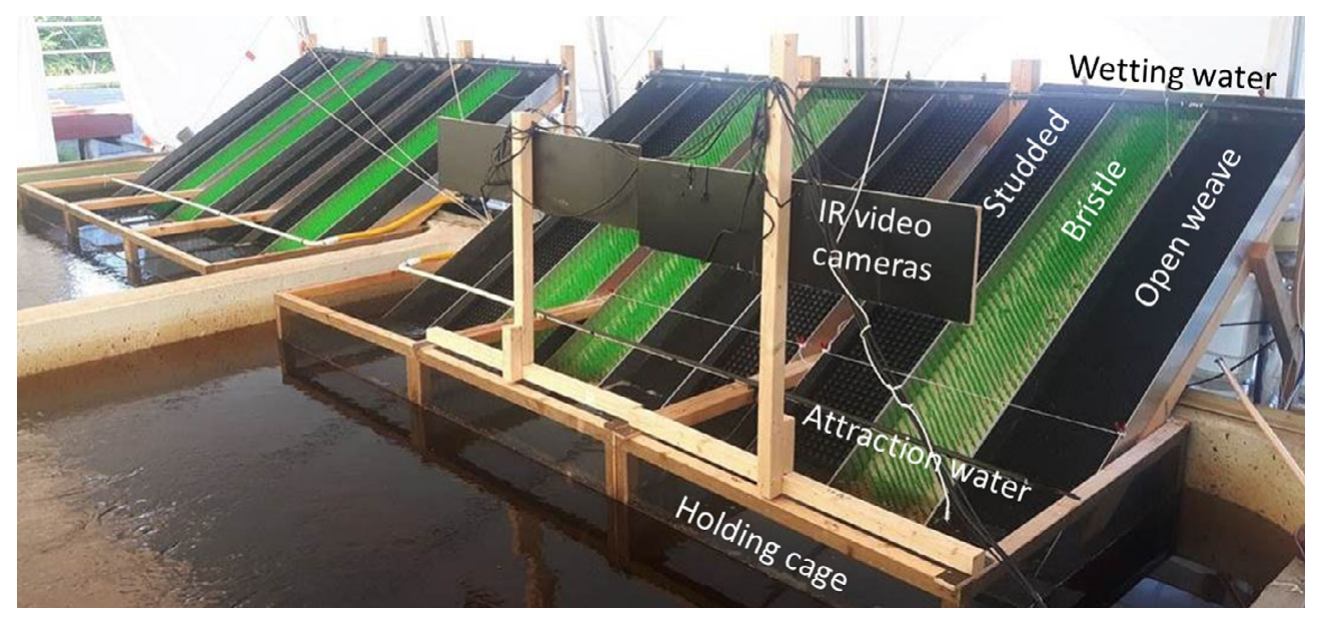
Ramps with three climbing substrata in each lane, holding cages and wetting water; infrared cameras filmed two of the ramps.10
In a flume, glass eels passed a model Crump weir more readily when eel tiles with studs covered its downstream face. The eels kept to the edges and climbed through the tiles in single bursts of swimming, at an estimated 68.5 cm per second.11 A follow-up study found that many eels and lampreys turned back or were washed downstream after reaching the top of tiles on a vertical weir, 33 and 80 per cent respectively, so tiles should continue to the crest.12
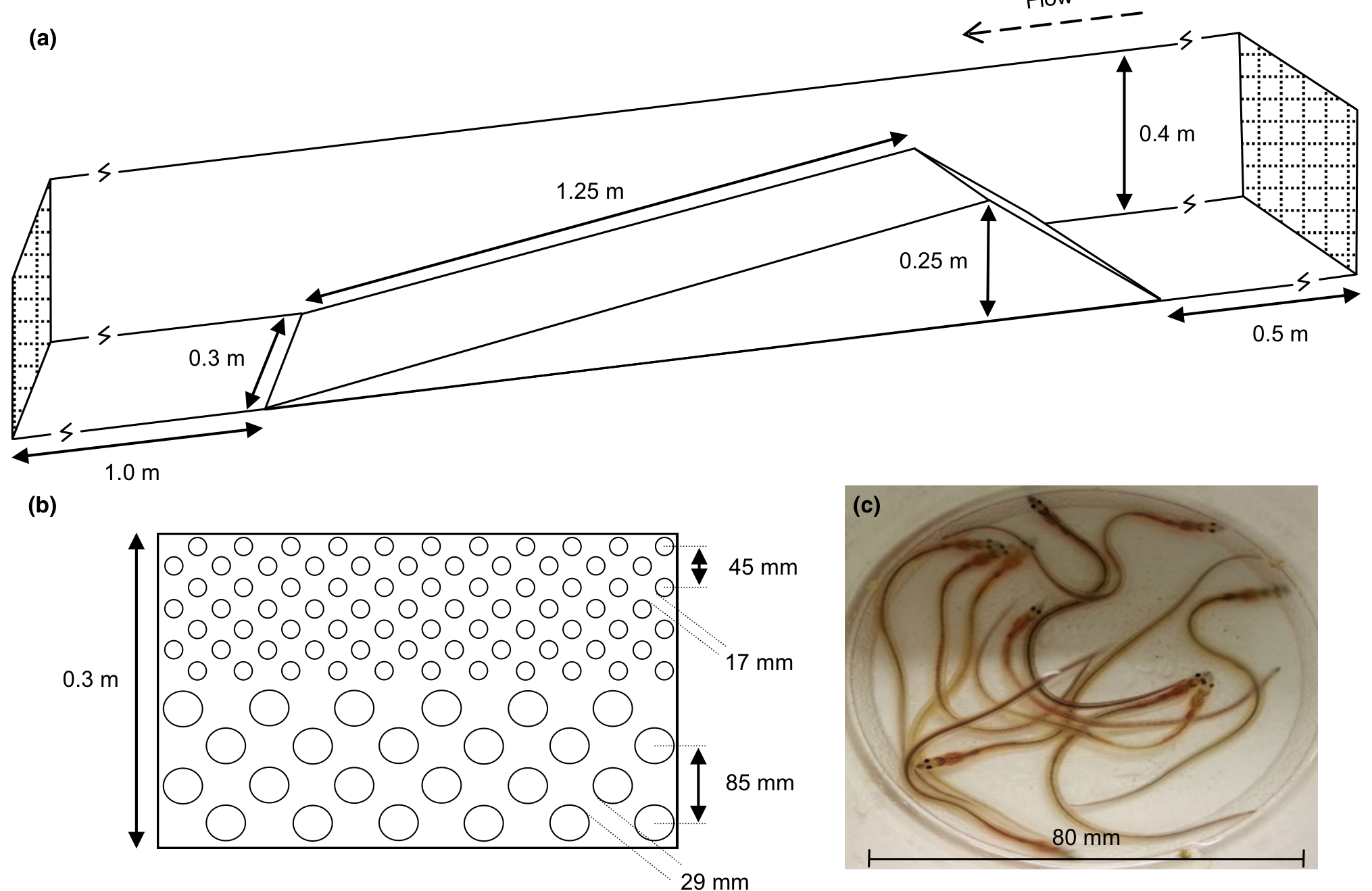
The model Crump weir and its dimensions, the layout of studs on the eel tiles, and the glass eels used in the trials.11
Cameras can also count at passes for whole seasons. At Millville Dam on the Shenandoah River, a motion-activated camera in a housing on the eel ladder photographed each yellow-phase American eel, and the daily counts and lengths from the photographs agreed with physical counts and measurements.2 Counting on this scale matters: an eel ladder at Coimbra weir in Portugal counted and measured 12,019 juvenile eels in two and a half years, 93 per cent of them between April and September.13
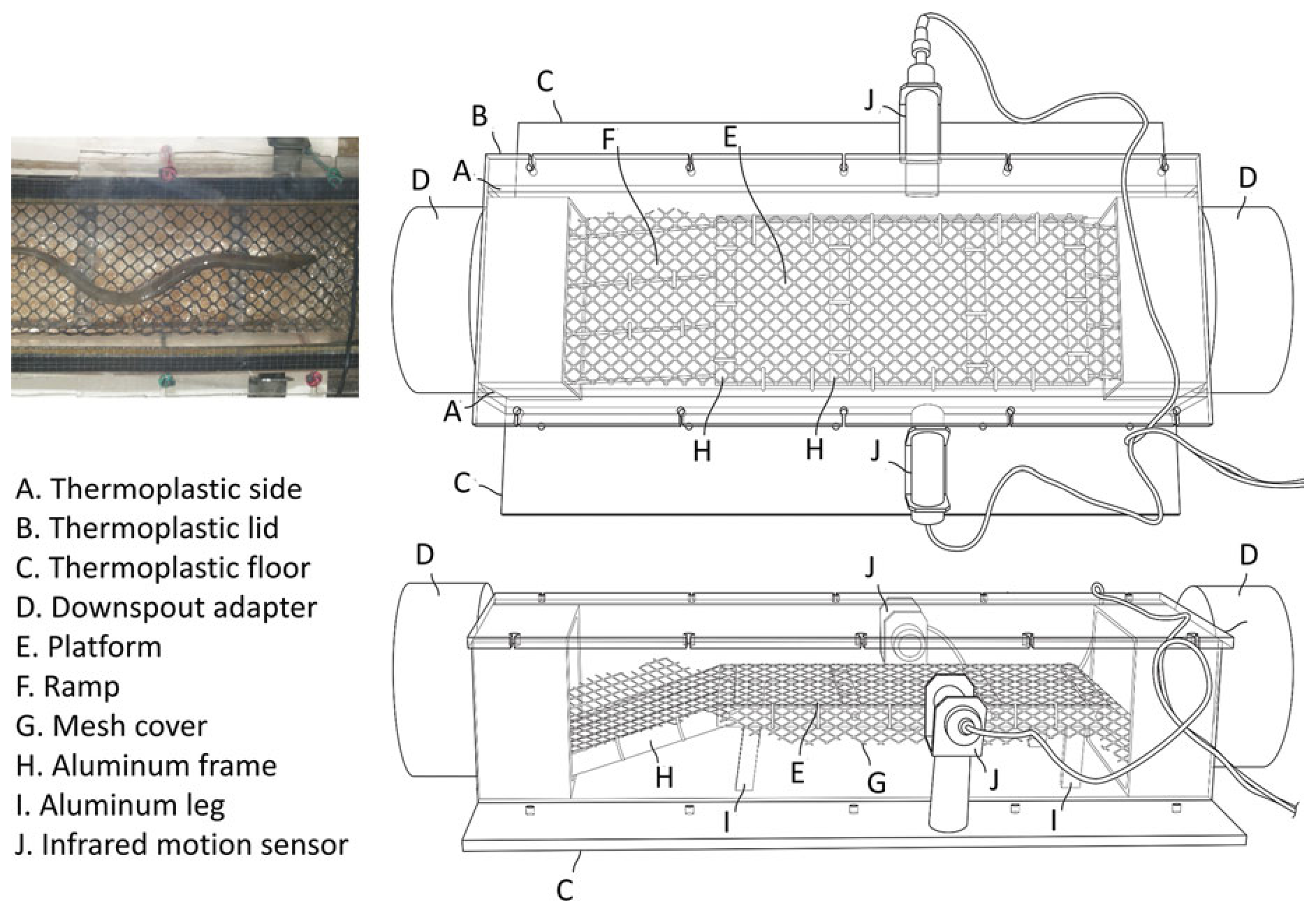
The eel ladder camera: top and side views of the housing, with infrared motion sensors, and a photograph of an eel inside it.2
Eels at Weirs, Pumps and Hydropower
Silver eels migrate downstream at night and often in turbid water, so studies at barriers rely on imaging sonar, which forms images from sound, together with tags.
- On the River Erne, eel counts from an acoustic camera downstream of a fishing weir related closely to the weir's daily catches, so the camera could monitor migration and swimming behaviour.14
- At a large pumping station, an acoustic camera showed eels approaching the trash rack head first, tail first, curled up or drifting sideways; 41 per cent swam through, and the rest turned at or in front of the rack.15
- In a catchment with pumping stations, telemetry showed silver eels moving fast through open reaches but waiting for days at the pumps, and sonar at the intake screen showed most eels turning back.4
- At a shaft hydropower plant with a horizontal screen, an acoustic camera showed fish, eels above all, lingering and searching near the screen, behaviour that raises the risk of entering the turbine.16
- At a tidal sluice on the River Huntspill, a multibeam sonar recorded across the whole channel for five months. Software kept only the frames with eel-like targets, which cut processing time, and lengths measured on screen gave estimates of the mass of escaping eels.17
- Accelerometer tags showed silver eels most active between 15:00 and midnight, with a peak around 19:00, the time when most passed a tidal pumping station.5
- In flume trials of airlift and siphon bypasses, video recorded the behaviour of downstream-migrating American eels at the entrances while PIT tags recorded each passage; no eel died or showed injury.18
Reading Acoustic Images
Acoustic images need checking, because their errors differ from those of optical images. Two operators counted eels almost identically in acoustic-camera video but underestimated their lengths by 4 to 7 per cent.19 At two artificial reefs, imaging sonars recorded about three times the fish densities that simultaneous optical cameras recorded, but they could not separate fish from growth on the reef or detect fish inside complex structures.20
Combinations answer what sonar alone cannot. On a tributary of the Miramichi River, sonar counted migrating fish, mostly at night, while an underwater camera supplied the share of each species; the combined counts followed the catches of an index net.21
Automation helps with long records but still misses small eels. Computer vision identified more than 75 per cent of large eels in acoustic-camera footage from two sites but only 42 per cent of eels shorter than 60 cm.22 A deep-learning detector found migrating eels in sonar footage in real time, with F1-scores above 0.80, and transferred to lampreys.23 Reviews list the remaining problems: small fish in dense groups, species identification and the time needed to process large datasets.24, 25
Underwater Video in Rivers and Wetlands
- A review of field-based underwater video in Australian fresh waters found 11 studies, eight of them on threatened species, and expected wider use for behaviour and detection, including animal-borne video and citizen science.26
- Baited and unbaited cameras and nets together found the most species in Australian rivers, and the cameras recorded three species that the nets missed.27
- In rainforest stream pools, snorkelling found more species than baited video, while both detected large-bodied animals, eels among them, equally well.28
- Video recorded moray eels in tidal water under a bridge, where estuarine crocodiles made snorkelling unsafe.29
- In 133 deployments in two Ontario water bodies, underwater video detected a large rise in the abundance of an invasive goby, though a smaller rise than seine netting estimated; the authors recommend video beside other methods, or where nets are impossible, including for community groups.30
- Over seven years and 240 km of river below a large Amazonian dam, baited video recorded sharper declines in fish diversity than catch-based monitoring had.31
- A review of 185 freshwater studies proposed interim standards for remote underwater video: 1080p, at least 30 frames per second, 60 minutes per deployment, and data workflows that follow the FAIR principles.32
- Action cameras serve research filming, animal-borne recording and outreach, within limits of depth, turbidity, lenses and batteries.33 A low-cost autonomous camera recorded up to 212 hours of video over 14 days and used a buzzer to synchronise its video with hydrophones.34
Video Together with eDNA
eDNA records which species were present, and video records what they did, so the two methods complement each other.
- In remote streams, underwater cameras had the highest probability of detecting both target fishes, and turbidity lowered detection by all three methods for one species.6
- At 48 sites in Western Australia, eDNA and baited video together found over 30 per cent more fish genera than either alone.35
- Around New Caledonia, eDNA detected 44 per cent more shark species than underwater visual census and baited video.36
- In a survey of marine fishes, eDNA gave detection probabilities similar to or higher than visual census for some species and covered a broader area.37
Habitat Structure and Flow from Images
- Drone and underwater photogrammetry of river substrate gave measures of habitat complexity, such as rugosity, slope and fractal dimension, that cross-sections could not.8
- Particle image velocimetry turned video of the water surface into velocity fields, with mean errors below 3.5 per cent.9
- Time-lapse photography over seven months measured the extent and timing of seasonal floodplain habitats, underwater video recorded the fish, and a three-minute film combined both for public audiences.7
- The lab combined terrestrial lidar scans of 16 trees and feature recognition with observations of birds at 62 trees to describe how birds use branches.38 The lab also monitored 3D-printed tree cavities with data loggers, sound recorders, observations and nest material.39
Camera Traps and Automated Monitoring
A review of 266 camera-trap studies recommended linking survey design to the ecological process in question and accounting for imperfect detection.40 Camera traps also record behaviour, from feeding to interactions between species.41 Affordable recorders combined with machine learning point towards largely automated monitoring of ecological communities.42
What This Means for the Eel Project
- Film climbing structures with infrared video and log water temperature and rainfall beside it.
- Use imaging sonar where water is dark or turbid, and check lengths against eels of known size.
- Pair cameras with eDNA where cameras see little, so that presence and behaviour are both recorded.
- Record the same environmental variables at every deployment: temperature, flow, turbidity, light and rainfall.
References
Footnotes
Kume, Manabu, Yudai Yoshikawa, Tomoichiro Tanaka, Shun Watanabe, Hiromichi Mitamura, and Yoh Yamashita. “Water Temperature and Precipitation Stimulate Small-Sized Japanese Eels to Climb a Low-Height Vertical Weir.” PLOS ONE 17, no. 12 (2022): e0279617. https://doi.org/10.1371/journal.pone.0279617.˄
Welsh, Stuart A., and Joni L. Aldinger. “A Semi-Automated Method for Monitoring Dam Passage of Upstream Migrant Yellow-Phase American Eels.” North American Journal of Fisheries Management 34, no. 4 (2014): 702–9. https://doi.org/10.1080/02755947.2014.910580.˄
Lenihan, Eamonn S., T. Kieran McCarthy, and Colin Lawton. “Assessment of Silver Eel (Anguilla anguilla) Route Selection at a Water-Regulating Weir Using an Acoustic Camera.” Marine and Freshwater Research 72, no. 6 (2021): 754–65. https://doi.org/10.1071/mf20230.˄
Bolland, Jonathan D., Leona A. Murphy, Robert J. Stanford, Natalie V. Angelopoulos, Nicola J. Baker, Rosalind M. Wright, Jake D. Reeds, and Ian G. Cowx. “Direct and Indirect Impacts of Pumping Station Operation on Downstream Migration of Critically Endangered European Eel.” Fisheries Management and Ecology 26, no. 1 (2019): 76–85. https://doi.org/10.1111/fme.12312.˄
Knaap, Inge van der, Henry Kuipers, Joop van Eerbeek, Peter Paul Schollema, and Jeroen B. J. Huisman. “Assessing Downstream Passage of European Silver Eel at a Tidal Pumping Station: Acceleration as a Proxy for Eel Activity.” Movement Ecology 13, no. 1 (2025): 69. https://doi.org/10.1186/s40462-025-00588-9.˄
Castañeda, Rowshyra A., Alexander Van Nynatten, Steven Crookes, Bruce R. Ellender, Daniel D. Heath, Hugh J. MacIsaac, Nicholas E. Mandrak, and Olaf L. F. Weyl. “Detecting Native Freshwater Fishes Using Novel Non-Invasive Methods.” Frontiers in Environmental Science 8 (2020): 29. https://doi.org/10.3389/fenvs.2020.00029.˄
Myrvold, Knut Marius, and Tobias Houge Holter. “Visualizing Seasonal Habitats in River Floodplains Using Timelapse Photography and Underwater Video.” Aquatic Sciences 88, no. 2 (2026): 38. https://doi.org/10.1007/s00027-025-01238-3.˄
Kalacska, Margaret, Oliver Lucanus, Leandro Sousa, Thiago Vieira, and Juan Pablo Arroyo-Mora. “Freshwater Fish Habitat Complexity Mapping Using above and Underwater Structure-from-Motion Photogrammetry.” Remote Sensing 10, no. 12 (2018): 1912. https://doi.org/10.3390/rs10121912.˄
Muste, Marian, Ichiro Fujita, and Alexandre Hauet. “Large-Scale Particle Image Velocimetry for Measurements in Riverine Environments.” Water Resources Research 44, no. 4 (2008): W00D19. https://doi.org/10.1029/2008wr006950.˄
Watz, Johan, P. Anders Nilsson, Erik Degerman, Carl Tamario, and Olle Calles. “Climbing the Ladder: An Evaluation of Three Different Anguillid Eel Climbing Substrata and Placement of Upstream Passage Solutions at Migration Barriers.” Animal Conservation 22, no. 5 (2019): 452–62. https://doi.org/10.1111/acv.12485.˄
Vowles, Andrew S., Andrew M. Don, Perikles Karageorgopoulos, Thomas A. Worthington, and Paul S. Kemp. “Efficiency of a Dual Density Studded Fish Pass Designed to Mitigate for Impeded Upstream Passage of Juvenile European Eels (Anguilla anguilla) at a Model Crump Weir.” Fisheries Management and Ecology 22, no. 4 (2015): 307–16. https://doi.org/10.1111/fme.12128.˄
Vowles, Andrew S., Andrew M. Don, Perikles Karageorgopoulos, and Paul S. Kemp. “Passage of European Eel and River Lamprey at a Model Weir Provisioned with Studded Tiles.” Journal of Ecohydraulics 2, no. 2 (2017): 88–98. https://doi.org/10.1080/24705357.2017.1310001.˄
Monteiro, Rui M., Isabel Domingos, Pedro R. Almeida, José L. Costa, Esmeralda Pereira, Ana F. Belo, Teresa Portela, Ana Telhado, and Bernardo R. Quintella. “Upstream Movement of Juvenile Eels (Anguilla anguilla L.) in a Southwestern European River.” Environmental Biology of Fishes 106, no. 6 (2023): 1313–25. https://doi.org/10.1007/s10641-023-01417-x.˄
Lenihan, Eamonn S., T. Kieran McCarthy, and Colin Lawton. “Use of an Acoustic Camera to Monitor Seaward Migrating Silver-Phase Eels (Anguilla anguilla) in a Regulated River.” Ecohydrology & Hydrobiology 19, no. 2 (2019): 289–95. https://doi.org/10.1016/j.ecohyd.2018.07.001.˄
Van Keeken, Olvin Alior, Ralf Van Hal, Hendrik Volken Winter, Ingrid Tulp, and Arie Benjamin Griffioen. “Behavioural Responses of Eel (Anguilla anguilla) Approaching a Large Pumping Station with Trash Rack Using an Acoustic Camera (DIDSON).” Fisheries Management and Ecology 27, no. 5 (2020): 464–71. https://doi.org/10.1111/fme.12427.˄
Funk, Nicole, Josef Knott, Joachim Pander, and Juergen Geist. “Fish Behavior at the Horizontal Screen of a Novel Shaft Hydropower Plant.” River Research and Applications 40, no. 7 (2024): 1219–30. https://doi.org/10.1002/rra.4302.˄
Bilotta, Gary, Peter Sibley, John Hateley, and Andy Don. “Monitoring the Migration of the European Eel (Anguilla anguilla): A Non-Intrusive Sonar Method.” In From Sea to Source: International Guidance for the Restoration of Fish Migration Highways, edited by Peter Gough, 238–40. Veendam: Regional Water Authority Hunze en Aa’s, 2012.˄
Baker, Nicola, Alex Haro, Barnaby Watten, John Noreika, and Jonathan D. Bolland. “Comparison of Attraction, Entrance and Passage of Downstream Migrant American Eels (Anguilla rostrata) through Airlift and Siphon Deep Entrance Bypass Systems.” Ecological Engineering 126 (2019): 74–82. https://doi.org/10.1016/j.ecoleng.2018.10.011.˄
Lagarde, Raphaël, Jason Peyre, Elsa Amilhat, Manon Mercader, François Prellwitz, Gaël Simon, and Elisabeth Faliex. “In situ Evaluation of European Eel Counts and Length Estimates Accuracy from an Acoustic Camera (ARIS).” Knowledge & Management of Aquatic Ecosystems, no. 421 (2020): 44. https://doi.org/10.1051/kmae/2020037.˄
Sibley, Edward C. P., Travis S. Elsdon, Michael J. Marnane, Alethea S. Madgett, Euan S. Harvey, Thomas Cornulier, Damon Driessen, and Paul G. Fernandes. “Sound Sees More: A Comparison of Imaging Sonars and Optical Cameras for Estimating Fish Densities at Artificial Reefs.” Fisheries Research 264 (2023): 106720. https://doi.org/10.1016/j.fishres.2023.106720.˄
Helminen, Jani, and Tommi Linnansaari. “Combining Imaging Sonar Counting and Underwater Camera Species Apportioning to Estimate the Number of Atlantic Salmon (Salmo salar) and Striped Bass (Morone saxatilis) in the Miramichi River, New Brunswick, Canada.” North American Journal of Fisheries Management 43, no. 3 (2023): 743–57. https://doi.org/10.1002/nafm.10889.˄
Le Quinio, Azénor, Eric De Oliveira, Alexandre Girard, Jean Guillard, Jean-Marc Roussel, Fabrice Zaoui, and François Martignac. “Automatic Detection, Identification and Counting of Anguilliform Fish Using in situ Acoustic Camera Data: Development of a Cross-Camera Morphological Analysis Approach.” PLOS ONE 18, no. 2 (2023): e0273588. https://doi.org/10.1371/journal.pone.0273588.˄
Huang, Tao, Xiaoqin Zang, Grigoriy Kondyukov, Zhangshuan Hou, Guanze Peng, Joachim Pander, Josef Knott, et al. “Towards Automated and Real-Time Multi-Object Detection of Anguilliform Fishes from Sonar Data Using YOLOv8 Deep Learning Algorithm.” Ecological Informatics 91 (2025): 103381. https://doi.org/10.1016/j.ecoinf.2025.103381.˄
Wei, Yaoguang, Yunhong Duan, and Dong An. “Monitoring Fish Using Imaging Sonar: Capacity, Challenges and Future Perspective.” Fish and Fisheries 23, no. 6 (2022): 1347–70. https://doi.org/10.1111/faf.12693.˄
Munnelly, Ryan T., Jose C. Castillo, Nils Olav Handegard, Matthew E. Kimball, Kevin M. Boswell, and Guillaume Rieucau. “Applications and Analytical Approaches Using Imaging Sonar for Quantifying Behavioural Interactions among Aquatic Organisms and Their Environment.” ICES Journal of Marine Science 81, no. 2 (2024): 207–51. https://doi.org/10.1093/icesjms/fsad182.˄
Ebner, Brendan C., Danswell Starrs, David L. Morgan, Christopher J. Fulton, James A. Donaldson, J. Sean Doody, Stephen Cousins, et al. “Emergence of Field-Based Underwater Video for Understanding the Ecology of Freshwater Fishes and Crustaceans in Australia.” Journal of the Royal Society of Western Australia 97, no. 2 (2014): 287–96.˄
Ebner, Brendan C., and David L. Morgan. “Using Remote Underwater Video to Estimate Freshwater Fish Species Richness.” Journal of Fish Biology 82, no. 5 (2013): 1592–612. https://doi.org/10.1111/jfb.12096.˄
Ebner, Brendan C., Christopher J. Fulton, Stephen Cousins, James A. Donaldson, Mark J. Kennard, Jan-Olaf Meynecke, and Jason Schaffer. “Filming and Snorkelling as Visual Techniques to Survey Fauna in Difficult to Access Tropical Rainforest Streams.” Marine and Freshwater Research 66, no. 2 (2015): 120–26. https://doi.org/10.1071/mf13339.˄
Ebner, Brendan C., James A. Donaldson, Robert Courtney, Richard Fitzpatrick, Danswell Starrs, Cameron S. Fletcher, and Jamie Seymour. “Averting Danger under the Bridge: Video Confirms That Adult Small-Toothed Morays Tolerate Salinity before and during Tidal Influx.” Pacific Conservation Biology 26, no. 2 (2020): 182–89. https://doi.org/10.1071/pc19023.˄
Bowman, Jacob C., Amber L. Fedus, Michael G. Fox, and Graham D. Raby. “How Useful Is Underwater Video as a Fisheries Assessment Tool in Temperate Freshwater Ecosystems?” Transactions of the American Fisheries Society 155, no. 2 (2026): 200–213. https://doi.org/10.1093/tafafs/vnaf057.˄
Schmid, Kurt, Friedrich Wolfgang Keppeler, Fabio Renan Miranda Da Silva, Jhully Helen Da Silva Santos, Simone Franceschini, Jakob Brodersen, Tommaso Russo, Euan Harvey, José Amorim Reis-Filho, and Tommaso Giarrizzo. “Use of Long-Term Underwater Camera Surveillance to Assess the Effects of the Largest Amazonian Hydroelectric Dam on Fish Communities.” Scientific Reports 14, no. 1 (2024): 22366. https://doi.org/10.1038/s41598-024-70636-8.˄
Harwood, Matthew, Casey J. Broom, Angus Van Wyk, Rowshyra A. Castañeda, Marian Y. L. Wong, Anthony T. F. Bernard, Paul D. Stebbing, Alison M. Dunn, and Josie South. “Application, Development and Opportunities of Remote Underwater Video for Freshwater Fisheries Management.” Knowledge & Management of Aquatic Ecosystems, no. 427 (2026): 5. https://doi.org/10.1051/kmae/2026001.˄
Struthers, Daniel P., Andy J. Danylchuk, Alexander D. M. Wilson, and Steven J. Cooke. “Action Cameras: Bringing Aquatic and Fisheries Research into View.” Fisheries 40, no. 10 (2015): 502–12. https://doi.org/10.1080/03632415.2015.1082472.˄
Mouy, Xavier, Morgan Black, Kieran Cox, Jessica Qualley, Callum Mireault, Stan Dosso, and Francis Juanes. “FishCam: A Low-Cost Open Source Autonomous Camera for Aquatic Research.” HardwareX 8 (2020): e00110. https://doi.org/10.1016/j.ohx.2020.e00110.˄
Stat, Michael, Jeffrey John, Joseph D. DiBattista, Stephen J. Newman, Michael Bunce, and Euan S. Harvey. “Combined Use of eDNA Metabarcoding and Video Surveillance for the Assessment of Fish Biodiversity.” Conservation Biology 33, no. 1 (2019): 196–205. https://doi.org/10.1111/cobi.13183.˄
Boussarie, Germain, Judith Bakker, Owen S. Wangensteen, Stefano Mariani, Lucas Bonnin, Jean-Baptiste Juhel, Jeremy J. Kiszka, et al. “Environmental DNA Illuminates the Dark Diversity of Sharks.” Science Advances 4, no. 5 (2018): eaap9661. https://doi.org/10.1126/sciadv.aap9661.˄
Valdivia-Carrillo, Tania, Axayácatl Rocha-Olivares, Héctor Reyes-Bonilla, José Francisco Domínguez-Contreras, and Adrian Munguia-Vega. “Integrating eDNA Metabarcoding and Simultaneous Underwater Visual Surveys to Describe Complex Fish Communities in a Marine Biodiversity Hotspot.” Molecular Ecology Resources 21, no. 5 (2021): 1558–74. https://doi.org/10.1111/1755-0998.13375.˄
Holland, Alexander, Philip Gibbons, Jason Thompson, and Stanislav Roudavski. “Terrestrial Lidar Reveals New Information about Habitats Provided by Large Old Trees.” Biological Conservation 292 (2024): 110507. https://doi.org/10.1016/j.biocon.2024.110507.˄
Parker, Dan, Stanislav Roudavski, Therésa M. Jones, Nick Bradsworth, Bronwyn Isaac, Martin T. Lockett, and Kylie Soanes. “A Framework for Computer-Aided Design and Manufacturing of Habitat Structures for Cavity-Dependent Animals.” Methods in Ecology and Evolution 13, no. 4 (2022): 826–41. https://doi.org/10.1111/2041-210x.13806.˄
Burton, A. Cole, Eric Neilson, Dario Moreira, Andrew Ladle, Robin Steenweg, Jason T. Fisher, Erin Bayne, and Stan Boutin. “Wildlife Camera Trapping: A Review and Recommendations for Linking Surveys to Ecological Processes.” Journal of Applied Ecology 52, no. 3 (2015): 675–85. https://doi.org/10.1111/1365-2664.12432.˄
Caravaggi, Anthony, Peter B. Banks, A. Cole Burton, Caroline M. V. Finlay, Peter M. Haswell, Matt W. Hayward, Marcus J. Rowcliffe, and Mike D. Wood. “A Review of Camera Trapping for Conservation Behaviour Research.” Remote Sensing in Ecology and Conservation 3, no. 3 (2017): 109–22. https://doi.org/10.1002/rse2.48.˄
Besson, Marc, Jamie Alison, Kim Bjerge, Thomas E. Gorochowski, Toke T. Høye, Tommaso Jucker, Hjalte M. R. Mann, and Christopher F. Clements. “Towards the Fully Automated Monitoring of Ecological Communities.” Ecology Letters 25, no. 12 (2022): 2753–75. https://doi.org/10.1111/ele.14123.˄
Backlinks