Observation
This note gathers practical knowledge for watching animals at night, in air and in water, with the least disturbance. Anguillid eels are the worked case, because they move mostly at night, often in turbid water, and because much of what humans know about their behaviour comes from torches, cameras and sonar. The note starts with what such tools let humans learn from other beings and from other human practices, and where that learning stops. It then gives settings, conditions, lights, rigs and rules on disturbance.
Related Notes
- Anguillid Eels: eels, including their vision in Senses and Umwelt and their glow in Fluorescence.
- Sensing: cameras, imaging sonar, telemetry and eDNA, with a table of what each records and misses.
- Craft: photographic craft, including infrared illumination.
- Photography, Video and Drones: other tools for recording animals and places.
- Eel Project and Eel Capabilities: Student Brief: the eel project and its student brief.
- Sensory Ecology and Sensing: how the senses of humans and other beings overlap and differ.
- Light Pollution: artificial light at night.
- Limitations, Craft and Expertise: limits of human knowledge, craft knowledge and expertise.
Sharing Knowledge Across Beings and Practices
Observation tools connect humans with other beings, and they also connect human practices. A torch, a camera or a sonar lets humans perceive some of what other beings sense or emit. The same tools pass skills between science and everyday practices such as fishing, foraging and diving. Each tool also misses things, so what humans learn through it stays partial. The eel case shows each of these points.
- Tools work where the senses of humans and eels overlap. The cones of freshwater yellow eels absorb best at about 540–545 nm (green) and 435–440 nm (blue). Their rods absorb best near 523 nm.1 Human eyes are also most sensitive in the green. The green glow of eel muscle, which peaks at about 527–530 nm, therefore lies within the vision of both humans and eels.2 No study has yet tested whether eels see it.
- Tools also use differences between senses. Yellow eels have no cones that absorb best in the red, so red light should disturb them less than white or blue light.1 Disturbance and Ethics explains why red light still reaches them.
- Tools translate signals from one sense to another, and each translation loses something. Under a 395 nm ultraviolet torch, European glass eels (Anguilla anguilla) in tanks in Northern Ireland glowed bright yellow and stood out even when half hidden in gravel, whereas dead glass eels glowed much less.3 Imaging sonar turns eels into acoustic shapes that observers can count in darkness and turbid water. At a hydropower canal on the Dordogne and a lagoon channel at Port-La-Nouvelle in France, automated reading of sonar video identified more than 75% of large silver eels but detected only 42% of eels shorter than 60 cm.4
- Tools pass between everyday practice and science. The ultraviolet torch in the glass-eel study was a pet-urine detector bought online, and its authors pointed to foragers who search the shore at night with ultraviolet headlamps.3 Glass-eel surveys in Northern Ireland most often search estuary and river banks at night with strong spotlight torches.3 Māori fishers practised rama tuna, eeling by the light of flares made from kahikatea heartwood (see Eel Names and Languages). The pole light in this note joins a painter's extension pole, a vehicle mount and a dive light made for recreational divers.
- Scientific protocols make observations comparable but seldom record what fishers and Traditional Owners know. Protocols log light settings and include unlit control periods, so that observers can compare nights and places (see Use Pattern). Knowledge such as the Gunditjmara observation that kooyang start their journey downstream when the wattles bloom comes from other practices (see Australia). Of ten recent eel-science reviews, only three use the word "Indigenous" at all (see Knowledges Not Talking to Each Other).
- Eels respond to the tools, and their responses are data. Glass eels under the ultraviolet torch swam strongly away from it.3 In an experimental flume, European eels moving downstream more often rejected a route lit to about 20 lux, and those that took a lit route passed more quickly.5 Such avoidance disturbs the observation, but it also shows observers what the eels sense. Observers should therefore record it as a finding about the eels as well as a cost to them.
- Lent tools lose the know-how of their last user unless someone writes it down. A torch or camera passed from one person to the next arrives without the settings, placements and lessons of its previous use. The lab therefore keeps notes on use with each item of its equipment.
Settings
| Setting | Light path | Main limit |
|---|---|---|
| In air: canopy, margins and animals in flight | From torch to animal through air | Reach and disturbance |
| From the bank into water | Crosses the water surface twice, then meets particles | Glare, and backscatter (light that particles return toward the viewer) |
| Light under water, viewer on the bank | Starts below the surface, near the animal | Turbidity and aim |
| Camera under water | Light and camera both below the surface | Turbidity, and the distance from camera to animal |
Conditions to Record
- Measure turbidity with a turbidity tube or a Secchi disc.
- Note the colour, temperature, level and flow of the water.
- Note the state of the surface and any recent rain.
- Note the moon phase, cloud cover, nearby artificial light and the time.
- Log every light used: its colour, output, beam angle, duration and distance from the animal.
Light in Water
- Turbidity limits range most. Water absorbs and scatters light, and murky water does so within a short distance. With the light beside the camera or the viewer, images stay clear to about one attenuation length, the distance over which a beam loses about two thirds of its light. Beyond that, light scattered back from the water that both the light and the viewer see washes the image out, so more output mostly adds backscatter.6
- Backscatter depends mostly on geometry. Moving the light away from the line of sight of the viewer or camera shrinks the volume of water that both see. In computer models, lights set several metres from the camera kept images clear to two or three attenuation lengths.6 A change of colour helps less, because scattering by particles, the main source of murk, varies only gradually with wavelength.7
- Brown water absorbs blue light first. Humic substances washed out of soils colour water yellow to brown and absorb light most strongly at the blue end of the spectrum. Green light usually reaches furthest in inland waters, followed by red; in strongly coloured water, red light reaches as far as green or further.7 Blue light is therefore a poor choice for finding animals in such water.
- Water absorbs red and near-infrared light quickly. Pure water absorbs about 30% of red light at 650 nm in each metre,8 and about 98% of near-infrared light at 850 nm.9 Infrared illuminators therefore reach only a few tens of centimetres under water.
- Thermal cameras cannot see into water. Water absorbs almost all of the long-wave infrared that thermal cameras sense (8–14 μm) within a tenth of a millimetre, so these cameras record only the surface.10
Choosing Lights
- Reach depends on peak intensity in candela more than on output in lumens. The ANSI/PLATO FL1 standard rates beam distance as the distance at which a torch's light falls to 0.25 lux, which equals 2 × √(peak candela) metres (Streamlight's summary of FL1).
- Narrow beams light fewer particles. A beam of 10° or less lights less water around the animal than a wide beam. Beams of 90–120° suit close video only.
- Low output comes first. Choose a torch with a true low mode, and with output that the user can set before switching on, so that the first flash is dim.
- Red light comes from a red LED. A separate red LED gives more red light than a red filter over a white LED, because the filter absorbs most of the white light. Common red LEDs emit near 625 nm. Deeper red LEDs (650–660 nm) lie further from the peak of the eels' green cones, so they should disturb eels less.1 Water absorbs deeper red faster, however, so their range under water is shorter.8
- Neutral white serves identification. Neutral white light (4,000–5,000 K) with a high colour rendering index shows colours truly. Cool white (6,500 K) often throws further but renders colours poorly.
Use Pattern
- Arrive before dark and let your eyes adapt.
- Search with low output or red light.
- Detect animals by eyeshine, silhouette or movement.
- Identify with brief white light, keeping the edge of the beam on the animal.
- Observe in red or dim light, and switch off when finished.
- Include unlit control periods, and log the light settings with every observation.
Disturbance and Ethics
- Keep light on an animal brief. A university procedure for fauna surveys advises avoiding high-powered spotlights (50 W or less is often enough), lighting an animal only as long as identification needs, and using the edge of the beam for longer viewing (Charles Darwin University Animal Ethics Committee 2023).
- Light changes how eels move. In an experimental flume, European eels moving downstream more often rejected a route lit to about 20 lux. When given a choice, fewer eels chose a lit channel, and those that did passed more quickly.5
- Ultraviolet light disturbs glass eels. All live glass eels in the Northern Ireland tank trials swam strongly away from the ultraviolet torch.3
- Red light reduces disturbance without removing it. Yellow eels lack red-sensitive cones.1 Their freshwater pigments, however, absorb further toward the red than the pigments of marine fishes do, so red light still reaches the edge of their vision.1
- Light colour changes what observers record in some places. At the Houtman Abrolhos Islands, Western Australia, baited stereo-video lit with red, white or blue light recorded different numbers and assemblages of fish at night. Red light recorded the most fish (43% of all individuals). A cardinalfish (Apogon doederleini), a moray eel (Gymnothorax woodwardi) and a bullseye (Pempheris klunzingeri) were also more abundant and stayed longer in view under red light.11 In Gulf St Vincent, South Australia, where visibility was about 3–4 m, red and blue lights on 107 night deployments of baited video recorded similar species and numbers at five of six sites.12 Observers therefore need to test light colours at each site.
- Bait changes behaviour. Keep baited and unbaited observations separate.
- Nests, roosts and dens stay unlit. Check animal ethics approval and permits before any research use.
Rigs
Rig A: Bank Scan
Rig A is a handheld torch with a red LED beside its white LED, a beam adjustable from spot to flood, and an output that the user can set before switching on. One example is the Wolf Eyes X-Beam Red. A lever moves either its white LED or its 625 nm red LED into the optic, and a ring sets the output before or after switching on. The maker rates the white light at 1,620 lm with a throw of 200 m and the red light at a throw of 120 m. The torch weighs 284 g with its single 18650 cell.
Search margins, banks and canopy on low output. Once you find an animal, switch to red.
Rig B: Pole Light
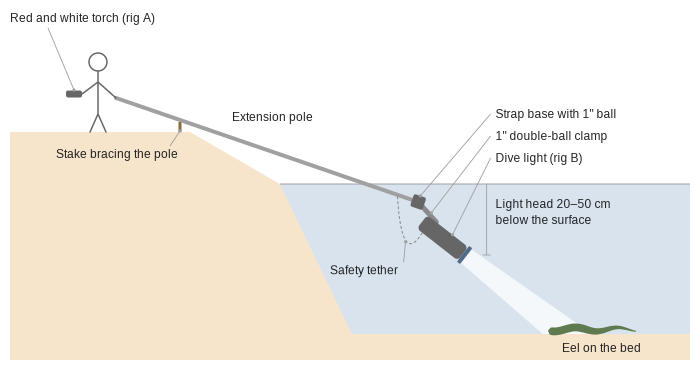
The pole light in use, not to scale: an extension pole braced on a stake holds a dive light 20–50 cm below the surface, angled toward the bed, while the viewer stays off the beam axis with a red and white torch (rig A).
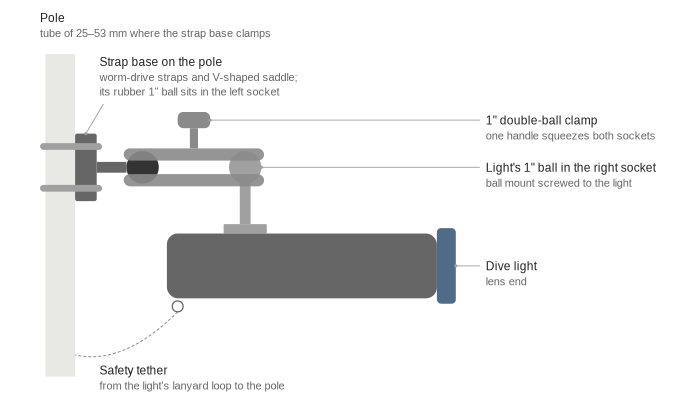
The mount: a strap base clamped to the pole ends in a 1" rubber ball, a double-ball clamp joins it to a ball mount screwed to the light, and a tether runs from the light's lanyard loop to the pole.
| Part | Specification | Example |
|---|---|---|
| Pole | Telescopic, with a tube of 25–53 mm where the base clamps | Painter's extension pole |
| Strap base | Worm-drive straps, V-shaped saddle and 1" (B-size) rubber ball; fits tubes of 25–53 mm; rated load about 0.9 kg | RAM-B-108BU |
| Clamp | 1" double-ball clamp with one handle | Bigblue Double Clip (CLIP-02) |
| Light | Spot of 1,300 lm at 6°; flood of 4,200 lm at 120° (also 2,100 and 1,050 lm); red of 150 lm; blue of 80 lm with a removable yellow filter; 6,500 K; tested to 100 m; 432 g; a 32650 cell that the user can replace | Bigblue VTL4200PB |
| Arm (optional) | 1" double-ball arm of 12.7 or 20.3 cm, which needs a second clamp | Bigblue 5-Inch (ARM05) or 8-Inch (ARM08) Camera Arm |
Hold the light head 20–50 cm below the surface, angled 30–45° down, with the viewer off the beam axis. Set the mode and switch on just before immersion. Lower the light slowly without touching the bed, and brace the pole on a stake. Rinse the rig after use.
The light runs for about 1.5 hours at full flood, and its battery takes 7–8 hours to charge, so carry a spare cell.
Rig C: Camera Station
Place a camera 0.3–1 m from the route that eels are expected to take, with the light on an arm (30–100 cm) that holds it off the lens axis to reduce backscatter.6 Use red or near-infrared light, include unlit control periods, keep a scale object in view, and run a cable to a monitor on the bank. Eels at Climbing Structures and Passes shows camera stations that recorded eels.
Rig D: Fluorescence Check
Use an ultraviolet torch, or blue light through a yellow barrier filter. Rig B's light has both. Work at close range, in clear water or a tray, and keep exposure brief, because glass eels avoid ultraviolet light.3 The fluorescent protein in eel muscle absorbs best near 490–496 nm, so blue light excites it more strongly than ultraviolet light does.2 Fluorescence describes what glows in eels, and at which life stages.
Other Methods
- Cameras, imaging sonar, telemetry and eDNA each record some things and miss others. Methods at a Glance compares them.
- A viewing tube or bathyscope removes glare from the surface but leaves turbidity. Polarising filters reduce glare, mainly at dusk.
Eels as the Case
- Scan margins, logs, cavities and culverts from the bank with rig A.
- On the same patch, at measured turbidity, compare the pole light (rig B) with a bank torch, in red light, white light and darkness.
- Set up a camera station (rig C), or use imaging sonar where the water is opaque.
- When glass eels arrive, test an ultraviolet torch for presence and absence at night. A team in Northern Ireland proposed this use after tank trials and after field trials that found glass eels in dark tunnels.3
References
Footnotes
Bowmaker, James K., Ma’ayan Semo, David M. Hunt, and Glen Jeffery. “Eel Visual Pigments Revisited: The Fate of Retinal Cones during Metamorphosis.” Visual Neuroscience 25, no. 3 (2008): 249–55. https://doi.org/10.1017/S0952523808080152.˄
Funahashi, Aki, Takao Itakura, Abeer A. I. Hassanin, Masaharu Komatsu, Seiichi Hayashi, and Yoshio Kaminishi. “Ubiquitous Distribution of Fluorescent Protein in Muscles of Four Species and Two Subspecies of Eel (Genus Anguilla).” Journal of Genetics 96, no. 1 (2017): 127–33. https://doi.org/10.1007/s12041-017-0751-5.˄
Moore, Andrew, Fearghail Armstrong, and Derek W. Evans. “Fluorescence of European Glass Eel (Anguilla anguilla L.) under Ultraviolet Light.” Aquaculture, Fish and Fisheries 4, no. 3 (2024): e167. https://doi.org/10.1002/aff2.167.˄
Le Quinio, Azénor, Eric De Oliveira, Alexandre Girard, Jean Guillard, Jean-Marc Roussel, Fabrice Zaoui, and François Martignac. “Automatic Detection, Identification and Counting of Anguilliform Fish Using in situ Acoustic Camera Data: Development of a Cross-Camera Morphological Analysis Approach.” PLOS ONE 18, no. 2 (2023): e0273588. https://doi.org/10.1371/journal.pone.0273588.˄
Vowles, Andrew S., and Paul S. Kemp. “Artificial Light at Night (ALAN) Affects the Downstream Movement Behaviour of the Critically Endangered European Eel, Anguilla anguilla.” Environmental Pollution 274 (2021): 116585. https://doi.org/10.1016/j.envpol.2021.116585.˄
Jaffe, Jules S. “Computer Modeling and the Design of Optimal Underwater Imaging Systems.” IEEE Journal of Oceanic Engineering 15, no. 2 (1990): 101–11. https://doi.org/10.1109/48.50695.˄
Kirk, John T. O. Light and Photosynthesis in Aquatic Ecosystems. 1983. 3rd ed. Cambridge: Cambridge University Press, 2011.˄
Pope, Robin M., and Edward S. Fry. “Absorption Spectrum (380–700 nm) of Pure Water. II. Integrating Cavity Measurements.” Applied Optics 36, no. 33 (1997): 8710–23. https://doi.org/10.1364/AO.36.008710.˄
Kou, Linhong, Daniel Labrie, and Petr Chylek. “Refractive Indices of Water and Ice in the 0.65- to 2.5-μm Spectral Range.” Applied Optics 32, no. 19 (1993): 3531–40. https://doi.org/10.1364/AO.32.003531.˄
Hale, George M., and Marvin R. Querry. “Optical Constants of Water in the 200-nm to 200-μm Wavelength Region.” Applied Optics 12, no. 3 (1973): 555–63. https://doi.org/10.1364/AO.12.000555.˄
Fitzpatrick, Conor, Dianne McLean, and Euan S. Harvey. “Using Artificial Illumination to Survey Nocturnal Reef Fish.” Fisheries Research 146 (2013): 41–50. https://doi.org/10.1016/j.fishres.2013.03.016.˄
Whitmarsh, Sasha K., Peter G. Fairweather, and Charlie Huveneers. “Lack of Light Colour Effects When Sampling Fish at Night in Low Visibility Environments.” Journal of Fish Biology 95, no. 3 (2019): 952–55. https://doi.org/10.1111/jfb.14058.˄
Backlinks