Templates
This note collects the templates that lab members use when they plan, take, record and file research images. The examples come from the eel project, but the structure suits any field project. The note develops principles 3, 5, 8 and 12 of Photography.
Status: working draft of 10 November 2026. Each template is a separate section, so a project can copy the parts it needs.
Related Notes
- Photography: the principles.
- Sensing: the sensors whose records these templates cover.
- Co-production: permissions and cultural authority.
- Video: the lab's rules for video.
- File Structure (Private): where image files go.
Shot List
A shot list turns the research question into subjects to photograph. For an eel site it covers:
- Context: the site in its surroundings, access points and signage.
- Channel and banks: upstream, downstream and cross-section views, bank material and slope.
- Vegetation and cover: overhanging plants, aquatic plants and woody debris.
- Shelter: undercut banks, rocks, crevices and artificial structures.
- Barriers and passage: weirs, culverts, fishways and climbing substrates.
- Drainage connections: outfalls, pipes and grates.
- Eels and other species: animals seen, with counts and behaviour.
- Pressures: litter, stormwater, algal growth and invasive species.
- Fixed photo points: the same views from marked positions at every visit.
Video of behaviour needs a sampling rule chosen in advance, such as following one animal for a set time or scanning the whole group at intervals, because each rule biases the record in a known way.1
How to Photograph
- Photograph each feature at three distances: wide (in its setting), medium (the whole feature) and close (texture and detail).
- Put a scale in frame whenever size matters, and take one more frame without it. A measuring board or a guide fixed to an observation bin lets each animal's length be read from the photograph.2, 3
- Hold the camera level for upstream, downstream and cross-section views, so that slopes read correctly.
- Use a polarising filter, or move, to cut glare from the water.
- Keep video short (10 to 30 seconds) and steady, and name the subject aloud at the start when the camera records sound.
- Photograph signs and labels that identify features or species.
- Avoid recognisable faces of members of the public, and record consent where people appear.
Fixed Photo Points
Repeat photographs answer questions about change only when the camera returns to the same position, direction and framing. A smartphone's satellite position and compass can locate photo points precisely enough for repeat photography.4 Fixed cameras still drift, so each series needs checks of the field of view and, when it shifts, a redrawn region of interest.5
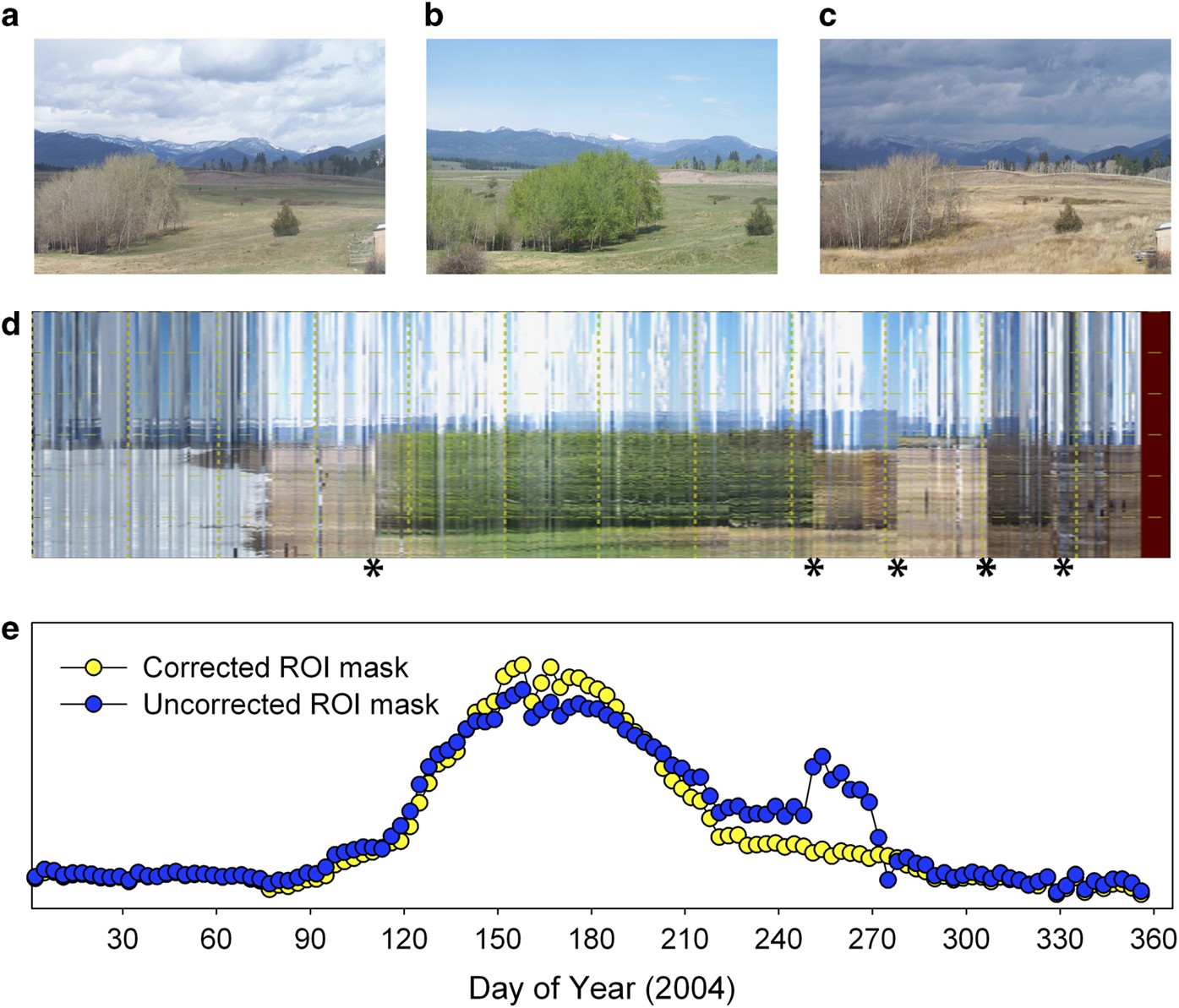
A shift in a fixed camera's field of view, and the region of interest redrawn to keep the series comparable.5
Ground-based photographs from archives, as well as from research, can serve as data on ecological change.6 A record of place, date and direction now makes today's photographs usable in the same way later.
Field Record
Per visit
- Site name, site code and waterway.
- Date, start and end time.
- Photographers and other observers.
- Weather, light and rain in the previous 48 hours; tide stage at tidal sites.
- Water clarity, colour, flow and estimated depth.
- Events that affect behaviour: feeding times at managed ponds, dusk, flow releases, tide changes.
- Permissions and any conditions on photography.
- The Traditional Owners of the Country visited, and any cultural places or material at the site.
Per photograph or video
- The feature shown and its category from the shot list.
- The viewing direction: upstream, downstream, left bank, right bank or a compass bearing.
- Animals seen: species, count, approximate length and behaviour.
- The evidence type: direct (animal seen) or inferred (feature only).
- The fixed photo point, where one applies.
Caption Formula
What the image shows, where, when, who took it and under what rights, in sentence case with the scientific name in full on first use. For example: "Short-finned eels (Anguilla australis) gathering before the 2 pm feeding, pond at Melbourne Museum, 6 November 2026, 1:43 pm. Photograph by Stanislav Roudavski, © Deep Design Lab, CC BY 4.0."
Metadata in the Files
The record travels with each file when it is written into the file's embedded metadata. ExifTool writes the IPTC fields, which image software reads, and the Darwin Core fields, which describe the organism and the occurrence.
| Record | Field |
|---|---|
| Title | XMP-dc:Title |
| Caption | XMP-dc:Description |
| Keywords | XMP-dc:Subject |
| Photographer | XMP-dc:Creator |
| Rights | XMP-dc:Rights, XMP-xmpRights:WebStatement, XMP-cc:License |
| Credit | XMP-photoshop:Credit |
| Place | XMP-iptcCore:Location, XMP-photoshop:City, XMP-photoshop:State, XMP-photoshop:Country |
| Event | XMP-iptcExt:Event |
| Scientific name | XMP-dwc:TaxonScientificName |
| Common name | XMP-dwc:TaxonVernacularName |
| Conditions of use | XMP-photoshop:Instructions |
Shared values go into an arguments file, one per line, and one command writes them to a whole folder:
-charset
utf8
-overwrite_original
-P
-XMP-dc:Title=Short-finned eels aggregating before feeding at Melbourne Museum
-XMP-dc:Subject=Eels project; Anguilla australis; short-finned eel; urban
-XMP-dc:Creator=Stanislav Roudavski
-XMP-dwc:TaxonScientificName=Anguilla australis
-XMP-dwc:TaxonVernacularName=short-finned eel
-XMP-iptcCore:Location=Melbourne Museum
exiftool -sep "; " -@ visit.args "D:/path/to/visit folder"
The list separator goes on the command line, because the arguments file trims spaces. Files without satellite positions can take them from a GPS track: exiftool -geotag track.gpx "D:/path/to/visit folder".
Names and Folders
- Each visit gets a folder named by date, site name and site code:
2026-11-06 Melbourne Museum MM. - The camera's file names stay unchanged inside the folder.
- Each image's ID joins the site code and the file name stem:
MM-20261106_134335. - Keywords come from a shared list, so that searches work across sites.
- Captions use the 12-hour clock (1:43 pm); embedded tags use ISO times with the time zone (13:43:35+11:00).
Catalogue Columns
One row per file, with the columns ID, File, Folder, Caption, Subject, Date, Conditions, Source, Rights, Cultural Sensitivity and Technical. The values come from the embedded tags, so the catalogue and the files agree.
Permissions
- The landholder's or site manager's permission, with any conditions, recorded in the conditions field.
- Advice from the Traditional Owners before photographing or publishing cultural places, practices or material (Co-production).
- Consent from people who appear in images, before publication.
- A plan for human images that research cameras record by accident.7
- The lab's default rights: © Deep Design Lab, CC BY 4.0, with the photographer named in the creator and credit fields.
Reporting Standards for Camera Data
- A report of a camera-trap study should state the equipment, settings, placement, sampling effort and analysis, so that others can repeat it.8
- Camtrap DP records deployments, media files and observations in one open format for exchange and archiving.9
- A field and annotation guide for baited stereo-video sets common rules for deployment and for annotating imagery, so that datasets can be combined across studies.10
- For remote underwater video in fresh water, a review of 185 studies proposed interim standards: 1080p, at least 30 frames per second and 60 minutes per deployment.11
- Studies should report the factors that affect detection, so that their data can be compared and reused.12
References
Footnotes
Altmann, Jeanne. “Observational Study of Behavior: Sampling Methods.” Behaviour 49, nos. 3–4 (1974): 227–66. https://doi.org/10.1163/156853974X00534.˄
Welsh, Stuart A., and Joni L. Aldinger. “A Semi-Automated Method for Monitoring Dam Passage of Upstream Migrant Yellow-Phase American Eels.” North American Journal of Fisheries Management 34, no. 4 (2014): 702–9. https://doi.org/10.1080/02755947.2014.910580.˄
Whitelock, Nicole A., Kevin S. Simon, and George L. W. Perry. “An Urban Taonga: The Distribution and Abundance of Tuna in Urban Streams across Tāmaki Makaurau, Aotearoa-New Zealand.” New Zealand Journal of Marine and Freshwater Research 60, no. 1 (2026): e70010. https://doi.org/10.1002/nzm2.70010.˄
Hammond, William M., Marie E. B. Stone, and Paul A. Stone. “Picture Worth a Thousand Words: Updating Repeat Photography for 21st Century Ecologists.” Ecology and Evolution 10, no. 24 (2020): 14113–21. https://doi.org/10.1002/ece3.7001.˄
Richardson, Andrew D., Koen Hufkens, Tom Milliman, Donald M. Aubrecht, Min Chen, Josh M. Gray, Miriam R. Johnston, et al. “Tracking Vegetation Phenology across Diverse North American Biomes Using PhenoCam Imagery.” Scientific Data 5, no. 1 (2018): 180028. https://doi.org/10.1038/sdata.2018.28.˄
Depauw, Leen, Haben Blondeel, Emiel De Lombaerde, Karen De Pauw, Dries Landuyt, Eline Lorer, Pieter Vangansbeke, Thomas Vanneste, Kris Verheyen, and Pieter De Frenne. “The Use of Photos to Investigate Ecological Change.” Journal of Ecology 110, no. 6 (2022): 1220–36. https://doi.org/10.1111/1365-2745.13876.˄
Sharma, Koustubh, Matthias Fiechter, Todd George, Juliette Young, Justine Shanti Alexander, Ajay Bijoor, Kulbhushansingh Suryawanshi, and Charudutt Mishra. “Conservation and People: Towards an Ethical Code of Conduct for the Use of Camera Traps in Wildlife Research.” Ecological Solutions and Evidence 1, no. 2 (2020): e12033. https://doi.org/10.1002/2688-8319.12033.˄
Meek, Paul Douglas, Guy Ballard, Andrew W. Claridge, Roland Kays, Katherine E. Moseby, Tim O’Brien, Allan F. O’Connell, et al. “Recommended Guiding Principles for Reporting on Camera Trapping Research.” Biodiversity and Conservation 23, no. 9 (2014): 2321–43. https://doi.org/10.1007/s10531-014-0712-8.˄
Bubnicki, Jakub W., Ben Norton, Steven J. Baskauf, Tom Bruce, Francesca Cagnacci, Jim Casaer, Marcin Churski, et al. “Camtrap DP: An Open Standard for the FAIR Exchange and Archiving of Camera Trap Data.” Remote Sensing in Ecology and Conservation 10, no. 3 (2024): 283–95. https://doi.org/10.1002/rse2.374.˄
Langlois, Tim, Jordan Goetze, Todd Bond, Jacquomo Monk, Rene A. Abesamis, Jacob Asher, Neville Barrett, et al. “A Field and Video Annotation Guide for Baited Remote Underwater Stereo-Video Surveys of Demersal Fish Assemblages.” Methods in Ecology and Evolution 11, no. 11 (2020): 1401–9. https://doi.org/10.1111/2041-210x.13470.˄
Harwood, Matthew, Casey J. Broom, Angus Van Wyk, Rowshyra A. Castañeda, Marian Y. L. Wong, Anthony T. F. Bernard, Paul D. Stebbing, Alison M. Dunn, and Josie South. “Application, Development and Opportunities of Remote Underwater Video for Freshwater Fisheries Management.” Knowledge & Management of Aquatic Ecosystems, no. 427 (2026): 5. https://doi.org/10.1051/kmae/2026001.˄
Hofmeester, Tim R., Joris P. G. M. Cromsigt, John Odden, Henrik Andrén, Jonas Kindberg, and John D. C. Linnell. “Framing Pictures: A Conceptual Framework to Identify and Correct for Biases in Detection Probability of Camera Traps Enabling Multi-Species Comparison.” Ecology and Evolution 9, no. 4 (2019): 2320–36. https://doi.org/10.1002/ece3.4878.˄
Backlinks