Maps and Taxonomies of Agents
Researchers have drawn many maps of the kinds of agent. The maps differ in what they order, in the agents that they place and in the agents that they leave out. A recent book on biological agency states that no single definition of agency has universal consensus,1 and critics count the variety of concepts as a difficulty for empirical research.2 This note compares the maps by form: scales and ladders that rank along one line, spaces with several dimensions, criteria that decide whether a system counts as an agent, and classifications within one domain.
Agent lists the types of agent that these notes use. Grounding states which maps support each type, and Biological Individuality compares accounts of individuality.
How Levin and Co-Authors Map Agents
Levin and his co-authors use five devices. Each device compares systems of any origin and material. Each treats the place of a system as an estimate that experiments can revise.
- Axis of persuadability. The axis orders systems by the kind of intervention that changes their behaviour: the rewiring of hardware; the rewriting of a set point; training with rewards and punishments; the communication of reasons. A mechanical clock, a homeostatic circuit, an animal and a human mark the four waypoints. The caption states that the axis is no linear scale of nature. The text makes the position of a system an empirical matter that depends on the observer: the right position is the one that gives the most efficient prediction and control.3
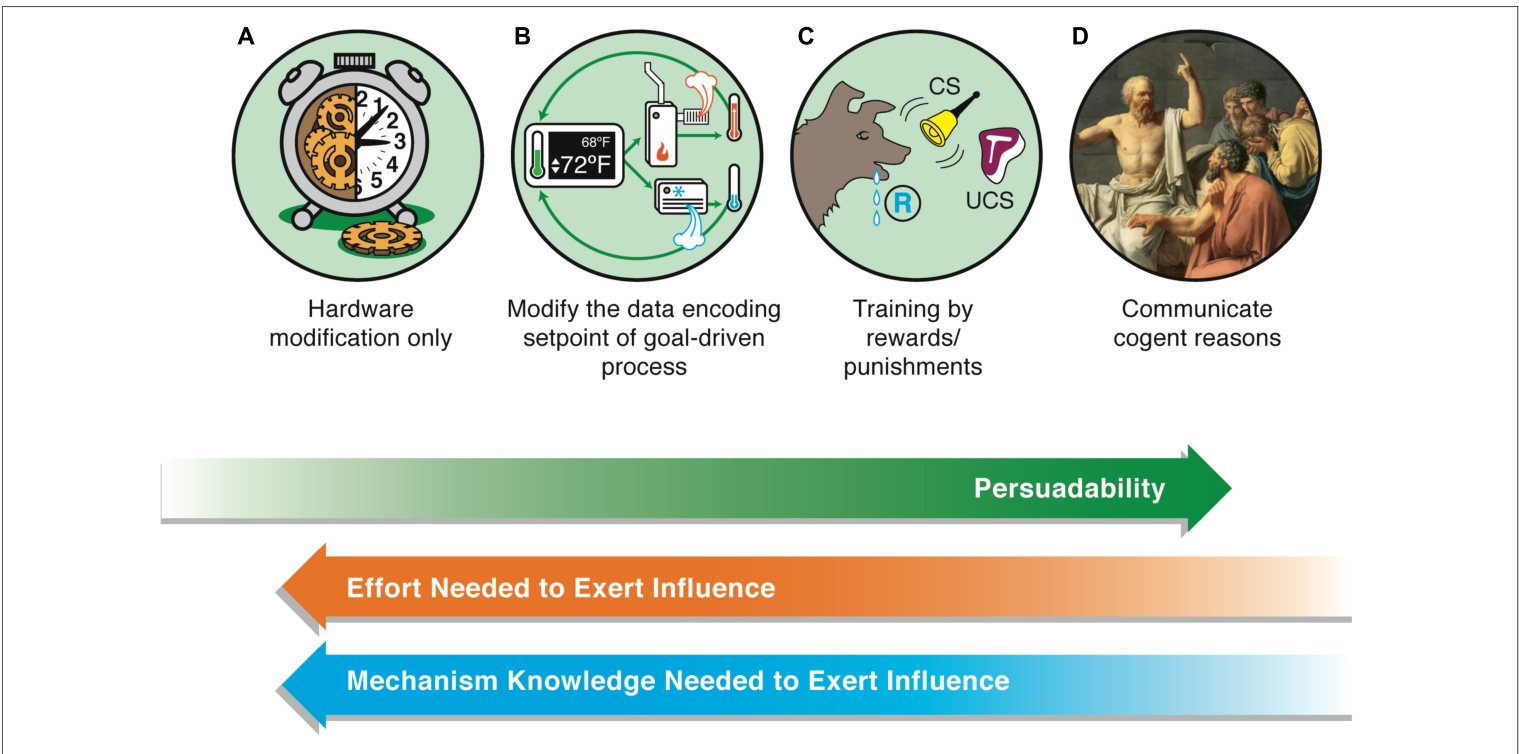
Levin, 2022, figure 2.3
- Cognitive light cone. The cone is the most distant set of events, in time and in space, that a system can measure and attempts to regulate. Schematic cones for a tick, a dog and a human differ in reach. The cones of cells, organs, organisms and swarms nest and overlap. The scheme sets no upper bound on their size.4 Agency explains the cone in detail.
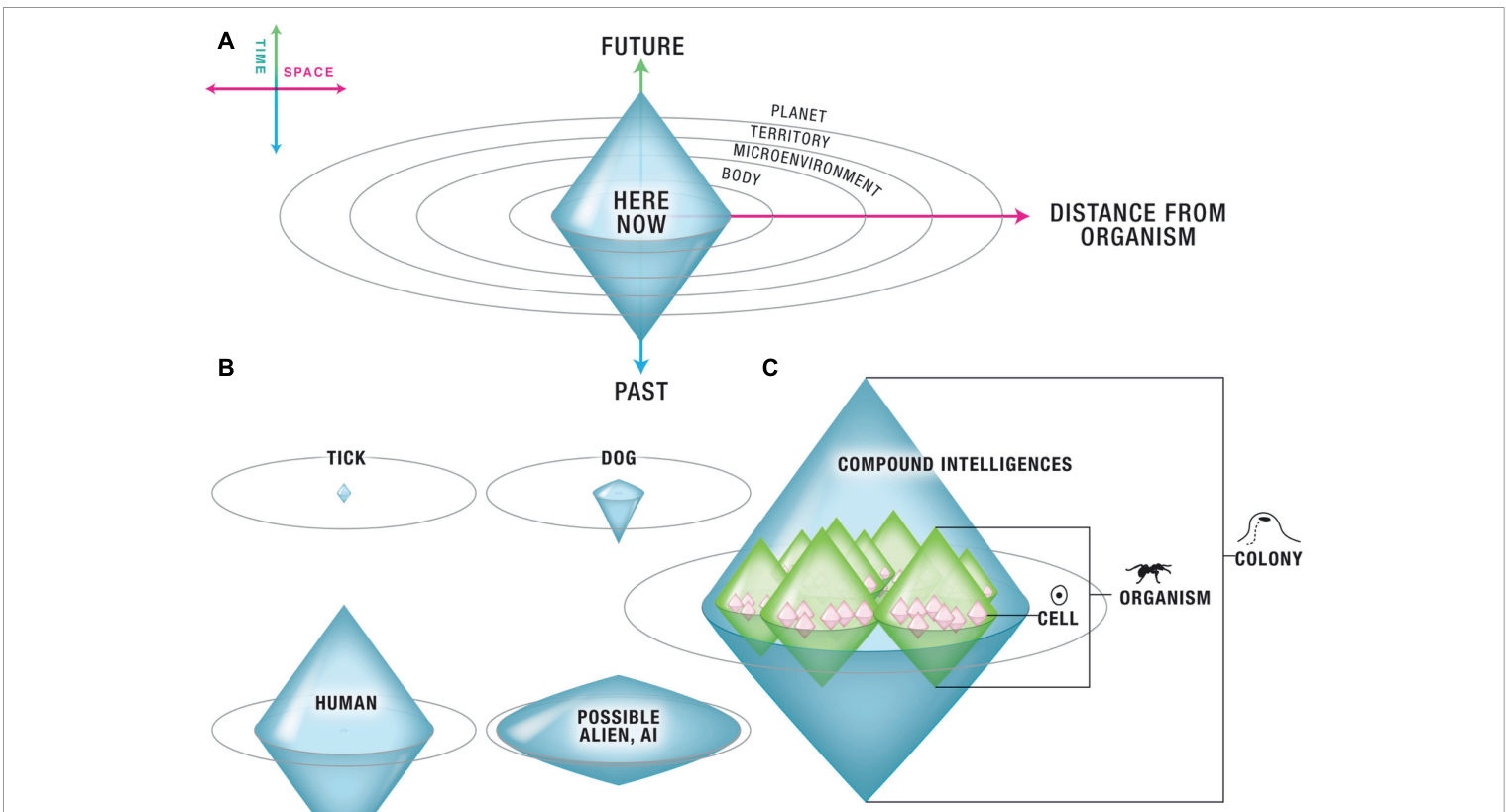
Levin, 2019, figure 2.4
- Scale of purposiveness. Several papers redraw an older classification of behaviour, the first row of the table of scales below, as a continuum from passive matter to reflective minds.4, 5
- Problem spaces. Systems solve problems in transcriptional, metabolic, physiological, anatomical, behavioural, social and linguistic spaces. The comparison asks how competently a system navigates one space. The authors call any estimate of intelligence "an IQ test for the observer".6
- Option space of beings. Evolved material, engineered material and software combine into hybrots, chimaeras, cyborgs and other beings that have no place on the tree of life. A table lists the kinds, and the text states that sharp boundaries between them cannot be drawn. The authors ask what the minimal axes of a space of all possible goal-seeking agents would be.5 An earlier paper draws the space with two continuous axes: the share of design and of evolution in the origin of a system; the degree of autonomy that the system can implement. Every level of organisation has such a space of its own.7
A preprint of 2026 with Levin as a co-author adds three cognition spaces, which the table of spaces below describes.8
Scales and Ladders
Each scheme in this group ranks behaviour or agents along one line.
| Scheme | What it orders | Agents that it places | Limits or stance of the authors |
|---|---|---|---|
| Classification of behaviour9 | Behaviour, through nested divisions: active or passive, purposeful or random, with or without feedback from the goal, predictive or without prediction, and orders of prediction | A cat that chases a mouse predicts the path of the mouse. A person who throws a stone at a moving target has to foresee two paths | Each division "singles out arbitrarily one feature". The units are kinds of behaviour |
| Axis of persuadability3 | The kind of intervention to which a system responds, from rewiring to argument | Mechanical clocks, homeostatic circuits, animals, humans | Estimates are open to revision and depend on the observer |
| Tower of generate and test10, 11 | The place where candidate moves are generated and tested: in the lineage (Darwinian creatures), in behaviour by trial (Skinnerian), in an inner environment before action (Popperian), and with tools taken from culture (Gregorian) | Simple invertebrates as the likely Skinnerian creatures; fish, reptiles, birds and mammals as Popperian; humans as Gregorian | Each class is a subset of the class below it. The floors mark advances in cognitive power, and the author states that they are no clear periods of evolutionary history. Whether an animal is Popperian is a question for research |
| Types of psychological agency12 | The architecture of decision and control: goal-directed agency through feedback control; intentional agency with one executive tier; rational agency with a second, reflective tier; socially normative agency in shared activities | Lizards and other reptiles; squirrels and rats; chimpanzees; humans | The book follows the line to humans and sets birds and bees aside. It denies psychological agency to the earliest bacteria |
| Five levels of agency13 | Organismic agency, ontogenetic agency, directed agency, directed agency with extended flexibility, and agency with a preconceived goal | Every cell and organism at the first level; bacteria that follow a gradient at the third; a hunting lion at the fourth; humans at the fifth, with first stages in some primates, ravens and parrots | Boundaries between the last three levels are hard to draw. The authors contrast organisms with machines |
| Four concepts of agent14 | The demands that a concept makes: a minimal agent moves from an internal cause; an intelligent agent senses and responds flexibly; a rational agent chooses as if it maximised utility; an intentional agent acts on beliefs, desires and intentions | Cells, hearts and insect colonies as minimal agents; thermostats, robots, organisms and immune systems as intelligent agents; humans as intentional agents | A species fails even the minimal concept. None of the four concepts covers autonomy, which distinguishes organisms from other flexible systems |
| Nested control15 | The level that sets the goal: fixed programmes, programmes that experience modifies, regulators with a set point, operant responses, and a self that models the agent | Frogs, hounds, cats, drivers of cars; most animals when nothing constrains them | The authors treat freedom and determinism as inputs to a spectrum of systems |
| Degrees of internal control16 | The depth and the number of nested fields inside a system that direct its parts | A falling rock as goal-directed and hardly agential; Escherichia coli that follows a food gradient; a dung beetle; humans | The link between internal hierarchy and agency is a heuristic. For insect colonies the agent is hard to delimit |
| Three levels for three kinds17 | Active, reactive and proactive agency in natural, collective and automated agents | Biochemicals, prokaryotes and viruses, organisms; mobs and organisations; thermostats and artificial intelligence | The author denies that collectives and machines can set their own goals. He removes corporate persons and artificial persons from his table |
| Control systems by experience18 | Non-Intentional, Intentional and meta-Intentional control systems | Insects as likely non-Intentional; vertebrates as Intentional; humans as meta-Intentional | The scheme covers biological entities only. The authors call their attempt "only partially successful" |
Spaces with Several Dimensions
Each scheme in this group gives a system a profile or a position in a space.
| Scheme | Dimensions | Agents that it places | Limits or stance of the authors |
|---|---|---|---|
| Cognitive light cone4 | The reach of goals in space; the reach in time, backward as memory and forward as anticipation | Tick, dog, human; cells, organs, organisms and swarms as nested cones; possible engineered beings | The diagrams are schematic. The author notes that behavioural data from real organisms have yet to fill them |
| Problem spaces6 | The space in which a system acts: transcriptional, metabolic, physiological, anatomical, behavioural, social, linguistic | Cells, planarians, the slime mould Physarum polycephalum, animals, humans, implanted pumps | Every estimate is a claim of an observer, which experiments test |
| Option space of living machines7 | The degree of design and of evolution in the origin of a system; the degree of autonomy that it can implement. Cells, organisms and swarms each have a space of their own | Cells with synthetic circuits, evolved organisms, swarms that mix designed and evolved members | The authors ask whether the continuum of fused biological and technological systems has natural kinds or major transitions at all |
| Option space of beings5 | The amount of cognition in each component, and the share of design and of evolution in its origin | Organoids, cyborgs, biobots, hybrots, animats, chimaeras | Sharp boundaries between the kinds cannot be drawn. The minimal axes are an open question |
| Cognition spaces (preprint)8 | Three spaces with three axes each. Basal: spatial, computational and developmental complexity. Neural: individual agency, the complexity of interactions between agents, and computational complexity. Human with machine: three further axes for the artificial system, for human control and for the exchange between the two | Bacteria, Physarum, organoids and xenobots; animals from planarians to primates, insect societies, robots and game-playing programs; expert systems, chatbots and language models with their users | The authors place systems in the basal space relative to each other and without a metric. Artificial systems cluster at high computation and low agency. Empty regions do not show that a form is impossible |
| Morphospace of consciousness19 | Autonomic, computational and social complexity | Humans at one corner; bacteria, Physarum, ants, bees, birds and cephalopods; artificial intelligence systems high on computation and low on the other two axes; robot swarms | The space is "only a first attempt", and much of it is empty |
| Morphospace of organs and organoids20 | The complexity that developmental mechanisms introduce; the potential to store information and to react to it; the physical state | Natural organs, organoids and artificial organs | A large fraction of the space is empty, and the authors read the void as a source of new designs |
| Machine kingdom and behavioural features21 | A space of behavioural features, which include cognitive abilities and personality traits; tests measure the features | The machine kingdom: all interactive systems that take inputs and produce outputs, with living organisms as a special case | A feature is an abstract property that an observer infers through observation and interaction |
| Dimensions of animal consciousness22 | Perceptual richness, evaluative richness, unity, temporality and selfhood | Mammals, birds and cephalopods | The profiles are conjectures. The authors reject one sliding scale of more and less conscious species |
| Space of possible minds23 | Many divisions between kinds of mechanism, for example fixed or self-modifying, with one goal or with many generators of motives, with or without monitoring of its own processes | Thermostats, simple organisms, computer programs, animals, infants and adults | The descriptions are "general and vague". The space is "not a continuum, nor is it a dichotomy" |
| Taxonomies of minds24 | A review of schemes that divide minds by origin, by embodiment, by likeness to human abilities and by further criteria. It treats all minds as software | Humans as a small subset; other animals, uploads, hive minds, proposed superintelligences | The author calls his own ladder of superintelligence speculative |
| Atlas of intelligence25 | A proposed open repository of systems, tests and results, from which maps along chosen dimensions can be drawn | Humans, other animals, plants, artificial intelligence systems, robots, corporations, hybrids and collectives | The authors find that most existing maps are figurative, drawn without measured data |
| Profile of artificial agency26 | Goal-directedness, autonomy, direct impact on the world, long-term planning, and action for reasons | All living organisms as minimally goal-directed; chess programs; a chatbot, which acts only after a prompt; agents in video games | A system without minimal goal-directedness is no agent. The other four dimensions are conceptually independent of each other |
| Agentic profiles27 | Autonomy, efficacy, goal complexity and generality, each with graded levels | A game-playing program, a chat model, a model with tools, a self-driving car | Profiles change when a system gains tools or a new deployment. The scheme covers artificial intelligence only |
Criteria for Counting as an Agent
Each scheme in this group states conditions, and it sorts systems into agents and other systems.
| Scheme | Criterion | Counts as an agent | Does not count |
|---|---|---|---|
| Individuality, asymmetry and norms28 | The system defines its own identity, is the source of its activity, and regulates that activity by norms of its own | A bacterium whose swimming along a gradient depends on its metabolism | A gas in a container; a cell under passive osmosis; a person with a tremor; systems that follow norms set from outside |
| Autonomy theory29 | The behaviour depends on the organisation of the system and helps to maintain that organisation. Adaptive agency adds regulation of the interaction | A plant that grows toward light; a white blood cell that pursues a bacterium; a foraging rabbit | Artefacts, whose purposes come from others. An ecosystem can have closure and still be no agent |
| Signatures of viability30 | Six signatures of an organisation that sustains itself, which give a graded diagnosis | Bacteria as full agents; multicellular organisms; ecosystems as collective or distributed agents relative to scale | Viruses, which depend on hosts. Protocells and synthetic minimal cells count in part |
| Organismal agency31 | Goals that derive from the needs of the entity itself, behaviour of the whole, and some control over that behaviour | Organisms and groups of organisms | Refrigerators, traffic lights and robotic lawnmowers; parts such as hearts |
| Semiotic agency32 | Choices that depend on signs, in goal-directed activity | Organisms, their organs, cells and organelles, colonies, populations, symbiotic consortia, robots, computers, viruses | Even advanced robots stay at the lower of two levels of sign use |
| Whole and parts33 | A whole is agential relative to its parts when it leads them to do more of what they normally do, as if it relieved the constraints between them | Cells relative to their molecules; organisms relative to their cells | The result depends on the definition of the parts. The account draws no absolute line |
| Aligned error correction34 | Coupling, closure, commitment, and local action that reduces error at the scale of the whole | Simulated collectives, with cells in a body as the motivating case | A collective whose members still interact after their alignment fails |
| Autonomous agents35 | A system that is situated in an environment and is part of it, senses the environment and acts on it over time, in pursuit of its own agenda, so that its actions affect what it senses later | Biological, robotic and computational agents; the last divide into software agents and artificial life agents. A thermostat and a bacterium satisfy the definition | Ordinary programs, which the definition sets apart from software agents |
| Group agency36 | An agent has representational states, motivational states and the capacity to process both and to act on them. A group is an agent when it meets these conditions as a group | Organised groups such as companies, churches and states | Mere collections of people |
| Autonomous groups37 | The processes of a group produce and sustain each other. Each process stops without that network | Universities, companies, a chain of rescuers; most likely colonies of bees and ants | A pair of people who paint a house together; "the market" as a figure of speech |
| Agential individual38 | Cognitive control processes at the level of one whole serve the survival and reproduction of that whole. The account requires a mechanism for sensing and responsive action | A honeybee hive; a mule; a mouse | Worker honeybees, whose control processes serve the hive; a virus particle; a seed that rolls down a hill |
| Evolutionary agent39, 40 | The parts of a collective share the goal of maximal fitness. The concept requires no cognition, and the authors call their use of agency heuristic. Two scores measure the agreement of the parts | Genes, cell lineages, organisms, eusocial colonies, corals and lichens, each to the degree that its parts agree | A wasp with the Paternal Sex Ratio chromosome, which serves the goals of that chromosome |
| Critique of biological agency2 | Agency is a psychological concept. Goal-directedness is either adaptation or cognition | Humans, and possibly other animals with complex nervous systems | Yeast, ferns and most other organisms, for which the authors find no phenomenon that the concept would describe |
Classifications within One Domain
| Domain | Scheme | Classes |
|---|---|---|
| Biological individuals | Organismality as high cooperation and low conflict41 | Organisms, societies, simple groups and competitors, on two continuous axes. The cells of a whale, a colony of honeybees and a human city take different places |
| Information theory of individuality42 | Organismal, colonial and driven individuals | |
| Kinds of biological individuals43 | Evolutionary individuals, compared with physiological, ecological and developmental kinds | |
| Kinds of individual ranked by purpose44 | Evolutionary individuals, which policing and demarcation mechanisms produce and which occur in degrees. Immunological, metabolic, persisting and autonomous individuals, which the book treats as kinds for narrower purposes | |
| Three kinds of biological individual38 | Evolutionary individuals, organisms and agential individuals. A honeybee hive is an agential and evolutionary individual. Its workers are organisms. A mouse is all three. Biological Individuality reproduces the tables and figures of the sources in these rows | |
| Individuals before and after reversions39 | Organismal, evolutionary-agential and paradigmatic individuals. A paradigmatic reversion undoes a transition. An agential reversion leaves the body intact while one of its parts takes over its goals | |
| Basal cognition | Toolkit of capacities45 | Thirteen capacities, from orienting and sensing to anticipation and communication, each observed in prokaryotes |
| Cognitive networks | Liquid and solid brains46 | Networks with fixed parts or with moving parts, with or without neurons: brains, plant tissues, ant colonies, immune systems, slime moulds |
| Living collectives | Informational architecture47 | A continuum from non-living to living collectives, by the control that a collective has over its own state |
| Group decisions | Aggregate and interactive decisions48 | One decision that binds all members, or interdependent decisions without one binding outcome. The class of a case depends on the interest of the observer |
| Human action | Elements of agency49 | The reactivation of past patterns, the projection of possible futures, and practical evaluation in the present |
| Modes of human agency50 | Individual agency, proxy agency through others who act on a person's behalf, and collective agency. Four core properties: intentionality, forethought, self-reactiveness and self-reflectiveness | |
| Machines | Scales of machine behaviour51 | Single machines, collectives of machines, and hybrids of machines with people |
| Forms of superintelligence52 | Speed, collective and quality superintelligence | |
| Composites | Kinds of new beings5 | Organoids, cyborgs, biobots, hybrots, animats, chimaeras |
| Robotic taxonomic key53 | Structure, actuation, sensing and control, each organic, hybrid or synthetic. The authors use the terms organobot, biohybrid robot and cyborg drone. The goals of a cyborg drone are set from outside | |
| Routes to an individual of humans with artificial intelligence54 | Artificial intelligence that persists without reproduction and alters selection on humans; lineages of artificial intelligence that reproduce and associate with humans; artificial intelligence that parents pass to offspring as part of development. The author calls the analysis speculative | |
| Political standing | Zoopolis55 | Domesticated animals as citizens, wild animals as members of sovereign communities, liminal animals as denizens. The status follows from the relationship with a human political community |
| Legal standing | Boundaries of legal personhood56 | Humans, corporations, higher-order animals, artificial intelligence and a hypothetical spontaneous intelligence, compared on five criteria. The section Tables from the Sources reproduces the comparison |
| Planets | Planetary intelligence57 | Immature biosphere, mature biosphere, immature technosphere, mature technosphere |
Tables from the Sources
Some sources print their comparison as a table. Such a table shows the range of kinds and the angles of comparison at a glance. The images reproduce the tables as printed, with the captions that the sources give them.
Kinds of Agent by Level of Agency
Martinelli crosses three kinds of agent with three levels of agency.17


Martinelli, 2025, tables 1 and 2, 290.17
- Active. The agent forms a state that is directed at an end-state and acts on it. A thermostat is the author's example, and enzymes are his natural case.
- Reactive. The agent selects among actions in pursuit of a goal that is set for it. The author's examples are a chess-playing machine, bacteria that adapt their behaviour to their neighbours, firms and governments.
- Proactive. The agent pursues goals that it generates itself. The author reserves this level for organisms, which run from the simplest eukaryotic cells to human beings in his account. Prokaryotes therefore stand outside his class of organisms.
- The two cells at the lower right. A second table in the paper deletes corporate persons and artificial persons. The author argues that collectives and machines receive their goals from their human members or engineers, so neither can be proactive.
Conditions for Agency: Five Test Cases
Barandiaran, Di Paolo and Rohde apply their three conditions to five systems.28
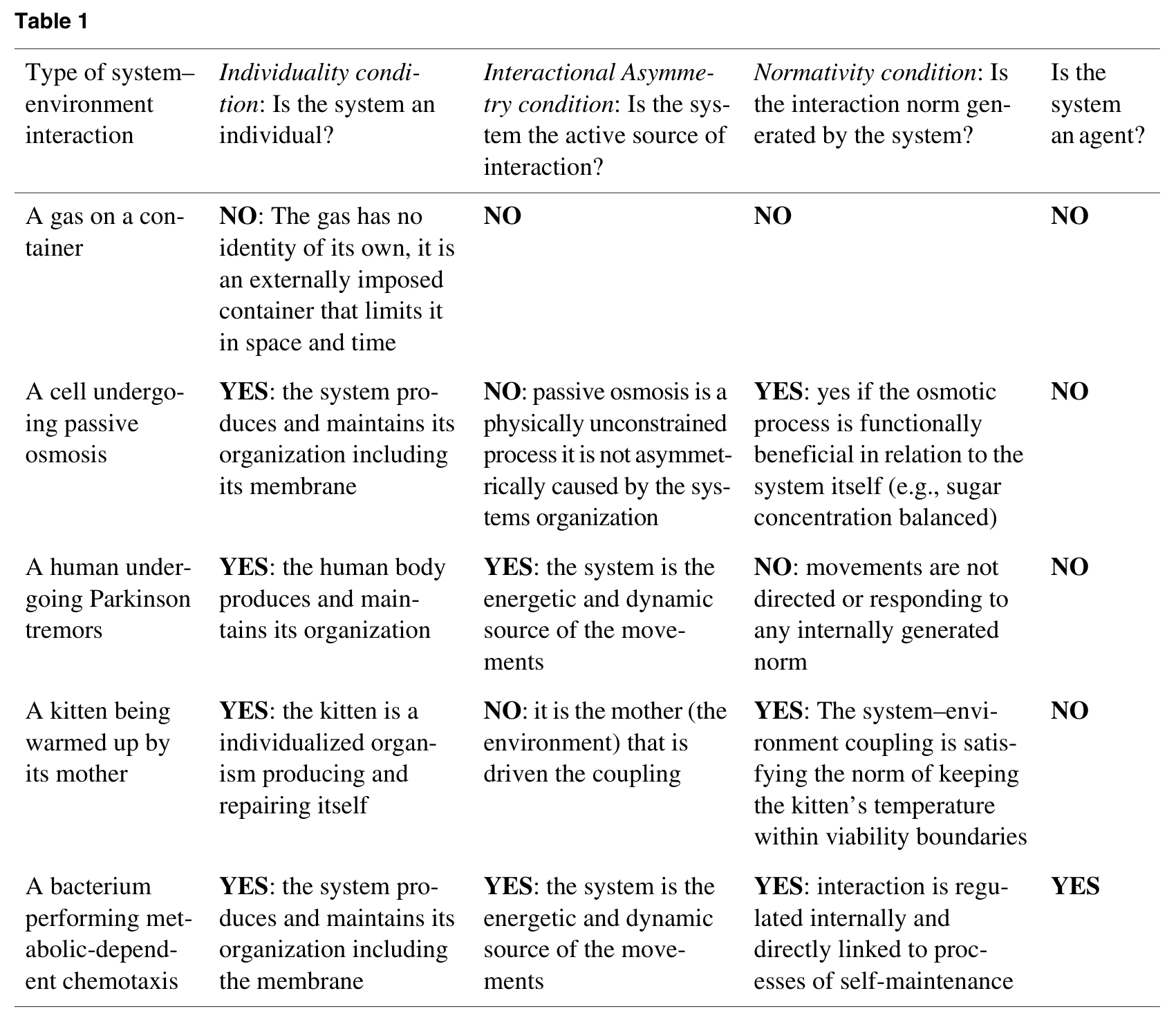
Barandiaran, Di Paolo and Rohde, 2009, table 1, 374.28
- Individuality. The system produces and maintains its own organisation. The container gives the gas its limits, so the gas has no identity of its own.
- Interactional asymmetry. The system is the active source of the interaction. Osmosis proceeds without any doing of the cell, and the mother drives the warming of the kitten.
- Normativity. The system generates the norm of the interaction. The tremor answers to no norm of the person. The "Yes" for osmosis is conditional: the process has to benefit the cell.
- Agreement with the text. The text states that each condition is necessary and that no two suffice without the third. Three of the five systems fail exactly one condition.
Signatures of Agency: Six Edge Cases
Spencer applies six signatures of biological agency to six systems.30
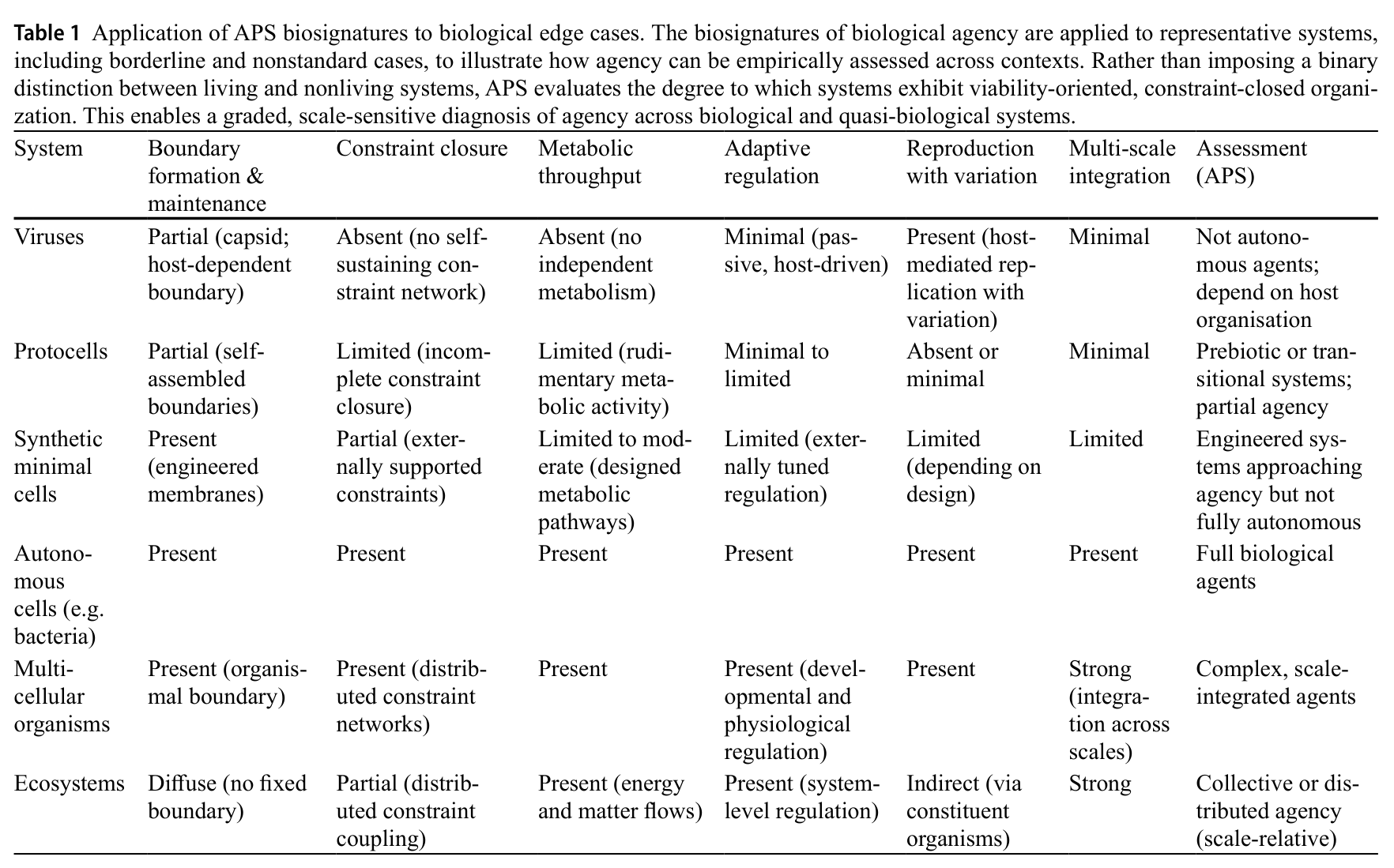
Spencer, 2026, table 1. The article is online ahead of print.30
- Qualifications. The paper qualifies most cells in brackets. Viruses reproduce through their hosts. The boundary of a synthetic minimal cell is an engineered membrane. An ecosystem has no fixed boundary, and it reproduces through its organisms.
- Ecosystems. The table gives ecosystems a place among agents, as collective or distributed agents relative to scale.
- Two lists of signatures. The abstract lists six other signatures: homeostasis, adaptive plasticity, selective boundary regulation, goal-directed behaviour, recursive self-repair and cross-scale coordination. Both tables of the paper use the six that head the columns of this table.
Agentic Profiles: Four Systems on Four Scales
Kasirzadeh and Gabriel place four systems on four scales, each of which runs from 0 to 5.27
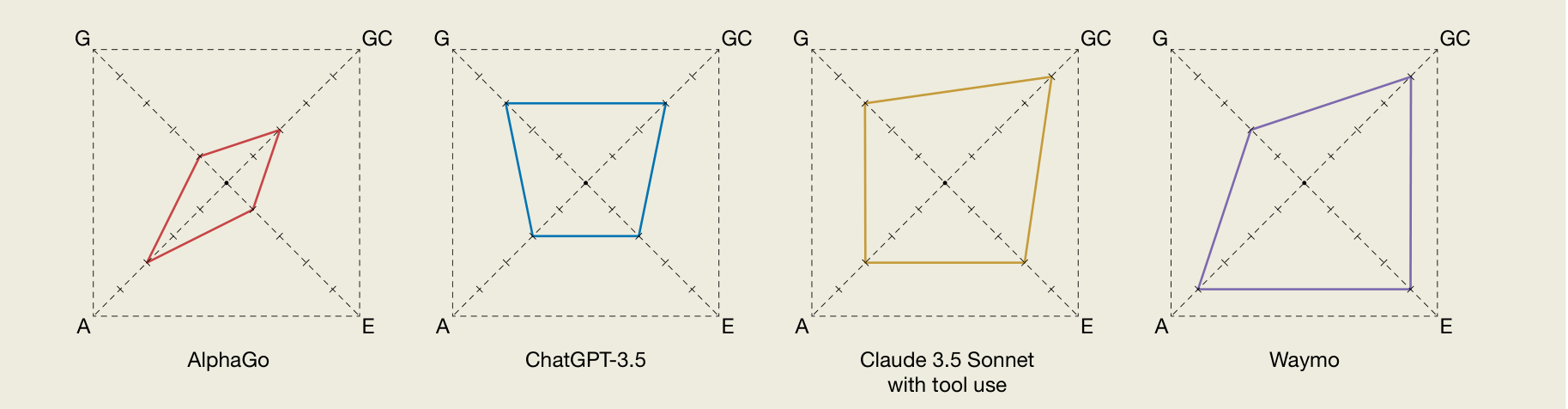
Kasirzadeh and Gabriel, 2026, box 1, 325. The charts show autonomy (A), efficacy (E), goal complexity (GC) and generality (G).27
- Levels. The text of the box gives the levels: AlphaGo A.3, E.1, GC.2 and G.1; ChatGPT-3.5 as a stand-alone chat A.2, E.2, GC.3 and G.3; Claude 3.5 Sonnet with tool use A.3, E.3, GC.4 and G.3; the Waymo car A.4, E.4, GC.4 and G.2.
- Autonomy. The levels run from action that a principal dictates to action without oversight. At level A.4 a system performs all tasks independently in certain circumstances.
- Efficacy. The level combines the impact of a system with its environment, which is simulated, mediated through people, or physical. AlphaGo acts in a simulated game, the chat models act through their users, and the car acts on the physical world.
- No single rank. The car has the highest autonomy and the highest efficacy. Its generality is lower than that of the chat models. The authors reject "the crude, linear idea" that a more agentic system always requires more governance.
- Wording. The box and the scales use different words for some levels. The box describes A.4 as a "very high level of autonomy", and the scale calls it high autonomy.
Legal Personhood: Five Entities on Five Criteria
Chen and Burgess compare four holders or candidates of legal personhood with a hypothetical spontaneous intelligence, which evolves within the internet without human design.56
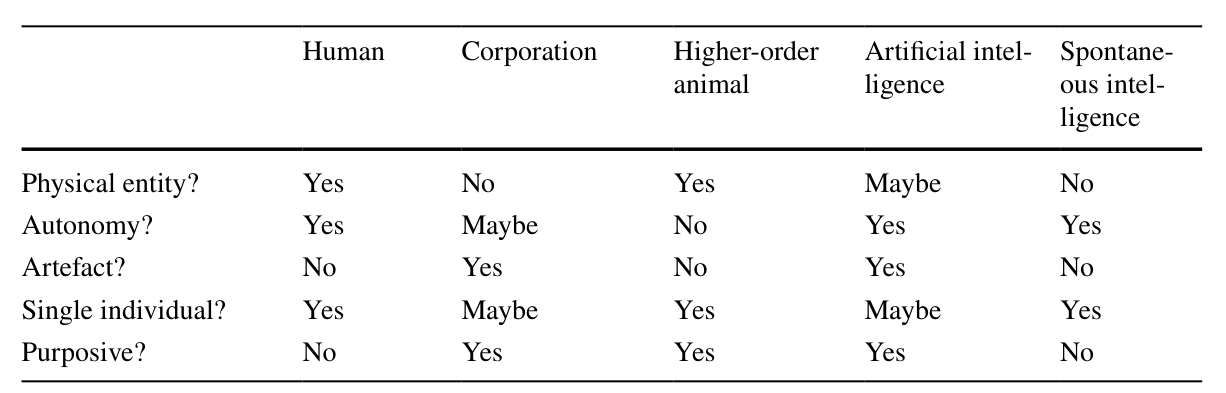
Chen and Burgess, 2019, 82. The paper prints the table without a number and without a caption.56
The authors' text explains the rows.
- Physical entity. A company has no physical form, and its registered office ties it to a jurisdiction. Artificial intelligence receives "Maybe": software resides somewhere and a self-driving car has a location, while software alone can lack a physical form.
- Autonomy. The row concerns legal action. The authors grant that a higher-order animal has autonomy "to go about its daily business". They answer "No" because a human agent has to act for the animal in court.
- Artefact. Humans created the entity for a particular goal.
- Single individual. The entity consists of one individual or of several. A company has a controlling mind that consists of its board and its shareholders.
- Purposive. Humans ascribe legal personhood to the entity for a particular goal. An animal is no artefact, and a grant of legal personhood to one animal for one purpose is purposive.
The authors conclude that the spontaneous intelligence shares more features with humans than with artificial intelligence. They add that this conclusion is no argument for granting it legal personhood. Their counts of shared features differ from the table in two places. The text counts three points in common for a human and a spontaneous intelligence. It counts one for a higher-order animal and a spontaneous intelligence. The table shows four identical cells for the first pair and two for the second. The counts agree with the table when the row on single individuals is left out.
What the Maps Share and Where They Differ
- Rank and profile. The ladders rank agents on one line. Several authors prefer profiles. Sloman rejects a single continuum of minds.23 Birch and colleagues reject a single scale of animal consciousness.22 Dung proposes a profile with several dimensions for artificial agents.26 The axis of persuadability is a single line that its author declares to be no scale of nature.3 Decision Styles records the same disagreement for decision styles.
- The observer. Several schemes make the place of a system depend on the observer. Experiments determine the place of a system on the axis of persuadability,3 an estimate of intelligence tests the observer,6 and the class of a group decision depends on the interest of the scientist.48 Agency requires that every claim about an agent state its observer.
- The agent and the organism. One thesis observes that discussions of agency often assume the individual, and it starts without the assumption that the organism is the agent. In its account a honeybee hive is the agential individual, and each worker is an organism whose control processes serve the hive.38 Two papers define an individual through the agreement of its parts on the goal of fitness, without cognition, and they measure that agreement with two scores.39, 40 One book accepts that the fitting unit depends on the question and argues that a question defined well enough has one true answer.44
- Artefacts divide the schemes. Accounts that derive agency from self-maintenance exclude machines, or they grant machines agency in a derived sense.28, 29, 17 Accounts that start from behaviour or from control include thermostats, programs and robots.14, 3, 32 One paper reviews the differences that are commonly claimed between machines and living things and concludes that no simple dichotomy separates the two.7 The preprint on cognition spaces places artificial systems at high computation and low agency. Its authors give the reason that the existence of such systems does not depend on their own activity.8
- Who is missing. No scheme in this note covers all the types in Agent. Few schemes place ecosystems, and those that do describe a distributed agency or doubt that closure suffices.30, 29 One scheme treats whole planets.57 The political typology places animals by their relationship with human communities.55 The schemes read for this note place no rivers, hills or other places as agents. Personhood covers the legal recognition of such entities.
- Maps without measurements. Most maps are schematic. The authors of the atlas proposal find that existing maps lack measured data,25 and the diagrams of the cognitive light cone await data from real organisms.4
- Empty regions. The two morphospaces show large empty regions. Their authors read the gaps as forms that evolution and engineering have yet to reach, which future synthetic and hybrid systems could occupy.8, 19 Design Potential (Private) treats states that no agent has reached as possibilities for design.
Use in the Review
- The table of kinds of agent by families of decision styles in Decision Styles is a further map. Its rows combine units from several of the schemes above, and its columns record ways of deciding.
- For the review in More-than-Human Participation (Review), the works in this note are seed literature on the forms of agents. The review can test which of these maps the literature on more-than-human design uses.
References
Footnotes
Moreno, Álvaro, and Juli Peretó. An Evolutionary Story of Agency: How Life Evolved to Act on Its Own. Cham: Springer, 2026.˄
DiFrisco, James, and Richard Gawne. “Biological Agency: A Concept without a Research Program.” Journal of Evolutionary Biology 38, no. 2 (2025): 143–56. https://doi.org/10.1093/jeb/voae153.˄
Levin, Michael. “Technological Approach to Mind Everywhere: An Experimentally-Grounded Framework for Understanding Diverse Bodies and Minds.” Frontiers in Systems Neuroscience 16 (2022): 768201. https://doi.org/10.3389/fnsys.2022.768201.˄
Levin, Michael. “The Computational Boundary of a ‘Self’: Developmental Bioelectricity Drives Multicellularity and Scale-Free Cognition.” Frontiers in Psychology 10 (2019): 2688. https://doi.org/10.3389/fpsyg.2019.02688.˄
Clawson, Wesley P., and Michael Levin. “Endless Forms Most Beautiful 2.0: Teleonomy and the Bioengineering of Chimaeric and Synthetic Organisms.” Biological Journal of the Linnean Society 139, no. 4 (2023): 457–86. https://doi.org/10.1093/biolinnean/blac073.˄
Fields, Chris, and Michael Levin. “Competency in Navigating Arbitrary Spaces as an Invariant for Analyzing Cognition in Diverse Embodiments.” Entropy 24, no. 6 (2022): 819. https://doi.org/10.3390/e24060819.˄
Bongard, Josh, and Michael Levin. “Living Things Are Not (20th Century) Machines: Updating Mechanism Metaphors in Light of the Modern Science of Machine Behavior.” Frontiers in Ecology and Evolution 9 (2021): 650726. https://doi.org/10.3389/fevo.2021.650726.˄
Solé, Ricard, Luís F. Seoane, Jordi Pla-Mauri, Michael Timothy Bennett, Michael E. Hochberg, and Michael Levin. “Cognition Spaces: Natural, Artificial, and Hybrid.” arXiv:2601.12837. Preprint, arXiv, 2026. https://doi.org/10.48550/arXiv.2601.12837.˄
Rosenblueth, Arturo, Norbert Wiener, and Julian Bigelow. “Behavior, Purpose and Teleology.” Philosophy of Science 10, no. 1 (1943): 18–24. https://doi.org/10.1086/286788.˄
Dennett, Daniel C. Darwin’s Dangerous Idea: Evolution and the Meaning of Life. New York: Simon & Schuster, 1995.˄
Dennett, Daniel C. Kinds of Minds: Toward an Understanding of Consciousness. New York: Basic Books, 1996.˄
Tomasello, Michael. The Evolution of Agency: Behavioral Organization from Lizards to Humans. Cambridge, MA: MIT Press, 2022.˄
Rosslenbroich, Bernd, Susanna Kümmell, and Benjamin Bembé. “Agency as an Inherent Property of Living Organisms.” Biological Theory 19, no. 4 (2024): 224–36. https://doi.org/10.1007/s13752-024-00471-7.˄
Okasha, Samir. “The Concept of Agent in Biology: Motivations and Meanings.” Biological Theory 19, no. 1 (2024): 6–10. https://doi.org/10.1007/s13752-023-00439-z.˄
Killeen, Peter R., Stephen Helms Tillery, and Felipe Cabrera. “Agency.” The Journal of General Psychology 152, no. 3 (2025): 526–76. https://doi.org/10.1080/00221309.2024.2433277.˄
Babcock, Gunnar, and Daniel W. McShea. “Agency as Internal Control.” In The Riddle of Organismal Agency: New Historical and Philosophical Reflections, edited by Alejandro Fábregas-Tejeda, Jan Baedke, Guido I. Prieto, and Gregory Radick, 207–22. Abingdon: Routledge, 2025. https://doi.org/10.4324/9781003413318-16.˄
Martinelli, Emanuele. “A Taxonomy of Agents.” Philosophical Explorations 28, no. 3 (2025): 285–302. https://doi.org/10.1080/13869795.2025.2521296.˄
Brizio, Adelina, and Maurizio Tirassa. “Biological Agency: Its Subjective Foundations and a Large-Scale Taxonomy.” Frontiers in Psychology 7 (2016): 41. https://doi.org/10.3389/fpsyg.2016.00041.˄
Arsiwalla, Xerxes D., Ricard Solé, Clément Moulin-Frier, Ivan Herreros, Martí Sánchez-Fibla, and Paul F. M. J. Verschure. “The Morphospace of Consciousness: Three Kinds of Complexity for Minds and Machines.” NeuroSci 4, no. 2 (2023): 79–102. https://doi.org/10.3390/neurosci4020009.˄
Ollé-Vila, Aina, Salva Duran-Nebreda, Núria Conde-Pueyo, Raúl Montañez, and Ricard Solé. “A Morphospace for Synthetic Organs and Organoids: The Possible and the Actual.” Integrative Biology 8, no. 4 (2016): 485–503. https://doi.org/10.1039/C5IB00324E.˄
Hernández-Orallo, José. The Measure of All Minds: Evaluating Natural and Artificial Intelligence. Cambridge: Cambridge University Press, 2017.˄
Birch, Jonathan, Alexandra K. Schnell, and Nicola S. Clayton. “Dimensions of Animal Consciousness.” Trends in Cognitive Sciences 24, no. 10 (2020): 789–801. https://doi.org/10.1016/j.tics.2020.07.007.˄
Sloman, Aaron. “The Structure of the Space of Possible Minds.” In The Mind and the Machine: Philosophical Aspects of Artificial Intelligence, edited by Steve Torrance, 35–42. Chichester: Ellis Horwood, 1984.˄
Yampolskiy, Roman V. “Taxonomies of Intelligence: A Comprehensive Guide to the Universe of Minds.” Seeds of Science, ahead of print, 2023. https://doi.org/10.53975/9r72-i78l.˄
Bhatnagar, Sankalp, Anna Alexandrova, Shahar Avin, Stephen Cave, Lucy Cheke, Matthew Crosby, Jan Feyereisl, et al. “Mapping Intelligence: Requirements and Possibilities.” In Philosophy and Theory of Artificial Intelligence 2017, edited by Vincent C. Müller, 117–35. Cham: Springer, 2018. https://doi.org/10.1007/978-3-319-96448-5_13.˄
Dung, Leonard. “Understanding Artificial Agency.” The Philosophical Quarterly 75, no. 2 (2025): 450–72. https://doi.org/10.1093/pq/pqae010.˄
Kasirzadeh, Atoosa, and Iason Gabriel. “Agentic Profiles for Effective AI Governance.” Nature 656, no. 8127 (2026): 320–28. https://doi.org/10.1038/s41586-026-10805-z.˄
Barandiaran, Xabier E., Ezequiel A. Di Paolo, and Marieke Rohde. “Defining Agency: Individuality, Normativity, Asymmetry, and Spatio-Temporality in Action.” Adaptive Behavior 17, no. 5 (2009): 367–86. https://doi.org/10.1177/1059712309343819.˄
Virenque, Louis, and Matteo Mossio. “What Is Agency? A View from Autonomy Theory.” Biological Theory 19, no. 1 (2024): 11–15. https://doi.org/10.1007/s13752-023-00441-5.˄
Spencer, Roger D. “Agency as the Defining Activity of Life: A Viability-Oriented Framework Integrating Process and Scale.” Biological Theory, ahead of print, 2026. https://doi.org/10.1007/s13752-026-00547-6.˄
Aaby, Bendik Hellem. “Organismal Agency as a (Partly Psychological) Capacity.” In The Riddle of Organismal Agency: New Historical and Philosophical Reflections, edited by Alejandro Fábregas-Tejeda, Jan Baedke, Guido I. Prieto, and Gregory Radick, 240–54. Abingdon: Routledge, 2025. https://doi.org/10.4324/9781003413318-18.˄
Sharov, Alexei A. “Mind, Agency, and Biosemiotics.” Journal of Cognitive Science 19, no. 2 (2018): 195–228. https://doi.org/10.17791/jcs.2018.19.2.195.˄
Watson, Richard A. “Agency, Goal-Directed Behavior, and Part-Whole Relationships in Biological Systems.” Biological Theory 19, no. 1 (2024): 22–36. https://doi.org/10.1007/s13752-023-00447-z.˄
Cortés-Poza, Yuriria. “When Does a Collection Become an Agent? Aligned Error Correction and Identity Persistence in Multiscale Systems.” Biosystems 270 (2026): 105970. https://doi.org/10.1016/j.biosystems.2026.105970.˄
Franklin, Stan, and Art Graesser. “Is It an Agent, or Just a Program? A Taxonomy for Autonomous Agents.” In Intelligent Agents III: Agent Theories, Architectures, and Languages, edited by Jörg P. Müller, Michael Wooldridge, and Nicholas R. Jennings, 21–35. Berlin: Springer, 1997. https://doi.org/10.1007/BFb0013570.˄
List, Christian, and Philip Pettit. Group Agency: The Possibility, Design, and Status of Corporate Agents. Oxford: Oxford University Press, 2011.˄
Lewis-Martin, Jimmy. “What Kinds of Groups Are Group Agents?” Synthese 200, no. 4 (2022): 283. https://doi.org/10.1007/s11229-022-03766-z.˄
Mann, Rebecca Catherine. “Complex Individuality: The Spatial, Temporal, and Agential Dimensions of the Problem of Biological Individuality.” PhD Thesis, University of Sydney, 2026.˄
Schenkel, Martijn A., J. Arvid Ågren, and Manus M. Patten. “Evolutionary Transitions and Reversions in Individuality.” Journal of Evolutionary Biology 39, no. 4 (2026): 423–36. https://doi.org/10.1093/jeb/voag007.˄
Schenkel, Martijn A., Manus M. Patten, and J. Arvid Ågren. “Internal Conflicts and the Measurement of Evolutionary Individuality.” Biology & Philosophy 40, no. 6 (2025): 29. https://doi.org/10.1007/s10539-025-10001-9.˄
Queller, David C., and Joan E. Strassmann. “Beyond Society: The Evolution of Organismality.” Philosophical Transactions of the Royal Society B: Biological Sciences 364, no. 1533 (2009): 3143–55. https://doi.org/10.1098/rstb.2009.0095.˄
Krakauer, David C., Nils Bertschinger, Eckehard Olbrich, Jessica C. Flack, and Nihat Ay. “The Information Theory of Individuality.” Theory in Biosciences 139, no. 2 (2020): 209–23. https://doi.org/10.1007/s12064-020-00313-7.˄
DiFrisco, James. “Kinds of Biological Individuals: Sortals, Projectibility, and Selection.” The British Journal for the Philosophy of Science 70, no. 3 (2019): 845–75. https://doi.org/10.1093/bjps/axy006.˄
Clarke, Ellen. The Units of Life: Kinds of Individual in Biology. Oxford: Oxford University Press, 2025.˄
Lyon, Pamela, Fred Keijzer, Detlev Arendt, and Michael Levin. “Reframing Cognition: Getting down to Biological Basics.” Philosophical Transactions of the Royal Society B: Biological Sciences 376, no. 1820 (2021): 20190750. https://doi.org/10.1098/rstb.2019.0750.˄
Solé, Ricard, Melanie Moses, and Stephanie Forrest. “Liquid Brains, Solid Brains.” Philosophical Transactions of the Royal Society B: Biological Sciences 374, no. 1774 (2019): 20190040. https://doi.org/10.1098/rstb.2019.0040.˄
Kim, Hyunju, Gabriele Valentini, Jake Hanson, and Sara Imari Walker. “Informational Architecture across Non-Living and Living Collectives.” Theory in Biosciences 140, no. 4 (2021): 325–41. https://doi.org/10.1007/s12064-020-00331-5.˄
Conradt, Larissa, and Christian List. “Group Decisions in Humans and Animals: A Survey.” Philosophical Transactions of the Royal Society B: Biological Sciences 364, no. 1518 (2009): 719–42. https://doi.org/10.1098/rstb.2008.0276.˄
Emirbayer, Mustafa, and Ann Mische. “What Is Agency?” American Journal of Sociology 103, no. 4 (1998): 962–1023. https://doi.org/10.1086/231294.˄
Bandura, Albert. “Toward a Psychology of Human Agency.” Perspectives on Psychological Science 1, no. 2 (2006): 164–80. https://doi.org/10.1111/j.1745-6916.2006.00011.x.˄
Rahwan, Iyad, Manuel Cebrian, Nick Obradovich, Josh Bongard, Jean-François Bonnefon, Cynthia Breazeal, Jacob W. Crandall, et al. “Machine Behaviour.” Nature 568, no. 7753 (2019): 477–86. https://doi.org/10.1038/s41586-019-1138-y.˄
Bostrom, Nick. Superintelligence: Paths, Dangers, Strategies. Oxford: Oxford University Press, 2014.˄
Webster-Wood, Victoria A., Ozan Akkus, Umut A. Gurkan, Hillel J. Chiel, and Roger D. Quinn. “Organismal Engineering: Toward a Robotic Taxonomic Key for Devices Using Organic Materials.” Science Robotics 2, no. 12 (2017): eaap9281. https://doi.org/10.1126/scirobotics.aap9281.˄
Rainey, Paul B. “Autogenic Transitions in Individuality.” Comptes Rendus. Biologies 349 (2026): 121–29. https://doi.org/10.5802/crbiol.198.˄
Donaldson, Sue, and Will Kymlicka. Zoopolis: A Political Theory of Animal Rights. Oxford: Oxford University Press, 2011.˄
Chen, Jiahong, and Paul Burgess. “The Boundaries of Legal Personhood: How Spontaneous Intelligence Can Problematise Differences between Humans, Artificial Intelligence, Companies and Animals.” Artificial Intelligence and Law 27, no. 1 (2019): 73–92. https://doi.org/10.1007/s10506-018-9229-x.˄
Frank, Adam, David Grinspoon, and Sara Imari Walker. “Intelligence as a Planetary Scale Process.” International Journal of Astrobiology 21, no. 2 (2022): 47–61. https://doi.org/10.1017/s147355042100029x.˄
Backlinks