Design Futures
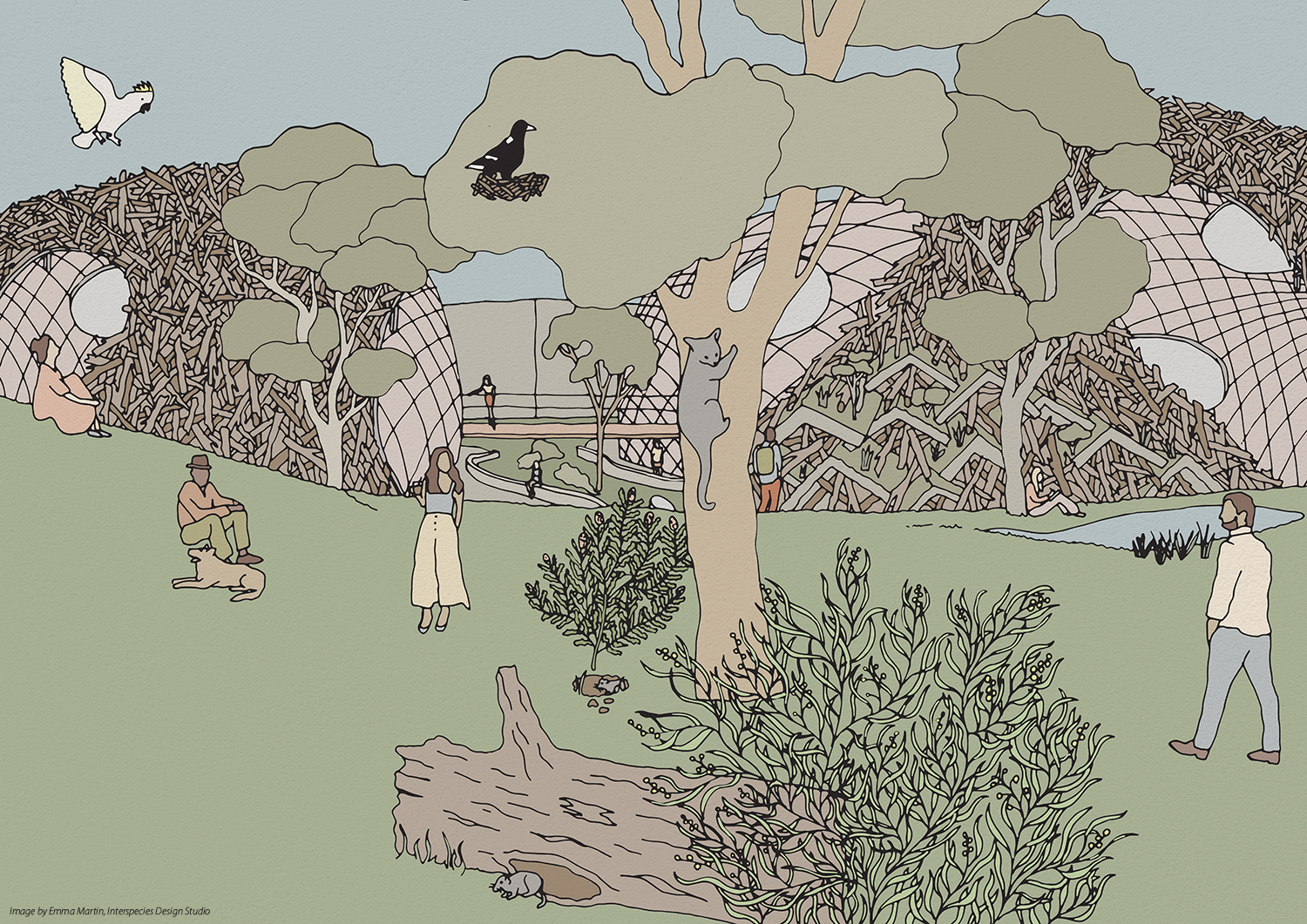
Image credit: Emma Martin, Interspecies Design Studio, 2020, this studio explored some of the topics considered in this subject, have a look at a selection of the resulting projects at this link
Are you ready for the world of tomorrow? The future promises thrilling technologies, but will also bring collapsing biodiversity, a destabilised climate, and increasingly oppressive AI systems. Are you equipped with scientific insights, creative ethical tools, design frameworks, and technical innovations that can respond to these crises while supporting all forms of life, human and nonhuman?
If you would like a glimpse into your future careers, consider enrolling in the Design Futures elective, ABPL90147, in Semester 1, 2026. Students in this subject have:
- Presented their work at international conferences, festivals, and exhibitions.
- Published in academic and professional journals.
- Won awards in design and innovation competitions.
- Developed ideas that led to advanced research in academia.
- Secured creative roles in world-leading architectural and design practices.
The subject is open to graduate students in the Melbourne School of Design and other faculties. Research students are also very welcome.
Justification
Commercial firms, governments, and non-governmental organisations compete for graduates who can innovate in response to major changes in global societies and environments. Independent entrepreneurship also demands strategic foresight.
This subject responds to these challenges by examining phenomena, ideas, research, and technologies that will shape emerging trends. It forecasts the future of design across disciplines, including design and architecture. It identifies significant innovations, outlines necessary changes, and guides in-depth investigation.
The seminar reconsiders relationships between humans, nonhuman organisms, and machines within emerging systems. It focuses on:
- Places as complex systems that house multispecies inhabitants and call for design through living laboratories or ongoing experiments.
- Design as a participatory practice that can involve animals, plants, and algorithms as well as humans, often in the context of simulations and self-organising systems.
- Representation as a way to connect design stakeholders through advanced visualisation, data mining, and machine learning.
- Fabrication and construction using innovative materials with minimal environmental impact, supported by robotics and augmented reality.
- Monitoring of the resulting performance through remote imaging and sensor networks.
- Adaptation, reuse, and decommissioning that follow natural, societal, and technical lifecycles.
The teaching approach combines reading with visual presentations by guests and case-study analysis. In the second half of the subject, students define their own creative assignments and develop expertise that aligns with their professional goals.
The subject can support in-depth research for design studios, theses, and research degrees. It also provides evidence of skills in design innovation for future employers. In addition, previous iterations have supported design and art projects, contributed to research within design practices, and laid foundations for innovative career paths and business models.
Further Details
Contact: Stanislav Roudavski, srou@unimelb.edu.au, all questions welcome.
Video presentations: Vimeo
Publications: Academia, Google Scholar
Research and creative collective: Deep Design Lab, Knowledge base: Deep-Design Knowledge Garden
See the Handbook and the subject materials on Canvas soon.
Testimonials
In the words of past students...
“I have learnt so much and had my perspective on architecture and many other things completely changed, in a good way.”
"This is the only subject in my whole course to ever cover content like this – it's really valuable to me and I strongly believe it would be invaluable as a core part of my course (landscape architecture)."
"The introduction of previously untouched and unheard of topics and perspectives was extremely eye opening for me. The consideration of the non–human experience and advancements in AI including their impact on design and subsequently on our changing roles as designers is something I wish existed as a mandatory subject for all Melbourne School of Design students."
"The content is remarkably well resourced (it's outstanding), and it seemed like no matter the student tangent their was knowledgeable and insightful guidance (both spontaneous and resourced)."
“I have learned so much from simply being exposed to seminar discussions and the suggested readings. So often in architecture it is about deliverables deliverables deliverables. Drawing drawing drawing. … I hold Stanislav in high regard, and hope that he continues teaching this seminar so that my fellow peers may have the opportunity to learn from his subject as I have.”