Gaia
Notes on Gaian thinking and its consequences for design, justice, and intelligence.
Cf.
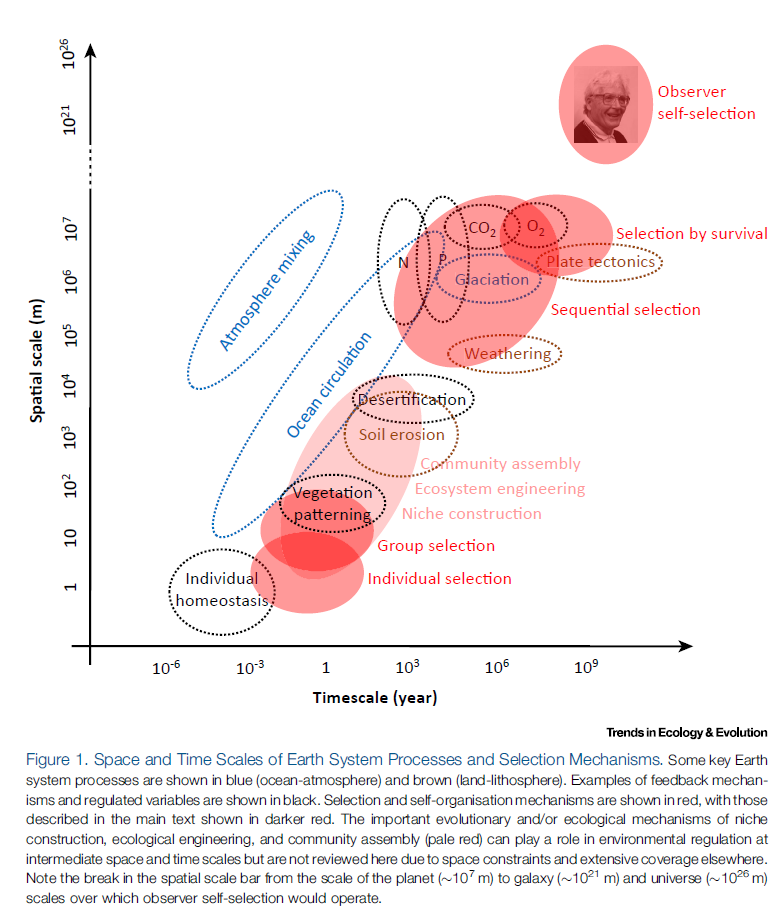
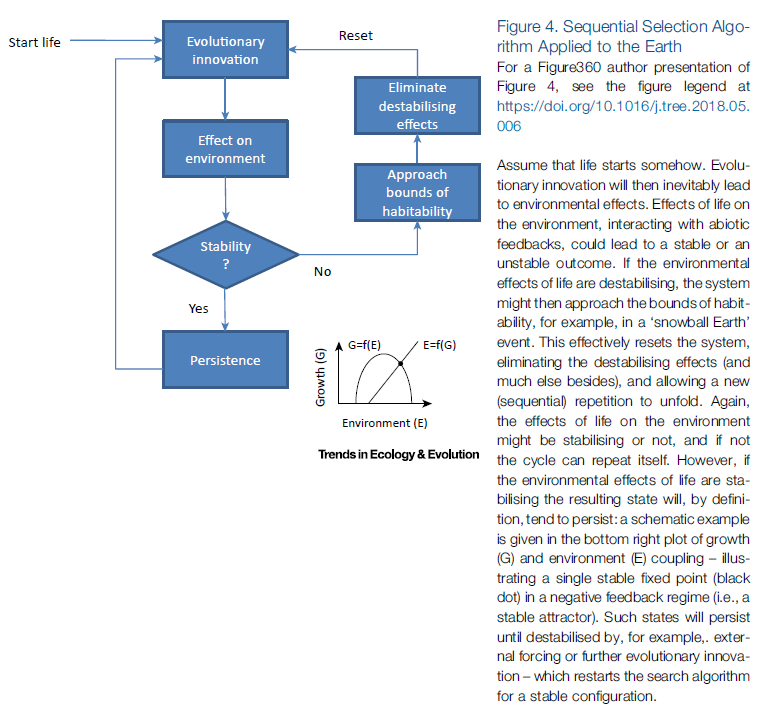
Lenton, Timothy M., Stuart J. Daines, James G. Dyke, Arwen E. Nicholson, David M. Wilkinson, and Hywel T. P. Williams. ‘Selection for Gaia Across Multiple Scales’. Trends in Ecology & Evolution 33, no. 8 (2018): 633–45. https://doi.org/10/gd3qcm.
Implications
Gaian framing reshapes a range of related questions. If Gaia is a coupled system that can be selected, stabilised, destabilised, and partially steered through feedbacks across scales, this carries implications for Design, Justice, and Intelligence, among other concepts.
Design
- Move from object design to feedback design. If planetary persistence depends on system feedbacks, design should target monitoring loops, response loops, and repair loops, not only products or services.
- Evaluate interventions by contribution to Earth-system stability. The key question becomes: does this design strengthen adaptive capacity and reduce destabilising feedbacks?
- Design at nested scales at the same time. The multi-scale argument means local interventions need explicit links to regional and planetary effects.
- Treat humans as regulators, not the controllers. Gaia 2.0 supports reflexive stewardship, but it does not support total control narratives.
- Redefine success criteria in design briefs. Success should include long time horizons, cross-species impacts, and reversibility under uncertainty.
Justice
- Expand the subject of justice beyond humans. A Gaian framework supports ecological and multispecies justice because habitability depends on interspecies relations.
- Connect justice to Earth-regulating functions. Fairness is not only the distribution of harms and benefits. It is also fair access to stable climatic and ecological conditions.
- Make responsibility multi-dimensional. Governance compatible with Gaia and with the conditions for life implies responsibility by historical contribution, present capacity, and current leverage over feedback systems.
- Strengthen procedural justice for absent stakeholders. Future generations, nonhuman life, and affected ecologies need representation in decisions.
- Guard against technocratic capture. Planetary systems can lead to biased top-down control unless governance includes accountability, plural knowledge systems, and contestability.
Intelligence
- Reframe intelligence as a distributed planetary process. Intelligence is not only human or machine cognition. It includes sensing, memory, coordination, and adaptation across the biosphere, institutions, and technologies.
- Shift from optimisation intelligence to viability intelligence. The relevant intelligence question is not maximising one metric. It is maintaining conditions for continued life.
- Position AI as a subsystem of planetary intelligence. AI should support early warning, coordination, and repair, while remaining constrained by justice and ecological limits.
- Link cognition to niche and feedback construction. This view aligns with accounts of intelligence that emphasise decision-making in changing environments and more-than-human cognition.
- Use system-level intelligence metrics. Track whether intelligence infrastructures reduce delay, improve collective learning, and prevent tipping dynamics.
Good design and good intelligence are those that increase just habitability. Justice is not an external addition to design or intelligence. It is part of the condition for stable planetary regulation.
References
Bapteste, Eric, Philippe Gérard, Catherine Larose, Manuel Blouin, Fabrice Not, Liliane Campos, Géraldine Aïdan, et al. “The Epistemic Revolution Induced by Microbiome Studies: An Interdisciplinary View.” Biology 10, no. 7 (2021): 651. https://doi.org/10.3390/biology10070651.
Callicott, J. Baird. Thinking Like a Planet: The Land Ethic and the Earth Ethic. New York: Oxford University Press, 2013.
Clarke, Bruce. Gaian Systems: Lynn Margulis, Neocybernetics, and the End of the Anthropocene. Minneapolis: University of Minnesota Press, 2020.
Clarke, Bruce. ‘Rethinking Gaia: Stengers, Latour, Margulis’. Theory, Culture & Society 34, no. 4 (1 July 2017): 3–26. https://doi.org/10/gf37jv.
Dahlmann, Frederik. “Conceptualising Sustainability as the Pursuit of Life.” Journal of Business Ethics 196, no. 3 (2025): 499–521. https://doi.org/10.1007/s10551-024-05617-y.
Doolittle, W. Ford. ‘Making Evolutionary Sense of Gaia’. Trends in Ecology & Evolution 34, no. 10 (2019): 889–94. https://doi.org/10/gf8xdh.
F. Gilbert, Scott. “Ethical Implications of Being a Holobiont.” Integrative and Comparative Biology 65, no. 3 (2025): 525–37. https://doi.org/10.1093/icb/icaf124.
Frank, Adam, David Grinspoon, and Sara Walker. “Intelligence as a Planetary Scale Process.” International Journal of Astrobiology 21, no. 2 (2022): 47–61. https://doi.org/10.1017/S147355042100029X.
Harding, Stephan. Animate Earth: Science, Intuition and Gaia. 2nd ed. 2006. Reprint, Cambridge: Green Books, 2013.
Humphreys, Stephen. “How to Define Unjust Planetary Change.” Nature 619, no. 7968 (2023): 35–36. https://doi.org/10.1038/d41586-023-01743-1.
Landecker, Hannah. “Life as Aftermath: Social Theory for an Age of Anthropogenic Biology.” Science, Technology, & Human Values 50, no. 4 (2025): 679–712. https://doi.org/10.1177/01622439241233946.
Latour, Bruno, and Catherine Porter. Facing Gaia: Eight Lectures on the New Climatic Regime. Cambridge: Polity, 2017.
Lenton, Timothy M., and Bruno Latour. ‘Gaia 2.0’. Science 361, no. 6407 (2018): 1066–68. https://doi.org/10/gfgnf9.
Lenton, Timothy M., Stuart J. Daines, James G. Dyke, Arwen E. Nicholson, David M. Wilkinson, and Hywel T. P. Williams. ‘Selection for Gaia Across Multiple Scales’. Trends in Ecology & Evolution 33, no. 8 (2018): 633–45. https://doi.org/10/gd3qcm.
Lenton, Timothy M., Sébastien Dutreuil, and Bruno Latour. “Gaia as Seen from Within.” Theory, Culture & Society 41, no. 5 (2024): 69–90. https://doi.org/10.1177/02632764241275574.
Lenton, Timothy M. “Life on Earth Is Hard to Spot.” The Anthropocene Review 7, no. 3 (2020): 248–72. https://doi.org/10.1177/2053019620918939.
Lenton, Timothy M., Timothy A. Kohler, Pablo A. Marquet, Richard A. Boyle, Michel Crucifix, David M. Wilkinson, and Marten Scheffer. “Survival of the Systems.” Trends in Ecology & Evolution 36, no. 4 (2021): 333–44. https://doi.org/10.1016/j.tree.2020.12.003.
Lenton, Timothy M. “The Evolution of Gaia(s).” Philosophical Transactions of the Royal Society B: Biological Sciences 380, no. 1931 (2025): rstb.2024.0095. https://doi.org/10.1098/rstb.2024.0095.
Margulis, Lynn, and Dorion Sagan. Slanted Truths: Essays on Gaia, Symbiosis and Evolution. New York: Springer, 1997.
Margulis, Lynn. Symbiotic Planet: A New Look at Evolution. New York: Basic Books, 1998.
Nordblad, Julia. “The Nature of Planetary Habitability: A Conceptual History of Biodiversity and Ecosystem Services.” Environmental History 30, no. 2 (2025): 256–80. https://doi.org/10.1086/734558.
Pak, Chris. Terraforming: Ecopolitical Transformations and Environmentalism in Science Fiction. Liverpool: Liverpool University Press, 2016.
Ruse, Michael. The Gaia Hypothesis: Science on a Pagan Planet. Chicago: The University of Chicago Press, 2013.
Schneider, Stephen Henry, ed. Scientists Debate Gaia: The Next Century. Cambridge, MA: MIT Press, 2004.
Shoshitaishvili, Boris. “Is Our Planet Doubly Alive? Gaia, Globalization, and the Anthropocene’s Planetary Superorganisms.” The Anthropocene Review 10, no. 2 (2023): 434–54. https://doi.org/10.1177/20530196221087789.
Tyrrell, Toby. On Gaia: A Critical Investigation of the Relationship between Life and Earth. Princeton: Princeton University Press, 2013.
Backlinks